

If you've ever watched grandmasters navigate complex middlegame positions with confidence, you've likely witnessed the power of solid opening preparation. The french defense stands as one of chess's most respected and strategically rich openings, offering Black a resilient pawn structure and dynamic counterattacking chances. Unlike aggressive gambits that seek immediate tactical complications, this opening emphasises positional understanding and long-term planning. Whether you're building your opening repertoire from scratch or looking to add a reliable weapon against 1.e4, understanding the french defense can transform your approach to the game.
What Makes the French Defense Special
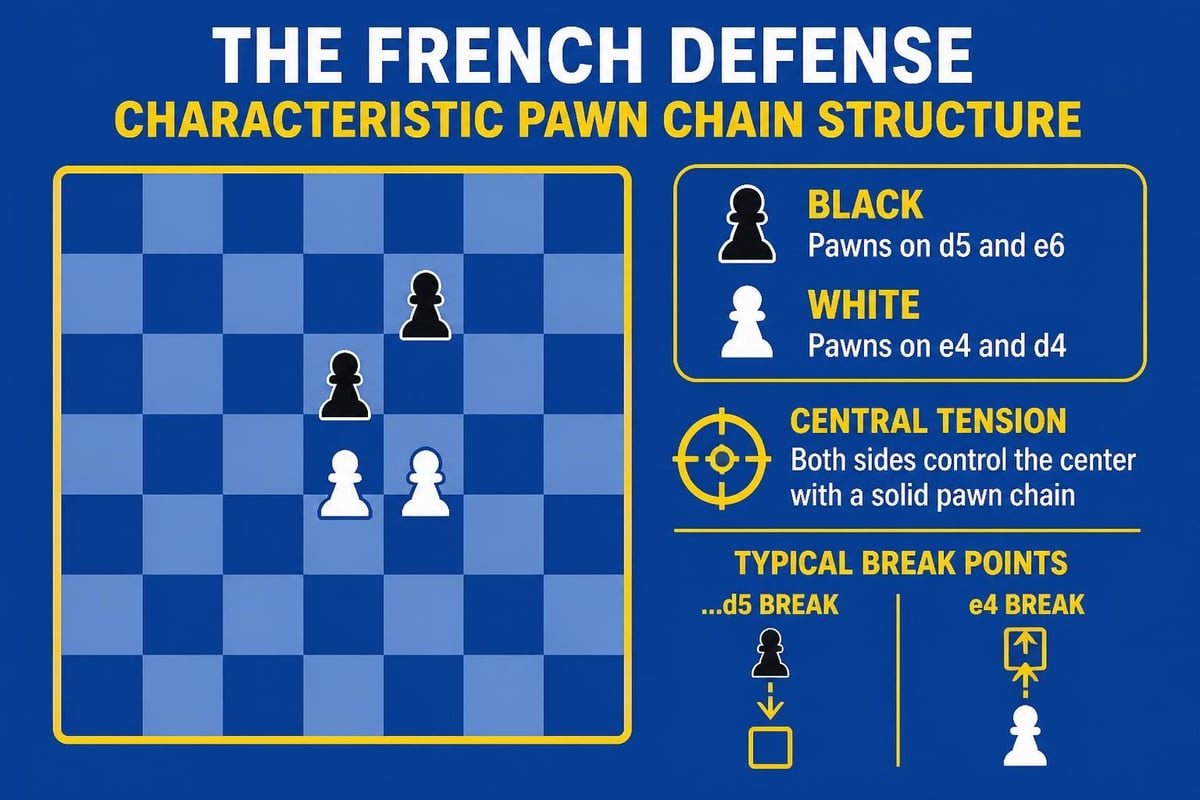
The french defense begins with the moves 1.e4 e6, immediately signalling Black's intention to challenge White's central pawn on the next move with 2...d5. This approach differs fundamentally from openings like the Sicilian Defense or King's Indian structures. Rather than allowing White unrestricted central control, you're immediately contesting the e4 pawn and creating tension in the centre.
What truly sets this opening apart is its philosophical approach to chess. You're accepting a slightly cramped position in exchange for a rock-solid pawn structure and clear strategic goals. The light-squared bishop on c8 often becomes temporarily restricted behind the e6 pawn, but this trade-off brings significant compensations.
Core Strategic Ideas
The beauty of the french defense lies in its concrete strategic framework. When you play this opening, you're working with several interconnected plans:
- Central counterplay: Challenging White's centre with ...c5 or ...f6 breaks
- Queenside expansion: Advancing pawns on the a, b, and c files to create threats
- Piece activity: Developing the light-squared bishop via d7 or, in some lines, a6
- King safety: Castling kingside while maintaining solid defensive resources
Understanding these themes helps you navigate the middlegame with confidence. Unlike some openings where you're simply reacting to your opponent's plans, the french defense provides clear structural guidance from the very first moves.
Main Variations You Need to Know
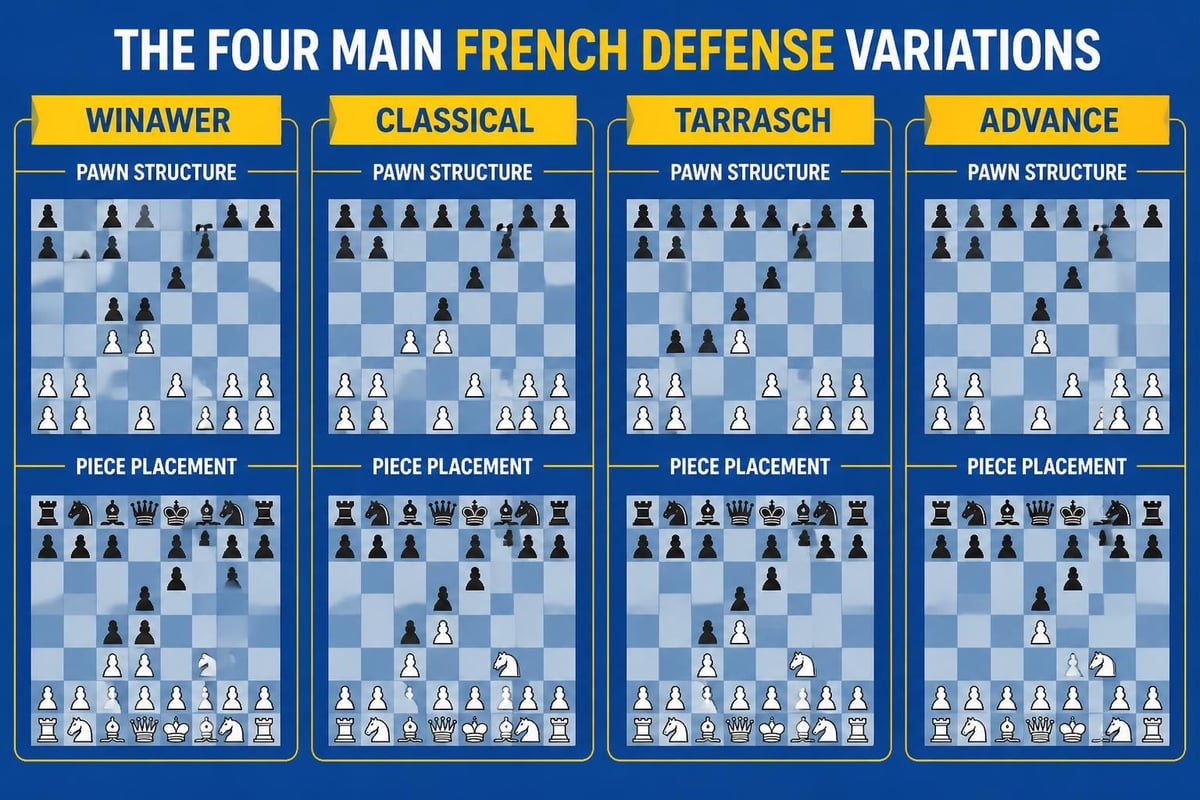
The french defense branches into several major variations after 1.e4 e6 2.d4 d5. Your choice depends on your playing style and how much theory you want to memorise. Let's explore the most important lines you'll encounter.
The Winawer Variation (3.Nc3 Bb4)
This aggressive approach pins White's knight immediately and often leads to sharp, unbalanced positions. After 3.Nc3 Bb4, you're embracing tactical complications. White typically plays 4.e5, gaining space but allowing you to damage White's pawn structure with 4...c5.
The Winawer demands precise calculation and theoretical knowledge. You'll face positions where White's spatial advantage must be met with accurate counterplay. Many club players find this variation exciting but theoretically demanding.
The Classical Variation (3.Nc3 Nf6)
If you prefer balanced, strategic chess, the Classical might suit your style perfectly. After 3.Nc3 Nf6, you're developing naturally and putting immediate pressure on e4. White's main continuation is 4.Bg5, pinning your knight.
| Variation | Character | Theory Level | Recommended For |
|---|---|---|---|
| Winawer | Sharp, tactical | High | Aggressive players |
| Classical | Strategic, balanced | Medium | Positional players |
| Tarrasch | Dynamic, active | Medium-High | Versatile players |
| Advance | Closed, manoeuvring | Medium | Patient players |
The Classical variation offers rich strategic content without forcing you to memorise 20 moves of theory. Similar to what you might find when exploring the Queen's Gambit's strategic depth, this variation rewards understanding over memorisation.
The Tarrasch Variation (3.Nd2)
White sidesteps the pin threat by developing the knight to d2 instead. This seemingly modest move introduces its own complexities. After 3...Nf6, White typically continues 4.e5 Nfd7 5.Bd3 c5 6.c3, building a solid pawn centre.
The Tarrasch leads to positions where both sides have clear plans. You'll typically break with ...f6 or expand on the queenside with ...Nc6 and ...Qb6. These positions require patience and positional understanding rather than tactical sharpness.
The Advance Variation (3.e5)
When White plays 3.e5, you enter closed positions reminiscent of the King's Indian structure. White gains space immediately, but you receive clear counterplay on the queenside. Your typical plan involves ...c5, ...Nc6, and sometimes ...f6 to undermine White's centre.
The Advance variation is particularly instructive for improving players because the strategic plans are so clear-cut. You're learning important chess concepts about pawn chains, space advantage, and minority attacks.
Typical Middlegame Plans and Structures
Once you've navigated the opening moves, understanding typical middlegame plans becomes crucial. The french defense creates distinctive pawn structures that dictate both sides' strategies. Let's examine what you should be aiming for in different scenarios.
When You've Established ...c5
Breaking with ...c5 is often your primary strategic goal. This move challenges White's d4 pawn and opens lines for your pieces. After exchanges on d4, you're typically left with a symmetrical pawn structure in the centre but with active piece play.
In these positions, you should focus on:
- Activating your light-squared bishop (finally!)
- Controlling key central squares like d5 and e4
- Creating threats against White's potentially weakened kingside
- Maintaining piece coordination to prevent White's space advantage from becoming oppressive
The transformation from cramped opening positions to dynamic middlegames is one of the french defense's most satisfying aspects. Understanding these structural transformations helps you play the opening with confidence.
Handling the Closed Centre
Sometimes White maintains the tension, refusing to allow simplification. In these closed structures, piece manoeuvring becomes paramount. Your knights often find excellent squares on c5 or e5, while your bishops need creative routing.
Think about piece placement rather than immediate tactical strikes. Which pieces need improving? Where's your worst-placed piece? These questions guide your plan formulation in closed positions, much like the strategic thinking required when studying the Caro-Kann Defense.
The Light-Squared Bishop Problem
Let's address the elephant in the room. Your light-squared bishop starts the game locked behind the e6 pawn, and this piece can struggle to find active play. However, this "problem" is more nuanced than it appears.
Several solutions exist:
- The Bd7-e8-g6 manoeuvre: Rerouting via the back rank to reach the kingside
- Playing ...b6 and ...Ba6: Developing via the long diagonal in certain structures
- Trading it off: Sometimes exchanging this bishop for White's knight eliminates your problem piece
- Accepting its passive role: Occasionally, this bishop simply defends, which is perfectly acceptable
The key is recognising which solution fits your specific position. Pattern recognition develops through practice, which is why working through annotated games and puzzles proves invaluable.

Common Mistakes and How to Avoid Them
Even experienced players make typical errors when playing the french defense. Recognising these pitfalls helps you sidestep them in your own games. Let's examine the most frequent mistakes and their remedies.
Moving Too Quickly in the Centre
Impatience is the enemy of good French Defense play. Many players rush to break with ...c5 before completing development, allowing White's pieces to invade with devastating effect. Before launching central breaks, ensure your pieces are coordinated and your king is safe.
A useful rule of thumb: complete kingside development before initiating central action unless tactical considerations demand otherwise. This disciplined approach, similar to principles found in the Italian Game, prevents premature attacks that collapse.
Neglecting Piece Activity
The french defense can lead to cramped positions where every tempo matters. Passive piece placement compounds your spatial disadvantage. Don't simply react to White's threats; find active squares for your pieces even within your slightly restricted space.
Your rooks, in particular, need careful handling. Placing them on semi-open files or supporting pawn breaks helps maintain dynamism despite spatial constraints.
Forgetting King Safety
In sharp Winawer lines especially, players sometimes become so focused on queenside counterplay that they neglect kingside safety. White's spatial advantage often translates into dangerous attacking potential. Before committing to queenside expansion, verify your king has adequate defenders.
Practical Tips for Tournament Play
Theory is essential, but practical skills win games. When you sit down to play the french defense in a tournament, certain practical considerations matter as much as opening knowledge.
Time Management
The french defense positions often require careful calculation, especially when deciding whether to accept pawn weaknesses for activity. Budget your time wisely. Don't spend 20 minutes on move 8, but equally, don't rush critical decisions about pawn structure.
A balanced approach to time management helps you navigate both theoretical positions and novel ideas from your opponents. Developing your overall chess understanding supports better time allocation during games.
Dealing with Sidelines
Not every opponent will play the main lines. You'll face the Exchange Variation (3.exd5), the King's Indian Attack setup, and various other systems. Rather than memorising every possible sideline, understand the strategic principles.
Against the Exchange Variation, for instance, you're fighting for equality through active piece play since the symmetrical pawn structure offers White minimal advantage. Focus on piece activity and creating imbalances rather than seeking an opening advantage.
Building Your Repertoire
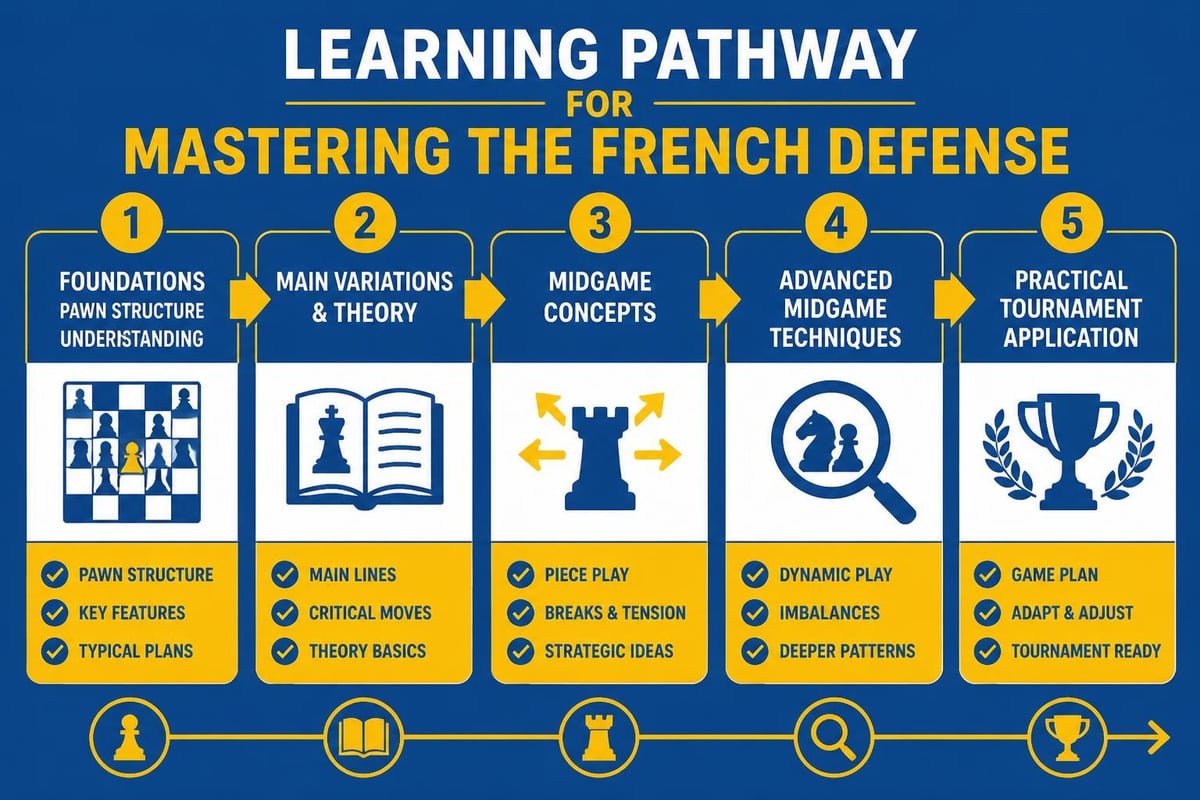
You don't need to learn every variation simultaneously. Start with one main line that suits your style. If you enjoy sharp play, begin with the Winawer. If you prefer strategic chess, the Classical might be your entry point.
As you gain experience, gradually expand your repertoire. This systematic approach, similar to how you might explore different chess openings methodically, prevents overwhelming yourself with theory while building solid foundations.
Why Choose the French Defense for Your Repertoire
With dozens of defences to 1.e4 available, why specifically choose the french defense? The answer depends on your chess goals and playing style, but several compelling reasons exist.
Solid and Reliable
Unlike speculative gambits or hypermodern systems requiring precise understanding, the french defense offers a sound, classical approach. You're unlikely to be blown off the board if you forget theory. The solid pawn structure provides inherent defensive resources even in unfamiliar positions.
This reliability makes it excellent for tournament play where you need consistent results. Strategic understanding matters more than memorisation, which suits improving players developing their chess intuition.
Rich Strategic Content
Every game teaches you something about pawn chains, piece manoeuvring, and positional play. The french defense serves as an educational opening, improving your overall chess understanding beyond just opening knowledge.
The concepts you learn transfer to other openings and middlegame positions. Understanding minority attacks, pawn chain dynamics, and space advantages helps across your entire chess career.
Flexibility Across Levels
The french defense remains relevant from beginner to grandmaster level. Club players can achieve good results with general understanding, while advanced players can delve into deep theoretical battles. This scalability means your investment in learning pays dividends throughout your chess journey.
Comparing with Similar Openings
How does the french defense stack up against alternatives like the Caro-Kann or Scandinavian? Each has merits, but the French offers particularly clear strategic guidance. The pawn structure isn't as symmetrical as the Caro-Kann, leading to more imbalanced, fighting positions.
| Opening Feature | French Defense | Caro-Kann | Scandinavian |
|---|---|---|---|
| Pawn structure complexity | High | Medium | Low |
| Theoretical demands | Medium-High | Medium | Low-Medium |
| Strategic clarity | High | High | Medium |
| Typical game character | Strategic battles | Solid, resilient | Active, tactical |
Training Resources and Study Methods
Improving your french defense requires structured study beyond simply playing games. Let's explore effective training methods that accelerate your mastery of this opening.
Studying Model Games
Watching how strong players handle the french defense teaches you typical plans and ideas. Focus on games by specialists like Botvinnik, Korchnoi, or modern practitioners like Tkachiev. Don't just play through moves; understand the strategic concepts behind each decision.
Pay particular attention to middlegame transitions. How do strong players transform their opening advantage into endgame superiority? These practical skills matter more than knowing 25 moves of theory in one specific line.
Solving Themed Puzzles
Working through tactical puzzles arising from french defense positions sharpens your calculation while familiarising you with typical patterns. Many positions feature characteristic breaks like ...f6 or ...c5, teaching you when these moves work and when they backfire.
This focused practice, similar to improving positional skills through puzzles, develops pattern recognition specific to your opening repertoire.
Creating Your Own Reference Materials
While studying, create summary notes of key positions and plans. Which squares do your pieces typically occupy? What pawn breaks are you aiming for in different structures? Building your personal reference guide reinforces learning and provides quick review before tournaments.
Using Technology Effectively
Modern chess engines and databases offer incredible learning opportunities. After each game, analyse with an engine to discover where your understanding fell short. Did you miss a tactical opportunity? Did you pursue the wrong plan?
However, don't let engines replace thinking. First, analyse yourself, determining where you went wrong and what you should have played. Only then check engine recommendations. This active learning approach builds genuine understanding rather than passive memorisation.
Balancing Theory and Understanding
How much theory should you learn? Enough to navigate the first 8-10 moves confidently, then rely on strategic understanding. Memorising 20-move variations rarely helps unless you're a titled player. Instead, understand the key strategic concepts that guide piece placement and plan formulation.
Focus your study time on understanding why moves are played rather than memorising sequences. When you understand the underlying logic, you'll find the right moves even in unfamiliar positions.
Transitioning to the Middlegame
The critical phase in any french defense game occurs when opening transitions into middlegame. Your success depends on smoothly implementing your strategic plan while remaining alert to tactical opportunities.
Identifying the Critical Moment
Every game reaches a point where the "opening" ends and the "real game" begins. In the french defense, this often coincides with central tension resolution. When pawns are exchanged on d4 or e5, positions transform dramatically.
Recognise these moments and calculate carefully. The decisions you make during transitions determine whether you enter a favourable or unfavourable middlegame. Take your time on these critical moves, even if it means spending extra minutes.
Maintaining Flexibility
While the french defense provides clear strategic frameworks, avoid becoming rigid in your thinking. If circumstances change, adapt your plan. Perhaps you intended to castle kingside, but tactical considerations now favour keeping your king in the centre. Adjust accordingly.
Flexibility separates strong players from weak ones. Use your strategic knowledge as guidance, not dogma.
Practical Examples from Tournament Play
Examining how the french defense performs in actual tournament conditions provides valuable insights. In recent years, strong players continue achieving excellent results with this opening. The theoretical developments focus on refining existing variations rather than discovering revolutionary new ideas.
This stability benefits practical players who prefer deep understanding over constantly updating theory. You can build a reliable repertoire that serves you for years without becoming outdated.
When Not to Play the French Defense
Honesty is essential when discussing any opening. The french defense isn't perfect for everyone or every situation. Understanding when to avoid it helps you make informed repertoire decisions.
If You Dislike Cramped Positions
Some players psychologically struggle with restricted space. If you need immediate activity and dislike manoeuvring within constraints, openings like the Sicilian Defense might suit you better.
Against Particularly Well-Prepared Opponents
If you know your opponent has deeply studied the french defense and you haven't, consider switching to a secondary defence. Surprising prepared opponents occasionally makes strategic sense, though building a solid main repertoire remains more important long-term.
Time Pressure Situations
In rapid or blitz chess, complex French Defense positions can prove challenging to navigate quickly. The precise calculation required in some variations suits classical time controls better. For faster time controls, you might prefer more straightforward systems.
Advanced Concepts for Improving Players
Once you've mastered basic French Defense principles, several advanced concepts can elevate your play to the next level. These subtle ideas separate expert practitioners from casual users.
Dynamic Pawn Breaks
Beyond the standard ...c5 break, advanced players employ ...f6, ...g5, and even ...h5 in specific situations. Understanding when these aggressive moves work requires deep positional assessment. The risk of weakening your position must be balanced against the benefit of activity.
Study games where these breaks succeed and fail. What were the distinguishing features? This analysis develops your positional judgment.
Prophylactic Thinking
Sometimes the best move prevents your opponent's plan rather than advancing your own. In french defense positions, recognising what White wants to achieve and preventing it proactively demonstrates advanced understanding.
This defensive awareness, combined with the strategic concepts from exploring various opening systems, creates a well-rounded playing style.
Endgame Transitions
Many french defense games transpose into complex endgames where pawn structure knowledge proves critical. Understanding which endgames favour you helps guide your middlegame decisions. Sometimes trading pieces leads to favourable endgames; other times, maintaining complexity serves your interests better.
The french defense often produces endgames with bishops of opposite colours or rook and pawn endings where subtle differences in pawn structure matter enormously. Studying these typical endgames complements your opening preparation perfectly.
The french defense offers a perfect blend of solid structure, clear strategic guidance, and rich tactical possibilities that can serve you throughout your chess journey. By understanding its core principles rather than merely memorising variations, you'll develop genuine chess strength that extends beyond this single opening. Ready to add this powerful weapon to your repertoire? Chess Cheat Sheets provides comprehensive guides, streamlined reference materials, and practical resources designed specifically to help players like you master the french defense and other essential openings without drowning in endless theory. Start building your confident, reliable opening repertoire today.


