

If you want to stand out in today’s fast-paced chess world, mastering the most common chess openings is your secret weapon. The right opening knowledge can give you a decisive edge, especially as 2026 brings even deeper online competition and smarter chess engines. In this article, you’ll discover the top 8 chess openings every player needs to know, along with the strategies and reasons why these classics are still vital. Ready to boost your performance, stay ahead of trends, and start winning more games? Dive in and make these openings part of your winning formula.

Why Chess Openings Matter in 2026
Mastering the most common chess openings is more important than ever as chess continues to evolve in 2026. Whether you are a club player or an aspiring grandmaster, staying ahead of the curve means understanding how opening theory, trends, and preparation shape every game. Let’s break down why openings matter so much in today’s competitive environment.

The Evolving Chess Meta
Chess has transformed dramatically, especially with the rise of powerful engines and widespread online play. In 2026, the most common chess openings are shaped by trends set by top grandmasters and the influence of AI-driven analysis. You’ll notice that new engine discoveries spark fresh interest in lines previously thought unplayable.
Online platforms like Chess.com and Lichess help popularize openings quickly, as players witness elite matches and try these ideas themselves. For example, the resurgence of the Italian Game and the rise of hypermodern setups are direct results of this meta shift. In recent tournaments, opening preparation has often been the deciding factor, making it clear why staying current is vital.
Key Principles of Successful Openings
No matter how much theory you learn, the most common chess openings still rely on timeless principles. Controlling the center, developing your pieces rapidly, and keeping your king safe are non-negotiable. Rather than memorizing endless move orders, focus on understanding the ideas behind each opening.
Classical and hypermodern strategies both have their place. Beginners often neglect these basics, falling into traps or getting lost after a single unexpected move. If you internalize these principles, you’ll navigate even the sharpest lines with confidence. Every opening featured in this list rewards players who get the fundamentals right.
How to Choose the Right Opening Repertoire
Choosing among the most common chess openings can feel overwhelming, but it should reflect your personal style. Are you more tactical or positional? Some players prefer to specialize deeply in a few lines, while others enjoy versatility and flexibility.
Build a repertoire for both White and Black, preparing for the responses you’ll face most often. Use opening explorer tools, watch model games, and look for resources that match your needs. Preparation means you won’t be caught off guard, and you can adapt as trends shift. Find what inspires you to learn and keep evolving your openings.
Statistics: Most Played Openings in Recent Years
Data from FIDE and online platforms reveal fascinating trends in the most common chess openings. For instance, the Italian Game and London System have surged in popularity, while classics like the Sicilian and Queen’s Gambit remain top choices. Win rates can vary by rating level, with some openings performing better among advanced players.
Check out the Chess.com Chess Stats Infographic for up-to-date information on which openings dominate today’s chess landscape. Recent tournaments highlight how opening choice impacts results, underlining the importance of studying these lines. The openings in our top 8 list reflect what’s working at every level.
Top 8 Most Common Chess Openings to Master in 2026
When you’re aiming to boost your chess skills in 2026, getting familiar with the most common chess openings is a game-changer. Why? Because these openings keep popping up in online games, club battles, and even top-level tournaments. Let’s walk through each one and see why they’re vital, how you can use them, and who should add them to their repertoire.
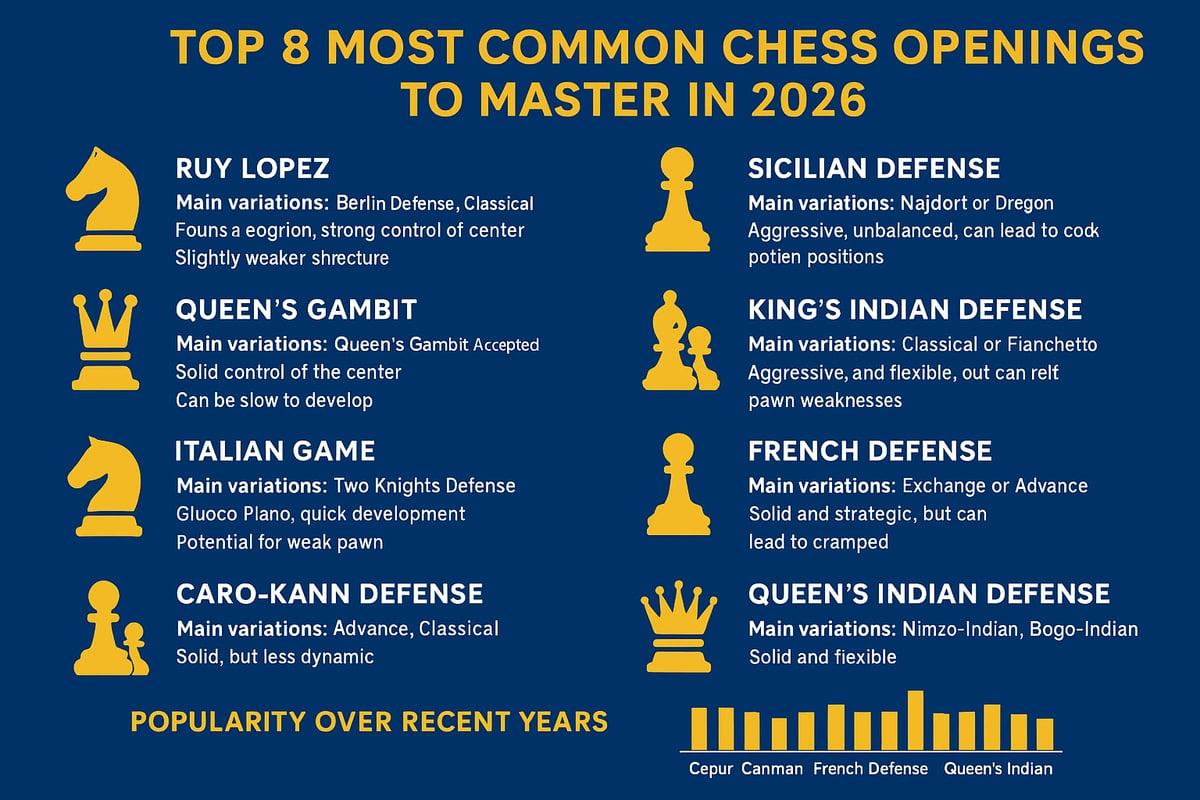
1. Sicilian Defense
Among the most common chess openings, the Sicilian Defense is the undisputed heavyweight when you play 1.e4 as White. Black responds with c5, instantly signaling a fight for the center and a desire for dynamic play.
Some of the core Sicilian variations include the Najdorf, Dragon, Scheveningen, and Accelerated Dragon. Each brings its own flavor, but all share the idea of asymmetrical pawn structures and counterattacking chances for Black.
What makes the Sicilian one of the most common chess openings is its blend of tactical fireworks and deep strategy. Black aims for activity, not just survival. The pawn structures create unbalanced positions, letting both sides play for a win.
Strengths? The Sicilian gives Black high winning chances and tons of variety. Weaknesses? It’s complex and needs more study than many other most common chess openings. If you love sharp, double-edged games, this is your playground.
You’ll find the Sicilian in recent World Championship matches and countless online blitz games. To learn it, focus on the main lines and recurring tactical motifs. Aggressive players who aren’t afraid of a theoretical challenge will thrive here.
2. Queen’s Gambit
The Queen’s Gambit stands tall among the most common chess openings, starting with 1.d4 d5 2.c4. It’s been a mainstay for centuries, but its popularity soared again after the Netflix series “The Queen’s Gambit.”
Key variations include the Queen’s Gambit Accepted, Declined, and the Slav Defense. Each brings unique central tension and strategic plans, like the minority attack or playing for a pawn majority on the queenside.
What keeps the Queen’s Gambit among the most common chess openings? It’s solid, flexible, and suitable for every level. The downside is that if you’re unprepared, games can get slow and maneuvering. But don’t be fooled—a well-timed opening trap can decide a game early.
You’ll see this opening everywhere, from elite tournaments to online blitz. If you want a deeper dive, check out this Pros and cons of the Queen's Gambit guide for more insights.
To master it, study both main lines and common traps. It’s a great fit for players who want a balance of strategy and tactics in their most common chess openings.
3. Italian Game
The Italian Game is back in fashion and is now one of the most common chess openings in both online and over-the-board play. It starts with 1.e4 e5 2.Nf3 Nc6 3.Bc4, leading to lively, open positions.
Popular variations include the Giuoco Piano, Evans Gambit, and Two Knights Defense. The Italian Game is all about early piece activity and targeting the f7 square, one of the weakest points in Black’s camp.
This opening is easy to learn and leads to tactical, open games, which is why it ranks high among the most common chess openings. However, the main lines are well-studied, and sometimes games can fizzle out into draws if both sides play predictably.
You’ll see the Italian Game in top-level rapid and blitz events, where its traps and sharp lines can catch even strong opponents off guard. Focus on attacking ideas and classic pitfalls to get the most out of this opening.
If you’re a fan of open, tactical play and want to keep your most common chess openings simple yet effective, the Italian Game is your go-to.
4. Ruy Lopez
The Ruy Lopez is a true pillar among the most common chess openings. With 1.e4 e5 2.Nf3 Nc6 3.Bb5, White puts immediate pressure on Black’s center, setting the stage for rich, strategic battles.
Main variations include the Morphy Defense, Berlin Defense, and the Open Ruy Lopez. The opening is famous for its subtle pressure on e5 and potential pawn structure imbalances.
Why is the Ruy Lopez one of the most common chess openings? It combines deep positional ideas with tactical opportunities. The downside is that it demands an understanding of nuanced plans, not just memorized moves.
You’ll find the Ruy Lopez in countless World Championship matches. To master it, study typical middlegame plans and key pawn structures. Players who enjoy a mix of strategy and tactics will love adding the Ruy Lopez to their most common chess openings.
5. Caro-Kann Defense
The Caro-Kann Defense is a favorite for players who want reliability in their most common chess openings. It starts with 1.e4 c6, offering Black a solid, resilient setup.
Key variations are the Advance, Classical, Exchange, and Panov-Botvinnik Attack. The Caro-Kann’s strategic themes revolve around a strong pawn structure, flexibility, and counterplay.
What makes this defense one of the most common chess openings? It’s tough for White to break through, and Black often gets clear plans. The main drawback is that it can get passive if Black isn’t proactive.
World Champions like Carlsen and Anand have relied on the Caro-Kann in must-win situations. To learn it, focus on endgames and thematic maneuvers. If you like solid, strategic battles in your most common chess openings, the Caro-Kann is for you.
6. French Defense
The French Defense has a reputation for solidity and is a regular sight among the most common chess openings. With 1.e4 e6, Black aims to challenge White’s center with d5 on the next move.
Main variations include the Advance, Tarrasch, Winawer, and Exchange. The French is famous for its closed center, pawn breaks like c5 and f6, and the notorious “bad” light-squared bishop.
This defense is one of the most common chess openings because it offers Black a strong defensive structure and rich middlegame plans. The downside is that it can get passive if Black mishandles the light-squared bishop.
You’ll see the French Defense in classical matches and online play. To master it, focus on typical pawn structures and plans for both sides. Players who like closed positions and counterplay will thrive with the French in their most common chess openings.
7. King’s Indian Defense
The King’s Indian Defense is a dynamic weapon among the most common chess openings for those facing 1.d4. Black allows White to build a center, then strikes back with pieces and pawns.
Main variations are the Classical, Fianchetto, Four Pawns Attack, and Saemisch. The King’s Indian is all about sharp kingside attacks for Black and central pawn thrusts for White.
Why is it a staple in the most common chess openings? It leads to unbalanced, tactical positions with winning chances for both sides. The downside is that it’s risky if White knows the theory well.
Famous games by Kasparov and Nakamura have showcased its attacking power. To learn it, study model games and key pawn breaks. If you want fireworks in your most common chess openings, the King’s Indian Defense is perfect.
8. English Opening
The English Opening is the chameleon among the most common chess openings, starting with 1.c4. It’s flexible and often avoids the heaviest theory, making it a favorite for creative players.
Core variations are the Symmetrical, Reversed Sicilian, and Botvinnik System. The English focuses on controlling the center from the flanks and allows for unique pawn structures.
What keeps it among the most common chess openings? Its flexibility and ability to transpose into other lines. The weakness is that it can become passive if White isn’t proactive.
You’ll spot the English Opening in rapid and blitz games by elite players like Carlsen. To get the most out of it, understand typical plans and pawn breaks. If you want to dictate the pace and keep your most common chess openings unpredictable, the English is a smart pick.
How to Practice and Master Chess Openings Efficiently
Do you ever feel overwhelmed by the sheer amount of theory behind the most common chess openings? You’re not alone. With so many lines and ideas to absorb, finding an efficient way to practice is key to real improvement. Let’s break down how you can master these openings—without burning out or getting lost in endless variations.

Study Methods for Lasting Opening Knowledge
Mastering the most common chess openings starts with understanding, not memorizing. Instead of just drilling move orders, focus on why each move is played. Annotated games and opening explorers help reveal the ideas behind the moves, making the learning process much more effective.
Try mixing in video lessons and interactive courses. They bring the theory to life and often highlight recurring motifs you’ll see across different openings. Repetition is your friend—use flashcards or spaced repetition apps to reinforce key positions.
Solving opening-specific puzzles can also cement these concepts. Building your own repertoire database, even if it’s just a notebook or a digital tool, helps you track what you’ve learned and spot patterns across the most common chess openings.
Practical Drills and Training Tools
Putting theory into practice is where you’ll see real gains. Play blitz or rapid games that start from your chosen lines, so you get comfortable in the typical positions that arise from the most common chess openings.
You can also join thematic tournaments, where every game begins in a specific opening. Online tools like Chess.com’s Opening Trainer or Lichess’s Opening Explorer are fantastic for drilling lines and reviewing games. Want a hands-on challenge? Try solving Sicilian Defense opening puzzles to sharpen your tactical awareness in one of the most popular openings.
Don’t forget to review your own games. Look for where you left known paths, made mistakes, or found yourself unsure. Joining a study group or a club brings a social element and lets you learn from others’ experiences with the most common chess openings.
Tracking Progress and Adapting Your Repertoire
How do you know if your work on the most common chess openings is paying off? Keep an eye on your rating progress and analyze your games after each session. Tools like engines and databases reveal if your opening choices are leading to good middlegame positions or if you’re repeating the same mistakes.
Experiment with new lines from time to time. Staying unpredictable keeps opponents on their toes and ensures your repertoire doesn’t go stale. Keep a journal or digital notes on your games, recording key positions and ideas you want to revisit.
Every few months, review your entire repertoire. Cull out openings that aren’t working and add new ones that fit your evolving style. This way, your approach to the most common chess openings stays fresh and effective, setting you up for success in every game.
Common Mistakes to Avoid When Learning Chess Openings
Learning the most common chess openings can feel exciting, but even experienced players fall into avoidable traps. By steering clear of these pitfalls, you’ll build a stronger foundation and see real improvement in your results.
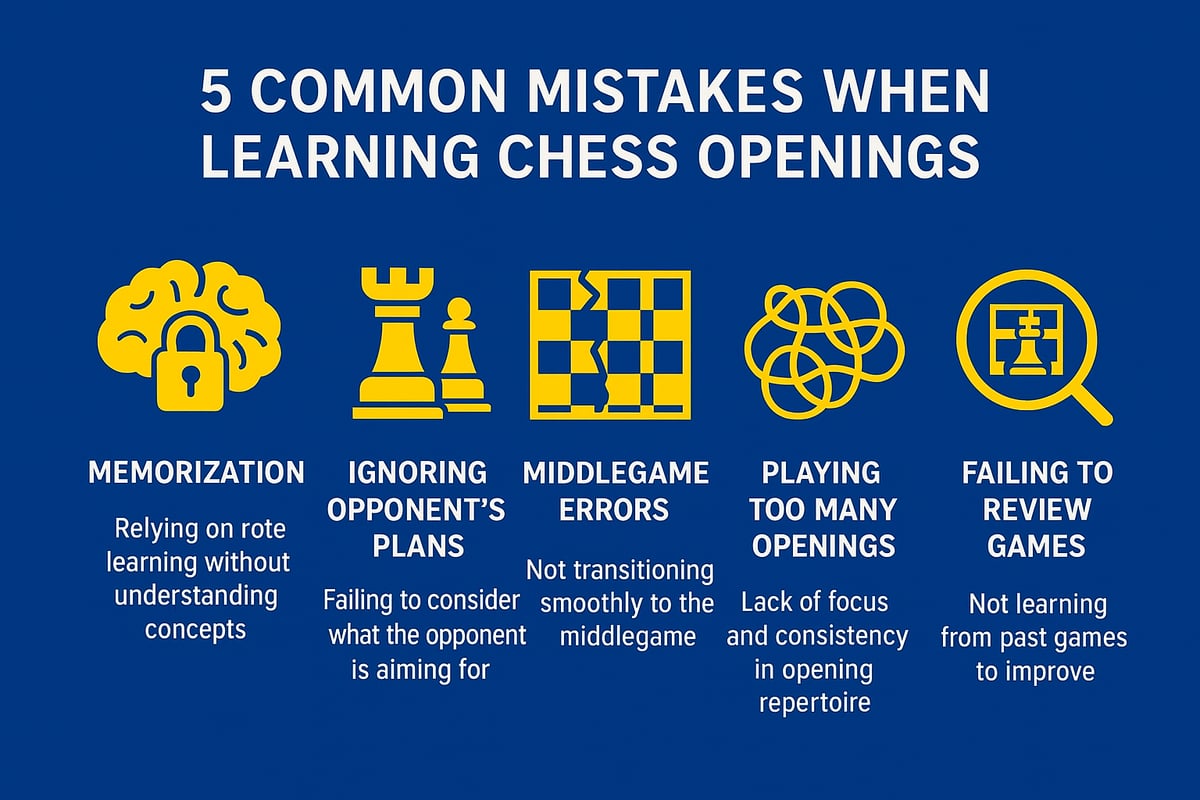
Over-Memorization Without Understanding
It’s tempting to memorize move sequences for the most common chess openings, especially when you want quick wins. However, focusing only on memorization leaves you lost the moment an opponent plays something unexpected.
Instead, aim to understand the reasons behind each move. For example, knowing why a pawn move supports the center helps you adapt, not just recite.
Ignoring Opponent’s Plans
Many players get so wrapped up in their chosen lines that they forget the opponent has plans too. If you ignore what your rival is aiming for, you can walk right into traps—even in the most common chess openings.
Ask yourself: What is my opponent threatening? This mindset keeps you alert and ready to counter surprises.
Neglecting Middlegame Transitions
Mastering the most common chess openings is just step one. If you don’t understand the typical middlegame positions that arise, you might waste your advantage or lose your way.
Try to study how opening ideas connect to middlegame plans. For example, after playing a popular line, look at how top players handle the resulting positions.
Playing Too Many Openings
It’s easy to get excited about all the choices among the most common chess openings. But spreading yourself too thin slows real progress. Jumping between too many lines means you never master any of them.
Focus on a core set of openings that match your style. Once you’re comfortable, slowly add new ones to your repertoire.
Failing to Review and Analyze Games
One of the biggest mistakes in learning the most common chess openings is skipping post-game analysis. Without reviewing your games, you’ll repeat errors and miss growth opportunities.
Use engine analysis and practical tools, like Ruy Lopez chess opening puzzles, to spot where you went wrong and reinforce good habits. Regular review turns experience into lasting improvement.
You’ve just learned why mastering the right chess openings can make all the difference in your game, especially with all the changes happening in 2026. Maybe you’re feeling inspired but a little overwhelmed—where do you start, and how do you keep all these lines straight? That’s where a little help goes a long way. If you want a clear, step by step path to building confidence in your openings—without endless memorization or getting lost in theory—I highly recommend you Start Improving Your Openings. Why not give yourself an edge and see just how much smoother your chess can feel?


