

If you've ever wondered what lies beyond the 64 squares of your standard chessboard, you're in for a fascinating journey. The shogi board, the foundation of Japan's beloved strategic game, offers chess players a fresh perspective on tactical warfare. While you might be comfortable navigating the familiar territory of your chess openings, the shogi board presents an entirely different battlefield with its own quirks, dimensions, and strategic possibilities. Let's explore what makes this Japanese game board so unique and why understanding it might actually sharpen your chess thinking.
What Makes a Shogi Board Different from Chess?
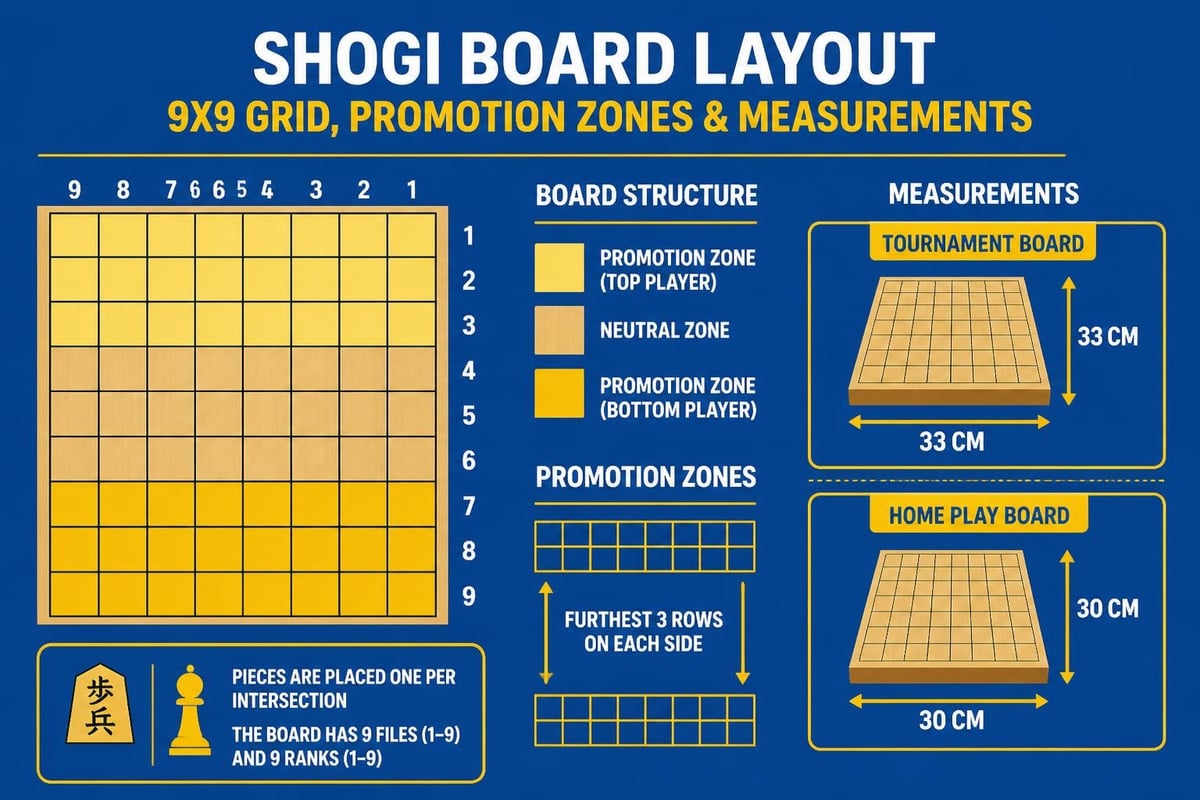
You've probably noticed that chess boards are perfectly square, but a shogi board breaks that mold entirely. This rectangular playing surface measures 9 columns by 9 rows, giving you 81 squares instead of the 64 you're used to. That's 17 more squares of tactical complexity!
The orientation matters too. Unlike chess where both players see the board identically, the history of shogi reveals that the board is traditionally positioned with the longer dimension running between players. Each square is slightly rectangular rather than perfectly square, which gives the board a distinctive elongated appearance.
Here's what really sets it apart:
- No colour distinction: Shogi boards don't have alternating light and dark squares like chess
- Uniform appearance: All 81 squares look identical, creating a clean, minimalist aesthetic
- Piece ownership: Instead of colour, pieces face toward their owner's side
- Drop zones: The entire board serves as potential territory for dropped pieces
Standard Shogi Board Dimensions
Getting the measurements right matters whether you're buying your first board or just curious about the specifications. According to detailed shogi piece and board dimensions, professional boards follow precise standards.
| Board Type | Overall Size | Square Size | Thickness |
|---|---|---|---|
| Tournament | 33cm × 36cm | 3.6cm × 3.3cm | 15-18cm |
| Standard Home | 30cm × 33cm | 3.3cm × 3.0cm | 6-9cm |
| Travel/Portable | 25cm × 27cm | 2.7cm × 2.5cm | 2-3cm |
The professional boards can be surprisingly substantial. Tournament-grade boards are often crafted from single pieces of Kaya wood (Japanese nutmeg) and can weigh over 20 kilograms. That's commitment to the game!
Understanding the Board's Promotion Zones
Here's where things get strategically interesting. The shogi board features promotion zones that fundamentally change how you think about piece development. The furthest three rows on your opponent's side of the board constitute the promotion zone, where most of your pieces can transform into more powerful versions.
Think about how this compares to chess. In chess, only pawns promote, and only on the eighth rank. On a shogi board, almost every piece type can promote, and they get three whole rows of opportunity. This creates a dynamic where pushing into enemy territory isn't just about control – it's about upgrading your entire army.
How Promotion Zones Affect Strategy
You'll need to completely rethink your approach to piece development. Unlike mastering the London System middlegame plans where you gradually build pressure, shogi rewards bold advances into the promotion zone.
- Early aggression: Getting pieces into the zone early creates immediate threats
- Defensive dilemmas: Opponents must choose between blocking promotions or maintaining position
- Timing decisions: Knowing when to promote versus maintaining piece flexibility
- Zone control: Dominating the promotion area becomes a strategic priority
The psychological aspect differs from chess too. While chess players might carefully prepare pawn breaks and piece manoeuvres, shogi players often race to activate their pieces through promotion.
The Grid System and Notation
Reading a shogi board requires learning a different notation system than algebraic chess notation. The files (columns) are numbered 1-9 from right to left from Black's perspective, while the ranks (rows) are numbered 1-9 from top to bottom.
This might feel backwards at first, especially since you're used to files running a-h from left to right. But there's logic here: traditional Japanese writing flows from right to left, top to bottom. The board notation follows this cultural convention.
Recording Moves on the Board
When writing down moves, you'll express them as coordinates followed by the piece name. So "2六歩" means "pawn to square 2-6." The comprehensive guide at New World Encyclopedia explains how this notation integrates with the physical board layout.
The drop rule adds another layer. When you capture pieces in shogi, they join your hand (your reserve), and you can drop them back onto almost any empty square. This means the entire board remains active throughout the game – there's no such thing as a "quiet" area.
Board Materials and Craftsmanship
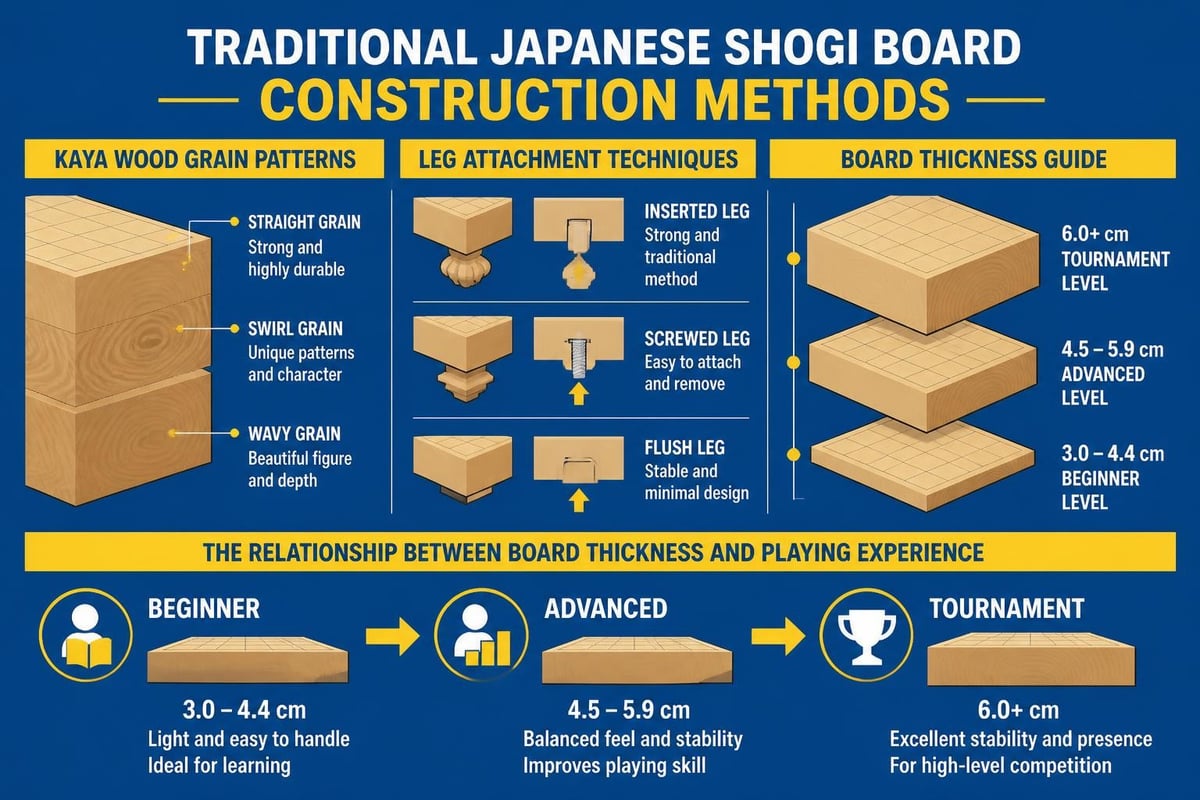
You'll find shogi boards crafted from various materials, each affecting both aesthetics and gameplay. The traditional choice is Kaya wood, prized for its beautiful grain, perfect density, and subtle fragrance. High-end boards can cost thousands of pounds.
Traditional Materials:
- Kaya wood – The gold standard, offering ideal weight and acoustic properties
- Agathis – A more affordable alternative with similar characteristics
- Bamboo – Lightweight and eco-friendly for casual play
- Folding boards – Practical synthetic materials for travel
The legs on floor boards (known as "足付き盤" or ashi-tsuki-ban) deserve mention too. These elevated boards sit about 15-20cm off the ground, allowing players to sit in traditional seiza position. The hollow space beneath creates a satisfying resonance when pieces are placed firmly – a sound that experienced players find deeply satisfying.
Comparing Board Complexity: Shogi vs Chess
Let's talk numbers for a moment. Research into the state-space complexity of shogi reveals fascinating comparisons between these games. The shogi board's 81 squares combined with the drop rule create exponentially more possible positions than chess.
| Aspect | Chess | Shogi |
|---|---|---|
| Board squares | 64 | 81 |
| Starting pieces | 32 | 40 |
| Piece types | 6 | 8 (14 with promotions) |
| Average game length | 40 moves | 115 moves |
| Estimated positions | 10^43 | 10^71 |
That's right – shogi has approximately 10^28 times more possible board positions than chess. The drop rule is the main culprit here, turning every captured piece into a potential wildcard that could appear anywhere on the board.
What Chess Players Can Learn
Studying the shogi board teaches valuable lessons applicable to your chess improvement. The constant threat of drops demands a level of vigilance that sharpens your tactical awareness. You can't rely on "safe" squares the same way you might in chess.
The promotion zone mechanic also offers insights into the value of aggressive play. While chess rewards patient buildup in many common chess openings, shogi often demands quicker action to secure promotional advantages.

Beginner-Friendly Board Variants
Not ready to tackle the full 9×9 board complexity? You're not alone. Japanese educators developed simplified versions that teach core concepts on smaller boards.
Dōbutsu shōgi (Animal Shogi) uses a tiny 3×4 board with just eight pieces. This child-friendly variant maintains the essential shogi board mechanics – promotion zones, drops, and directional pieces – while reducing the overwhelming complexity.
Popular Variant Board Sizes:
- Dōbutsu shōgi: 3×4 (12 squares) – Perfect for absolute beginners
- 5-Go shōgi: 5×5 (25 squares) – Intermediate stepping stone
- Standard shōgi: 9×9 (81 squares) – The complete game
- Chu shōgi: 12×12 (144 squares) – Historical large variant
Starting with a smaller board makes perfect sense. It's like how beginners might focus on mastering specific chess openings before tackling the full repertoire of chess theory.
Setting Up Your Shogi Board
Initial setup on a shogi board follows specific conventions. Unlike chess where you might instinctively know which corner gets the queen's rook, shogi's setup requires learning the proper arrangement.
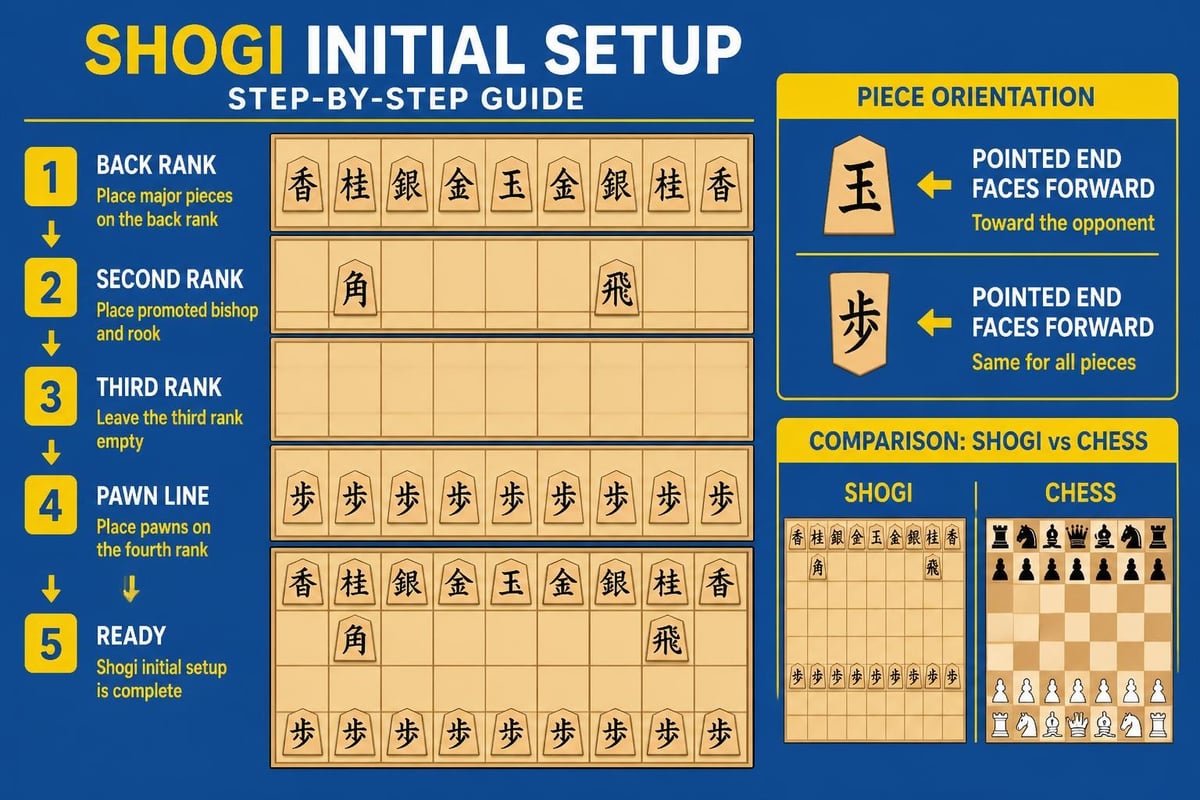
The back rank holds your major pieces: from right to left (from your perspective), you'll place the lance, knight, silver general, gold general, king, gold general, silver general, knight, and lance. The second rank gets the bishop (角行) on the left and rook (飛車) on the right.
Your nine pawns occupy the entire third rank, sitting one square further back than chess pawns. This creates an interesting dynamic where pawn structure develops differently than in chess.
Key Setup Differences from Chess
- No colour coding: Pieces point toward their owner rather than having distinct colours
- Asymmetric major pieces: Bishop and rook sit on opposite sides of the king
- Broader pawn formation: Nine pawns versus eight creates different opening dynamics
- Piece orientation: All pieces must face forward – a dropped piece facing the wrong way is illegal
The lack of colour means you'll need to pay attention to piece orientation. This actually trains a different kind of spatial awareness than chess, where piece identity is immediately obvious from colour.
How AI Changed the Shogi Board Landscape
Recent years have transformed how players approach the shogi board, much like computer engines revolutionised chess. Research on AI's impact on professional shogi players shows remarkable parallels to chess's computer revolution.
The development of engines like Bonanza, GPS Shogi, and eventually the MuZero algorithm revealed entirely new strategies on the traditional 81-square board. Just as chess players track their Elo ratings and study engine analysis, shogi players now have powerful tools to decode board positions.
AI Impact on Board Understanding:
- Novel opening sequences previously considered dubious
- Refined endgame technique on reduced material boards
- Drop timing optimisation in complex middle game positions
- Defensive resources in seemingly lost board positions
This technological evolution means modern shogi board analysis looks remarkably different from even a decade ago. Traditional joseki (established patterns) have been challenged, refined, or outright replaced.
Practical Considerations for Acquiring a Board
Ready to get your hands on an actual shogi board? You've got options ranging from budget-friendly to investment-grade pieces.
For beginners, a folding magnetic board costs £20-40 and works brilliantly for learning. These portable options let you practice anywhere without worrying about piece stability. As you advance, you might invest in a solid wood table board (£80-200) that offers better durability and aesthetics.
The serious equipment – floor boards with legs – starts around £300 and scales up to several thousand pounds for master-crafted Kaya wood boards. These aren't just playing surfaces; they're furniture pieces and family heirlooms.
| Budget Range | Board Type | Best For |
|---|---|---|
| £20-50 | Magnetic/folding | Beginners, travel |
| £50-100 | Basic wooden table board | Regular home play |
| £100-300 | Quality wooden board | Serious study |
| £300-1000 | Entry-level floor board | Traditional experience |
| £1000+ | Professional Kaya board | Collectors, tournament play |
Don't feel pressured to buy expensive equipment immediately. The board doesn't make the player – understanding the tactical nuances does. Start with something affordable and upgrade as your passion grows.
Reading the Board: Pattern Recognition
Developing board vision in shogi requires building new pattern recognition skills. Unlike chess where you've trained your eye to spot knight forks, discovered attacks, and pawn breaks, the shogi board demands recognising different tactical motifs.
Common patterns include the "climbing silver" (advancing your silver general toward promotion), the "ranging rook" setup (moving your rook to the side files), and various drop-based tactics. These patterns repeat across different board positions, just like how you'd recognise Ruy Lopez structures or Caro-Kann pawn formations in chess.
The key is systematic study. Start by solving simple problems: "Where can I drop a piece to create a fork?" or "Which piece should enter the promotion zone first?" This builds the same intuitive understanding you've developed for chess tactics.
Building Your Board Intuition
Your chess experience actually helps here. The core principles of piece coordination, king safety, and tactical awareness transfer beautifully. What changes is the specific application on the shogi board's unique geometry.
- Study professional games with commentary explaining board evaluation
- Practice tsume-shogi (checkmate problems) to sharpen tactical vision
- Analyse your games to understand which board areas you neglect
- Review joseki to learn standard opening positions
- Use AI analysis to discover missed opportunities on the board
The mathematical beauty of shogi piece movements, explored in academic research, reveals geometric patterns that skilled players internalise. Your brain builds these pattern libraries through repetition, exactly like chess study.
Historical Board Variations
The modern 9×9 shogi board wasn't always the standard. Historical variants used different dimensions and rules, offering glimpses into the game's evolution. Shō shōgi, for instance, represents an earlier stage that informed modern play.
Larger variants like Chu shōgi (12×12), Dai shōgi (15×15), and even the massive Taikyoku shōgi (36×36 with 402 pieces!) demonstrate how the board concept scaled dramatically throughout history. These variants eventually gave way to the more manageable 9×9 standard we know today.
The consolidation around the current board size happened for practical reasons. A 9×9 grid offers sufficient complexity without becoming unwieldy. Players can mentally track all 81 squares while maintaining reasonable game lengths. It strikes an ideal balance between strategic depth and playability.
Cross-Training Your Strategic Thinking
Here's the exciting part: studying the shogi board can actually improve your chess. The tactical patterns, while different, train your brain to process complex board states efficiently. The constant vigilance required to monitor potential drops sharpens your awareness of piece placement.
Think of it as cross-training for your mind. Just as athletes use different sports to build complementary skills, chess players benefit from exploring related strategy games. The shogi board challenges your assumptions about piece values, territorial control, and initiative in ways that refresh your chess perspective.
Many strong chess players dabble in shogi and report enhanced pattern recognition and tactical alertness in their chess games. The mental flexibility developed by switching between rule sets translates into more creative problem-solving at the chess board.
You might find yourself spotting chess tactics you'd previously missed, simply because shogi trained you to consider non-obvious piece placements and sacrifices. The games complement each other beautifully, each strengthening different aspects of your strategic thinking.
Understanding the shogi board opens fascinating strategic vistas beyond the familiar 64 squares of chess. Whether you explore it as a curiosity or embrace it as a serious study, the insights you gain will enrich your overall board game understanding. If you're passionate about improving your strategic skills efficiently, Chess Cheat Sheets offers comprehensive guides and resources that help you master chess concepts without extensive study, applying the same streamlined learning approach that makes games like shogi accessible to dedicated players. Our cheat sheets, puzzles, and opening guides provide the structured practice you need to elevate your game with confidence.


