

If you're tired of getting crushed in sharp tactical battles and want a solid, reliable defense against 1.e4, you've probably heard about the Caro Kann Defense. Named after the players Horatio Caro and Marcus Kann who analysed it in the 1890s, this opening has been a favourite of world champions and club players alike for over a century. What makes it so appealing? Unlike some opening systems that require memorizing 25 moves of theory, the caro kann defense offers you sound strategic principles and a sturdy pawn structure that's forgiving when you don't know every theoretical nuance. Let me walk you through why this might be exactly what your opening repertoire needs.
Why the Caro Kann Defense Deserves Your Attention
You're probably wondering what makes this opening stand out among the dozens of responses to 1.e4. The answer lies in its unique blend of solidity and counterattacking potential.
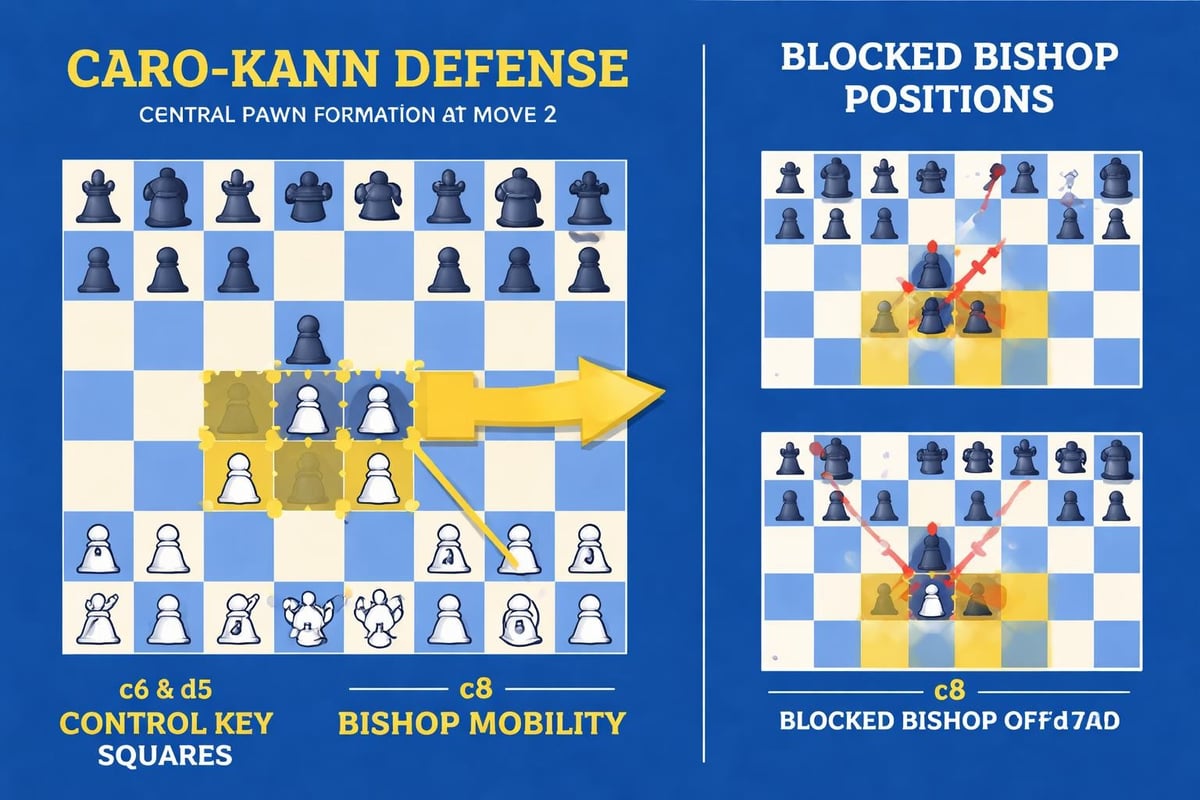
The opening starts with 1.e4 c6, which might look passive at first glance. After all, you're not immediately contesting the centre with a pawn, are you? But here's the clever bit: you're preparing 2...d5, which will challenge White's central pawn whilst keeping your light-squared bishop free. This is the fundamental difference between the Caro Kann and its cousin, the French Defense, where Black's light-squared bishop often becomes a problem piece.
Strategic Benefits That Matter
When you play the caro kann defense, you're signing up for specific middlegame characteristics:
- Solid pawn structure that's difficult to break down
- Active piece play without the typical French bishop problems
- Reliable positional foundations even when you're not booked up
- Flexibility to choose between different pawn structures based on your preference
The comprehensive analysis of the Caro-Kann Defence shows how top grandmasters have employed this opening to reach world championship matches. Former World Champion Anatoly Karpov used it extensively, as did Garry Kasparov in his later years when he wanted something solid with Black.
Main Variations You Need to Know
The beauty of the caro kann defense is that after 1.e4 c6 2.d4 d5, White faces a critical decision. Each of White's main options leads to distinctly different types of positions, so you'll want to be prepared for what's coming.
The Classical Variation (3.Nc3 or 3.Nd2)
This is where most of your games will head. White develops the knight, and after 3...dxe4 4.Nxe4 Bf5, you get that lovely light-squared bishop outside the pawn chain. This is what the opening is all about!
| Move | White | Black | Key Idea |
|---|---|---|---|
| 3 | Nc3/Nd2 | dxe4 | Exchange on e4 |
| 4 | Nxe4 | Bf5 | Develop bishop actively |
| 5 | Ng3 | Bg6 | Maintain the bishop |
| 6 | h4 | h6 | Prevent h5 harassment |
The 3.Nd2 move is particularly popular at club level because it avoids some of Black's sharper options. After 3...dxe4 4.Nxe4, you still get your Bf5, and the game typically continues with a battle for central control.
The Advance Variation (3.e5)
Here's where things get tense. White pushes forward with 3.e5, gaining space but also committing to a particular pawn structure. This variation leads to a completely different type of game, one that's more about strategic maneuvering than tactical complications.
After 3.e5, you typically respond with 3...Bf5, developing your bishop before it gets locked in. The position resembles a French Defense structure, but remember, your light-squared bishop is already outside the chain. You'll then continue with ...e6, ...Nd7, and look to undermine White's centre with ...c5 at the right moment.
The strategic ideas and middlegame themes in this variation revolve around piece placement and timely pawn breaks. If you're comfortable with slightly cramped but solid positions, you'll enjoy this line.
The Exchange Variation (3.exd5)
White plays 3.exd5 cxd5, leading to a symmetrical pawn structure that many consider drawish. Don't let that fool you, though! This variation requires precise understanding to handle well.
The resulting positions are excellent learning tools because they teach you about:
- Minor piece placement in symmetrical structures
- Pawn break timing with moves like ...c5 or ...e5
- Piece coordination when material is reduced
- Converting small advantages in simplified positions
Many club players dismiss this variation as boring, but it's actually a fantastic way to improve your general chess understanding. Plus, at your level, opponents often misplay these "simple" positions.

Practical Tips for Playing the Caro Kann
Now that you understand the main variations, let's talk about how to actually play this opening effectively in your games. Theory is one thing, but knowing practical patterns is what wins games.
Development Priorities
Your piece development in the caro kann defense follows a logical pattern. After you've played ...c6 and ...d5, and assuming White hasn't gone for the Advance Variation, your next moves typically include:
- ...Bf5 or ...Bg4 (depending on the variation)
- ...e6 to support the centre and prepare bishop development
- ...Nd7 rather than ...Nc6, keeping the c-file potentially open
- ...Ngf6 attacking central squares
- ...Bd6 or ...Be7 completing kingside development
This isn't a rigid formula, but it's the natural flow of development that works in most positions. The key is understanding why each piece goes where it does.
Common Pawn Breaks
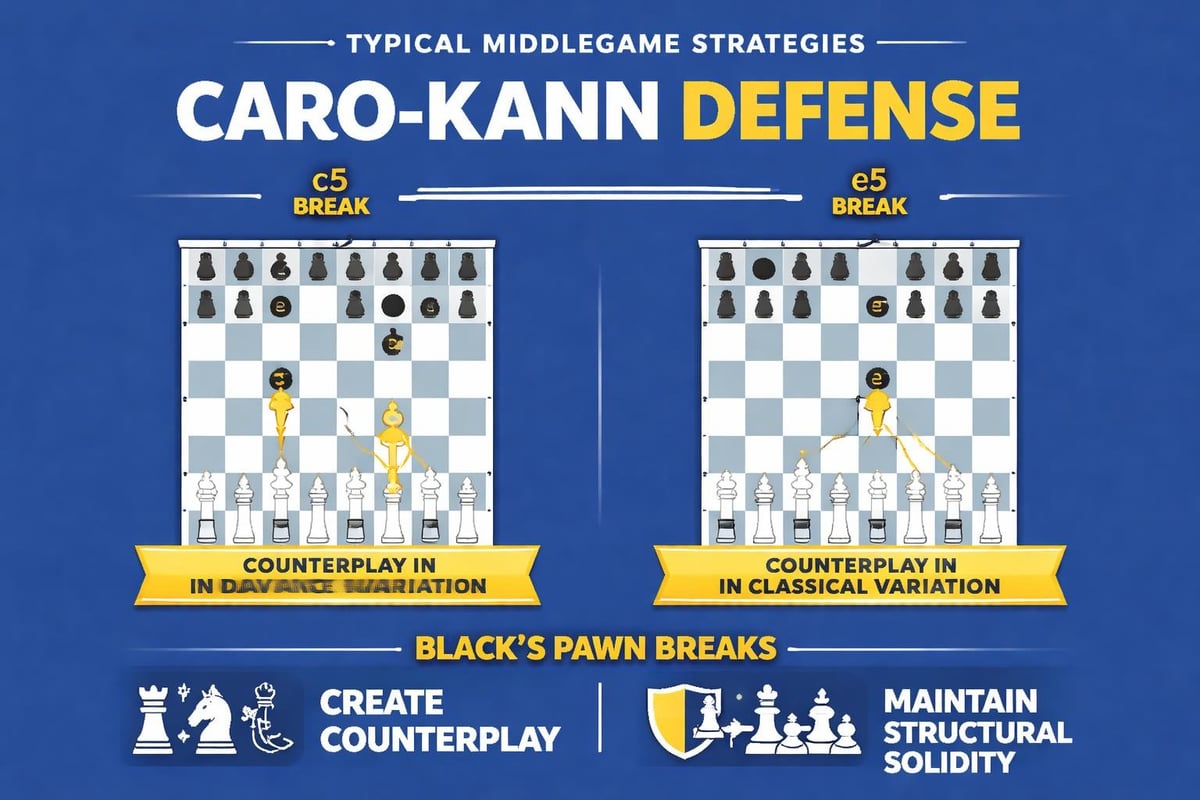
Understanding when to strike in the centre is crucial. Here are the main pawn breaks you'll be looking for:
...c5 - This undermines White's d4 pawn and opens lines on the queenside. You'll typically play this after completing development.
...e5 - Less common but powerful when available, this break challenges White's centre directly and opens lines for your pieces.
...f6 - In the Advance Variation, this directly attacks White's pawn chain. Time it carefully, as it does weaken your kingside.
Avoiding Common Mistakes
I've seen countless players lose with the caro kann defense not because the opening is bad, but because they misunderstand its requirements. Let me share the mistakes I see most often.
Premature Pawn Breaks
Just because ...c5 is thematic doesn't mean you should play it on move 8! Make sure your pieces are developed and coordinated first. A pawn break without piece support is just a weakness.
Neglecting King Safety
The caro kann defense is solid, but that doesn't mean you can ignore king safety. Don't delay castling too long, especially in sharper variations. I've seen players get caught in the centre because they were too focused on queenside play.
Passive Piece Placement
Yes, the opening is solid, but solid doesn't mean passive. Your bishops should be active, your knights should control key squares, and your rooks should occupy open or semi-open files. The guide to common mistakes in the Caro-Kann covers these pitfalls in detail.
Forgetting About the Initiative
Here's something that catches many Caro Kann players: you can't just develop and hope for the best. White often has the initiative in the opening, and you need to know when to exchange pieces, when to challenge the centre, and when to simply consolidate. This positional awareness comes with practice and study.
Transitioning to the Middlegame
The moment you finish developing your pieces, you're entering the middlegame, and this is where understanding typical plans becomes essential. The caro kann defense doesn't give you a forced winning position, but it gives you something arguably more valuable: a reliable, sound position with clear plans.
Piece Coordination Patterns
In Classical Variation positions, you're often looking to coordinate your pieces towards the queenside. Your rook might come to c8, your knight from d7 can reroute to c4 or b6, and your light-squared bishop from f5/g6 supports both defense and attack.
The strategic concepts behind this defense emphasize this piece harmony. You're not trying to create immediate threats but building a position where White has no obvious way to create serious problems.
| Plan | When to Use | Key Pieces Involved |
|---|---|---|
| Queenside expansion | After completing development | Rooks, queen, c-pawn |
| Central control | When White's centre is fixed | Knights, pawns |
| Kingside defense | Against White's h4-h5 plans | Pawns, bishop on g6 |
| Piece exchanges | When slightly cramped | All pieces strategically |
Knowing Your Pawn Structures
Different variations of the caro kann defense lead to different pawn structures, and understanding these structures is half the battle:
IQP positions - Sometimes after ...c5 and exchanges, White gets an isolated queen's pawn on d4. Know how to blockade and attack it.
Hanging pawns - When both sides have c and d pawns without e-pawns, the resulting tension requires careful handling.
Advanced pawn structures - In the Advance Variation, you're dealing with a space disadvantage but also clear targets in White's pawn chain.
Resources for Deepening Your Understanding
You've got the basics now, but mastering any opening requires ongoing study. The good news is you don't need to spend hours every day on this. Focused, efficient study works better than endless theoretical memorization.
The practical training workflow for the Caro-Kann suggests a structured approach: start with understanding the key positions, then study complete games by strong players, and finally practice the positions yourself.
For those wanting comprehensive coverage, the detailed guide at Chess Cheat Sheets offers streamlined theory and key variations without overwhelming you with obscure sidelines.
Studying Model Games
Watching how grandmasters handle typical positions is invaluable. Look for games by:
- Anatoly Karpov (Classical approach)
- Viswanathan Anand (Dynamic handling)
- Mikhail Botvinnik (Strategic depth)
When you study these games, don't just memorize the moves. Ask yourself why each player made their decisions, what plans they were pursuing, and how they handled critical moments.
Handling White's Aggressive Tries
Not every opponent will give you a quiet Classical or Exchange Variation. Some players love the sharp, aggressive lines, and you need to be ready for them.
The Panov-Botvinnik Attack
After 1.e4 c6 2.d4 d5 3.exd5 cxd5 4.c4, White immediately challenges your central pawn. This leads to open, tactical positions that require precise play. The guide explaining how to counter the Caro-Kann covers this from both sides, which is useful for understanding White's ideas.
Your main response is 4...Nf6, and after 5.Nc3 e6 (or 5...Nc6), you're heading into IQP territory. These positions are more tactical than typical Caro Kann games, so if you prefer solid, positional play, you might want to study this variation extra carefully.
The Two Knights Attack
When White plays 2.Nc3 (instead of 2.d4), they're avoiding your main lines and heading for different territory. After 2...d5 3.Nf3, you're in the Two Knights Variation, which combines features of both the Vienna Game and the Caro Kann.
This isn't as critical as the main lines, but you should know the basic ideas:
- Develop normally with ...Bg4 or ...Bf5
- Consider ...e6 and ...Nf6
- Look for opportunities to exchange White's e4 pawn
- Keep your structure flexible
Choosing Your Variation Style
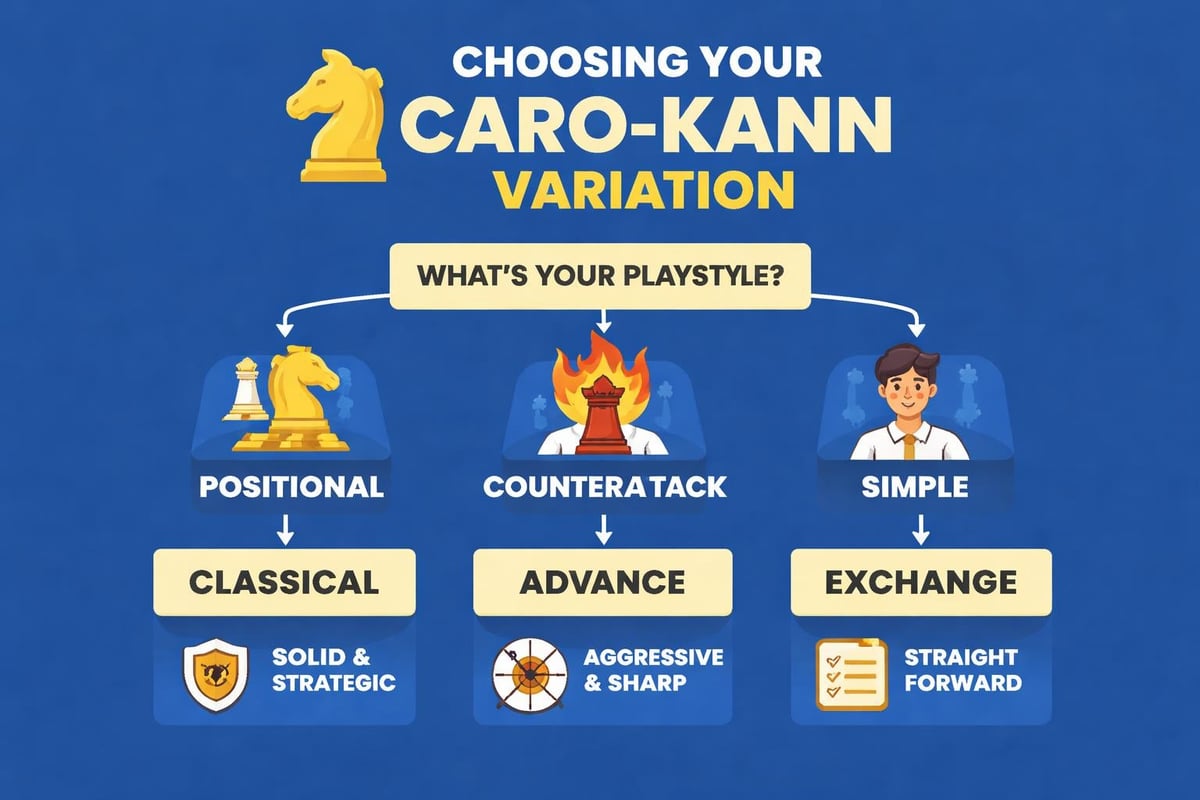
Here's something nobody tells beginners about the caro kann defense: you can customize it to your playing style. Seriously! Different move orders and setups within the opening lead to different types of positions.
If you like solid, strategic chess: Focus on the Classical lines with 3.Nc3 dxe4 4.Nxe4 Bf5. These positions reward positional understanding and long-term planning.
If you enjoy counterattacking: Study the Advance Variation deeply. Learn the pawn breaks, understand the piece regrouping patterns, and embrace slightly cramped positions.
If you want simplicity: The Exchange Variation might seem boring, but it's an excellent practical choice. You can't lose in the opening, and if your opponent doesn't know the resulting positions well, you'll often outplay them in the middlegame.
For players looking to expand their opening repertoire beyond the Caro Kann, exploring chess openings for intermediate players can provide valuable perspective on different strategic themes.
Building Your Opening Repertoire Around the Caro Kann
One opening doesn't make a complete repertoire, but the caro kann defense can be the foundation of your Black repertoire against 1.e4. Here's how to build around it effectively.
Complementary Openings
If you're playing the Caro Kann, you also need answers to 1.d4, 1.c4, and 1.Nf3. The good news is that the strategic principles you're learning (solid structure, active pieces, patient play) transfer well to other openings.
Consider learning:
- A solid defense to 1.d4 like the Queen's Gambit Declined or Slav Defense
- A reliable system against 1.Nf3 that transposes to your d4 repertoire
- Responses to offbeat first moves (these don't need deep preparation)
The beauty of focusing on one solid defense like the Caro Kann is that it allows you to understand chess principles deeply rather than memorizing countless variations superficially. For additional resources on building a complete repertoire, check out recommended chess books on openings.
Training Methodology
How should you actually learn this opening? Here's a practical approach that works:
Week 1-2: Learn the basic moves and ideas of each main variation. Don't worry about memorizing yet, just understand the plans.
Week 3-4: Play through 5-10 master games in each major variation. This builds pattern recognition.
Week 5-6: Start using the opening in your games. Accept that you'll make mistakes and learn from them.
Ongoing: Review your games, identify where you went wrong, and study those specific positions more deeply.
This methodical approach, combined with the streamlined resources available at Chess Cheat Sheets, ensures you're learning efficiently without getting overwhelmed by theoretical minutiae.
Staying Current in 2026
The chess world keeps evolving, and opening theory develops constantly. However, the caro kann defense is mature enough that radical new ideas are rare. What changes is the emphasis on certain variations and the refinement of known positions.
Modern Trends
In 2026, we're seeing:
- Increased interest in the Advance Variation at the top level
- Refined treatment of the Two Knights Attack
- Computer-assisted preparation revealing new depths in "simple" positions
- Greater emphasis on understanding plans over memorizing moves
The practical implication? Focus on understanding rather than memorization, and you'll stay relevant regardless of theoretical fashions.
Using Modern Tools Wisely
You have access to incredible tools like chess engines and databases. Use them wisely:
- Check your games with an engine to spot tactical oversights
- Don't memorize engine moves without understanding why they work
- Study complete games rather than just opening theory
- Focus on typical positions more than forced tactical sequences
Remember, at club level, understanding typical positions and plans beats memorizing 20 moves of computer-approved theory that your opponent won't follow anyway.
The Caro Kann Defense offers you exactly what every improving player needs: a reliable foundation that grows with your understanding and rewards strategic thinking over pure memorization. Whether you're looking to add a solid weapon against 1.e4 or simply want to improve your positional chess, this opening delivers consistent results without requiring exhaustive study. Ready to master it efficiently? Chess Cheat Sheets provides streamlined guides, practical cheat sheets, and targeted resources designed specifically for players like you who want to improve quickly without getting lost in endless theory.


