

Ever wondered why your chess elo seems to change after every game, or what it really says about your skill level in 2026? You’re not alone. The world of chess ratings can feel mysterious, even confusing, to most players.
This guide is here to clear things up. We’ll break down how the chess elo system works, why it matters for your progress, and what’s new for 2026. Get ready to explore its origins, the math behind your number, rating categories, inflation, and the key differences between online and over-the-board ratings.
By understanding your chess elo, you can set smarter goals, track your improvement, and play with more confidence. Let’s dive in and take the guesswork out of your chess journey.
The Origins and Evolution of the Chess Elo Rating System
Ever wondered who’s behind the number that defines your chess journey? The story of the chess elo system starts with a brilliant mind and a desire to make chess fairer for everyone. Let’s dive into where it all began, how it’s changed over time, and why it still matters to every player, from beginners to world champions.
The Birth of Elo: Arpad Elo’s Contribution
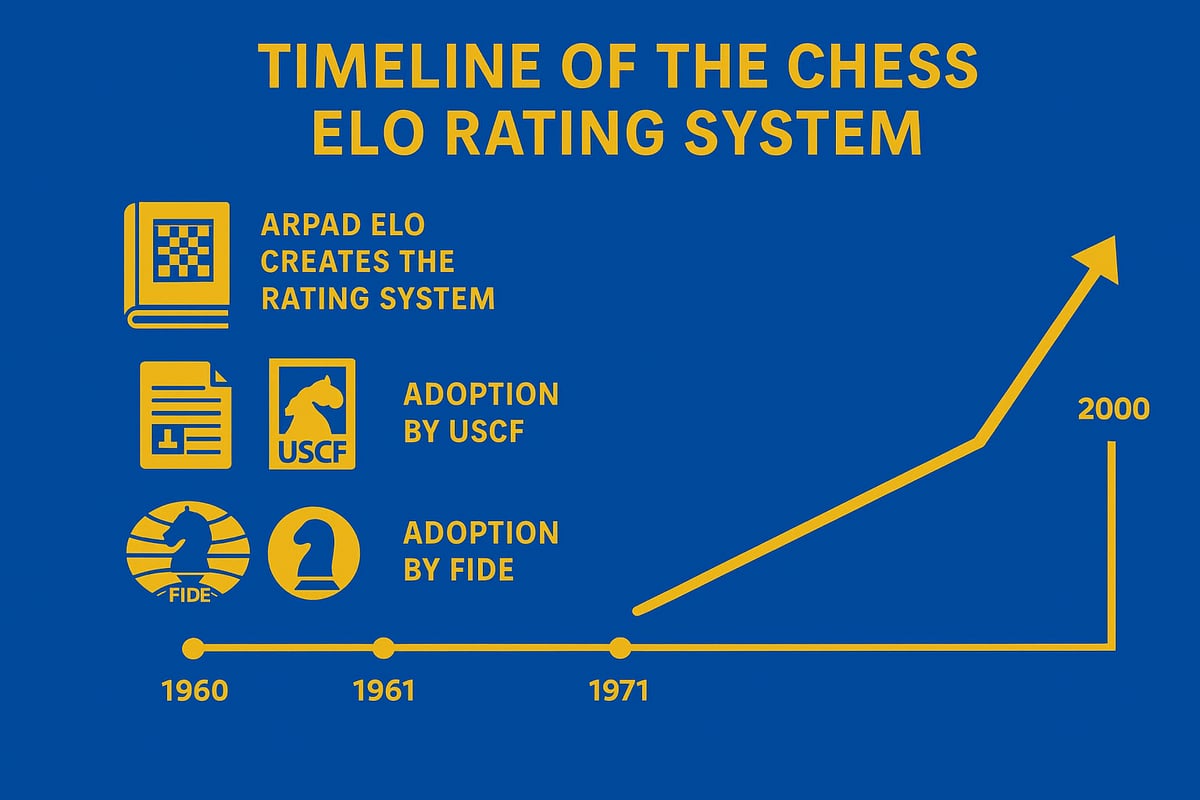
The chess elo system owes its name to Arpad Elo, a Hungarian-American physics professor and passionate chess master. Before Elo, chess federations struggled with ranking methods that were inconsistent and often unfair. Systems like Harkness and Ingo lacked mathematical precision, making it tough for players to trust their ratings.
Elo’s background in statistics and love for chess led him to design a new system in the 1950s. His model aimed to rate players based on performance against others, rather than arbitrary measures. The US Chess Federation adopted the chess elo system in 1960, quickly improving rating accuracy. In 1970, FIDE, the world chess governing body, made chess elo the global standard. This move unified chess competitions and sparked worldwide trust in the system.
Key Milestones in Elo’s History
Since its adoption, the chess elo system has seen remarkable milestones. Early on, calculations were done by hand, with rating lists published on paper. As computers arrived, federations shifted to digital rating updates, making the process faster and more accurate.
Online chess platforms like Chess.com and Lichess introduced their own adaptations, allowing millions to track their chess elo in real time. Historical moments include Magnus Carlsen’s record of 2882, the highest chess elo ever reached. The system keeps evolving, especially with recent updates. For example, in 2024, FIDE made significant changes to rating floors and initial ratings to address deflation, which you can read about in FIDE's 2024 Rating System Changes. These adjustments set the stage for a more balanced chess landscape leading into 2026.
Elo’s Enduring Influence
Today, the chess elo system is the heartbeat of competitive chess worldwide. National federations and online sites alike rely on it to rank players, set tournament pairings, and award titles. Chess elo also inspired modern systems like Glicko and Glicko-2, which add volatility and reliability factors for even finer tuning.
Elo ratings play a key role in achieving milestones such as Grandmaster or International Master titles. The chess elo number you see next to your name connects you to a global community and a tradition that spans decades. Whether you’re playing online or over the board, the chess elo system continues to shape how we measure skill, progress, and achievement in chess.
How the Chess Elo System Works in 2026
Ever feel like your chess elo is a mysterious number that goes up and down without warning? You’re not alone. In 2026, the chess elo system is more transparent and data-driven than ever. Let’s break down exactly how it works, so you can finally understand what’s behind every rating jump—or drop.
Core Principles of Elo Ratings
At its heart, the chess elo system is all about measuring your relative strength compared to other players. Your rating isn’t a fixed measure of your chess ability—it’s a snapshot of your results versus the competition.
The math behind chess elo predicts how likely you are to win, lose, or draw against a given opponent. For example, if you’re 100 points above your rival, you have about a 64 percent chance of winning. With a 200-point lead, your win odds jump to 75 percent.
These probabilities aren’t just for bragging rights—they’re built into every calculation. The system expects you to perform at your level. If you do better, your chess elo climbs. If you fall short, it drops. The official FIDE Rating Regulations Effective March 2024 lay out the exact rules used globally, ensuring consistency across federations.
Understanding these basics is key. Your chess elo isn’t just a number—it tells a story about your journey, your progress, and your next goal.

The Elo Calculation Process
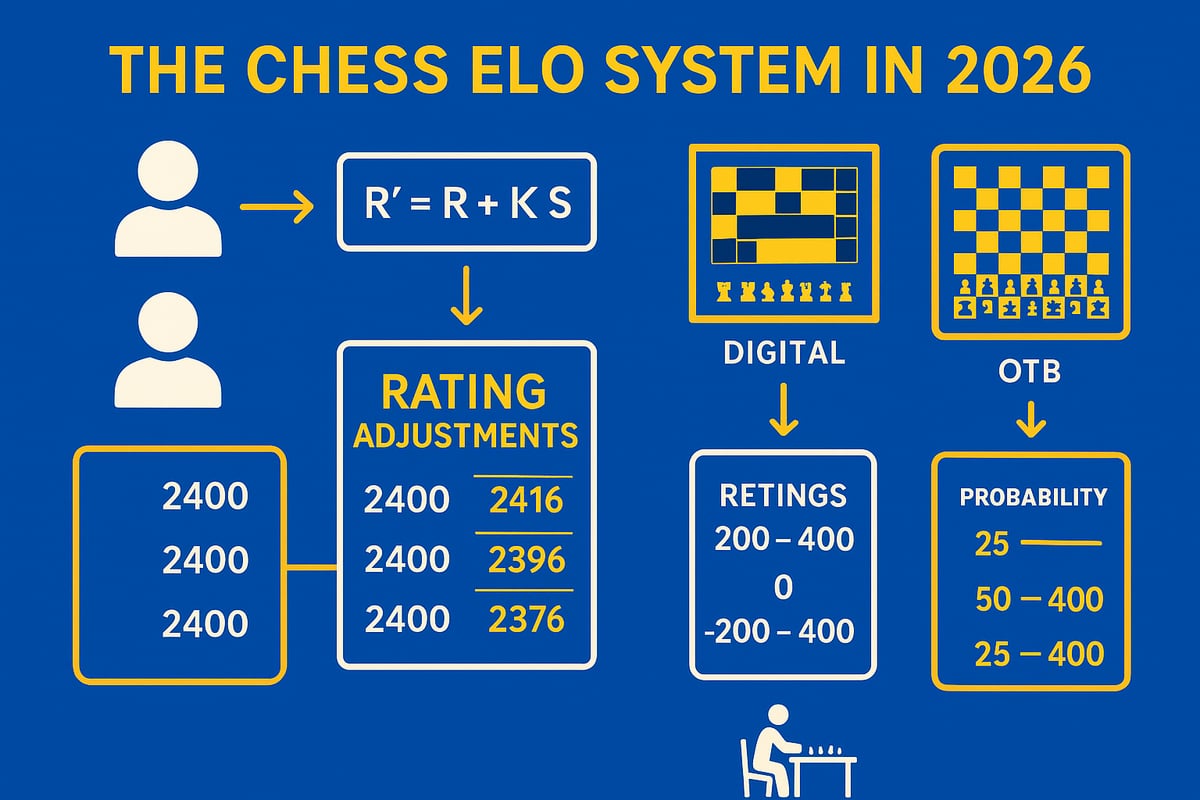
So, how does your chess elo actually change after a game? It all comes down to a straightforward formula:
Rnew = Rold + K × (W – We)
Let’s break that down:
-
Roldis your current rating. -
Kis the development coefficient (how “swingy” your rating is). -
Wis your game result (1 for a win, 0.5 for a draw, 0 for a loss). -
Weis your expected score, based on the rating gap.
For new players (fewer than 30 games), the K-factor is 40. For established players under 2400, it’s 20. For elite players above 2400, it drops to 10. This means your chess elo changes faster when you’re new, and more slowly as you become experienced.
Here’s a quick example: If a player rated 1500 beats a 1600-rated opponent, their expected score was low, so they gain more points. If they lose, the rating impact is minimal. It’s all about rewarding upsets and stabilizing performance over time.
Online vs. OTB Elo in 2026
In 2026, chess elo ratings are everywhere—but not all are created equal. Over-the-board (OTB) ratings, like those from FIDE and US Chess, are calculated from in-person tournament games. Online platforms, such as Chess.com and Lichess, use their own systems, sometimes based on Elo, but often with tweaks.
For example, Chess.com uses a variant called Glicko-2, which adjusts for rating volatility and how often you play. Online ratings can change instantly, reflecting your latest performance, while OTB ratings are usually updated after events.
Here’s a quick comparison:
| Platform | System | Update Frequency | Volatility |
|---|---|---|---|
| FIDE/USCF | Elo | After tournaments | Lower |
| Chess.com | Glicko-2 | Instantly | Higher |
| Lichess | Glicko-2 | Instantly | Higher |
That’s why your online chess elo might look very different from your official OTB rating. Each serves a unique purpose, tracking your growth in different chess worlds.
Step-by-Step: What Happens After a Game?
Curious what actually happens behind the scenes when your chess elo changes? Here’s a step-by-step breakdown:
- The system pulls both players’ current ratings and K-factors.
- It calculates each player’s expected score based on the rating gap.
- Your actual result (win, loss, or draw) is entered.
- The formula updates both ratings instantly online, or after the event in OTB play.
- Your new chess elo appears on your profile and leaderboards, ready for your next challenge.
This process repeats for every game, making your rating a living, breathing reflection of your chess journey. Whether you’re climbing the ranks online or facing rivals across the board, understanding this cycle empowers you to make sense of every rating change.
Understanding Chess Rating Categories and Titles
Ever wondered where your chess elo places you in the global chess community? Understanding rating categories and official titles is your roadmap to measuring progress and setting realistic goals. Whether you’re just starting or aiming for a master title, knowing these distinctions can help you navigate your chess journey.
Elo Ranges and Player Classes
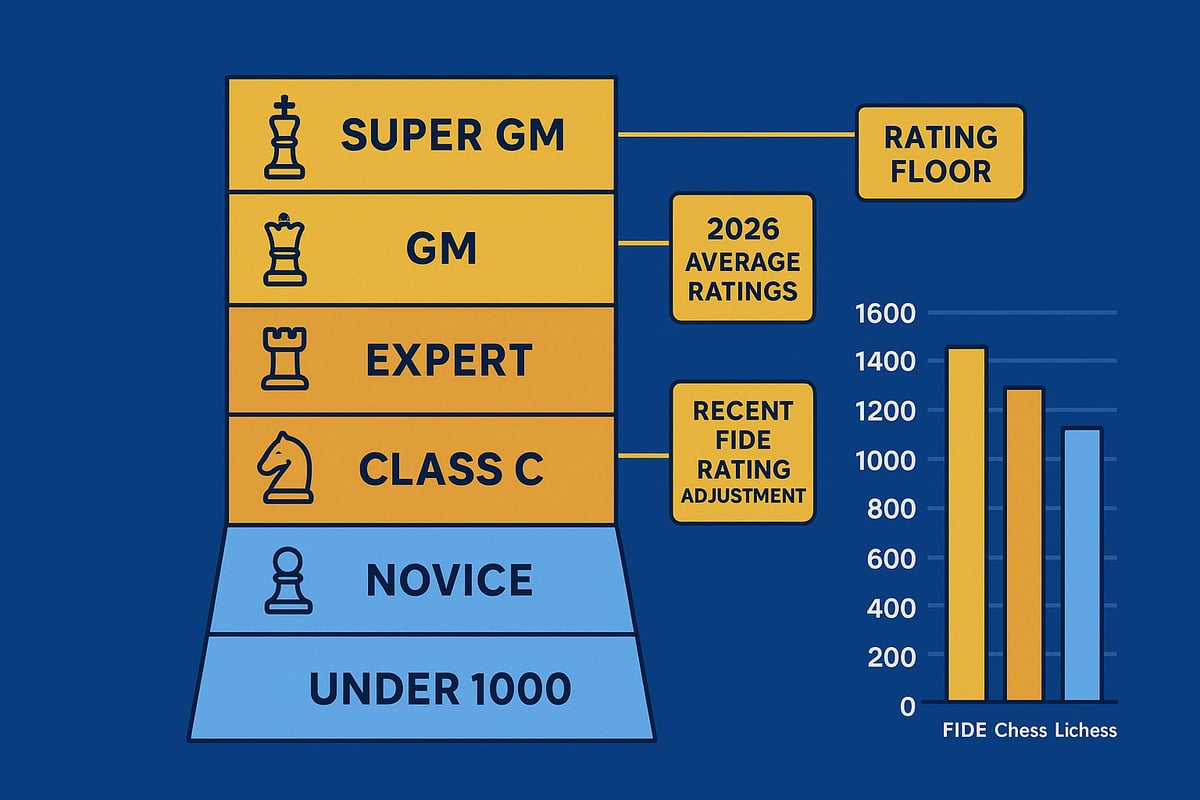
Let’s break down the chess elo landscape. Your rating isn’t just a number—it represents your skill level compared to the chess world at large. Each range has its own class, and knowing where you stand helps you target your next step. Here’s a quick look at the common categories:
| Rating Range | Class/Title |
|---|---|
| 2700+ | Super Grandmaster |
| 2500–2699 | Grandmaster (GM) |
| 2400–2499 | International Master (IM) |
| 2300–2399 | FIDE Master (FM) |
| 2200–2299 | Candidate/National Master |
| 2000–2199 | Expert |
| 1800–1999 | Class A |
| 1600–1799 | Class B |
| 1400–1599 | Class C |
| 1200–1399 | Class D |
| 1000–1199 | Class E/Novice |
| Under 1000 | Beginner |
Most online chess platforms start ratings around 400, so if you’re just beginning, don’t worry—you’re not alone. The chess elo system allows you to see steady progress as you climb these classes.
Title Norms and Requirements
Dreaming of a chess title? FIDE and national federations grant titles based on your chess elo and performance in official tournaments. Here’s how it works:
- Grandmaster (GM): Achieve a 2500 chess elo and earn three GM norms in top-level tournaments.
- International Master (IM): Reach a 2400 rating and secure three IM norms.
- FIDE Master (FM): Attain a 2300 rating—no norms needed.
- Candidate Master (CM): Cross the 2200 threshold.
National titles, like US Chess National Master, typically require a 2200 rating. Each title is a major milestone and a testament to your chess elo achievements.
2026 Trends in Rating Distribution
Chess rating trends are shifting in 2026. With more players joining online and over-the-board events, the average chess elo is evolving. Recent years have seen a surge in super-GMs, but also an adjustment for club and casual players.
On March 1, 2024, FIDE made a historic move to address rating deflation, adding rating points to over 350,000 players. This adjustment, FIDE's Rating Adjustments for 350,000 Players, aimed to make chess elo ratings more reflective of today’s competitive landscape. As a result, the average club player now sits slightly higher in the rating pool, and it’s more achievable to reach new milestones.
Online platforms like Chess.com and Lichess show similar trends, with new players entering at lower ratings but progressing faster thanks to better learning tools and analytics.
Rating Floors and Minimums
Rating floors are built into the chess elo system to prevent players from dropping too far after a string of tough games. For example, FIDE sets rating floors (like 1000 or 1200), so your rating won’t fall below these points even after several losses.
Different federations and online platforms have unique policies. Some online sites let you start as low as 400, while others establish provisional ratings that stabilize after your first 20–30 games. This keeps the chess elo system fair and prevents demoralizing rating crashes as you learn and improve.
Understanding how rating floors work helps you set realistic expectations and focus on growth rather than worrying about sudden drops.
The Math, Science, and Controversies Behind Elo
Ever wondered what’s really happening behind your chess elo jumps and drops? This section peels back the curtain on the math, science, and ongoing debates that shape the system. By the end, you’ll see why chess elo is both a powerful tool and a hot topic in the chess world.
The Elo Formula: A Closer Look
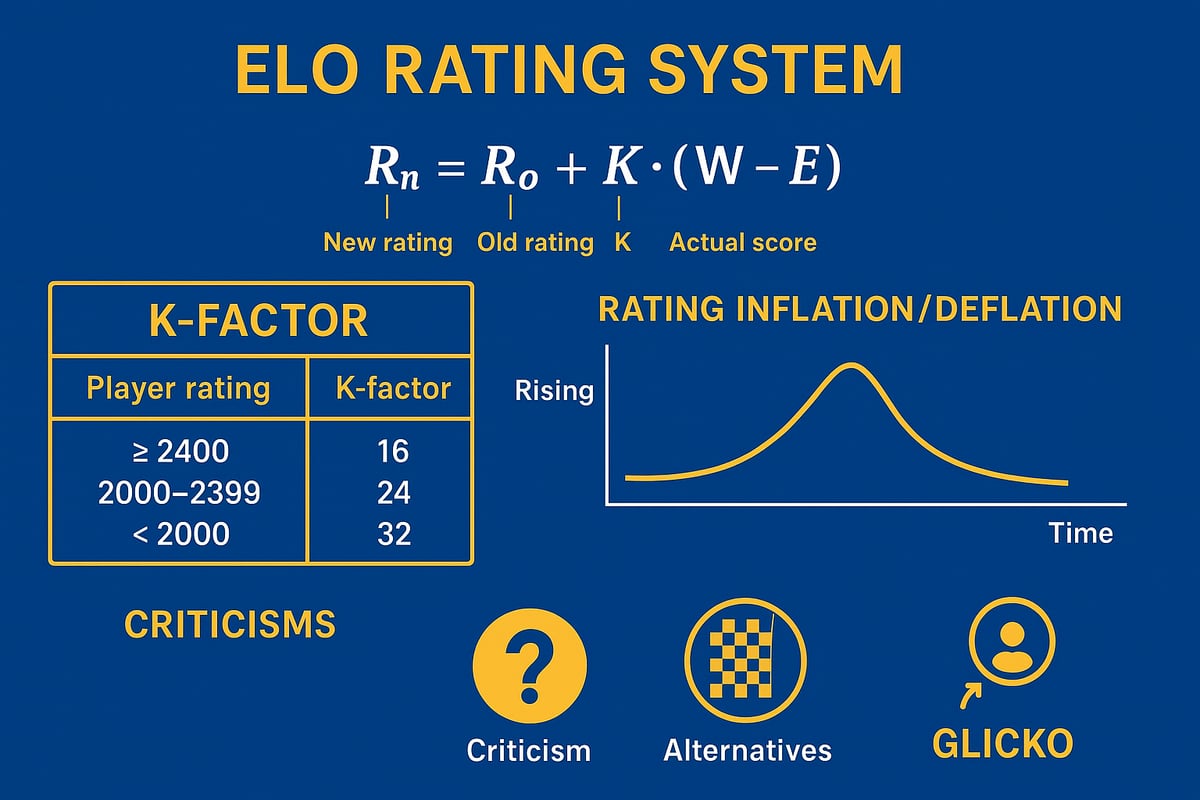
Let’s break down the backbone of chess elo: the formula. At its core, Elo is about predicting results and adjusting ratings based on what actually happens. The formula looks like this:
Rnew = Rold + K × (W – We)
-
Rold: Your current chess elo rating -
K: Development coefficient (how much your rating can change) -
W: Actual result (1 for a win, 0.5 for a draw, 0 for a loss) -
We: Expected result (probability based on rating gap)
For example, if you have a chess elo of 1500 and play someone rated 1600, your expected score is about 0.36. If you win, with a K of 20, your new rating will be:
Rnew = 1500 + 20 × (1 – 0.36) = 1512.8
K-factor matters a lot. Here’s a quick comparison:
| Player Type | K-Factor | Impact on Chess Elo |
|---|---|---|
| New player | 40 | Fast changes |
| Under 2400 | 20 | Moderate changes |
| Over 2400 | 10 | Slow, stable changes |
If you want to visualize how your chess elo changes over time, Visual chess rating tools can make these calculations and trends much easier to track and understand.
Inflation and Deflation in Chess Ratings
You might have heard that a 1300 chess elo today isn’t the same as it was decades ago. That’s rating inflation in action. As more players enter the system, especially at the lower end, the average rating can rise—even if overall skill doesn’t.
Deflation is the opposite. If too many strong players leave or retire, the pool can drop. Research, like Sonas’ FIDE rating analysis, shows that these swings can affect title norms and player motivation. For example, what counted as master strength in the 1980s might not map directly onto today’s chess elo landscape.
It’s important to remember that inflation or deflation doesn’t make your games less meaningful. Instead, it’s a reminder to focus on progress, not just numbers.
Criticisms and Limitations of Elo
No system is perfect, and chess elo has its share of critics. One big issue is the assumption that player skill follows a normal distribution, which isn’t always true, especially online.
Other common complaints include:
- Inactivity protection: Ratings don’t always reflect current form after long breaks.
- Easy manipulation: Online, engine abuse or sandbagging can skew results.
- Rapid changes: Blitz and bullet can swing chess elo scores wildly in a short span.
Despite these flaws, most agree that chess elo is a solid benchmark, especially when combined with common sense and context.
Modern Improvements and Alternatives
To address some of these issues, new systems have emerged. Glicko and Glicko-2, for example, add a “rating deviation” to show how reliable a player’s chess elo is. This helps account for volatility and gives a clearer picture of true skill.
Other systems, like Harkness and Ingo, played key roles before Elo became the standard. While debates continue, chess elo remains the backbone of competitive chess ratings worldwide.
Ultimately, understanding these systems helps you set smarter goals and navigate the chess world with confidence.
Practical Guide: Tracking, Improving, and Using Your Elo in 2026
Ready to take control of your chess journey in 2026? Whether you are just starting out or aiming to break into a new rating class, understanding how to track, improve, and use your chess elo is crucial. This section walks you through the practical steps of getting your rating, what affects it, how to boost it, and how to use it as a tool for real progress.
How to Obtain and Track Your Elo Rating
If you are new to chess elo, getting your first official rating is easier than ever in 2026. To get a FIDE rating, you will need to participate in rated tournaments organized by FIDE or your national federation. Most federations now offer online registration, making the process smooth and accessible.
For online play, platforms like Chess.com and Lichess automatically assign you a provisional chess elo after your first few games, usually within 20 to 30 matches. These platforms provide analytics that let you track your progress over time, including rating graphs, win/loss statistics, and performance by opening or time control.
To make the most of your chess elo journey, keep an eye on your rating history. Many sites let you download your full game archive, which can help you spot trends and target areas for improvement. Remember, your chess elo is a dynamic snapshot of your current level, not a verdict on your potential.
Factors That Impact Your Elo
Your chess elo is influenced by several factors, both on and off the board. The frequency of your games plays a significant role. Playing more often means your rating reflects your true skill more accurately, while long breaks can leave your rating stagnant or even subject to recalibration in some federations.
The strength of your opponents also matters. Facing stronger players gives you the chance to gain more points if you win or draw, while losses against much higher-rated opponents result in minimal rating loss. Consistency is key; streaks of wins or losses can have a big impact, especially if your K-factor (a rating volatility measure) is high for new players or juniors.
Finally, changes in the chess elo system, such as updates to K-factors or new rating floors, may affect how quickly your rating moves. Always check the latest rules from your federation or platform to stay informed.
Strategies to Improve Your Chess Elo
Boosting your chess elo takes more than just playing lots of games. A targeted approach to improvement will yield better, lasting results. Start by studying openings, tactics, and endgames—having a solid foundation in these areas is essential. If you want a structured way to sharpen your skills, check out this How to improve chess rating resource for puzzle-based learning.
Regular practice against a variety of opponents helps expose you to different styles and strategies. Analyze your games, especially your losses, to identify recurring mistakes. Try to focus on one area at a time, like mastering a favorite opening or improving your calculation speed.
Psychological factors matter too. Avoid playing when tired or frustrated, and develop routines to manage nerves during tournaments. Consistent, mindful practice is your best ally for sustainable chess elo growth.
Using Elo to Set Goals and Enter Tournaments
Your chess elo is more than just a number—it is a roadmap for setting realistic goals and choosing the right tournaments. Many competitions are organized by rating bands, so knowing your current level helps you find events where you will be competitively matched.
Set specific, achievable targets, such as moving from Class C to Class B within a year. Break your big goal into smaller milestones, like increasing your chess elo by 50 points every few months. Tracking your progress keeps you motivated and focused.
When entering tournaments, double-check the rating requirements and formats. Some events only accept players above or below certain chess elo thresholds, while others use your rating for pairings and prizes.
Comparing Elo Ratings Across Platforms
It is common for players to notice differences between their chess elo on FIDE, USCF, Chess.com, and Lichess. These ratings are not directly transferable because each system uses its own calculation method and player pool. For instance, Chess.com rapid ratings often run about 100 points higher than equivalent FIDE ratings for many players.
Here is a simple table to illustrate common differences:
| Platform | Typical Elo Range | Notes |
|---|---|---|
| FIDE | 1000–2800+ | Official, used for titles |
| USCF | 100–3000 | US-only, updates for FIDE events US Chess Rating Adjustments for FIDE Events |
| Chess.com | 400–3500 | Separate ratings for rapid, blitz, bullet |
| Lichess | 600–3000+ | Uses Glicko-2, often higher than FIDE |
To get a full picture, track your chess elo across all platforms and use statistical estimates for rough comparisons. This way, you can set meaningful goals and measure genuine progress regardless of where you play.
Common Questions and Misconceptions About Chess Elo
Ever find yourself scratching your head over your chess elo? You’re not alone. Let’s clear up some common confusions and give you the real scoop on what your chess rating means, how it works, and how to use it to track your progress.
Debunking Elo Myths
There’s a lot of misinformation about chess elo that even experienced players believe. Here are the biggest myths:
- Myth 1: Chess elo is an absolute measure of skill. Actually, it’s always relative to the pool of active players.
- Myth 2: Chess elo is the same across all platforms. In reality, different sites and federations use their own systems.
- Myth 3: A low chess elo means you’re a bad player. Not true. It usually means you’re still learning or new to the rating system.
- Myth 4: You can game the chess elo system for fast rating gains. Sustainable improvement always comes from skill, not shortcuts.
Understanding these myths helps you keep perspective about your chess elo journey.
Frequently Asked Questions
Curious about how chess elo works in practice? Here are the questions most players ask:
- Why do I gain or lose only a few points per game? The closer your chess elo is to your opponent’s, the smaller the change.
- How does inactivity affect my chess elo? Most systems freeze your rating, but some online platforms may adjust it for long breaks.
- What happens if I beat a much higher-rated player? You’ll gain more chess elo than usual, since the odds were against you.
- How are bot and engine ratings calculated? Typically, they use the same chess elo formula, but bots may be set to artificial levels.
- Why do my ratings differ between rapid, blitz, and bullet? Each time control has its own chess elo pool, so expect differences.
Real-World Examples and Case Studies
Let’s look at some real stories that show how chess elo plays out:
- A beginner starts at a chess elo of 800 and climbs to 1800 in three years through consistent play and study.
- Famous upsets, like when a lower-rated player beats a grandmaster, can lead to dramatic chess elo shifts and headlines.
- Online cheating and fair play measures impact chess elo, with platforms using detection tools to keep ratings meaningful.
Seeing these journeys and events reminds us that chess elo is a dynamic, living measure of progress.
Tips for Navigating the Elo System in 2026
Want to make the most of your chess elo in 2026? Here’s how to use it as a tool for growth:
- Stay active to keep your chess elo accurate and reflective of your current strength.
- Focus on learning and improvement, not just chasing numbers.
- Use your chess elo as motivation and a way to set achievable goals.
- Analyze your games and study key areas, like openings. If you want a structured approach, check out this Guide to chess openings to boost your understanding and rating.
Remember, chess elo is just one part of your chess story. Use it to track progress, not as a measure of your self-worth.
Now that you really know what your Elo rating means—and how to make sense of all the numbers, quirks, and changes in 2026—what’s the next step? If you’re looking to put your knowledge into action and see real improvement in your chess, your openings are a great place to start. I’ve seen so many players boost their rating just by sharpening their first few moves and understanding the ideas behind them. Want to give your progress a jump start? Check out the Start Improving Your Openings resource—it’s designed for players just like you who are ready to see their Elo climb, one smart move at a time.


