

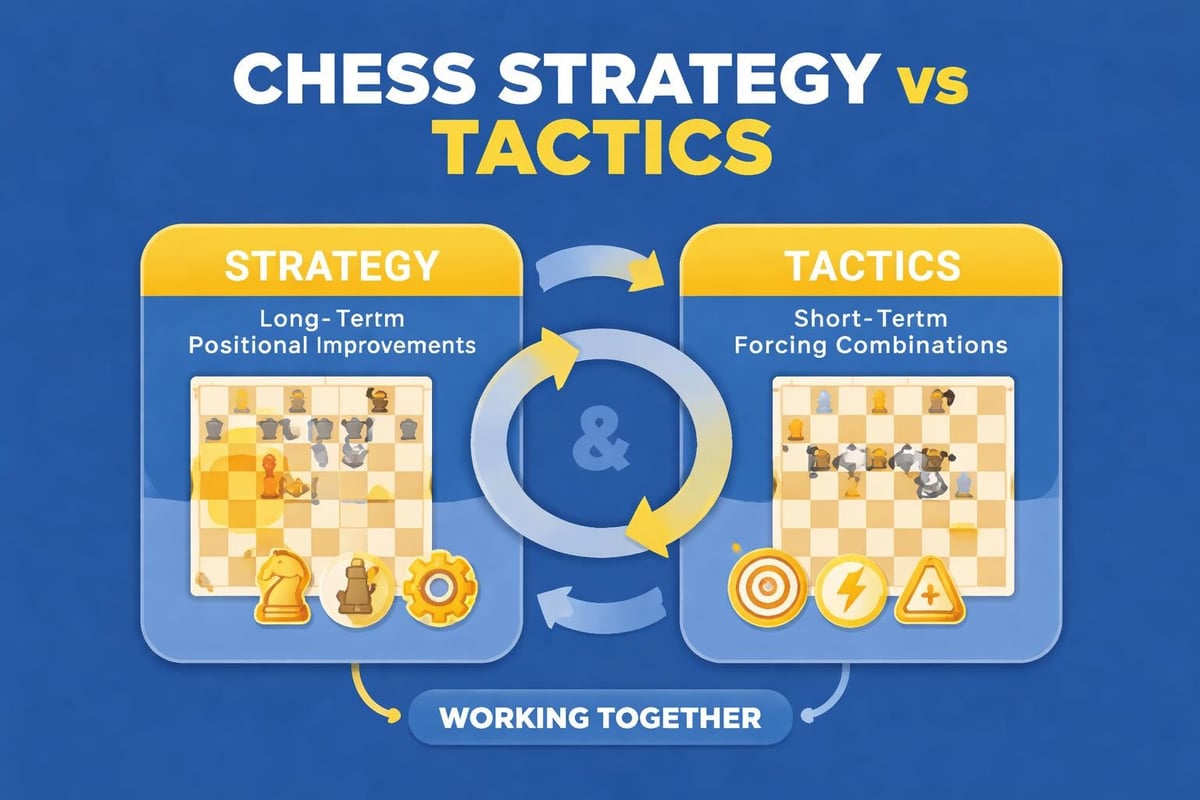
You've learned how the pieces move, you've played a few games, and now you're ready to actually understand what you're doing on the board. That's where basic chess strategy comes in. Unlike tactics, which are the sharp, immediate combinations that win material, strategy is about long-term planning and understanding what makes a position strong or weak. Think of it this way: tactics are the punches, but strategy is the footwork that gets you into position to land them. Whether you're just starting out or you've hit a plateau around 1000-1200 rating, grasping these fundamental concepts will transform how you approach every game.
What Makes Basic Chess Strategy Different From Tactics
Let's clear up a common confusion right away. Many players think chess is all about finding brilliant combinations and checkmate patterns. Whilst those are exciting, they're not the whole picture.
Strategy focuses on:
- Building better positions gradually
- Improving your worst-placed pieces
- Creating long-term advantages
- Controlling key squares and files
- Formulating plans based on pawn structures
Tactics, on the other hand, involve:
- Immediate threats and forcing moves
- Combinations that win material
- Checkmate patterns
- Forks, pins, skewers, and discoveries
The relationship between these two elements is crucial. As the saying goes, "tactics flow from a superior position." When you understand basic strategic concepts, you'll naturally create positions where tactical opportunities emerge. You're not just hoping to stumble upon a brilliant move; you're systematically building the conditions that make brilliant moves possible.
The Five Pillars of Strategic Understanding
When you're evaluating any chess position, you need a framework to organize your thinking. The five key strategic concepts provide exactly that. These aren't random principles; they're the fundamental elements that determine who's better in any given position.
Material Count and Piece Values
This is the most straightforward concept, but it's deeper than just counting pieces. Yes, you know a queen is worth more than a pawn, but do you consistently evaluate whether trading pieces helps or hurts your position?
| Piece | Relative Value | Strategic Notes |
|---|---|---|
| Pawn | 1 | More valuable when passed or central |
| Knight | 3 | Strongest in closed positions with outposts |
| Bishop | 3 | Excels in open positions with long diagonals |
| Rook | 5 | Needs open files and active placement |
| Queen | 9 | Most powerful but vulnerable to attacks |
Being up a pawn is great, but what if your pieces are completely uncoordinated? Material advantages only translate to wins when your pieces work together. Similarly, sometimes sacrificing material for a devastating attack is the right strategic choice.
Piece Activity and Coordination
A piece sitting in the corner doing nothing is practically worthless, regardless of its point value. Basic chess strategy emphasizes getting your pieces to squares where they control important areas and work together harmoniously.
Ask yourself these questions during every game:
- Which of my pieces is doing the least?
- Can I improve that piece with my next move?
- Are my rooks connected and on useful files?
- Do my pieces support each other's goals?
The best positions feature pieces that complement each other. Your bishop aims down a diagonal whilst your knight controls the squares the bishop can't reach. Your rooks double on an open file, multiplying their power. This coordination doesn't happen by accident; it requires deliberate planning.
Pawn Structure Fundamentals
Pawns are the soul of chess, and understanding pawn structures is perhaps the most important element of basic chess strategy. Why? Because unlike pieces, pawns can't move backwards. Every pawn move creates a permanent change to the position.
Strong pawn features:
- Connected pawn chains that support each other
- Passed pawns with no enemy pawns blocking their path
- Central pawns controlling key squares
Weak pawn features:
- Isolated pawns with no friendly pawns on adjacent files
- Doubled pawns stacked on the same file
- Backward pawns that can't advance safely
When you're learning various chess openings, you'll notice they create different pawn structures. The London System creates a solid but somewhat static structure, whilst the Sicilian Defense leads to asymmetrical positions with dynamic possibilities. Understanding these structures helps you formulate the right plans.

Opening Strategy: Building a Solid Foundation
The opening isn't about memorizing twenty moves deep. That's a common misconception that holds many players back. Instead, basic chess strategy in the opening revolves around a few simple principles that apply to almost every game.
Control the Center
The central four squares (d4, d5, e4, e5) are the most important territory on the board. Pieces placed in or controlling the center have maximum mobility and influence. A knight on e4 can reach eight squares, whilst a knight on a1 can only reach two. That's why nearly every sound opening aims to stake a claim in the center.
You can control the center in two main ways:
- Occupying it: Placing pawns on e4 and d4 (or e5 and d5 for Black)
- Pressuring it: Controlling central squares with pieces whilst keeping pawns flexible
Different openings take different approaches. If you're exploring openings for White, you'll find that 1.e4 immediately occupies the center, whilst systems like the English Opening apply pressure from afar.
Develop Your Pieces Efficiently
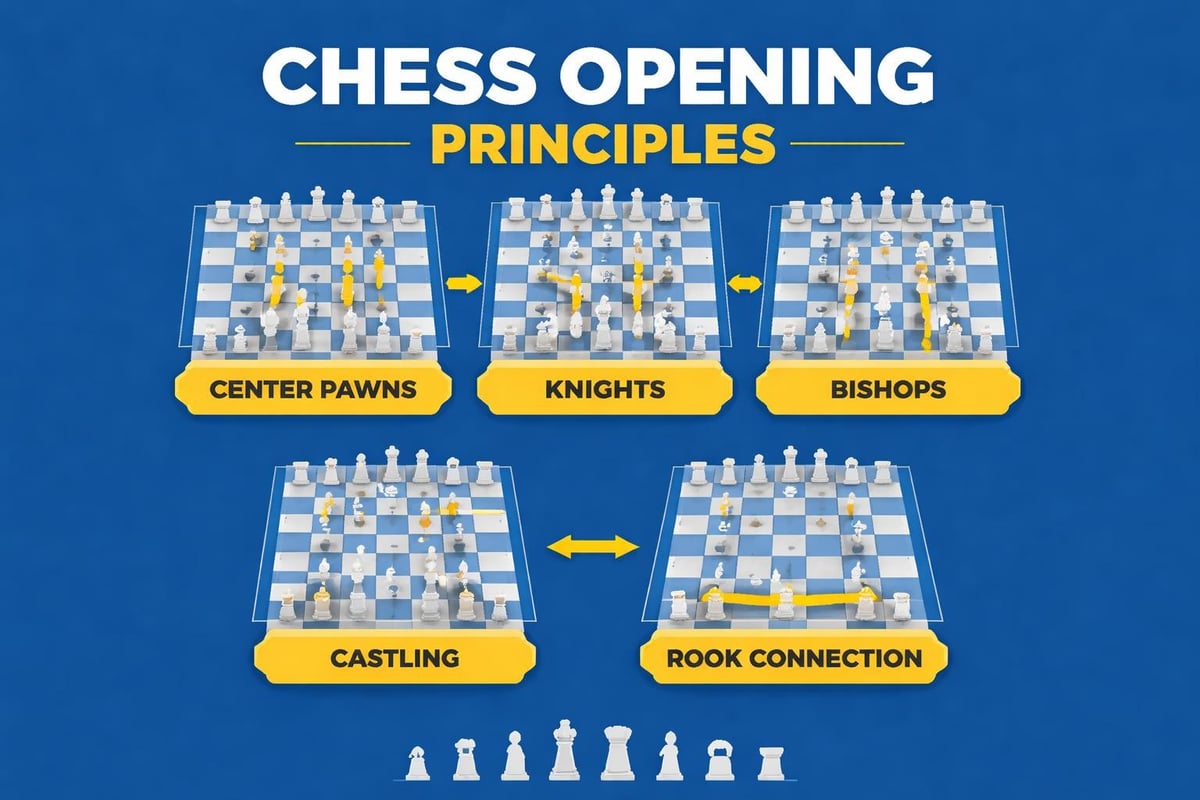
Development means bringing your pieces from their starting squares to active, useful positions. The general principle is simple: develop knights before bishops, castle early, and don't move the same piece twice in the opening unless necessary.
Development priorities:
- Control the center with pawns (1-2 moves)
- Develop knights toward the center (Nf3, Nc3)
- Develop bishops to active diagonals
- Castle to ensure king safety
- Connect rooks and activate the queen
Every move that doesn't contribute to development is potentially wasted time. Your opponent might use that time to complete their development and launch an attack whilst your pieces are still sleeping on the back rank.
King Safety Above All
Here's a sobering truth: all your strategic advantages mean nothing if your king gets checkmated. King safety is paramount, especially in the opening and middlegame. Castling is usually the most efficient way to tuck your king away whilst simultaneously activating a rook.
Most players should castle within the first ten moves. There are exceptions, but they require precise understanding. As a developing player following practical strategic advice, defaulting to early castling will save you from countless disasters.
Middlegame Strategy: Formulating and Executing Plans
The middlegame is where basic chess strategy truly shines. You've completed development, and now you need a plan. But how do you create one?
Identify Imbalances and Weaknesses
Every position has unique characteristics that suggest the right plan. Look for:
- Weak squares in your opponent's camp (especially around their king)
- Backward or isolated pawns you can attack
- Open files you can occupy with rooks
- Strong squares for your knights
- Vulnerable king positions
The strategic concepts outlined by experienced players emphasize that your plan should target your opponent's weaknesses whilst minimizing your own. If they have a weak pawn on d6, your plan might involve pressuring it with rooks and pieces until they're forced to defend passively.
The Principle of the Worst Placed Piece
This is one of the most practical strategic guidelines you'll ever learn. In almost any position, you have one piece that's doing less than the others. Finding and improving that piece is often your best plan.
Consider this approach:
- Survey all your pieces
- Identify which is least active or useful
- Calculate how to improve its position
- Execute that improvement (unless tactics intervene)
This simple method has improved the chess of countless players. It gives you a concrete plan when you're not sure what to do, and it systematically strengthens your position move by move.
Space and Piece Mobility
Space refers to the territory you control on the board. More space generally means more options for maneuvering your pieces. When you have a space advantage, you can reposition pieces easily to meet threats or create them. Your opponent, cramped and restricted, struggles to find useful moves.
| Advantage Type | How to Exploit It |
|---|---|
| Space advantage | Maneuver pieces to optimal squares, restrict opponent's options |
| Better development | Create immediate threats before opponent catches up |
| Superior pawn structure | Target opponent's weak pawns, create passed pawns |
| More active pieces | Trade pieces to highlight opponent's passivity |
Understanding these imbalances helps you recognize when to push for an attack and when to improve your position patiently. Basic chess strategy isn't always about aggression; sometimes the best plan is quiet improvement that leaves your opponent with no good options.
Endgame Strategy Fundamentals
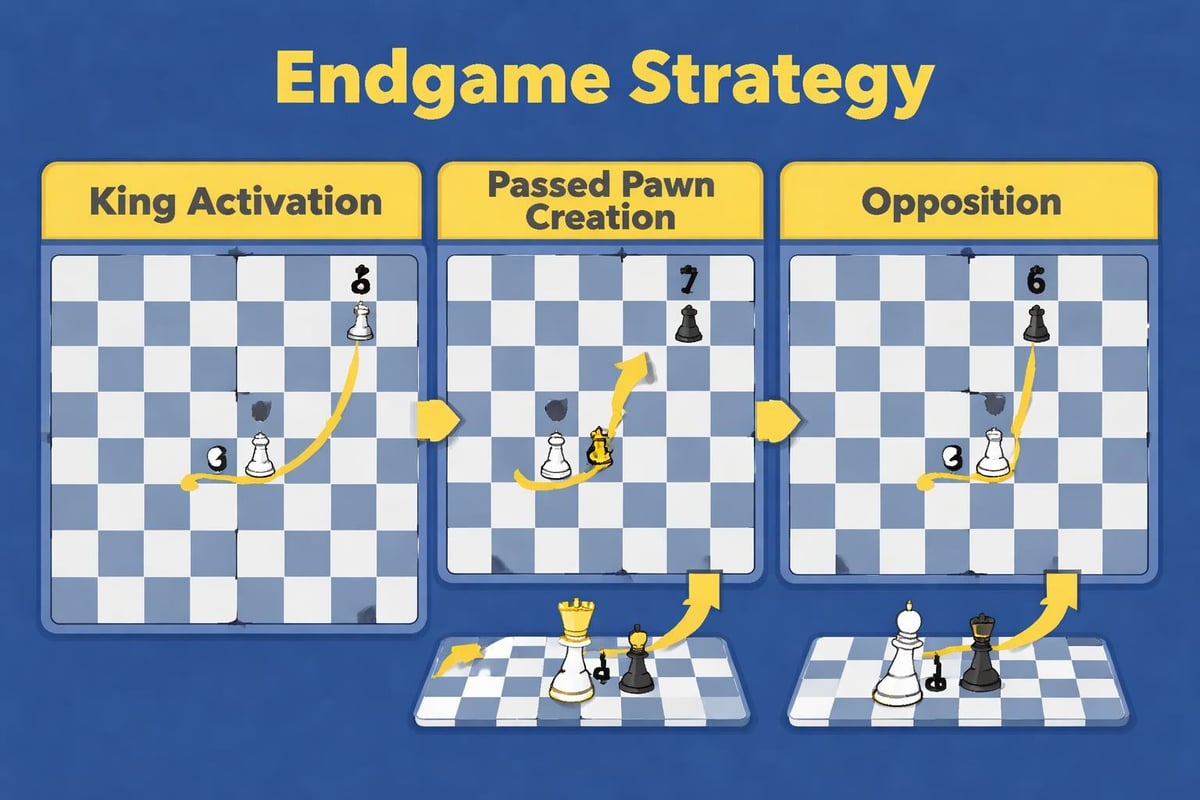
Many games reach the endgame, where the strategic principles shift somewhat. With fewer pieces on the board, the king transforms from a liability into a powerful piece. Pawn promotion becomes a concrete, achievable goal rather than a distant dream.
Activate Your King
In the opening, you hide your king. In the endgame, you activate it. The king is a strong piece worth about four points in the endgame, and using it effectively is crucial. Bring your king toward the center and toward any passed pawns, whether you're escorting your own or blockading your opponent's.
Create and Push Passed Pawns
A passed pawn is one with no enemy pawns able to stop it from promoting. These pawns are gold in the endgame. They force your opponent to dedicate pieces to stopping them, which often creates opportunities elsewhere on the board.
Passed pawn strategy includes:
- Creating passed pawns through pawn breaks
- Supporting passed pawns with your king and pieces
- Using passed pawns as decoys to infiltrate with your king
- Trading pieces to make it easier to push pawns
The Art of Opposition and Key Squares
These technical concepts might seem advanced, but they're part of basic chess strategy for endgames. Opposition means having your king directly facing the opponent's king with one square between them. The player not to move "has the opposition" and often has the advantage.
Key squares are critical squares that, if occupied by your king, guarantee pawn promotion or defense. Learning these patterns through systematic puzzle practice helps you convert advantages in the endgame rather than throwing away won positions.
Common Strategic Mistakes to Avoid
Even when you understand basic chess strategy in theory, certain mistakes trip up developing players repeatedly. Being aware of these pitfalls helps you avoid them.
Moving Without a Plan
This is the number one issue. You make a move because it seems reasonable, not because it fits into a coherent plan. Every move should either improve your position, prevent your opponent's improvement, or execute a tactical blow. Random moves simply waste time.
Ignoring Your Opponent's Threats
You've got a brilliant plan to attack on the queenside. Excellent! But your opponent is about to checkmate you in three moves. Basic chess strategy requires balance: pursue your plans whilst always checking what your opponent threatens. Calculate their most dangerous possibilities before committing to your move.
Premature Attacks
Attacking before you've completed development or established control is a recipe for disaster. Your attack runs out of steam, and suddenly you're left with poorly placed pieces and no follow-up. Build up first, attack second. As emphasized in fundamental strategic principles, patience in chess is a virtue that pays dividends.
Weakening Your Position Unnecessarily
Every pawn move creates potential weaknesses. Moving pawns around your king, creating isolated pawns, or leaving backward pawns all compromise your position. Make sure each pawn move serves a purpose. Don't weaken your structure without a concrete reason.
Developing Your Strategic Understanding
Understanding basic chess strategy conceptually is one thing; applying it consistently in your games is another. How do you bridge that gap?
Analyze Your Games
After each game, spend ten minutes reviewing what happened. Not just the tactical mistakes, but the strategic decisions. Did you fight for the center? Did you castle in time? Did you formulate clear plans, or did you drift aimlessly? This reflection embeds strategic thinking into your chess intuition.
If you're looking to improve systematically, analyzing your games is more valuable than playing ten new ones without reflection.
Study Annotated Games
Reading through master games with commentary reveals how strong players think strategically. You'll see how they identify weaknesses, formulate plans, and execute them over twenty or thirty moves. This is strategic education at its finest. The comprehensive approach outlined for beginners includes regular exposure to annotated games as a core component.
Focus on One Strategic Element at a Time
Don't try to master everything simultaneously. Spend a week focusing solely on piece activity. In every position, identify your worst piece and improve it. The next week, concentrate on pawn structure. This focused approach builds skills more effectively than trying to juggle all concepts at once.
Use Structured Learning Resources
Rather than scattered YouTube videos and random articles, consider structured resources that build on each other logically. Comprehensive opening guides help you understand the strategic ideas behind different opening systems, whilst cheat sheets provide quick reference when you need to recall key patterns.
Connecting Strategy Across Game Phases
The beauty of chess is how strategic ideas flow from opening to middlegame to endgame. A decision you make on move five shapes the position you'll have on move thirty. Understanding these connections elevates your play significantly.
For instance, choosing the Caro-Kann Classical Variation isn't just about the first ten moves. You're committing to a certain pawn structure that will influence your middlegame plans and potentially your endgame technique. The isolated queen's pawn structures, the minority attack, the bishop pair advantage... these strategic themes recur throughout the game.
Similarly, when playing as Black, understanding the best openings for Black means recognizing which strategic setups suit your style. Do you prefer solid, defensive positions that emphasize counterattacking? Or dynamic, unbalanced positions with mutual chances? Your opening choice reflects your strategic preferences.
Practical Application: A Strategic Checklist
When you sit down to play, use this mental checklist to ensure your strategic thinking stays on track:
Before the game:
- Have a clear opening repertoire with understood strategic ideas
- Know the typical plans for your chosen systems
During the opening (moves 1-10):
- Fight for central control
- Develop pieces efficiently
- Castle early
- Connect rooks
During the middlegame (moves 11-30):
- Identify the worst-placed piece and improve it
- Look for opponent's weaknesses
- Formulate a concrete plan
- Balance offense with defense
During the endgame (moves 30+):
- Activate your king
- Create passed pawns
- Calculate precisely
- Don't rush
This framework keeps basic chess strategy at the forefront of your decision-making rather than getting lost in calculation or panic.
The Role of Pattern Recognition in Strategy
As you gain experience, strategic understanding becomes increasingly automatic. You recognize a pawn structure and immediately know the typical plans. You see a bishop pair advantage and understand you should open the position. This pattern recognition is the fruit of consistent study and practice.
The positional concepts explained for beginners become second nature over time. You don't consciously think "I should target backward pawns"; you simply notice them and naturally orient your pieces toward them. This is chess mastery developing.
Working through puzzles regularly accelerates this pattern recognition. When you solve hundreds of positions involving weak squares, you start spotting them instantly in your games. The strategic plans outlined in various resources become templates you recognize and apply.
Mastering basic chess strategy transforms you from someone who merely knows how the pieces move into a true chess player who understands the game's deeper logic. By focusing on the fundamental principles-center control, piece development, king safety, pawn structure, and piece activity-you'll build a solid foundation that supports continuous improvement. Ready to accelerate your progress with clear, structured guidance? Chess Cheat Sheets provides streamlined guides, puzzles, and resources designed specifically to help you master these strategic concepts without overwhelming study, so you can start playing stronger chess immediately.


