

You've probably spent hours solving chess puzzles, only to find yourself making the same tactical mistakes in your games. What if there was a training method that could rewire your brain to spot winning combinations instantly? That's exactly what the woodpecker method promises to deliver. Named after how a woodpecker repeatedly strikes the same spot until it breaks through, this training approach has revolutionised how chess players develop their tactical vision. Instead of solving thousands of different puzzles once, you'll solve the same set repeatedly, each time faster than before, until patterns become second nature.
What Exactly Is the Woodpecker Method?
The woodpecker method is a systematic chess training technique developed by Grandmasters Axel Smith and Hans Tikkanen. Rather than working through puzzle books linearly, you solve the same collection of tactical positions multiple times over compressed timeframes.
Here's how it differs from traditional puzzle training:
- Traditional approach: Solve 3,000 different puzzles once each
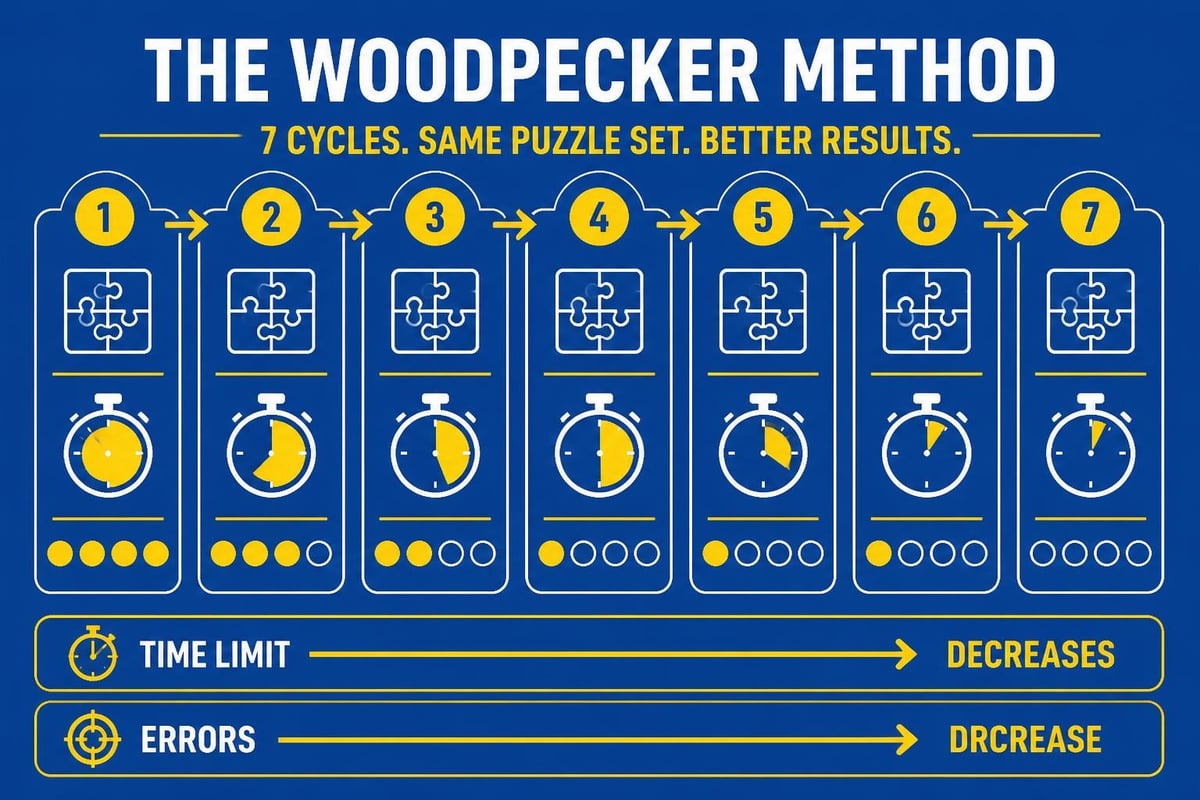
- Woodpecker method: Solve 1,000 puzzles seven times in decreasing intervals
- Focus: Speed and pattern recognition over brute-force calculation
- Goal: Automatic tactical awareness rather than conscious analysis
The method gained serious attention when Chessable explained how the woodpecker method can turbocharge tactical and strategic vision, showing that repetition creates neural pathways for instant pattern recognition. Think of it like learning to drive. At first, you consciously check mirrors, signal, and change gears. Eventually, these actions become automatic. The same transformation happens with chess tactics.
The Science Behind Repetitive Training
Why does solving the same puzzles repeatedly work better than constant variety? Your brain thrives on pattern recognition, and chess tactics follow predictable patterns. When you encounter a back-rank mate threat, a knight fork opportunity, or a pin, your mind needs to recognise these instantly rather than calculate from scratch every time.
Building Tactical Intuition
Each repetition strengthens the connection between position types and correct responses. During your first cycle through a puzzle set, you're calculating. By cycle five, you're recognising. By cycle seven, you're responding instinctively.
This matters enormously in practical play. You typically have limited time during games, and spending three minutes calculating a simple tactic means less time for critical strategic decisions. The pathway to positional understanding through the woodpecker method shows that rapid tactical recognition frees your mind to consider deeper positional factors.
Memory Consolidation
Neuroscience backs this approach. Spaced repetition, where you revisit information at increasing intervals, creates stronger long-term memories than single-exposure learning. The woodpecker method applies this principle perfectly by compressing repetitions into shorter timeframes.
| Cycle | Timeframe | Expected Accuracy | Mental State |
|---|---|---|---|
| 1 | Unlimited | 70-80% | Calculating carefully |
| 2-3 | 50% faster | 85-90% | Recognising patterns |
| 4-5 | 75% faster | 92-95% | Intuitive responses |
| 6-7 | 90% faster | 97-99% | Automatic recognition |
How to Implement the Woodpecker Method
Ready to start pecking away at your tactical weaknesses? Here's your practical roadmap for implementing this training system effectively.
Selecting Your Puzzle Set
Choose between 300 and 1,500 tactical puzzles appropriate for your current level. Don't aim too high. Puzzles should challenge you but remain solvable with effort. Most players benefit from starting with 500-700 positions.
Your puzzle collection should include:
- Diverse tactical themes: Pins, forks, skewers, discovered attacks, deflections
- Varying difficulty: Mostly at your level, some slightly harder
- Clear solutions: Positions with definite winning combinations
- Standard positions: Avoid bizarre compositions that rarely occur in games
Many players use comprehensive puzzle collections that organise positions by opening or theme, making it easier to focus on patterns relevant to your repertoire.
The Seven-Cycle Process
The woodpecker method for club players recommends this structured approach:
Cycle 1: Work through all puzzles without time pressure. Record which ones you solved correctly. This typically takes several weeks.
Cycle 2: Solve the entire set again, attempting to complete it in half the time. Focus on puzzles you missed previously.
Cycle 3: Cut your time by another 25-30%. Patterns should start feeling familiar now.
Cycles 4-7: Continue reducing time whilst maintaining 95%+ accuracy. By your final cycle, you should blast through puzzles almost automatically.
Tracking Your Progress
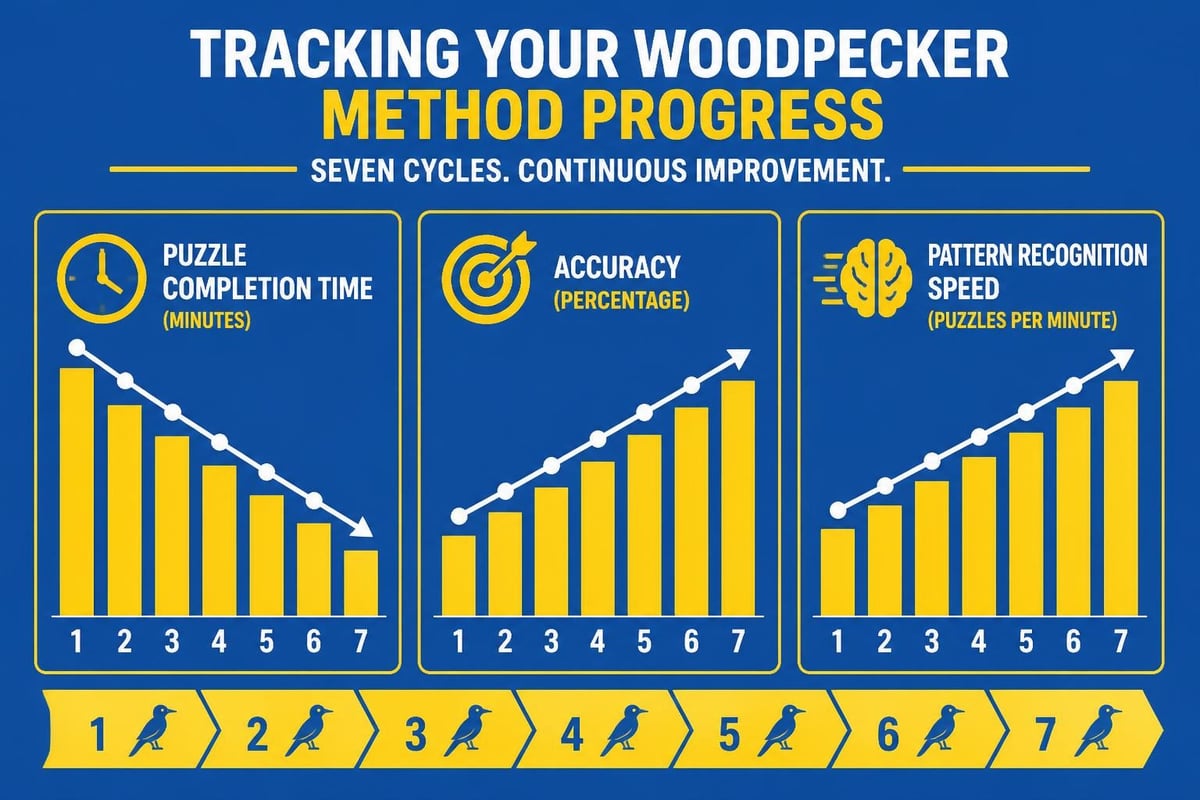
Documentation matters. Keep detailed records of:
- Time spent on each cycle
- Puzzles missed (and why)
- Improvement rate between cycles
- Patterns you struggle with most
This data reveals your tactical weaknesses. If you consistently miss knight forks, that's a clear signal to study knight tactics separately.
Common Pitfalls and How to Avoid Them
The woodpecker method looks straightforward, but several traps await the unwary practitioner. Let me walk you through the mistakes I see most often and how you can sidestep them.
Choosing Puzzles That Are Too Difficult
Nothing kills motivation faster than struggling through positions far above your level. If you're solving fewer than 60% of puzzles in your first cycle, they're too hard. Drop down a level. Building confidence and pattern recognition matters more than ego.
Rushing the First Cycle
Your initial run-through establishes your baseline understanding. Don't time yourself aggressively here. Take the necessary time to find correct solutions, even if that means 30-60 minutes per day for a month. This investment pays dividends in later cycles.
Skipping Difficult Positions
We all want to skip puzzles that frustrate us. Resist this temptation. Those difficult positions highlight precisely where your pattern recognition needs work. Mark them, but solve them.
Inconsistent Training Schedule
The woodpecker method works through compressed repetition. Solving 50 puzzles today, then nothing for a week, undermines the spaced repetition effect. Better to solve 10-15 daily than batch your training irregularly.
Here's a realistic weekly schedule:
- Monday-Friday: 30-45 minutes daily (15-25 puzzles)
- Saturday: 60-90 minutes (30-40 puzzles)
- Sunday: Rest or light review

Measuring Results and Adjusting Your Approach
How do you know if the woodpecker method is actually working for you? Results manifest in several ways, and understanding what to track helps you stay motivated through the repetitive cycles.
Performance Indicators
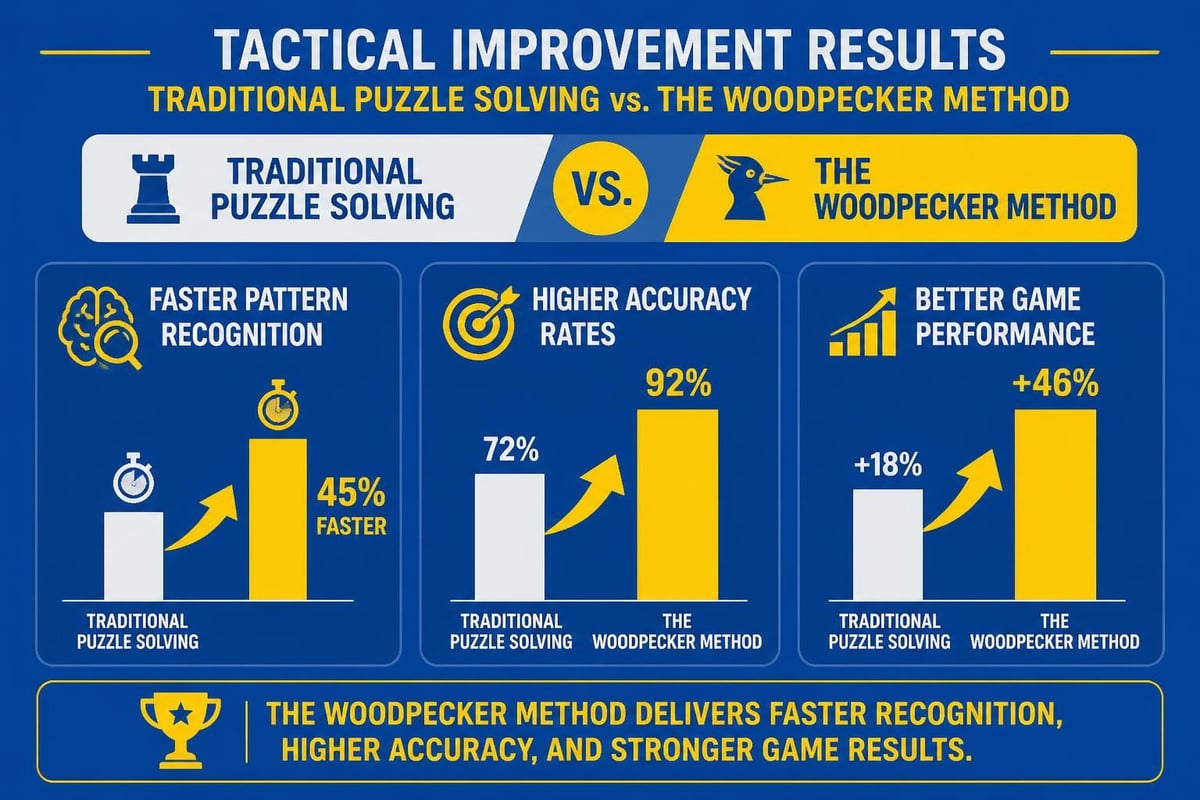
Your tactical rating on puzzle platforms provides an objective measure. Most players see their puzzle rating improve by 100-200 points after completing a full woodpecker cycle. That's significant.
More importantly, watch your game performance:
- Do you spot tactical opportunities faster during games?
- Are you avoiding blunders more consistently?
- Can you calculate variations more quickly?
- Do certain patterns jump out immediately?
Time Reduction Benchmarks
If your first cycle took 20 hours, aim for these targets:
| Cycle | Time Target | Percentage of Original |
|---|---|---|
| 2 | 10-12 hours | 50-60% |
| 3 | 6-8 hours | 30-40% |
| 4 | 4-5 hours | 20-25% |
| 5 | 3 hours | 15% |
| 6 | 2 hours | 10% |
| 7 | 1-1.5 hours | 5-7% |
These aren't rigid requirements. Some players compress faster, others need more time. What matters is consistent improvement between cycles.
Combining the Woodpecker Method with Other Training
The woodpecker method excels at tactical pattern recognition, but chess requires a broader skill set. How does this intensive repetition fit within a balanced improvement programme?
Integrating Opening Study
Tactical awareness amplifies opening knowledge. When you study chess openings, understanding the typical tactical themes in each system helps you recognise opportunities and avoid traps.
For instance, studying the Italian Game becomes more valuable when you've trained yourself to spot the tactical patterns that arise from those positions. Your opening preparation and tactical training reinforce each other.
Endgame Training
Don't neglect endgame study whilst woodpeckering through tactics. Technical endgames require different skills: calculation precision, knowledge of theoretical positions, and technique. Endgame expertise complements tactical training beautifully.
Consider this training split:
- 40% of study time: Woodpecker method cycles
- 30% of study time: Opening preparation and repertoire building
- 20% of study time: Endgame theory and practice
- 10% of study time: Game analysis and strategy
Positional Understanding
Pure tactics won't make you a complete player. Strategic concepts like pawn structures, piece activity, and long-term planning matter enormously. However, tactical sharpness provides the foundation. You can't execute strategic plans if you're missing tactical shots or falling into simple traps.
Adapting the Method for Different Skill Levels
The woodpecker method isn't one-size-fits-all. Your current playing strength determines how you should approach this training system.
Beginners (Rating Under 1200)
Start with fundamental tactical patterns: basic forks, pins, and skewers. Your puzzle set should contain 300-500 simple positions. Focus on recognising single-move tactics before progressing to complex combinations.
For beginners, chess videos explaining tactical themes complement the woodpecker method nicely. Understanding why a pattern works before drilling it creates deeper comprehension.
Intermediate Players (Rating 1200-1800)
This level benefits most dramatically from the woodpecker method. You understand basic tactics but need to recognise them faster and more reliably. Use 500-1,000 puzzles featuring two to three-move combinations.
Include positions from your typical opening repertoire. If you play the Sicilian Defense, incorporate tactical puzzles from those structures. Pattern recognition improves when you practice positions you'll actually encounter.
Advanced Players (Rating 1800+)
At higher levels, the woodpecker method helps maintain tactical sharpness and speed. Use 1,000-1,500 complex positions requiring deep calculation. Your cycles will take longer, but the precision gained in rapid pattern recognition pays off in tournament play.
Creating Your Own Woodpecker Sets
Whilst published puzzle books work perfectly well, creating personalised puzzle sets from your own games offers unique benefits. You'll drill patterns that specifically appear in your playing style and repertoire.
Mining Your Games for Tactical Positions
Review your last 50-100 games, extracting positions where:
- You missed a tactical opportunity
- Your opponent found a tactic against you
- Critical tactical moments determined the game outcome
- Complex combinations were available
These personal positions resonate more deeply because they're from your actual experience. You remember the emotional context of missing that winning combination, which strengthens the learning.
Supplementing with Opening-Specific Puzzles
If you play specific openings consistently, focus on tactical patterns from those systems. Playing the Catalan Opening? Study tactical puzzles arising from Catalan positions. The pattern recognition transfers directly to your games.
Many players create separate woodpecker sets for each opening in their repertoire. This targeted approach accelerates improvement in your actual playing positions.
Digital Tools and Resources
Modern technology makes implementing the woodpecker method easier than ever. Various platforms support this training style, though some work better than others.
Puzzle Platforms and Apps
Most online chess platforms offer puzzle collections, but few support the woodpecker methodology natively. You'll need to manually track which puzzles you've solved and organise them into repeated sets.
Dedicated woodpecker software allows you to:
- Create custom puzzle sets
- Track cycle times automatically
- Monitor accuracy across repetitions
- Identify problematic patterns
- Schedule training sessions
Physical Books vs Digital Training
The comprehensive woodpecker method guide discusses both approaches. Physical puzzle books offer distraction-free training and prevent the temptation to check hints or solutions prematurely. Digital platforms provide automatic tracking and statistical analysis.
Many successful practitioners combine both methods. They work through physical books for their first cycle, then use digital platforms for faster subsequent cycles.
Long-Term Maintenance and Progressive Development
Completing seven cycles through a puzzle set isn't the end of your woodpecker journey. How do you maintain gains and continue improving?
Refresher Cycles
Every three to six months, return to your completed puzzle sets for rapid refresher cycles. These maintenance sessions prevent pattern recognition from degrading. You should blast through the entire set in one or two sessions, confirming that patterns remain automatic.
Progressive Difficulty
After completing a full woodpecker cycle at your current level, advance to more challenging positions. This progressive overload ensures continuous improvement rather than plateauing.
A typical progression might look like:
- Set 1: Basic tactics at your current level (500 puzzles)
- Set 2: Intermediate tactics slightly above your level (700 puzzles)
- Set 3: Complex combinations challenging your calculation (1,000 puzzles)
- Set 4: Advanced positions from master games (1,200 puzzles)
Specialisation Phases
After establishing broad tactical foundations, consider specialised woodpecker sets focusing on specific weaknesses. Struggle with queen and rook endgames? Create a targeted set drilling those patterns.
Real-World Success Stories and Evidence
Does this method actually work, or is it just another chess training fad? The evidence from players worldwide suggests impressive results. Forum discussions about woodpecker method effectiveness reveal consistent patterns: players report significant tactical improvement, faster pattern recognition, and fewer blunders.
Documented Improvements
Players who complete full woodpecker cycles typically report:
- 100-200 point rating gains within three to six months
- Puzzle rating improvements of 200-300 points
- Reduced blunder rates by 30-50%
- Faster tactical calculation in time pressure situations
These results don't happen automatically. They require disciplined implementation, consistent training schedules, and honest effort through all seven cycles.
Critical Success Factors
What separates players who benefit dramatically from those who see modest gains?
Consistency: Training 30 minutes daily beats sporadic three-hour sessions
Honesty: Don't peek at solutions or skip difficult puzzles
Appropriate difficulty: Puzzles should challenge without overwhelming
Patience: Trust the process through cycles three and four when progress feels slow
Integration: Apply patterns learned during actual games
Customising for Your Schedule and Goals
Not everyone has time for intensive daily training. How can you adapt the woodpecker method to realistic time constraints whilst maintaining effectiveness?
Time-Compressed Approaches
If you can only dedicate 15-20 minutes daily, reduce your puzzle set to 300-400 positions. You'll still complete full cycles; they'll just take longer. What matters most isn't speed but consistent repetition with decreasing time intervals.
Weekend Warrior Schedules
Limited to weekend training? Structure longer sessions (90-120 minutes) on Saturdays and Sundays. Progress will be slower than daily training, but the method still works. Extend your cycle timeframes accordingly.
Tournament Preparation
Preparing for a specific tournament? Implement an accelerated woodpecker cycle in the four to six weeks beforehand. Use fewer puzzles (200-300) but complete five to six cycles rapidly. This intensive training sharpens tactical vision precisely when you need it.
The woodpecker method offers a scientifically grounded path to tactical mastery through intensive repetition and pattern recognition. By solving the same puzzles repeatedly across compressed timeframes, you transform conscious calculation into automatic tactical awareness. Whether you're struggling to spot basic combinations or looking to sharpen your already strong tactical vision, this systematic approach delivers measurable results. Complement your woodpecker training with comprehensive resources from Chess Cheat Sheets, where you'll find opening guides, puzzle collections, and endgame resources designed to accelerate your improvement without overwhelming study time. Start your tactical transformation today.


