

You've probably sat down at the chessboard, moved your first pawn, and then wondered: "What on earth do I do next?" The opening phase can feel overwhelming with its countless variations and complex theory. But here's the good news: you don't need to memorize hundreds of moves to play strong simple chess openings. In fact, the most effective approach for beginners and intermediate players is to focus on fundamental principles rather than endless memorization. Let me show you how mastering a few straightforward openings can transform your game without drowning you in theory.
Why Simple Chess Openings Matter More Than You Think
Think about it: every chess game begins with the opening. It's your foundation, your launchpad, your first impression on the board. Yet many players either wing it completely or try to memorize complex variations they don't truly understand.
Simple chess openings give you three crucial advantages:
- Confidence from the very first move
- Solid positions that don't collapse under pressure
- Time to focus on middlegame strategy instead of opening survival
When you play openings that make sense, you're not just moving pieces randomly. You're building something. And that mental clarity matters enormously, especially when you're facing an opponent who seems to know exactly what they're doing.
The beauty of focusing on simple chess openings is that they teach you universal principles. Control the center. Develop your pieces quickly. Safeguard your king. These aren't just opening ideas; they're chess wisdom that applies to every phase of the game. According to Chess.com's guide on beginner openings, mastering these fundamentals creates a solid foundation that serves you throughout your entire chess journey.
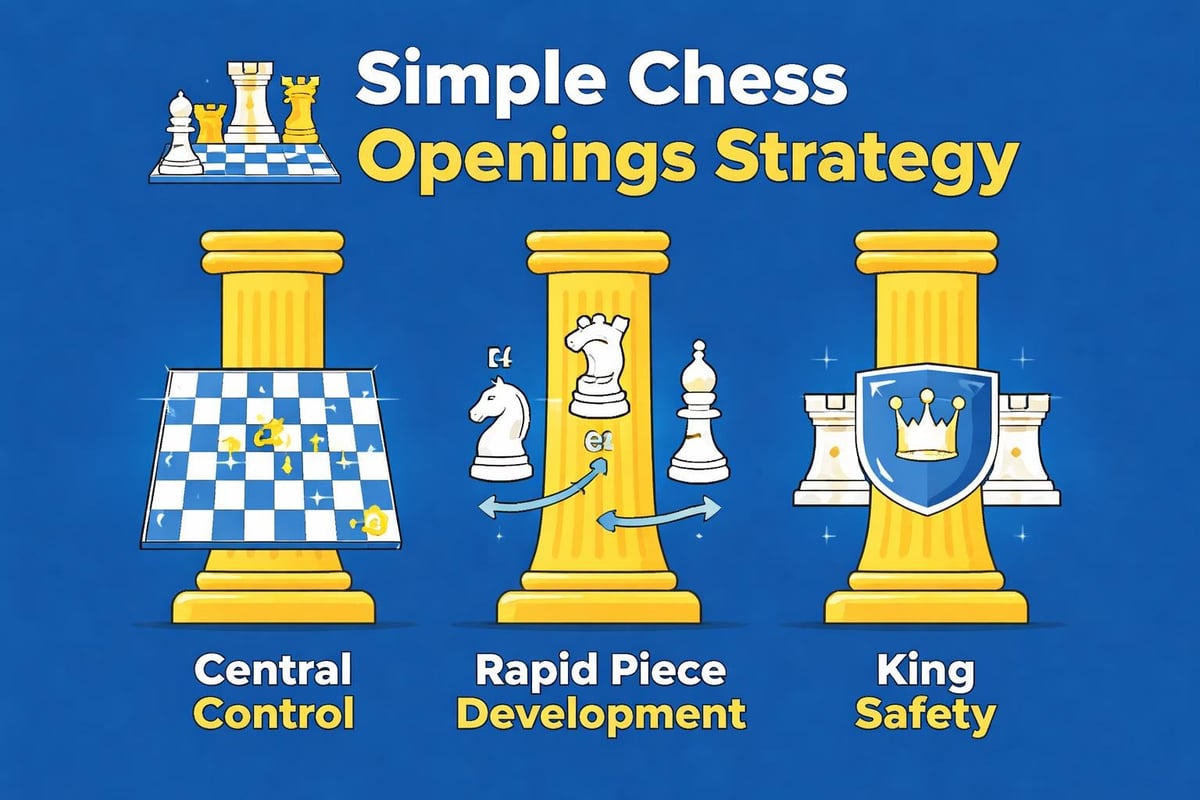
The Golden Principles Behind Every Strong Opening
Before we dive into specific openings, let's talk about what makes an opening "simple" and effective. You see, professional players might spend hours analyzing whether moving a knight to f3 or d2 is marginally better in move twelve of some obscure variation. You don't need that headache.
Control the Center
The four central squares-e4, e5, d4, and d5-are the heart of the chessboard. Pieces positioned centrally can reach more squares and exert more influence. Your opening moves should fight for control of these critical squares, either by occupying them with pawns or controlling them with pieces.
Develop Your Pieces Efficiently
Every move in the opening should ideally develop a new piece toward the center or improve your position. Moving the same piece twice (unless necessary) or pushing too many pawns wastes precious time. Think of development as mobilizing your army: you want all your soldiers ready for battle, not just a few.
Protect Your King
Castling isn't optional; it's essential. This single move accomplishes two things: it tucks your king into safety and activates your rook. Most simple chess openings for beginners prioritize quick development specifically to enable early castling.
Don't Bring Your Queen Out Early
Your queen is powerful but vulnerable. Bringing her out too early often means you'll spend subsequent moves retreating from enemy attacks whilst your opponent develops their pieces. Keep her back until your other pieces are positioned.

Top Simple Chess Openings for White
Let's get practical. When you're playing White, you have the advantage of moving first. Here are the most reliable simple chess openings that won't require years of study.
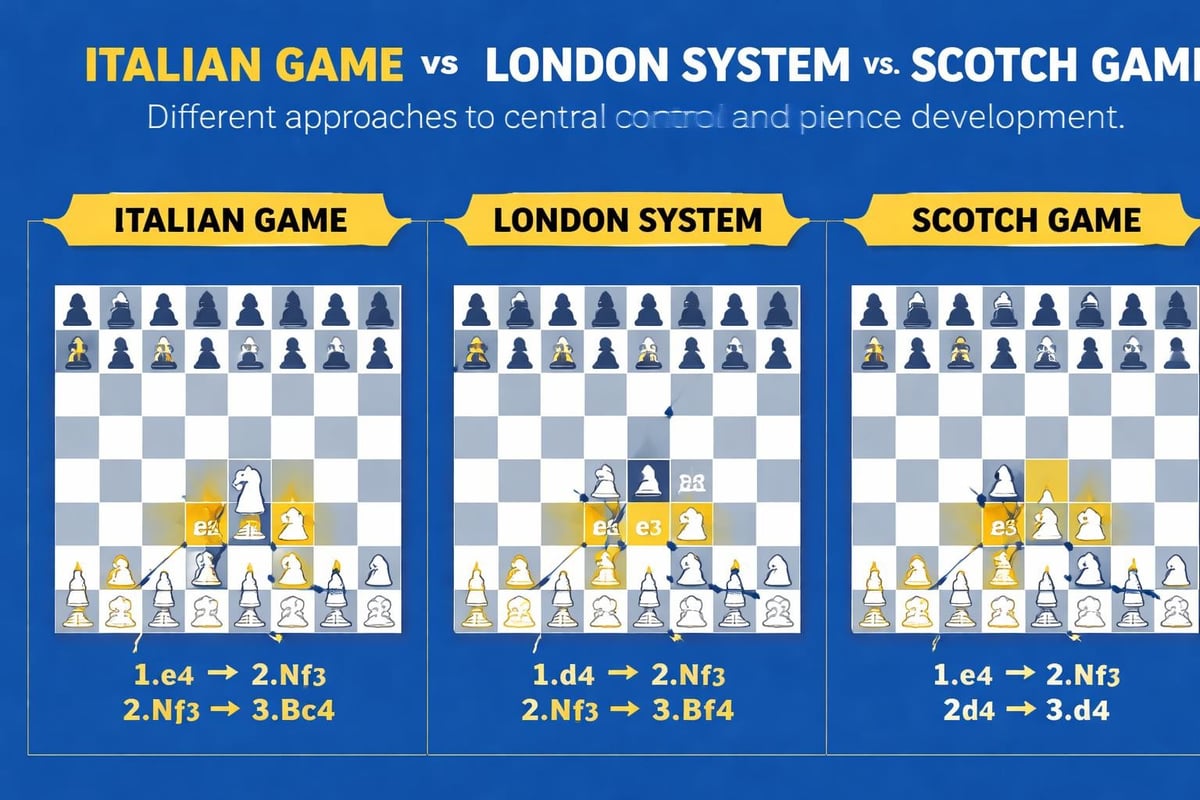
The Italian Game
Starting moves: 1.e4 e5 2.Nf3 Nc6 3.Bc4
The Italian Game is perhaps the perfect beginner opening. You're controlling the center with your e-pawn, developing knights and bishops toward active squares, and preparing to castle. The bishop on c4 eyes the vulnerable f7 square, creating immediate threats your opponent must respect.
| Advantage | Why It Matters |
|---|---|
| Natural development | Every move follows logical principles |
| Flexible plans | Multiple middlegame strategies available |
| Less theory | Fewer forced variations to memorize |
| Teaches tactics | Creates natural attacking chances |
What I love about the Italian Game is how it flows naturally. You're not contorting your pieces into weird positions or memorizing seventeen-move sequences. For a comprehensive breakdown of how this opening works, check out our Italian Game chess opening guide.
The London System
Starting moves: 1.d4 followed by 2.Bf4, 3.e3, 4.Nf3, 5.Nbd2, 6.c3
The London System has become incredibly popular in recent years, and for good reason. It's a setup-based opening, meaning you can often play the same structure regardless of what Black does. This consistency is gold for players who want reliability without memorizing countless variations.
You develop your pieces to sensible squares, maintain a solid pawn structure, and create a position that's difficult to crack. The London System exemplifies what simple chess openings should be: straightforward, solid, and effective. Our London System chess opening guide explores this opening in greater depth.
The Scotch Game
Starting moves: 1.e4 e5 2.Nf3 Nc6 3.d4
If you prefer a more direct approach, the Scotch Game delivers. By playing d4 on move three, you immediately challenge Black's central pawn and open lines for your pieces. This creates a more open game with tactical opportunities from the start.
The Scotch is slightly more forcing than the Italian Game but still follows clear principles. You can explore more about this dynamic option in our Scotch Game chess opening guide.
Reliable Simple Chess Openings for Black
Playing Black means responding to White's first move, but that doesn't mean you're just reacting. The right opening gives you an active, fighting position.
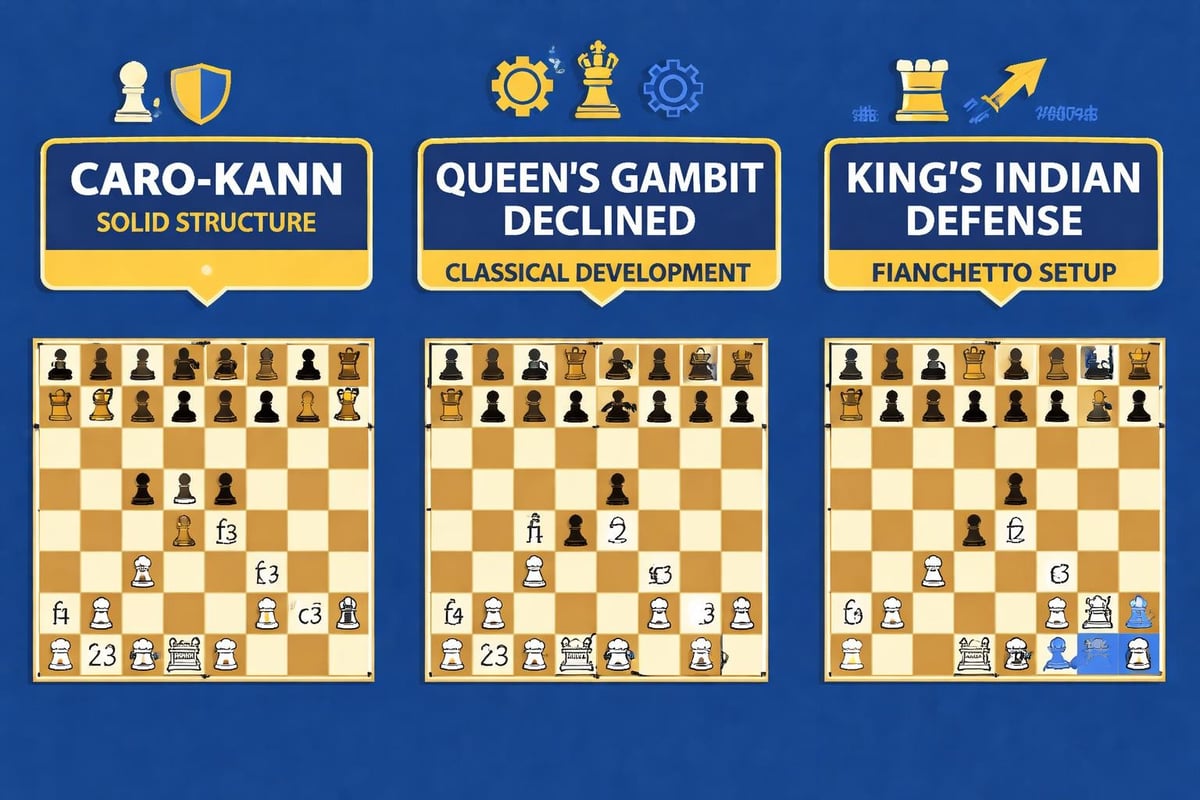
The Caro-Kann Defense
Starting moves: 1.e4 c6
When White plays 1.e4, the Caro-Kann offers a solid, reliable response. By playing c6, you prepare to challenge the center with d5 whilst keeping your position flexible. This opening is known for creating sturdy pawn structures that are difficult to break down.
Key benefits of the Caro-Kann:
- Solid pawn structure with few weaknesses
- Easy development of pieces
- Good defensive resources
- Clear plans in the middlegame
The Caro-Kann might seem slow initially, but it's rock-solid. You're building a fortress that gives your opponent few targets to attack. Learn how to avoid common pitfalls in our guide on 5 common Caro-Kann mistakes and how to fix them.
The French Defense
Starting moves: 1.e4 e6
The French Defense is another solid option against 1.e4. You prepare d5 whilst immediately controlling key central squares. Yes, your light-squared bishop gets temporarily blocked, but you'll find ways to activate it later.
This opening leads to positions with clear pawn chains and strategic battles. It's slightly more complex than some simple chess openings, but the core ideas remain straightforward: challenge the center, develop pieces, and create counterplay.
The Scandinavian Defense
Starting moves: 1.e4 d5
Talk about direct! The Scandinavian immediately challenges White's e4 pawn on the first move. After 2.exd5, Black typically recaptures with the queen (2...Qxd5) and then repositions it after White attacks with 3.Nc3.
Whilst bringing the queen out early breaks our earlier guideline, the Scandinavian is an exception because Black has a concrete plan. The queen won't stay in the center; she'll retreat to a safe square whilst Black develops normally. For detailed analysis, see our Scandinavian Defense chess opening guide.
Universal Openings Against 1.d4
When White opens with 1.d4 instead of 1.e4, you need a different set of responses. Here are simple chess openings that work beautifully.
The Queen's Gambit Declined
Starting moves: 1.d4 d5 2.c4 e6
Despite its name, the Queen's Gambit isn't actually a gambit-Black doesn't have to give up material. By declining with 2...e6, you maintain a pawn in the center and prepare to develop your pieces harmoniously.
This opening creates classical pawn structures and strategic battles. Both sides develop naturally, and the resulting positions offer rich middlegame play without requiring extensive theoretical knowledge. Our Queen's Gambit chess opening guide provides comprehensive coverage of this classic opening.
The King's Indian Defense
Starting moves: 1.d4 Nf6 2.c4 g6
The King's Indian takes a different approach: you fianchetto your kingside bishop (developing it to g7 via g6) and allow White to build a large pawn center. Then you attack that center with moves like e5 and f5.
This is a fighting defense that leads to dynamic positions. Whilst it requires understanding some strategic themes, the initial setup is simple: develop your kingside pieces, fianchetto your bishop, castle, and prepare counterattacks. For more details, explore our King's Indian Defense chess opening guide.
Common Mistakes to Avoid in Simple Chess Openings
Even with straightforward openings, certain errors can undermine your position before the middlegame begins. Let's talk about what to watch out for.
Moving Too Many Pawns
Pawns don't retreat. Every pawn move creates permanent changes to your position. Moving excessive pawns in the opening (especially wing pawns like a, b, g, or h) wastes time that should be spent developing pieces.
Better approach: Move only the pawns necessary to develop your pieces and control the center. Typically, that means e4/e5 or d4/d5, perhaps c3 or c6 for support, and maybe a fianchetto with g3/g6. That's it for the opening.
Neglecting King Safety
I've seen countless games where players develop pieces beautifully but forget to castle. Then their opponent launches an attack down the center or along open files, and suddenly the exposed king becomes a fatal weakness.
Castle early, usually within the first ten moves. According to basic chess opening guides, getting your king to safety should be a priority in virtually every opening.
Developing Pieces to Poor Squares
Not all development is created equal. Developing a knight to the rim (the edge of the board) or blocking your own pawns creates problems. Your pieces should occupy squares where they control the center and coordinate with each other.
Ignoring Your Opponent's Threats
Simple chess openings don't mean ignoring what your opponent is doing. If they're creating a genuine threat-attacking a piece, threatening checkmate, or preparing a devastating tactic-you must respond. Development is important, but not at the cost of walking into disaster.
Building Your Opening Repertoire Step by Step
You might be wondering: "How many openings should I learn?" It's a fair question, and the answer might surprise you.
Start with just two or three openings:
- One opening as White (try the Italian Game or London System)
- One response to 1.e4 as Black (Caro-Kann or French Defense)
- One response to 1.d4 as Black (Queen's Gambit Declined or King's Indian)
That's genuinely enough. Master these before adding more. Playing three openings deeply is far better than playing ten openings superficially.
How to Actually Learn an Opening
Learning simple chess openings isn't about memorizing moves; it's about understanding ideas. Here's my recommended process:
| Step | Focus | Method |
|---|---|---|
| 1. Learn the setup | First 4-5 moves | Play them on a board repeatedly |
| 2. Understand the ideas | Why these moves? | Study annotated games |
| 3. Practice the middlegame | Plans after move 10 | Play practice games |
| 4. Review your games | Find your mistakes | Analyze with a coach or engine |
For additional learning resources, check out our collection of best chess books on openings, which can supplement your practical experience.
Using Cheat Sheets Effectively
Here's where having quick-reference materials becomes invaluable. When you're starting with a new opening, having a one-page cheat sheet showing the key moves, typical positions, and common plans helps tremendously.
You don't need to memorize everything immediately. Keep your cheat sheet nearby during casual games or when studying. Over time, the patterns will become second nature, and you'll find yourself playing the moves automatically because they make sense, not because you've memorized them.
Practice Strategies That Actually Work
Knowing simple chess openings in theory and playing them confidently in games are two different things. How do you bridge that gap?
Play Lots of Games
There's no substitute for experience. Play your chosen openings repeatedly, even when you make mistakes. Each game teaches you something about the positions that arise, the tactics to watch for, and the plans that work.
Consider focusing on one opening exclusively for a month. Play it in every game, regardless of the result. This concentrated practice builds genuine understanding much faster than switching openings constantly.
Study Master Games
Watch how strong players handle your chosen openings. You don't need to understand every subtle nuance, but observe the general plans they employ. Where do they place their pieces? When do they break in the center? How do they coordinate their pieces for attack or defense?
Solve Tactical Puzzles
Many chess resources offer position-specific puzzles. Solving tactics from your opening helps you recognize patterns and combinations that arise naturally from your chosen systems.
Review and Adjust
After each game, spend a few minutes reviewing the opening phase. Did you follow the principles? Were there better moves available? Did you understand why you made each move, or were you just following memorized patterns?
Advanced Concepts Made Simple
Once you're comfortable with the basics of your simple chess openings, you can start understanding slightly more nuanced ideas without getting overwhelmed.
Pawn Breaks
A pawn break is when you push a pawn to challenge your opponent's pawn structure, typically to open lines or create weaknesses. In the Italian Game, d4 is often a key pawn break. In the King's Indian Defense, Black typically plays e5 or f5.
Understanding when and how to execute these breaks transforms your opening play from mechanical to dynamic.
Transpositions
Sometimes different move orders lead to the same position. This is called transposition. For instance, certain move orders in the English Opening can transpose into positions you know from other openings.
Don't worry too much about transpositions initially. As you gain experience, you'll start recognizing familiar positions even when you arrive at them via different routes.
Flexibility Within Structure
Simple chess openings provide a framework, not a straitjacket. Once you understand the principles, you can deviate when the position demands it. If your opponent plays an unusual move, respond based on principles (develop pieces, control center, safeguard king) rather than blindly following your planned sequence.
Adapting to Different Playing Styles
Your opponents won't always cooperate with your opening plans. Some will play aggressive gambits, others will build slow, strategic positions. How do you handle this variety whilst sticking to simple chess openings?
Against aggressive opponents:
- Stay calm and don't panic
- Defend accurately but look for counterattacking chances
- Remember that many aggressive attempts involve sacrificing material or weakening the king
- If you've developed properly, you'll have defensive resources
Against passive opponents:
- Build your position methodically
- Improve your piece placement gradually
- Don't rush to attack; wait for the right moment
- Create weaknesses in their position before striking
The beauty of solid simple chess openings is they perform well against various styles. You're not relying on your opponent making mistakes; you're building genuinely good positions.
Your Path Forward with Simple Chess Openings
You've now got the knowledge to build a practical, effective opening repertoire. The key is starting simple and going deep rather than broad. Choose one or two openings that appeal to you, study them thoroughly, and play them consistently.
Remember that every grandmaster started exactly where you are now: with basic openings, fundamental principles, and a willingness to learn from mistakes. The difference between struggling players and improving players isn't natural talent; it's deliberate practice with the right approach.
As you gain confidence, you'll naturally expand your repertoire and deepen your understanding. But that foundation-those simple chess openings built on sound principles-will serve you for your entire chess career. Whether you're playing casual games with friends or competing in tournaments, solid opening play gives you the platform to showcase your skills in the middlegame and endgame.
For more insights into building a strong opening foundation, explore resources on most common chess openings to see how your chosen systems fit into the broader landscape of chess theory.
Mastering simple chess openings doesn't require endless memorization or years of study-it requires understanding core principles and applying them consistently. Whether you choose the Italian Game, the Caro-Kann Defense, or the London System, focus on development, central control, and king safety. Chess Cheat Sheets provides streamlined guides and quick-reference materials specifically designed to help you master your chosen openings without overwhelming complexity, giving you the confidence to start every game with a solid foundation and clear plan.


