

The english opening chess system has transformed how players approach the game from White's very first move. Starting with 1.c4, this opening might seem modest at first glance, but don't let that fool you. It's been the weapon of choice for world champions and club players alike, offering flexibility that few openings can match. Unlike the immediate central occupation you see with 1.e4 or 1.d4, this opening takes a more nuanced approach, controlling the centre from afar whilst keeping your options delightfully open.

What Makes English Opening Chess Special
You've probably noticed that most chess openings follow predictable patterns. The English breaks that mould entirely. When you play 1.c4, you're immediately setting yourself apart from the crowd whilst embracing hypermodern chess principles.
The beauty of this system lies in its strategic depth rather than tactical fireworks. You're not threatening immediate mayhem on the board. Instead, you're building something more substantial: a position where your pieces coordinate beautifully, your central control remains firm, and your opponent must navigate without clear-cut equalising lines.
The History Behind the Opening
The English Opening earned its name from Howard Staunton, the strongest English player of the 19th century, who championed 1.c4 during his 1843 match against Saint-Amant. Though it existed earlier, Staunton's advocacy brought it prominence.
But here's where it gets interesting: the opening didn't achieve true respect until the hypermodern revolution of the 1920s. Players like Aron Nimzowitsch and Richard Réti demonstrated that you could control the centre with pieces rather than pawns. Suddenly, 1.c4 wasn't quirky anymore; it was sophisticated.
Core Strategic Principles
Understanding english opening chess requires shifting your mindset from direct confrontation to strategic manoeuvring. Let's explore what makes this opening tick.
Central Control Without Central Pawns
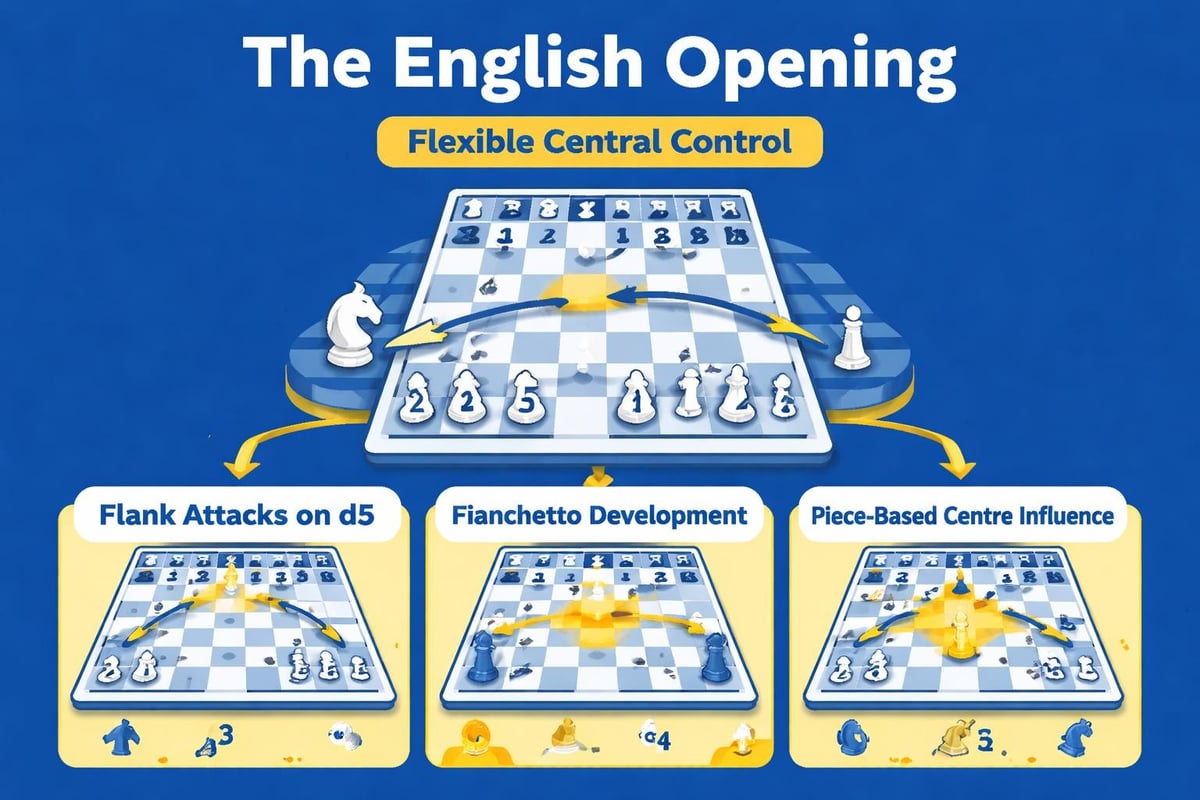
Your c4 pawn attacks the d5 square from the flank. This creates immediate tension because Black must decide whether to challenge your central influence with ...e5, mirror your setup with ...c5, or establish their own centre with ...d5.
Key strategic concepts include:
- Fianchetto Development: Developing your kingside bishop to g2 creates long-range pressure on the centre and queenside
- Flexible Piece Placement: Your knights might go to f3 and c3, or perhaps e2 and c3, depending on Black's setup
- Pawn Structure Fluidity: The position can transpose into various structures, from Sicilian Reversed to Queen's Gambit formations
Common Pawn Structures
Different pawn formations emerge from english opening chess, and recognising these patterns helps you navigate the middlegame confidently.
| Structure Type | White Formation | Black Formation | Key Features |
|---|---|---|---|
| Symmetrical | c4, Nf3, g3 | c5, Nf6, g6 | Balanced, strategic complexity |
| Reversed Sicilian | c4, Nc3, g3 | e5, Nc6 | White plays Sicilian with tempo |
| Botvinnik System | c4, e4, d3 | c5, e5 | Closed centre, kingside play |
| Hedgehog | c4, e4, d4 | e6, b6, d6 | Black stays flexible and compact |
Main Variations You Need to Know
The opening branches into several major systems, each with distinct characteristics and strategic goals. Understanding these helps you choose which path suits your style.
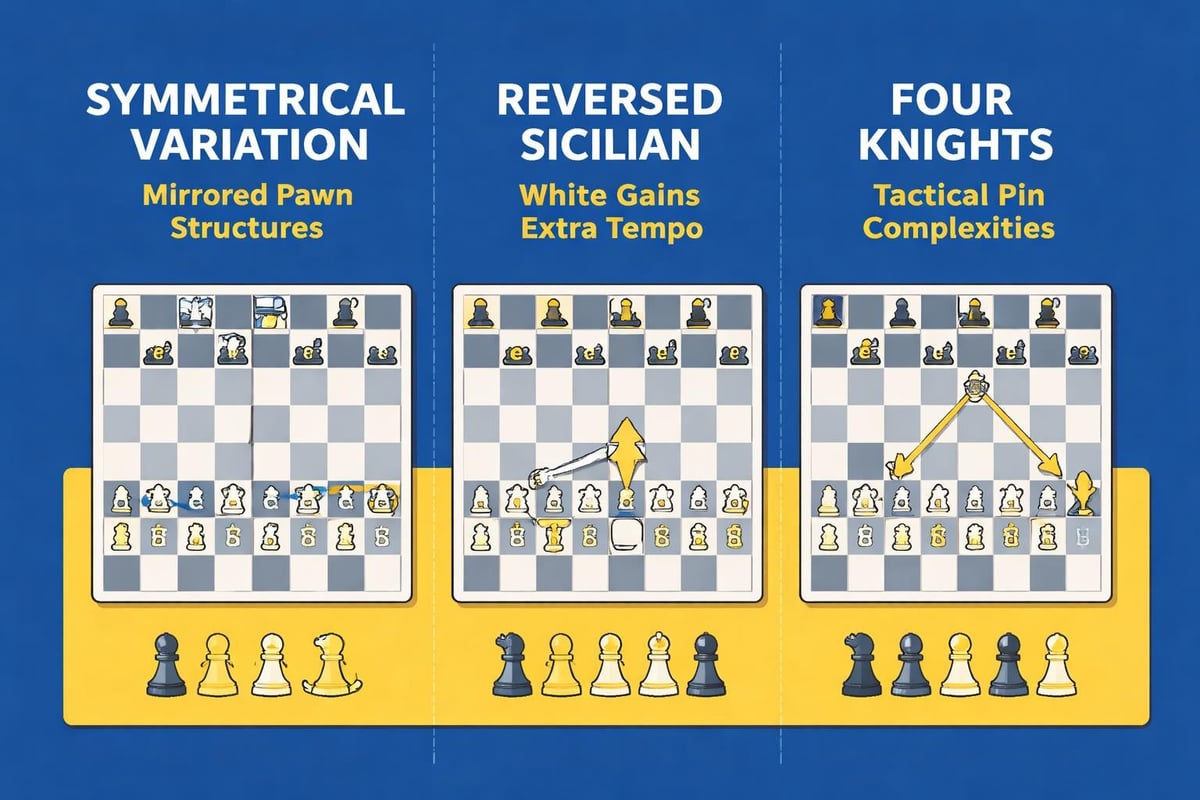
Symmetrical Variation (1.c4 c5)
When Black mirrors your opening move, you enter the Symmetrical English. This creates a fascinating strategic battle where small advantages matter enormously.
After 1.c4 c5 2.Nf3 Nf6 3.g3 g6, both sides develop similarly. Your extra tempo (moving first) provides slight pressure, but Black's solid structure makes breaking through challenging.
Critical positions arise after:
- 1.c4 c5 2.Nf3 Nc6 3.d4 (breaking symmetry immediately)
- 1.c4 c5 2.Nf3 Nf6 3.Nc3 (maintaining symmetry, building slowly)
- 1.c4 c5 2.g3 (ultra-flexible, keeping all options)
Reversed Sicilian (1.c4 e5)
Here's where things get delicious for White players. You're essentially playing the Sicilian Defence, but with an extra tempo since you're White. Chess.com's analysis highlights this as one of the opening's strongest weapons.
The typical move order runs: 1.c4 e5 2.Nc3 Nf6 3.Nf3 Nc6 4.g3
You'll often fianchetto your kingside bishop whilst Black pushes forward with ...d5 or maintains their central pawn with ...Bb4 pinning your knight.
Four Knights Variation
This solid system develops sensibly: 1.c4 e5 2.Nc3 Nf6 3.Nf3 Nc6 4.g3 Bb4
Black pins your knight immediately, creating tactical tension. You can respond with several moves, but 5.Bg2 followed by 6.0-0 remains most popular, accepting the doubled pawns after Bxc3.
The resulting positions feature:
- Improved piece activity for White despite doubled pawns
- Potential queenside pawn majority for White
- Dynamic imbalances favouring aggressive play
Practical Tips for Playing English Opening Chess
Moving from theory to practice requires understanding not just the moves, but the thought processes behind them. Let's make this practical.
Opening Move Order Tricks
Your move order matters enormously in english opening chess because it determines which structures you'll reach.
Starting with 1.c4 keeps maximum flexibility. You haven't committed to specific pawn structures yet. However, 1.Nf3 followed by 2.c4 might be equally effective, potentially avoiding certain Black systems whilst reaching similar positions.
Consider these move order benefits:
- 1.c4 first: Prevents Black's ...e5 followed by ...d5 setups that might equalise quickly
- 1.Nf3 first: Avoids the Symmetrical English if that concerns you
- Early g3: Signals fianchetto intentions, discouraging certain Black responses
Choosing Your Setup
You've got options galore, which is precisely why this opening suits creative players. But how do you choose?
Against solid players who avoid risks, the Symmetrical Variation offers long strategic battles where technique matters. You'll gradually outplay opponents who don't understand the nuances.
Facing aggressive opponents? The Reversed Sicilian punishes overly ambitious play. Your extra tempo means their typical attacking plans arrive a move too slow.
Common Mistakes to Avoid
Even experienced players stumble with this opening. Here's what trips people up:
Moving your queenside pieces before completing kingside development creates coordination issues. Your bishop on c1 needs to reach g2 (or b2 in some lines) before you commit to queenside action.
Allowing Black to seize space with ...d5 and ...e5 without challenging it surrenders your opening advantage. You must respond decisively when Black tries establishing a broad centre.
Playing too passively misses the point entirely. The English isn't passive; it's patient. There's a crucial difference. You're building pressure systematically, not avoiding confrontation.

Studying the English Opening Effectively
You're probably wondering how to actually learn this complex opening without drowning in variations. Let's structure your study efficiently.
Building Your Foundation
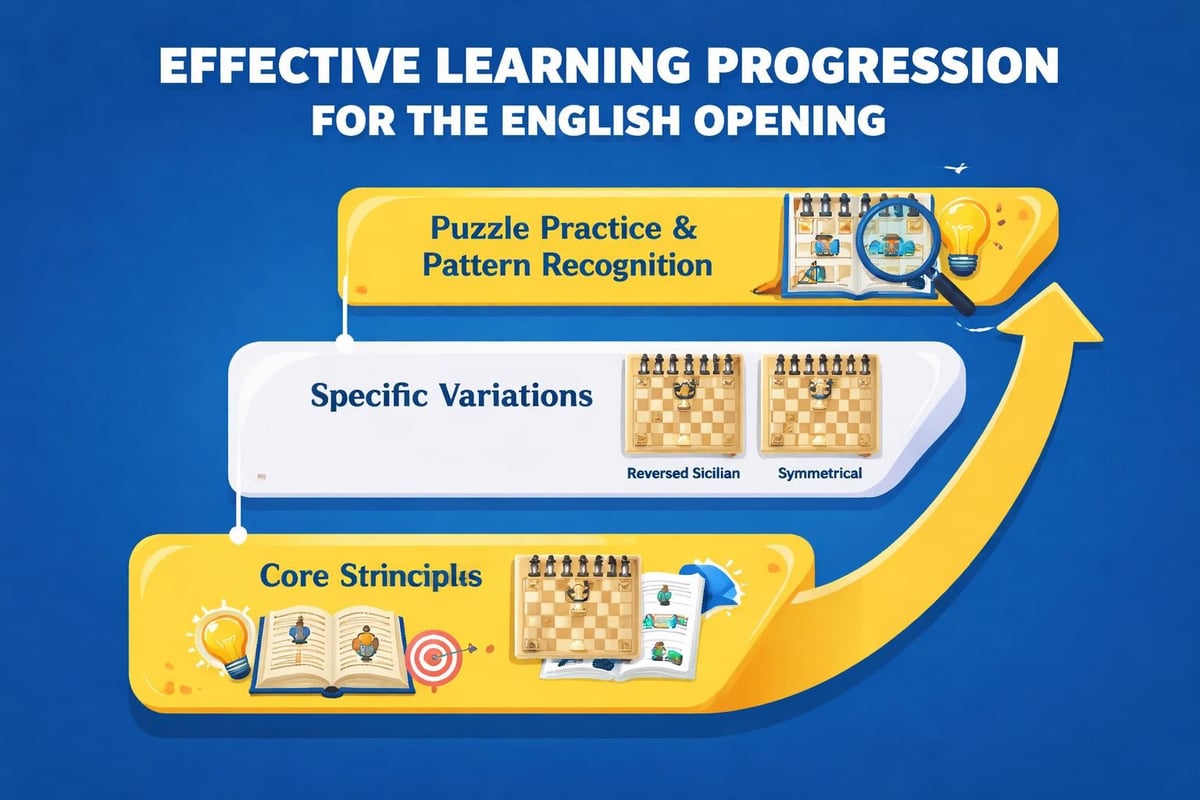
Start with the basic principles rather than memorising 20 moves deep. Understand why White plays c4, what you're trying to achieve, and how typical plans unfold.
The resources available for studying chess openings can seem overwhelming, but focus initially on understanding three variations deeply rather than ten superficially.
Recommended study sequence:
- Learn the Reversed Sicilian structure (most forcing for White)
- Study the Symmetrical Variation (most common response)
- Explore the Four Knights system (good tactical practice)
- Branch into minor variations as needed
Practice Through Puzzles
Theory means nothing without practical pattern recognition. Working through positions from english opening chess helps you recognise typical tactics and strategic motifs.
The 1000 English Opening chess puzzles provide excellent pattern training, exposing you to the tactical themes that emerge from these structures.
Analysing Master Games
Watching how strong players handle english opening chess reveals subtleties that theory books miss. Bobby Fischer occasionally employed it, whilst more recent adherents like Vladimir Kramnik and Magnus Carlsen have demonstrated its continuing viability at the highest levels.
Historical perspectives on the English Opening show how understanding has evolved, giving you insight into both classical and modern approaches.
Transpositions and Their Implications
Here's something that confuses many players: the English frequently transposes into other openings. Is that good or bad? It depends on your preparation.
Common Transposition Patterns
Your 1.c4 might become:
- A Queen's Gambit after 1.c4 e6 2.Nc3 d5 3.d4
- A King's Indian setup after 1.c4 Nf6 2.Nc3 g6 3.g3 Bg7 4.Bg2 0-0 5.Nf3 d6
- A Catalan structure after 1.c4 Nf6 2.g3 e6 3.Bg2 d5 4.Nf3
Understanding these connections deepens your positional understanding across multiple openings. You're not just learning one system; you're developing comprehensive chess knowledge.
When to Avoid Transpositions
Sometimes maintaining pure English positions serves you better, especially when you've prepared specific lines but your opponent knows Queen's Gambit theory better than English-specific variations.
Playing 2.Nc3 instead of 2.Nf3 often prevents many transpositions, keeping the game in territory where English specialists hold advantages over players who've prepared mainstream openings.
Modern Developments in 2026
Chess opening theory never stands still, and english opening chess continues evolving through engine analysis and creative players finding new ideas.
Engine-Approved Novelties
Computer analysis has refined our understanding of which positions favour White and by how much. Certain lines previously considered equal now show slight White advantages when played precisely.
The rise of neural network engines like Leela Chess Zero has particularly impacted English theory, as these engines excel at long-term positional compensation rather than immediate tactical justification.
Practical Results at Top Level
Elite players continue incorporating the English into their repertoires. It appears regularly in super-tournaments, often surprising opponents who've prepared extensively for 1.e4 or 1.d4.
The opening's flexibility makes it excellent for avoiding preparation, whilst its strategic richness ensures skilled players maintain winning chances against any opposition.
Tailoring the English to Your Style
Not every variation suits every player. Your personality and preferences should guide which English systems you emphasise.
For Positional Players
The Symmetrical Variation rewards patient maneuvering and subtle improvements to your position. Games often extend beyond move 40 before decisive advantages emerge.
If you enjoy studying strategic chess resources, building comprehensive understanding of typical plans and pawn structures, these positions suit you perfectly.
For Dynamic Players
The Reversed Sicilian offers more immediate confrontation. Tactics emerge earlier, and aggressive play finds more opportunities.
Combining the English with sharp systems in your complete opening repertoire creates versatility that opponents struggle to predict and prepare against.
For Tournament Players
Having the English as your primary 1.c4 weapon provides excellent practical benefits. You control which structures arise, making your preparation efficient whilst forcing opponents into less familiar territory.
Many players spend 80% of their opening study on defences against 1.e4 and 1.d4. By playing 1.c4, you immediately sidestep huge chunks of their preparation.
Building Your Complete Repertoire
The English works beautifully as part of a broader opening system. How you integrate it with your other openings matters.
| Your Style | Primary Opening | English Usage | Benefits |
|---|---|---|---|
| Universal Player | 1.c4 always | Main weapon | Maximum flexibility, minimal memorisation |
| Dual System | 1.e4 or 1.c4 | Alternative weapon | Variety, surprises opponents |
| Positional Focus | 1.d4 and 1.c4 | Related systems | Consistent themes, easier to master |
Consider how your opening choices complement each other rather than creating conflicting positions requiring different skills.
Resources for Continued Learning
You've got the foundation, but where should you go deeper? Several excellent resources exist specifically for english opening chess enthusiasts.
Quality instruction matters more than quantity of study. Spending time with comprehensive chess books that explain strategic concepts thoroughly beats skimming dozens of superficial sources.
Online databases let you explore games by strong players, whilst video content provides dynamic explanations that make complex ideas accessible. The key is active learning rather than passive consumption.
The English Opening offers a rich, strategic approach to chess that rewards study whilst remaining accessible to improving players. Whether you're drawn to its flexibility, its strategic depth, or its practical benefits in avoiding opponent preparation, mastering this system enhances your overall chess understanding. Ready to incorporate the English into your repertoire? Chess Cheat Sheets provides comprehensive guides, puzzles, and resources specifically designed to help you master chess openings like the English efficiently, building your confidence without overwhelming you with unnecessary complexity.


