

You've probably sat down to play chess and wondered: what should my first move be? It's a question every player asks themselves, whether you've just learned how the pieces move or you've been playing for years. The truth is, good opening moves in chess aren't about memorizing endless variations-they're about understanding core principles that guide your early game decisions. This guide will walk you through the essential moves, strategies, and concepts that'll help you start every game with confidence and purpose.
Why Your First Moves Matter More Than You Think
The opening phase sets the tone for everything that follows. Make strong moves early, and you'll find yourself with active pieces, a safe king, and promising attacking chances. Start poorly, and you'll spend the middlegame trying to untangle your position whilst your opponent dictates the action.
Think of the opening like laying the foundation for a house. You wouldn't start building walls before ensuring the base is solid, would you? The same logic applies here. Good opening moves in chess establish control, develop your forces, and prepare your position for the coming battle.
The Three Golden Rules
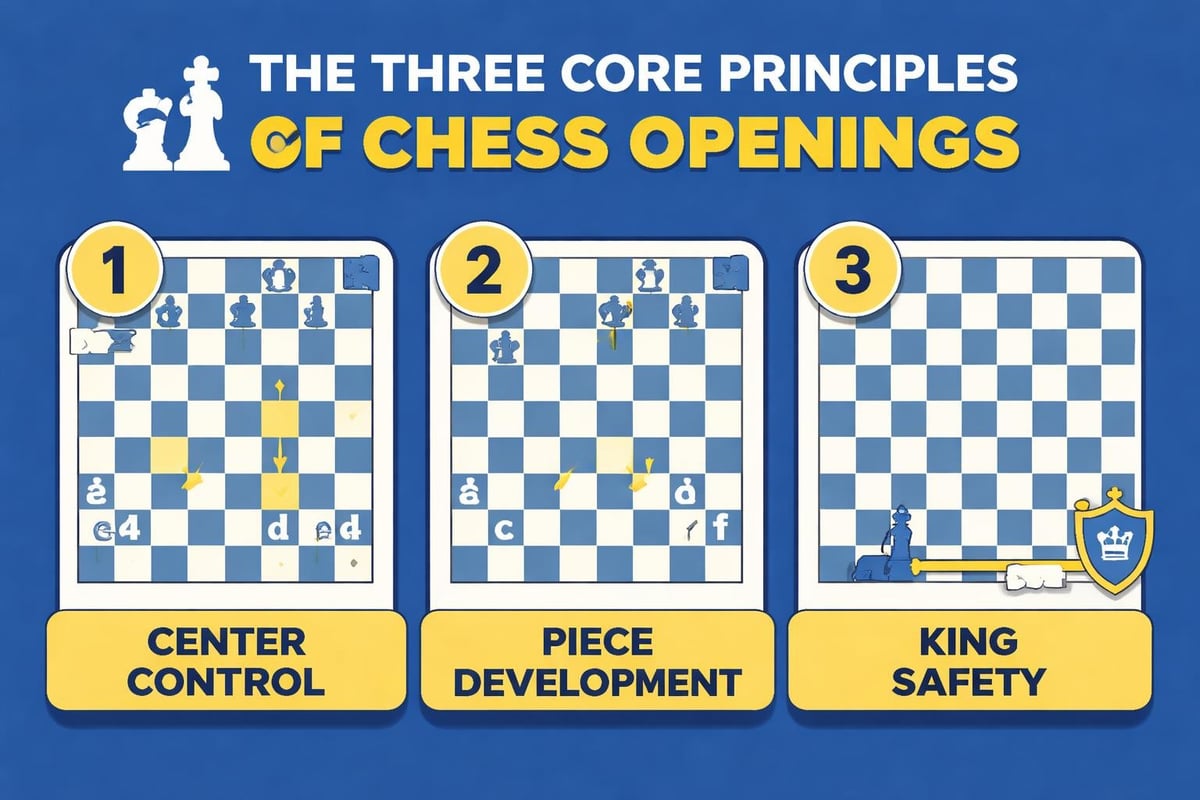
Before we dive into specific moves, let's establish the fundamental principles that govern strong opening play:
- Control the center with pawns and pieces
- Develop your pieces quickly and efficiently
- Safeguard your king through castling
These aren't just abstract concepts-they're practical guidelines that should inform every early move you make. When you're choosing between candidate moves, ask yourself: does this move help me achieve these goals?
The Best First Moves for White
White enjoys the advantage of moving first, which translates into a slight initiative. How you use that first move matters enormously. According to rankings of all 20 possible opening moves, some choices are far superior to others.
1.e4: The King's Pawn Opening
Moving your king's pawn two squares forward is the most popular first move at all levels of play. It accomplishes multiple objectives simultaneously: you control the center (specifically the d5 and f5 squares), you open lines for your queen and light-squared bishop, and you stake an immediate claim to space.
This move leads to sharp, tactical positions that reward active play. The best chess openings for beginners often start with 1.e4 because the resulting positions teach fundamental tactics and piece coordination.
1.d4: The Queen's Pawn Opening
The queen's pawn opening offers a slightly different flavor. It controls the center just as effectively as 1.e4 but often leads to slower, more strategic positions. You'll typically develop your pieces more methodically and fight for long-term advantages rather than immediate tactics.
Many players prefer 1.d4 because it's more flexible. You can transpose into numerous opening systems depending on your opponent's response, giving you plenty of options to steer the game toward positions you understand.
1.Nf3: The Réti Opening
This knight move represents a hypermodern approach. Instead of occupying the center with pawns immediately, you control it from afar whilst maintaining maximum flexibility. The Réti Opening can transpose into various setups, making it an excellent choice if you want to keep your options open.
| Move | Strengths | Best For |
|---|---|---|
| 1.e4 | Direct center control, open lines, sharp tactics | Players who enjoy aggressive, tactical games |
| 1.d4 | Solid center control, strategic flexibility, slower tempo | Players who prefer positional, strategic battles |
| 1.Nf3 | Maximum flexibility, hypermodern control, transpositional options | Players who want to avoid main theory |
| 1.c4 | Side control of center, quiet development, strategic richness | Players comfortable with subtle positional play |
Responding to 1.e4: Good Opening Moves for Black
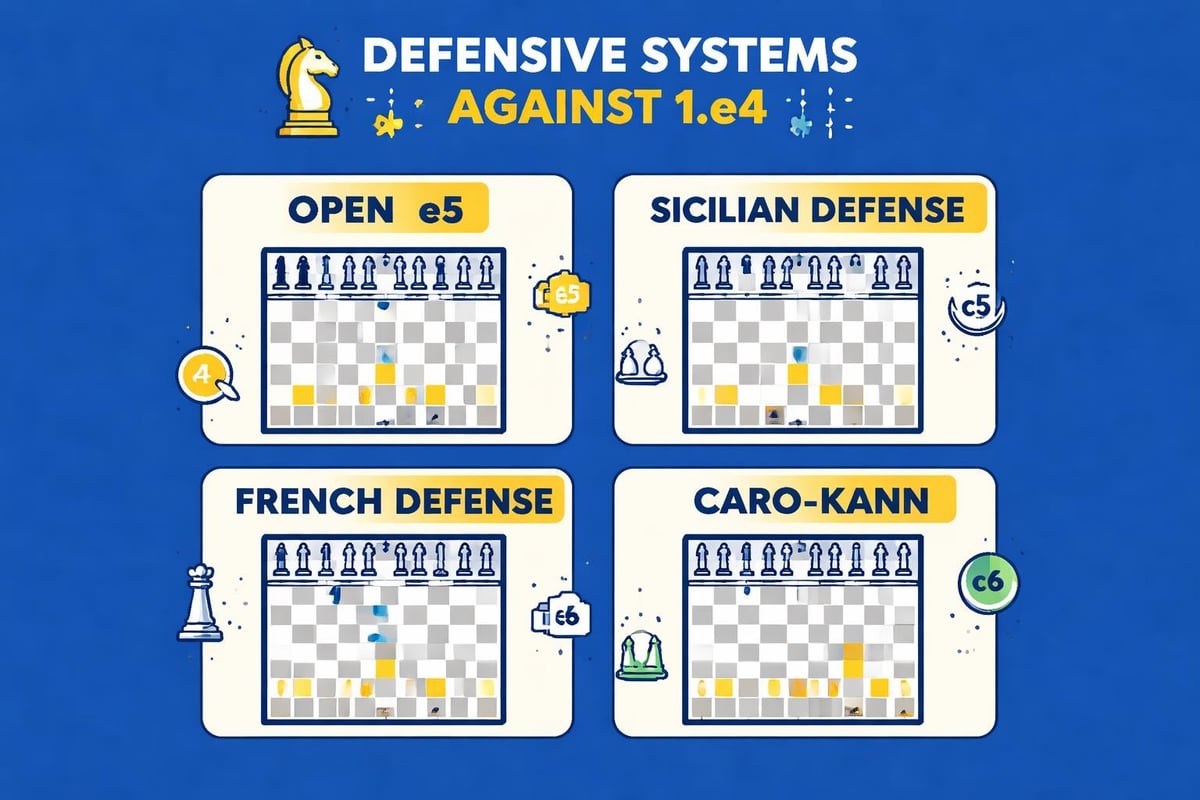
When your opponent opens with 1.e4, you've got several excellent responses. Each creates a distinct type of position with its own character and challenges.
The symmetrical 1...e5 is the most straightforward reply. You meet White's central control with equal force, fighting for your share of the center. This leads to classical openings like the Italian Game, the Spanish Opening (Ruy Lopez), and the Scotch Game.
If you prefer something more asymmetrical, consider 1...c5, the Sicilian Defense. This is the most popular opening at the highest levels because it creates immediate imbalance and fighting chances for Black.
The Caro-Kann Defense (1...c6) and French Defense (1...e6) offer solid, strategic alternatives. Both systems aim for a stable position before creating counterplay. If you're choosing between these two solid defenses, consider the comparison between the Caro-Kann and French Defense to understand which suits your style better.
Developing Your Pieces: The Second Wave of Opening Moves
After you've made your initial pawn move, what comes next? Good opening moves in chess continue developing your position methodically. Let's break down the typical development sequence.
Knights Before Bishops
Generally speaking, you should develop your knights before your bishops. Why? Knights have fewer good squares available, so their placement is less flexible. Your bishops, on the other hand, can often wait because you'll have a clearer picture of the pawn structure before committing them.
Typical knight development includes:
- Nf3 for White (or Nf6 for Black) to control the center
- Nc3 for White (or Nc6 for Black) to support central pawns
These moves accomplish multiple goals: they develop pieces toward the center, they prepare castling, and they don't create weaknesses in your position.
Bishop Deployment
Once your knights are out, your bishops should follow. The exact squares depend on your chosen opening, but some patterns emerge:
- Fianchetto development (g3/Bg2 or g6/Bg7) puts your bishop on the long diagonal
- Classical development (Bc4, Be2, or Bd3 for White) aims directly at key central squares
- Defensive development (Be7, Bd6) provides solid piece placement whilst preparing castling
Your light-squared bishop typically develops before your dark-squared bishop because it's not blocked by your d-pawn in most openings.

Common Opening Patterns Every Player Should Know
Rather than memorizing specific move orders, focus on understanding recurring patterns. These motifs appear across dozens of different openings and will serve you far better than rote memorization.
The Central Pawn Duo
Many strong openings feature pawns on e4 and d4 (for White) or e5 and d5 (for Black). This formation controls maximum central space and gives your pieces excellent scope. Of course, maintaining such a center requires careful piece coordination-your opponent will immediately try to undermine it.
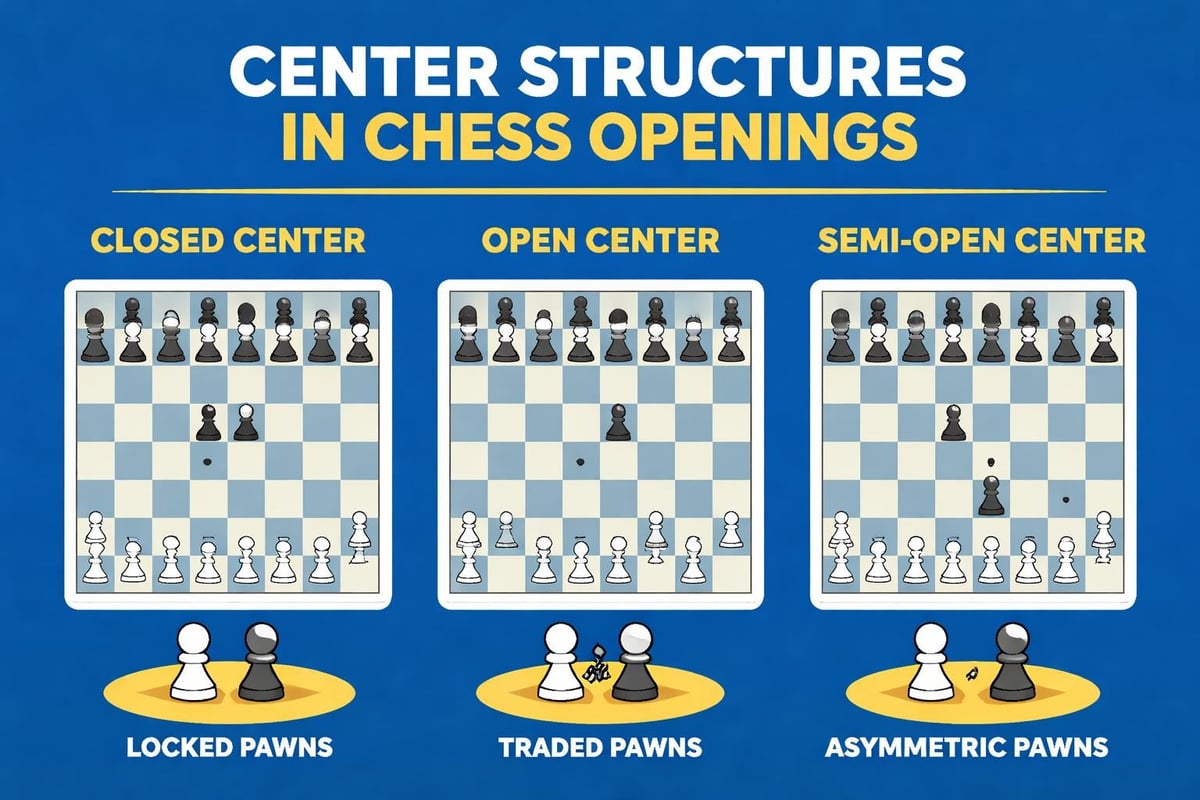
The Closed Center
When pawns on d4 and d5 face off (or e4 meets e5), you've got a closed center. These positions typically lead to slower, more maneuvering games. You'll fight for control on the flanks whilst gradually improving your piece placement.
The Open Center
If the central pawns trade off early, you're playing in an open center. These positions reward piece activity above all else. Your development speed becomes critical because whoever gets their pieces into the game first usually seizes the initiative.
| Center Type | Characteristics | Strategic Focus |
|---|---|---|
| Closed | Pawns locked, slow maneuvering | Pawn breaks, piece repositioning, flank attacks |
| Open | Few central pawns, piece activity paramount | Rapid development, tactical awareness, king safety |
| Semi-open | One player has central pawn, other doesn't | Piece pressure vs. space advantage |
Avoiding Common Opening Mistakes
Even when you know good opening moves in chess, it's easy to slip into bad habits. Let's address the most frequent errors and how to avoid them.
Moving the Same Piece Twice
One of the cardinal sins of opening play is moving the same piece multiple times whilst your other pieces sit undeveloped. Unless you're responding to a direct threat or winning material, each move should bring a new piece into play.
For example, after 1.e4 e5 2.Nf3 Nc6 3.Bc4, moving your knight again to grab a pawn on e5 might seem tempting. But after 3...Nxe4?, White plays 4.Bxf7+! and your king is suddenly in grave danger. Better to continue developing with moves like 3...Bc5 or 3...Nf6.
Neglecting King Safety
Castling isn't optional-it's essential. Good opening moves in chess should lead you toward castling within the first 10 moves. A king stuck in the center becomes a liability the moment the position opens up.
- Castle early (usually within the first 8-10 moves)
- Don't weaken the pawn shield around your castled king without good reason
- Be aware of your opponent's attacking potential before castling into danger
Making Too Many Pawn Moves
Pawns can't move backwards, so every pawn move is a permanent commitment. Whilst some pawn moves are necessary (controlling the center, creating development paths), making excessive pawn advances wastes time and creates weaknesses.
A good rule of thumb: in the opening, make 2-3 pawn moves, then focus entirely on piece development until you've castled and connected your rooks.
Opening Repertoire Building for Beginners
You don't need to know every opening variation to play strong chess. Instead, build a focused repertoire that covers the essential positions you'll face. Chess opening resources can help you structure your learning efficiently.
What to Include in Your Repertoire
As White:
- One main opening (either 1.e4 or 1.d4)
- Responses to common defenses (2-3 systems at most)
- A backup option for variety
As Black:
- One response to 1.e4
- One response to 1.d4
- A system against flank openings (1.Nf3, 1.c4)
This streamlined approach lets you develop genuine understanding rather than superficial knowledge of countless variations. You can explore the most common chess openings to identify which systems you'll face most frequently.
Study Methods That Actually Work
Reading about openings helps, but you need active engagement to truly learn. Here's what works:
- Play through master games in your chosen openings
- Solve puzzles from typical positions in your repertoire
- Play practice games where you deliberately reach your opening positions
- Review your games to identify where your opening knowledge ended
The opening puzzles collection offers targeted practice in specific opening systems, helping you recognize tactical patterns unique to each opening.
Practical Opening Principles to Remember
Let's consolidate everything into actionable guidelines you can use in your next game. These principles apply regardless of which specific opening you choose.
First five moves checklist:
- Control or contest the center (move 1-2)
- Develop knights toward the center (moves 2-4)
- Develop bishops to active squares (moves 3-6)
- Castle kingside (usually moves 6-10)
- Connect your rooks by developing your queen (moves 8-12)
Questions to ask before each move:
- Does this move develop a piece or improve my position?
- Am I addressing any threats from my opponent?
- Have I created any weaknesses I can't defend?
- Am I any closer to castling?
Advanced Opening Concepts for Improving Players
Once you've mastered the basics, you can start incorporating more sophisticated ideas into your opening play. These concepts separate intermediate players from beginners.
Pawn Tension and When to Resolve It
When your pawn faces off against your opponent's pawn (like e4 vs. e5 or d4 vs. d5), you've got pawn tension. The question becomes: should you maintain it, or should you capture?
Maintaining tension keeps your options open and forces your opponent to make difficult decisions. Releasing tension through a capture commits you to a specific pawn structure. Neither choice is inherently better-it depends on your plan and position.
Transpositions and Move Order Flexibility
Many openings can reach the same position through different move orders. Understanding these transpositions gives you flexibility and helps you avoid your opponent's preparation. For instance, the English Opening frequently transposes into other systems depending on Black's response.
Choosing Your Opening Based on Position Type
Different openings lead to different position types. If you prefer tactical battles, choose sharper openings. If you excel at endgames, select openings that often trade pieces. Good opening moves in chess should align with your strengths and preferences.
| Player Style | Recommended Openings | Position Type |
|---|---|---|
| Tactical | Italian Game, Sicilian Defense, King's Gambit | Sharp, concrete, tactical |
| Positional | Queen's Gambit, Caro-Kann, English Opening | Strategic, maneuvering, endgame-focused |
| Aggressive | Danish Gambit, King's Indian Attack, Dragon Variation | Attacking, dynamic, risk-taking |
| Solid | London System, French Defense, Slav Defense | Stable, safe, low-risk |
Putting It All Together
The journey from novice to competent opening player isn't about memorizing hundreds of moves. It's about internalizing principles, understanding typical plans, and recognizing patterns. When you focus on these fundamentals, good opening moves in chess become intuitive rather than mysterious.
Start each game with purpose. Control the center, develop your pieces efficiently, and safeguard your king. These simple goals provide a framework for all your opening decisions. As you gain experience, you'll develop preferences for certain positions and styles, but the core principles remain constant.
Remember that studying openings should be enjoyable, not overwhelming. Pick one or two systems you genuinely like, study them thoroughly, and expand from there. The best beginner chess books often emphasize this focused approach over encyclopedic knowledge.
Quick Reference Guide for Opening Success
Need a quick reminder before your next game? Here's a condensed checklist covering everything we've discussed.
Opening priorities in order:
- Make a strong first move (e4, d4, Nf3, or c4)
- Contest the center with pieces or pawns
- Develop both knights before move 6
- Castle before move 10
- Connect your rooks by move 12
Red flags to watch for:
- Your king still in the center after move 10
- Three or more pieces still on their starting squares after move 8
- Pawns advanced to the 5th rank or beyond in the opening
- Your queen developed very early and vulnerable to attacks
- Weaknesses around your king created unnecessarily
Recovery tactics:
If you find yourself in trouble after the opening, focus on completing your development, castling immediately if possible, and consolidating your position before attempting counterplay. Sometimes the best move is a quiet improving move that addresses your weaknesses rather than a flashy tactic.
Understanding good opening moves in chess transforms how you approach every game, giving you confidence and direction from move one. Whether you prefer aggressive tactics or strategic maneuvering, solid opening principles form the foundation of strong play. Chess Cheat Sheets provides comprehensive opening guides, targeted puzzles, and streamlined resources that help you master these critical first moves without overwhelming study sessions. Start building your opening repertoire today with tools designed specifically for practical improvement.


