
When you think about strategy games, chess likely springs to mind immediately. But have you ever considered its ancient cousin, Go? The term "go chess" might sound confusing at first - after all, these are two distinct games. However, exploring both games together reveals fascinating insights about strategic thinking that can enhance your chess understanding. Many chess enthusiasts discover that studying Go's principles offers fresh perspectives on position evaluation, long-term planning, and strategic thinking that directly translate back to the 64 squares.
Understanding the Go Chess Connection
The phrase "go chess" typically refers to the comparison or combination of these two strategic board games, though they're fundamentally different. While playing the game of chess involves capturing the opponent's king through tactical manoeuvres, Go focuses on controlling territory using black and white stones. This distinction matters because understanding both games enriches your strategic toolkit.
Chess players who explore Go often report improved positional understanding. Why? Because Go teaches you to think in terms of influence and potential rather than immediate threats. You start seeing the board as a landscape of possibilities rather than just pieces and squares.
The Historical Context
Both games boast ancient origins. Chess emerged from India around the 6th century, whilst Go originated in China over 2,500 years ago. The British Go Association provides detailed information about how to play Go, highlighting its deceptively simple rules that create profound complexity.
Despite their different cultural roots, both games share remarkable similarities:
- Pure strategy with no hidden information
- Two players competing with equal forces
- Victory requires planning, calculation, and intuition
- Draws are relatively rare (impossible in Go's traditional scoring)
What Chess Players Can Learn from Go
If you're serious about improving your chess, studying Go offers unexpected benefits. The transfer of skills might not be immediately obvious, but they're genuinely powerful.
Whole-Board Thinking
Go forces you to consider the entire board simultaneously. Unlike chess, where the action often concentrates around specific pieces or sectors, Go requires constant awareness of all areas. This translates beautifully to chess when evaluating positions. You'll find yourself naturally considering your queenside structure whilst planning a kingside attack.
The American Go Foundation offers excellent resources for learning Go that emphasize this global perspective. Chess players who develop this skill often notice improved performance in complex middlegame positions where multiple plans compete for attention.
Evaluating Long-Term Potential
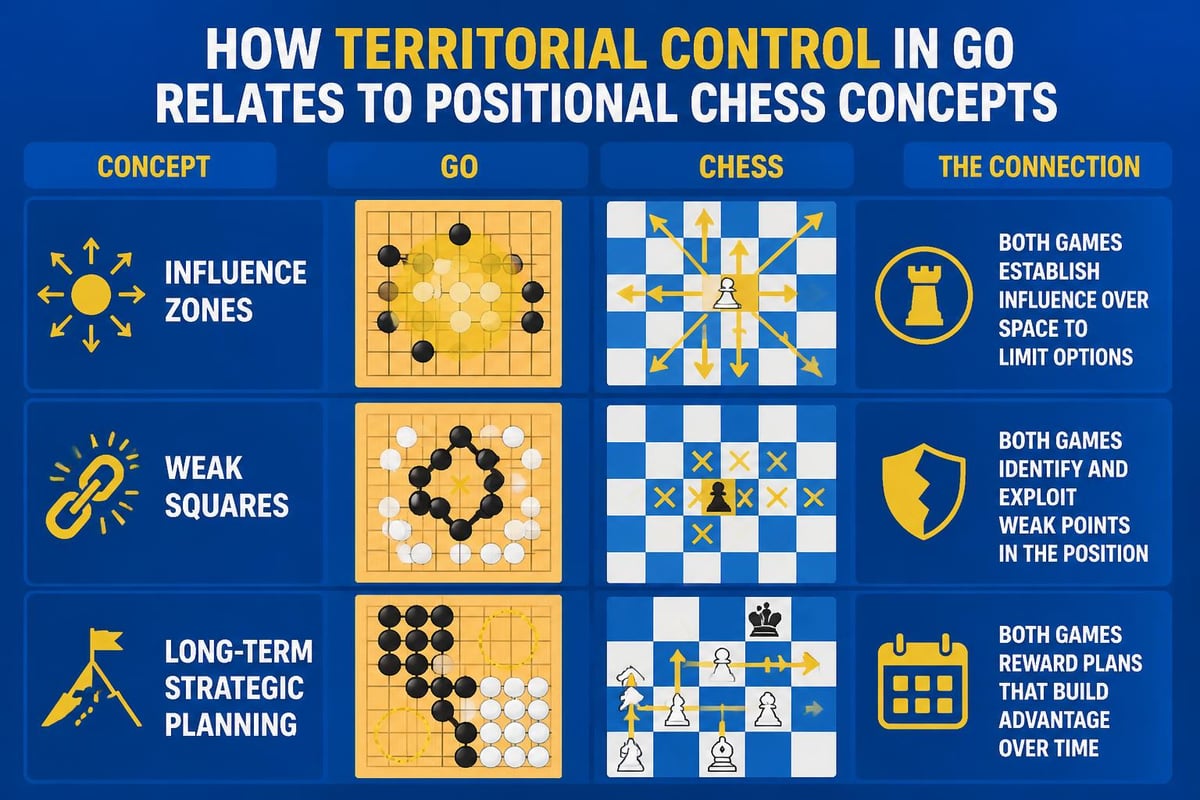
| Chess Concept | Go Equivalent | Shared Skill |
|---|---|---|
| Weak squares | Weak points | Identifying structural vulnerabilities |
| Space advantage | Territory | Controlling key areas |
| Piece activity | Stone influence | Maximizing your forces' reach |
| Pawn structure | Stone formations | Creating lasting advantages |
Go teaches patience in a way chess sometimes doesn't. You're building frameworks for future advantage rather than seeking immediate tactical wins. This mindset shift can transform how you approach chess openings, helping you understand why certain openings like the London System prioritize solid structure over immediate confrontation.
Intuition Development
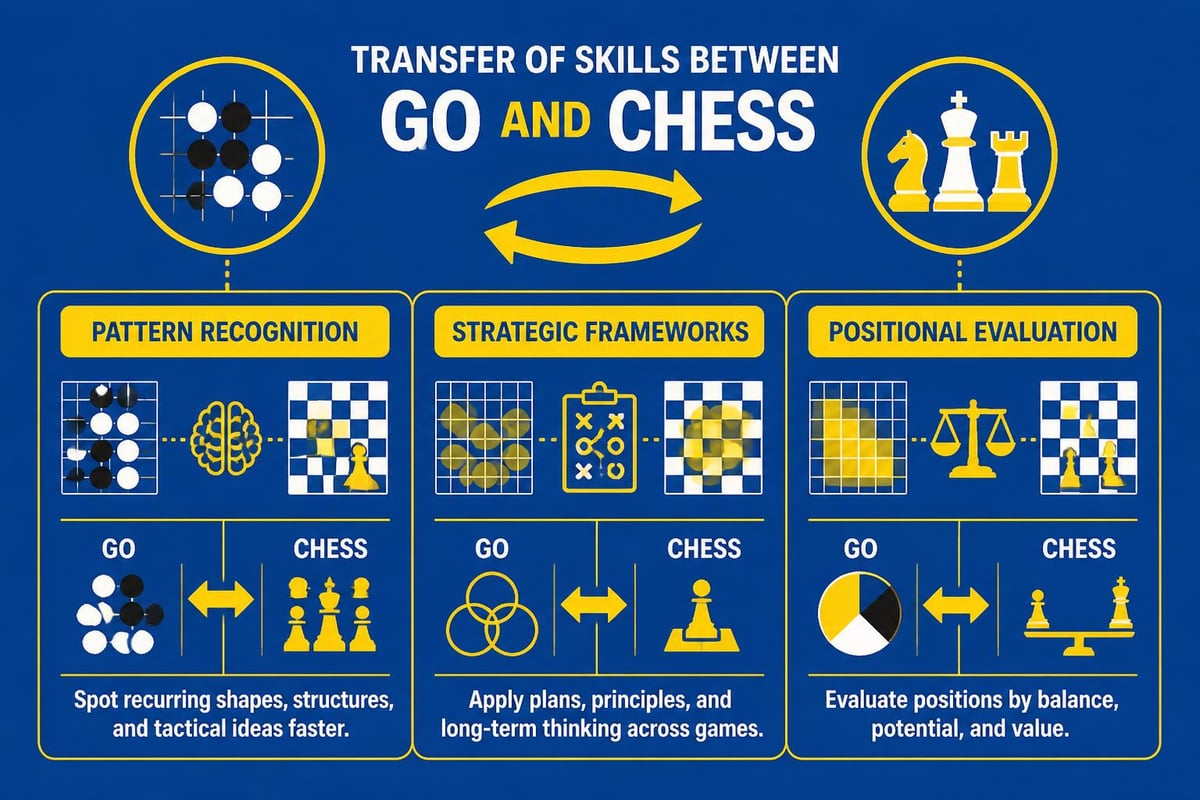
Both games require intuitive judgement alongside calculation. In Go, you can't calculate everything - there are simply too many possibilities. Instead, players develop pattern recognition and "feeling" for good moves. Sound familiar? That's exactly how strong chess players navigate complex positions.

The Artificial Intelligence Revolution in Go Chess
The intersection of AI development for both games tells a fascinating story about computational complexity. Chess fell to computers in 1997 when Deep Blue defeated Kasparov. Go, however, resisted AI mastery until 2016, when AlphaGo shocked the world by defeating Lee Sedol.
Why Go Challenged AI Longer
Go's complexity dwarfs chess in sheer numbers. The number of legal Go positions exceeds the atoms in the observable universe. Chess has roughly 10^120 possible games; Go has approximately 10^700.
This complexity meant traditional chess engine approaches - brute-force calculation with evaluation functions - simply couldn't work for Go. The chess programming community extensively documented these challenges, showing how Go required entirely new AI paradigms.
Modern AI Approaches to Go Chess
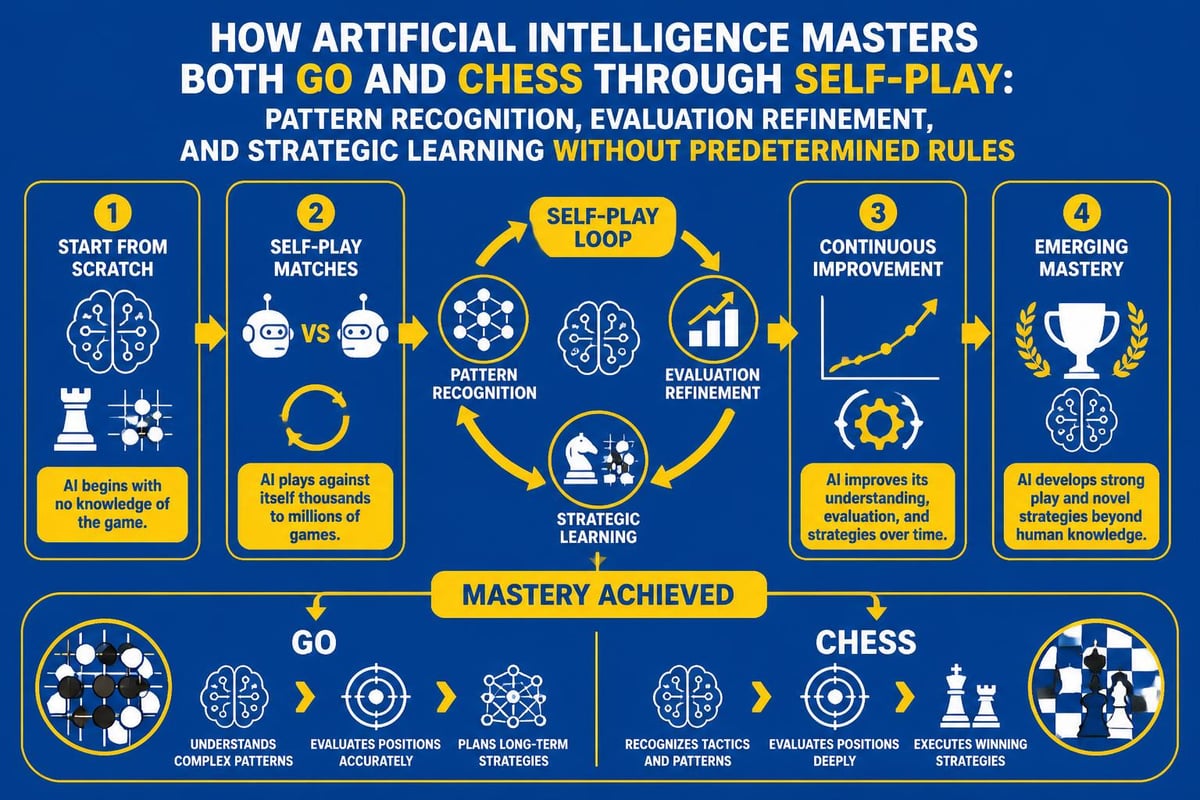
Recent breakthroughs like MuZero have achieved superhuman performance in both Go and chess using the same algorithm. This matters because it reveals universal principles of strategic thinking that transcend individual games.
The algorithm learns by:
- Playing millions of games against itself
- Recognizing successful patterns
- Developing intuition without explicit programming
- Refining evaluation through experience
Doesn't this sound remarkably like how humans improve at chess? You study games, recognize patterns, and develop intuition. The best chess learning approaches mirror these principles.
Comparing Strategic Principles
The British Go Association offers an excellent comparison between chess and Go, highlighting how each game emphasizes different aspects of strategic thinking. Let's examine these differences and what they mean for chess improvement.
Tactical vs Strategic Emphasis
Chess tends toward the tactical. A single move can deliver checkmate or win decisive material. Go rarely features such dramatic swings. Instead, advantages accumulate gradually through superior positional play.
This difference teaches chess players valuable lessons about patience and cumulative advantages. When you understand the pros and cons of positional openings, you're applying Go-like thinking to chess.
Simplification Strategies
In chess, exchanging pieces often leads toward a draw. Material simplification typically benefits the defender. Go works oppositely - the game often becomes more complex as stones accumulate. This teaches chess players to reconsider when simplification truly helps their position.
Consider these questions:
- Does your position improve with fewer pieces?
- Are you simplifying from strength or weakness?
- What long-term advantages remain after exchanges?
Programming Perspectives on Go Chess
The technical challenges of programming both games offer insights into their strategic depth. Whilst Go programming language exists for chess engine development, implementing Go gameplay requires different approaches.
Engine Development Lessons
Chess engines like Gochess demonstrate how modern programming tackles strategic games. The engine uses:
- Bitboard representation for efficient position evaluation
- Alpha-beta pruning for search optimization
- Static evaluation functions for position assessment
- Opening books and endgame tablebases
Go engines required revolutionary approaches like Monte Carlo Tree Search before deep learning transformed everything. Research on improved search strategies like Go-Exploit shows ongoing innovation in how computers approach strategic games.
Practical Training Methods Combining Both Games
How can you practically benefit from understanding go chess concepts? The answer lies in deliberate practice that transfers skills between games.
Pattern Recognition Exercises
Both games reward pattern recognition. In chess, you recognize tactical motifs. In Go, you recognize shape and formation patterns. Training both simultaneously strengthens your overall pattern recognition capability.
Try this approach:
- Study a chess position for five minutes
- Switch to a Go problem for five minutes
- Return to the chess position with fresh eyes
- Notice new patterns you previously missed
This cross-training prevents mental fatigue and builds cognitive flexibility.
Strategic Planning Drills
Go's emphasis on whole-board thinking complements chess strategic planning. Before calculating specific variations, ask yourself:
- Which areas of the board matter most?
- Where does my position hold potential?
- What frameworks am I building for later?
These questions, borrowed from Go thinking, improve your chess planning immensely. They're particularly valuable when studying various chess openings, helping you understand their strategic aims rather than just memorizing moves.
The Social and Cultural Dimensions
Beyond pure strategy, both games foster vibrant communities. The social aspects of go chess culture enhance learning and enjoyment.
Learning from Communities
Chess clubs exist worldwide, and Go communities, whilst smaller in Western countries, offer equally welcoming environments. Participating in both broadens your strategic game perspective whilst connecting you with diverse players.
Many top chess players have explored Go seriously. The reverse is also true - strong Go players often dabble in chess. This cross-pollination enriches both communities.
Teaching and Learning Approaches
| Aspect | Chess Education | Go Education | Combined Benefit |
|---|---|---|---|
| Opening theory | Extensive memorization | Flexible principles | Balanced approach |
| Tactical training | Puzzle-focused | Less emphasized | Complete tactical development |
| Positional concepts | Piece-centric | Territory-centric | Broader strategic vocabulary |
| Endgame study | Theoretical positions | Whole-board counting | Enhanced calculation skills |
The different teaching approaches complement each other beautifully. Chess education emphasizes concrete analysis; Go education emphasizes intuitive understanding. Together, they create well-rounded strategic thinkers.
Applying Go Principles to Chess Study
Let's get practical. How do you actually apply Go thinking to your chess improvement right now?
Rethinking Your Opening Repertoire
When building your opening repertoire, consider Go's territorial concepts. Instead of just learning variations, understand the space you're claiming. Openings for White often involve establishing central control - think of this as claiming vital territory.
Ask yourself:
- What territory does this opening secure?
- How does it restrict my opponent's influence?
- What potential does it create for later?
Middlegame Position Evaluation
Go players excel at evaluating positions without calculation. They develop intuition through experience with similar formations. You can apply this to chess by:
- Studying master games in your opening systems
- Observing typical pawn structures repeatedly
- Developing "feeling" for which positions favour you
This approach complements tactical calculation beautifully. You need both intuition and concrete analysis.
Converting Advantages
Go teaches the art of converting small advantages into victory. This skill transfers directly to chess endgames. Understanding how to gradually improve your position, restrict opponent options, and maintain advantages across many moves proves invaluable.
The Future of Go Chess Study
Where is the intersection of these games heading? AI developments suggest exciting possibilities for learning and analysis tools.
Cross-Game Analysis Tools
Imagine software that analyzes your chess games using Go-inspired evaluation metrics. Such tools could assess:
- Territorial control across the board
- Long-term positional potential
- Influence and mobility patterns
- Strategic cohesion of piece placement
These metrics would complement traditional chess analysis, offering fresh perspectives on your play.
Hybrid Training Programs
Forward-thinking coaches increasingly incorporate multi-game strategy training. Studying both chess and Go simultaneously develops broader cognitive skills than focusing on either alone. This approach builds transferable strategic thinking applicable beyond board games.
Consider how professional players train. They don't just play their main game - they study related disciplines. Advanced chess study increasingly incorporates cross-game insights.
Balancing Depth in Both Games
Should you actually study both games seriously, or just borrow concepts? The answer depends on your goals and available time.
Time Management Considerations
Most chess improvers benefit more from focused chess study than splitting time equally between games. However, occasional Go study provides valuable perspective shifts. Consider allocating:
- 85-90% of study time to chess
- 10-15% to Go for fresh perspectives
- Regular breaks using Go to prevent chess burnout
This balance maintains chess focus whilst harvesting Go's benefits.
Integration Strategies
Rather than treating them as separate pursuits, integrate Go concepts into chess study:
- During opening preparation, consider territorial aspects
- In middlegame analysis, think about whole-board dynamics
- When studying endgames, apply Go's patient conversion principles
This integration maximizes learning efficiency without requiring extensive Go study.
Understanding the relationship between Go and chess enriches your strategic thinking in ways that pure chess study cannot achieve alone. The territorial concepts, whole-board awareness, and patient strategic building from Go complement chess's tactical richness perfectly. Whether you're looking to deepen your opening understanding, improve middlegame planning, or simply gain fresh perspective on strategic thinking, exploring both games offers genuine benefits. Chess Cheat Sheets provides the streamlined guides, opening resources, and practical tools you need to apply these strategic insights efficiently, helping you improve your chess performance without getting lost in overwhelming theory.


