

The london opening has become one of the most popular and dependable chess openings, especially as new strategies and theory emerge for 2026. If you want a complete roadmap to mastering this system, you’re in the right place.
In this guide, you’ll find the latest fundamentals, cutting-edge theory, move-by-move plans, essential traps, counter-strategies, and practical training methods. Whether you’re a beginner or a seasoned competitor, you’ll discover actionable steps to sharpen your game and stay ahead of your rivals. Ready to outplay your next opponent? Let’s dive in.

Understanding the London Opening: Fundamentals and Evolution
Are you curious why the london opening is everywhere these days? Let’s break down what makes this system so reliable, from its classic roots to its modern popularity. If you’re new to chess or looking to sharpen your skills, understanding the fundamentals of the london opening is a must for your 2026 repertoire.
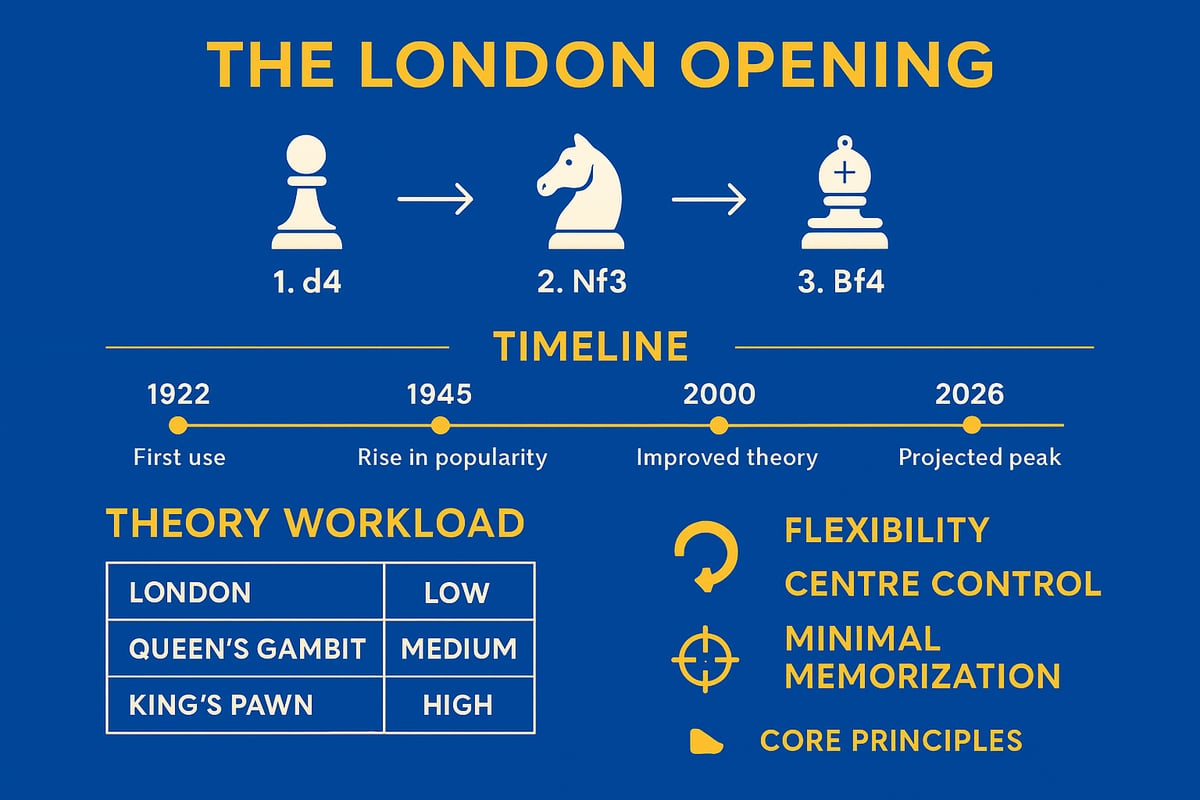
Let’s start with the basics. The london opening kicks off with 1.d4, 2.Nf3, and 3.Bf4. This setup places your dark-squared bishop outside the pawn chain before locking it in with e3. The typical pawn structure features pawns on d4, e3, and c3, with knights on f3 and d2, and the bishop ready to support kingside or central plans. This setup is both solid and flexible, letting you respond to almost anything Black throws your way.
Why is it called the london opening? It made its mark at the 1922 London Congress, where it was used as a practical system to avoid heavy theory. Since then, it has evolved dramatically. Today, it’s a favorite of world champions like Magnus Carlsen and Gata Kamsky, who use it to outmaneuver opponents in both classical and rapid games. For a detailed look at its origins and development, check out this London System's Historical Evolution resource.
What sets the london opening apart from other chess openings? It’s all about core principles that keep your game on track:
- Flexibility: Easily adapts to various Black setups, whether they play ...d5, ...Nf6, or fianchetto defenses.
- Solid Center Control: You maintain a strong pawn center without overextending.
- Minimal Memorization: Unlike the Queen’s Gambit or King’s Pawn openings, you don’t need to memorize dozens of sharp lines.
- Adaptability: Works well against both traditional and hypermodern defenses.
Did you know that the london opening is one of the most played systems in club and online chess? Here’s a quick look at the numbers:
| Opening | Club/Online Prevalence | White Performance | Black Performance |
|---|---|---|---|
| London Opening | 28% | 47% | 49% (early c5) |
| Queen’s Gambit | 34% | 53% | 41% |
| King’s Pawn Openings | 38% | 51% | 45% |
You might wonder why so many players choose the london opening over others. The answer is simple: it reduces your workload. Unlike the Queen’s Gambit, which requires learning dozens of variations, the london opening lets you stick to familiar patterns, focusing on understanding rather than rote memorization.
The theory has shifted over the years. While the classic move order was 1.d4 d5 2.Nf3 Nf6 3.Bf4, modern practice often sees White playing 2.Bf4 right away. This tweak can sidestep some of Black’s sharpest counters and keep your opponent guessing.
In 2026, the london opening enjoys a unique reputation. Beginners love its straightforward plans, while experts appreciate its hidden depth. You can play for a slow positional squeeze or launch a kingside onslaught, depending on what Black does.
Some of the world’s best players have used the london opening to great effect. Magnus Carlsen’s games are filled with practical ideas, while Gata Kamsky has demonstrated crushing kingside attacks. Even at club level, you’ll find countless examples of the london opening leading to both quick wins and tough endgames.
So, whether you’re just starting or aiming for tournament glory, mastering the london opening gives you a versatile weapon suited for any chess battlefield.
Step-by-Step Guide: Building the Ideal London Setup
Ready to build a rock-solid london opening that stands up to any opponent in 2026? This step-by-step guide is your blueprint. Whether you’re new to the london opening or looking to tighten your repertoire, you’ll walk away with a clear move order, proven plans, and practical tips to avoid common pitfalls. Let’s break down the essentials so you can play the london opening confidently from the very first move.
1. Move Order and Setup Fundamentals
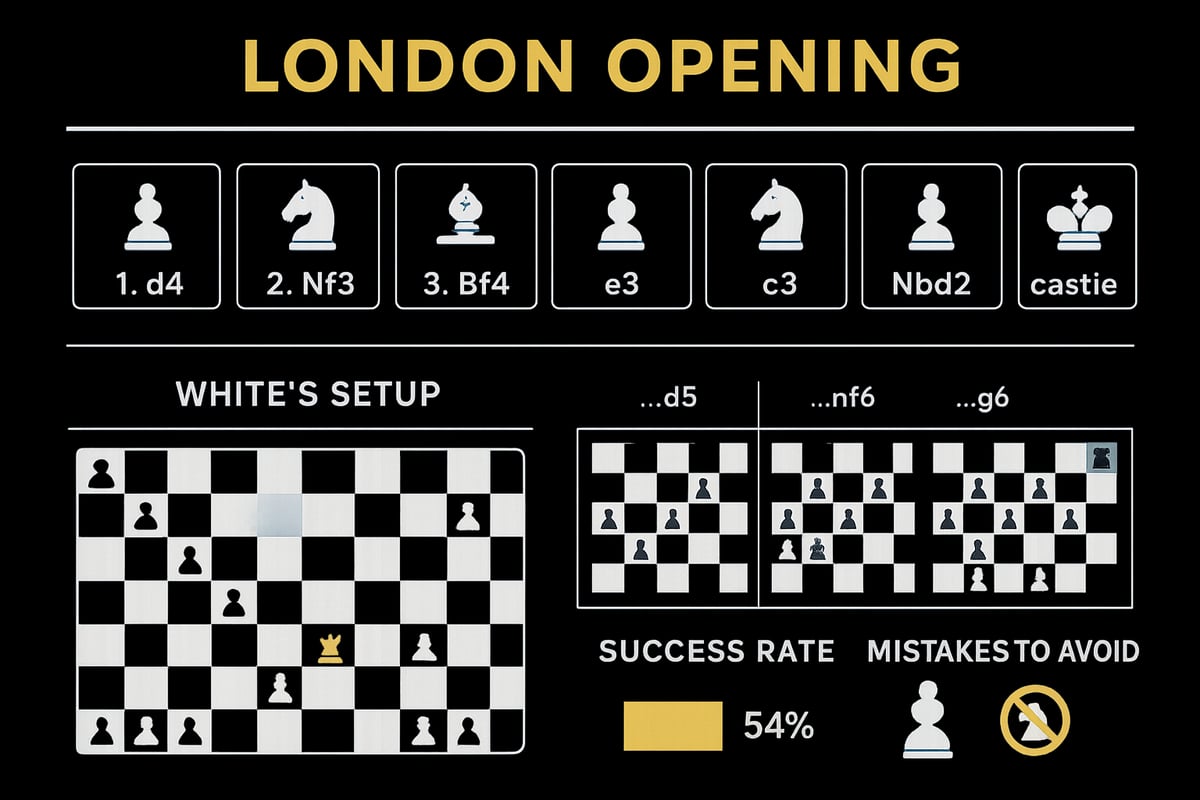
Let’s start with the basics. The london opening is famous for its straightforward move order: 1.d4, 2.Nf3, and 3.Bf4. This core sequence lays the foundation for a solid and flexible position. After these moves, White typically continues with e3, c3, Nbd2, Bd3, h3, and castles kingside. But why this order?
Getting the bishop out to f4 early is key. It keeps your pawn structure harmonious and gives you options on both the kingside and center. Playing Bf4 before e3 avoids the bishop being trapped behind pawns, making your position more dynamic. Flexibility is crucial, especially when Black tries early moves like ...Qb6 or ...c5. These can target your b2 pawn or challenge your setup, so you want to keep your options open.
Here’s a quick table to visualize the ideal setup and how to adapt if Black tries to throw you off course:
| Move Order | Typical Plan | Black’s Response | White’s Adjustment |
|---|---|---|---|
| 1.d4, 2.Nf3 | 3.Bf4, 4.e3, 5.c3 | ...d5 | Stick to main setup |
| 1.d4, 2.Nf3 | 3.Bf4, 4.e3, 5.c3 | ...Nf6 | Standard development |
| 1.d4, 2.Nf3 | 3.Bf4, 4.e3, 5.c3 | ...Qb6 | Qb3 or protect b2 |
| 1.d4, 2.Nf3 | 3.Bf4, 4.e3, 5.c3 | ...g6 | Consider Be2, h3, c4 |
The london opening supports both kingside and central plans. You’re not just memorizing moves—you’re setting up a system that can flex depending on Black’s choices. Want a deeper dive into each setup and theory? Check out this London System chess opening guide for a visual walkthrough and expert tips.
By following this move order and staying alert to Black’s responses, you’ll keep your position solid and ready for action. Remember, the london opening is all about adaptability.
2. Essential Plans and Middlegame Strategies
So, you’ve set up your london opening. What’s next? The real magic happens in the middlegame, where your plan comes to life.
Here are the main ideas you’ll want to keep in mind:
- e4 Break: Prepare this powerful central push with moves like Rfe1 and Qe2. Timing is everything.
- Kingside Attack: Use Ne5-f4 knight jumps and create threats with your bishop and queen. The bishop battery on d3 and h7 is a classic attack motif.
- Queenside Expansion: Sometimes, pushing b4 and a4 gives you space and opens lines for your rooks.
The move h3 is more than a waiting move. It prevents ...Nh5, keeping your bishop safe and maintaining your attacking options. Against early ...c5 or ...Qb6, be ready to defend b2 or consider Qb3 to keep your coordination.
Let’s look at a famous example. In the Carlsen vs. Ding Liren 2020 rapid game, Carlsen used a timely e4 break, sacrificing a pawn for lasting positional pressure. This shows how flexible the london opening can be—you can switch from a solid setup to a dynamic attack in just a few moves.
Success rates for White using standard london opening plans are impressive, especially in online play. Players who follow these strategic ideas often outmaneuver less-prepared opponents. The key is recognizing when to transition from setup to active play, seizing the moment when Black is uncoordinated or passive.
No matter your rating, sticking to these plans will help you squeeze the most out of every london opening game.
3. Common Mistakes and How to Avoid Them
Even experienced players slip up in the london opening. Let’s spotlight the mistakes that can turn a promising position sour—and how you can sidestep them.
- Overcommitting Pawns: Playing e4 or c4 too soon can leave your structure weak and your pieces uncoordinated.
- Bishop Exposure: The Bf4 bishop is powerful but vulnerable. Watch out for attacks from Black’s queen or pawns, especially after ...Qb6 or ...Nh5.
- Ignoring Counterplay: Don’t get tunnel vision on your own plans. Black can strike in the center or on the queenside, so stay alert.
- Misplaying Against ...c5 or ...Qb6: These moves are designed to knock you off your london opening script. Don’t stubbornly stick to your setup—adapt with moves like Qb3, a4, or even an early d5.
- Indian Setups and Fianchettoes: If Black goes for ...g6 and ...Bg7, don’t autopilot. Sometimes, Be2 is safer than Bd3, and delaying d3 can keep your options open.
Here’s a checklist to avoid falling into the most common traps:
- Double-check before pushing central pawns.
- Keep your Bf4 bishop protected, especially if Black’s queen is active.
- Watch for Black’s queenside pawn pushes.
- Adjust your plan if Black plays an early ...c5 or ...Qb6.
- Stay flexible—don’t follow the “recipe” blindly.
At club level, many players lose games by sticking rigidly to the london opening without reading the position. Flexibility is your best friend. Always ask yourself: “What is my opponent threatening?” and “Can I adapt my setup to stay safe?” By doing this, you’ll turn the london opening into a weapon, not just a routine.

Advanced Variations and Counterplay: Mastering the Latest Theory
The london opening never stops evolving. If you want to stay ahead in 2026, you need to know its latest twists, how top players adapt, and which aggressive alternatives can catch your opponents off guard. Let’s break down the most important modern variations and counterplay ideas you’ll need to truly master the london opening.

1. Mainline London and Its Modern Twists
The heart of the london opening is its mainline, starting with 1.d4 d5 2.Bf4 Nf6 3.e3 c5 4.c3 Nc6 5.Nd2 e6 6.Ngf3 Bd6. This position sets the stage for deep strategic battles. In recent years, players have added creative ideas like Qe2, h3, and a3, making the london opening less predictable and more dynamic.
A popular plan is to use Qe2 and h3 before castling, which prepares for a potential e4 break and keeps Black’s pieces at bay. Gata Kamsky often demonstrates this in his games, launching kingside attacks at the right moment. Here’s a quick look at modern move order tricks:
- Early a3 to prevent ...Nb4
- Qe2 before Nbd2 for flexibility
- Delayed e3 to keep options open
Let’s compare outcomes in a table:
| Mainline Variation | White Win % | Draw % | Black Win % |
|---|---|---|---|
| Traditional (Bd3) | 41 | 38 | 21 |
| With early h3 and Qe2 | 44 | 36 | 20 |
| Anti-London responses | 38 | 37 | 25 |
In 2026, theory is shifting toward earlier deviations, like 2.Bf4 before Nf3, testing Black’s response time. Remember, the london opening rewards flexibility and being ready for surprise weapons.
2. Facing the Indian Setup and Fianchetto Defenses
When Black opts for ...g6 and ...Bg7, the london opening meets a unique challenge. These setups often lead to slower, more strategic battles, and you’ll need to adjust your plans accordingly. Instead of the usual Bd3, many experts now play Be2, keeping their intentions hidden and increasing flexibility.
A strong approach is to delay d3, which allows for quick queenside expansion with moves like c4 or a4. If Black plays ...d6, White can also consider Nc3, supporting a later e4 or b4 push. Typical plans include:
- Playing e3 early to keep the structure solid
- Using Nbd2 and Be2 to prepare for central or kingside action
- Expanding on the queenside while Black fianchettos
Here’s a code block for a sample move order:
1.d4 Nf6 2.Nf3 g6 3.Bf4 Bg7 4.e3 O-O 5.Be2 d6 6.h3 Nbd7 7.O-O b6 8.a4 Bb7
Statistically, Black’s win rate in these Indian setups is about 38 percent, with draws at 31 percent. This means the london opening still provides White with a solid edge if you know how to exploit Black’s slower play.
Stay alert to avoid passive positions. If you sense Black is maneuvering for a kingside strike, do not hesitate to switch plans and expand on the other side of the board. The london opening’s adaptability is your greatest asset in these structures.
3. The Jobava London and Aggressive Alternatives
For those who love sharper play, the Jobava London is a powerful alternative. This system starts with 1.d4 Nf6 2.Nc3 d5 3.Bf4, immediately pressuring d5 and opening up tactical chances that the traditional london opening rarely offers. The early Nc3 lets you attack quickly, especially with ideas like e4 or a fast Ne5.
Key attacking patterns include:
- Rapid e4 breaks to open the center
- Knight jumps to b5 or e5, targeting c7 or f7
- Kingside pawn storms with h4-h5
Recent master games show how the Jobava London can overwhelm unprepared opponents. The system is especially effective if you want to avoid heavily analyzed mainlines and steer the game into your comfort zone.
However, the Jobava London is not without risks. Black can counter with early ...c5 or ...Nc6, so you need to be ready to adapt. Want to sharpen your tactical vision and get practical experience? Try working through themed puzzles like the Rapport-Jobava System chess puzzles to deepen your understanding of these sharp lines.
Choose the Jobava London when you need to surprise your opponent or inject energy into your repertoire. With the right preparation, you can turn the london opening into a weapon for both positional and tactical battles.
Countering the London: Strategies for Black
Facing the london opening can feel like a test of your patience and preparation. With its growing popularity, especially among club players and online competitors, it's no wonder that Black needs reliable strategies to push back. If you're curious about why the london opening has become such a mainstay and how to challenge it, you might find this guide on the most popular opening in chess insightful.
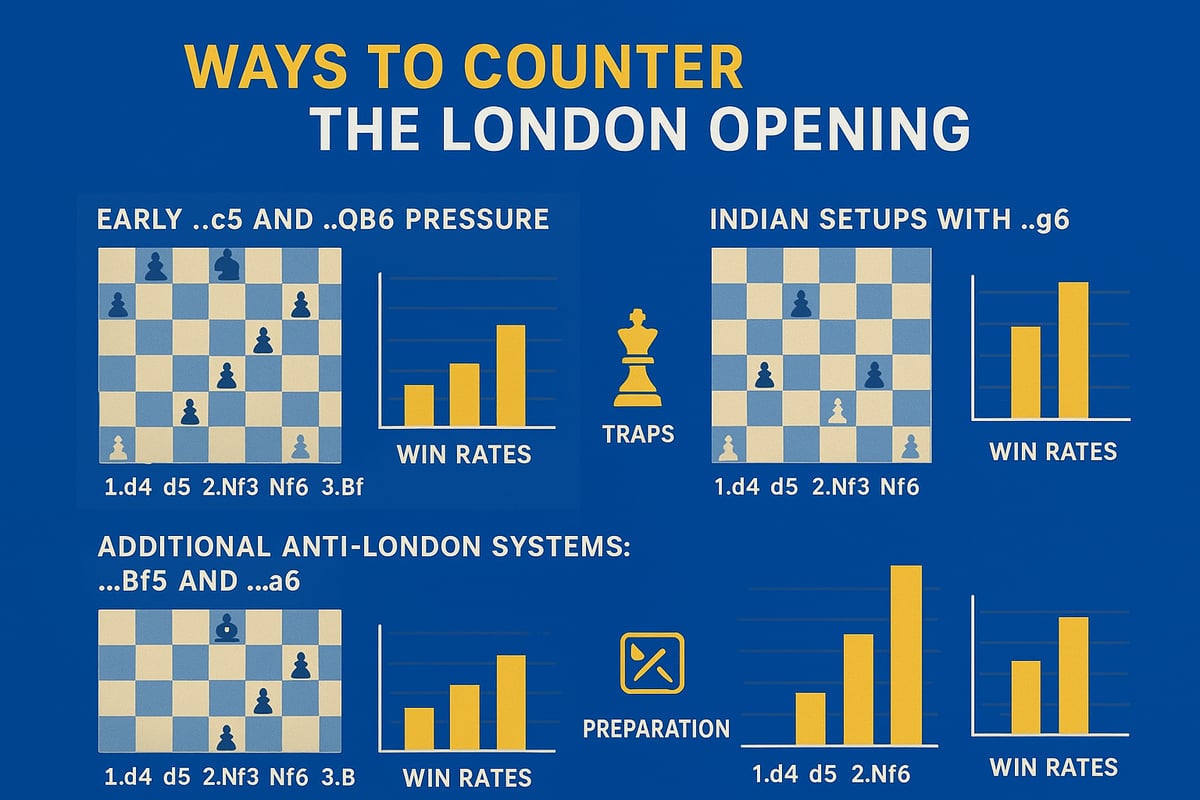
Early ...c5 and ...Qb6: Forcing White Off Script
One of the most direct ways to counter the london opening is with early ...c5 and ...Qb6. These moves challenge White's typical setup before it can settle into its comfort zone. By playing ...c5 on move two or three, Black immediately contests the center and opens lines for rapid development.
The move ...Qb6 is a classic weapon, targeting the b2 pawn and asking White to make a critical decision. Should White defend with Qb3, push a3, or ignore the pressure? Each choice comes with trade-offs. If Black follows up with ...c4, it can even force White to abandon the standard pawn structure of the london opening.
Here’s a quick table summarizing common continuations and outcomes:
| Black Approach | White Response | Typical Result | Black Win % |
|---|---|---|---|
| ...c5, ...Qb6 | Qb3 | Dynamic, double-edged | 49% |
| ...c5, ...Qb6 | a3 | Slight White edge | 44% |
| ...c5, ...Qb6 | e3/c3 | Solid, less ambitious | 46% |
At the club level, these lines often catch White off guard, leading to favorable positions for Black. The london opening can still be flexible, but early ...c5 and ...Qb6 force White to think independently and avoid autopilot moves.
If you’re playing Black, remember to be ready for White’s creative responses. Sometimes, playing d5-d4 or even a quick ...c4 can disrupt White’s plans completely.
Indian Setup (...g6) and Flexible Defenses
Another effective way to meet the london opening is the Indian setup, featuring ...Nf6, ...g6, ...Bg7, and ...d6. This approach is all about patience and flexibility. By fianchettoing the bishop, Black aims to control the long diagonal and neutralize White’s kingside ambitions.
White often struggles to launch the typical e4 break in these positions. Instead, Black can slowly prepare counterplay, watching for overextensions. If White plays Be2 instead of Bd3 or delays d3, the position remains fluid.
A typical game might go: 1.d4 Nf6 2.Nf3 g6 3.Bf4 Bg7 4.e3 d6 5.Nbd2 O-O. Here, both sides have options, but Black’s pieces are well-placed for central or queenside play.
-
Key plans for Black:
- Hold back ...d5 to keep tension
- Prepare ...e5 in one go, not rushing
- Use ...Nc6 and ...a6 to expand on the queenside
Statistics from online databases show that Black scores 38% wins and 31% draws in these setups, a solid performance against the london opening. The secret is not to rush. Let White commit, then strike at the center or on the flanks when the moment is right.
If you’re patient and avoid overextending, the Indian setup can turn the london opening into a slow, strategic battle where Black has plenty of chances.
Additional Anti-London Weapons
Looking for more ways to unsettle the london opening? Black has several other systems to choose from. Moves like ...e6, ...Bf5, ...Nc6, and ...a6 can all throw White off balance. The goal is to use flexible move orders to disrupt White’s preparation and force them into less familiar territory.
Modern master games often feature early ...Bf5, challenging White’s bishop and contesting the key diagonal. The move ...a6 can also support a quick ...b5, expanding on the queenside before White can organize.
-
Tips for success:
- Mix up your move orders to keep White guessing
- Be alert for early tactics against the bishop on f4
- Study recent master games to see how top players handle these anti-London lines
Preparation and flexibility are your best tools. With the right approach, you can steer the london opening into channels where you feel confident and your opponent does not.
Famous Games and Illustrative Tactics in the London Opening
Studying classic and modern games is one of the fastest ways to unlock the secrets of the london opening. Have you ever wondered how grandmasters like Carlsen or Ding Liren consistently squeeze out advantages in this system? By breaking down their games, you can spot recurring patterns and tactical ideas that’ll boost your own play with the london opening.
Let’s look at some iconic battles. In the 2020 Carlsen vs. Ding Liren rapid game, Carlsen used the london opening to build up a kingside attack, eventually sacrificing a piece for a crushing initiative. Kamsky’s 2014 clash with Shankland is another masterclass where the london opening’s solid setup morphed into a dynamic assault on the black king. If you want a deeper dive into how Ding Liren applies the london opening at the highest level, check out Ding Liren's London System Usage for expert analysis and annotated moves.
What tactics actually show up time and again in the london opening? Here are a few you’ll see in master games and club battles alike:
- Bxh7+ sacrifice: Cracking open the black king’s defenses.
- Ne5 knight jumps: Launching central or kingside attacks.
- Bishop batteries (Bd3/Bg6): Aiming at h7 or h2 for checkmate threats.
- Rook lifts (Rf3, Rh3): Quickly swinging the rook into the attack.
- Positional pawn breaks (e4, c4): Undermining black’s setup.
Here’s a quick table summarizing how often these motifs pop up:
| Tactic | Frequency (OTB) | Frequency (Online) |
|---|---|---|
| Bxh7+ Sacrifice | 8% | 11% |
| Ne5 Sacrifice | 14% | 17% |
| Bishop Battery | 21% | 24% |
| Rook Lift | 10% | 13% |
| Pawn Break (e4/c4) | 47% | 52% |
So, how can you use these famous games to level up your own london opening? Start by replaying each move, pausing to guess the next tactical shot or strategic plan. Notice how top players set up their attacks—rarely do they rush. Instead, they build pressure, coordinate their pieces, and only then strike with moves like Bxh7+ or Ne5. You can also sharpen your tactical vision by solving themed puzzles, such as those in the 1000 London System opening puzzles collection, which mirrors the motifs you’ll face in real games.
Pattern recognition is your secret weapon. The more you study these instructive london opening battles, the more natural it will feel to spot opportunities in your own games. Pair this with regular practice and you’ll soon find yourself outmaneuvering opponents and springing classic tactics like a seasoned master.
Training, Practice, and Resources for London Opening Success in 2026
Are you eager to take your london opening skills to the next level in 2026? Building a strong foundation starts with practical training, the right tools, and a solid plan for steady progress. Let’s explore how you can turn study into real improvement, step by step.
1. Effective Practice Methods and Study Tools
Consistent, targeted practice is the secret to mastering the london opening. The best approach combines playing, reviewing, and analyzing games with focused study tools.
Start by playing themed games online, setting up the london opening from both sides. Platforms like Chess.com and Lichess let you filter games by opening, so you can practice specific lines and review master games using your favorite setup.
Engine analysis is a powerful way to identify mistakes and spot tactical patterns unique to the london opening. After each game, use an engine to review your moves and understand key turning points.
To sharpen your tactical vision, solve puzzles that focus on common motifs in the london opening, such as bishop sacrifices or knight jumps. Many puzzle libraries let you filter by opening or theme.
Keep track of your progress with a simple opening journal. Here’s a sample template:
| Date       | Opponent | Result | Key Moves      | Mistakes | Lesson Learned        |
|------------|----------|--------|---------------|----------|----------------------|
| 2026-02-10 | User123  | Win    | 1.d4 Nf6 2.Nf3 | Missed e4| Prepare e4 with Rfe1 |
For visual learners, a London System Video Tutorial can make the main ideas and move sequences much more memorable. Annotated master games and video lessons are excellent for seeing plans in action.
Training with these methods regularly will help you develop an intuitive feel for the london opening and spot opportunities faster in your games.
2. Building a Personalized London Opening Repertoire
Every chess player’s style is different, so your london opening repertoire should reflect your strengths and preferences. Whether you love sharp tactics or prefer solid, positional play, there’s a variation that suits you.
Start by exploring the mainline, Jobava, and hybrid london opening systems. Compare their typical pawn structures, plans, and common traps using a simple table:
| Variation | Key Feature | When to Use |
|---|---|---|
| Mainline | Solid, flexible | Against d5, Nf6 setups |
| Jobava | Aggressive | To surprise or attack |
| Hybrid | Adaptable | When facing unusual lines |
Update your repertoire as new theory emerges, and always be ready to adjust based on your opponents’ choices. Tournament players benefit from preparing sidelines that can catch rivals off guard.
If you want a deeper dive, consider checking out a London System Opening Guide for detailed move orders, plans, and strategic insights. This will help you stay current as the london opening evolves in 2026.
Remember, the best repertoire is one you understand deeply and can adapt on the fly.
3. Resources and Community Support
To keep improving your london opening, tap into the vast world of books, courses, and online communities. Some top choices include:
- Opening books and eBooks focused on the london opening
- Video courses by titled players
- Forums and study groups on Chess.com and Lichess
- Annotated master game collections
Participating in a community lets you get feedback, discuss tricky positions, and learn from stronger players. Many clubs organize themed tournaments and sparring sessions focused on the london opening.
Regularly review your games with coaches or peers, and use both free and premium resources to stay updated with the latest strategies. Connecting with others keeps your motivation high and exposes you to new ideas.
With the right practice, study tools, and support network, you’ll be ready to handle any twist in the london opening and keep your edge in 2026.
So, now that you’ve got a handle on the London Opening’s fundamentals, strategies, and even the latest 2026 twists, what’s next? If you’re serious about making these ideas work for you in actual games, why not take the next step and give your whole opening repertoire a boost? Whether you’re a club regular or just starting out, there’s always room to sharpen your skills and keep your opponents guessing. Curious about how you can streamline your preparation for every opening, not just the London? Let’s make it easier—Start Improving Your Openings and see how much more confident you feel at the board!


