
You're staring at the board, clock ticking, and you know there's a good move somewhere. But which one? The ability to find best move chess solutions consistently separates improving players from those who plateau. Whether you're analyzing a crucial middlegame position or trying to understand why you lost that last game, knowing how to identify the strongest continuation is fundamental to your chess development. Today, we'll explore practical methods that don't require you to think like a grandmaster but will definitely help you play like a stronger one.
Understanding What Makes a Move "Best"
Before we dive into techniques, let's clarify what we mean when we try to find best move chess solutions. A "best" move isn't always about winning material or delivering checkmate. Sometimes it's the move that maintains equality in a difficult position. Other times, it's the choice that gives your opponent the most chances to go wrong.
Chess engines evaluate moves based on concrete calculation, assigning numerical values to positions. But you're not a computer. You need a practical framework that balances accuracy with the reality of limited time and mental energy during a game.
The Human vs Engine Perspective
Engines like Stockfish can calculate millions of positions per second, as explained in how chess engines evaluate positions. They consider factors like material balance, king safety, piece activity, and pawn structure with perfect consistency.
You, on the other hand, work with pattern recognition, intuition, and calculation. The goal isn't to replicate engine thinking but to develop a systematic approach that works for human brains. That's where structured evaluation methods come in handy.
The Candidate Move Method
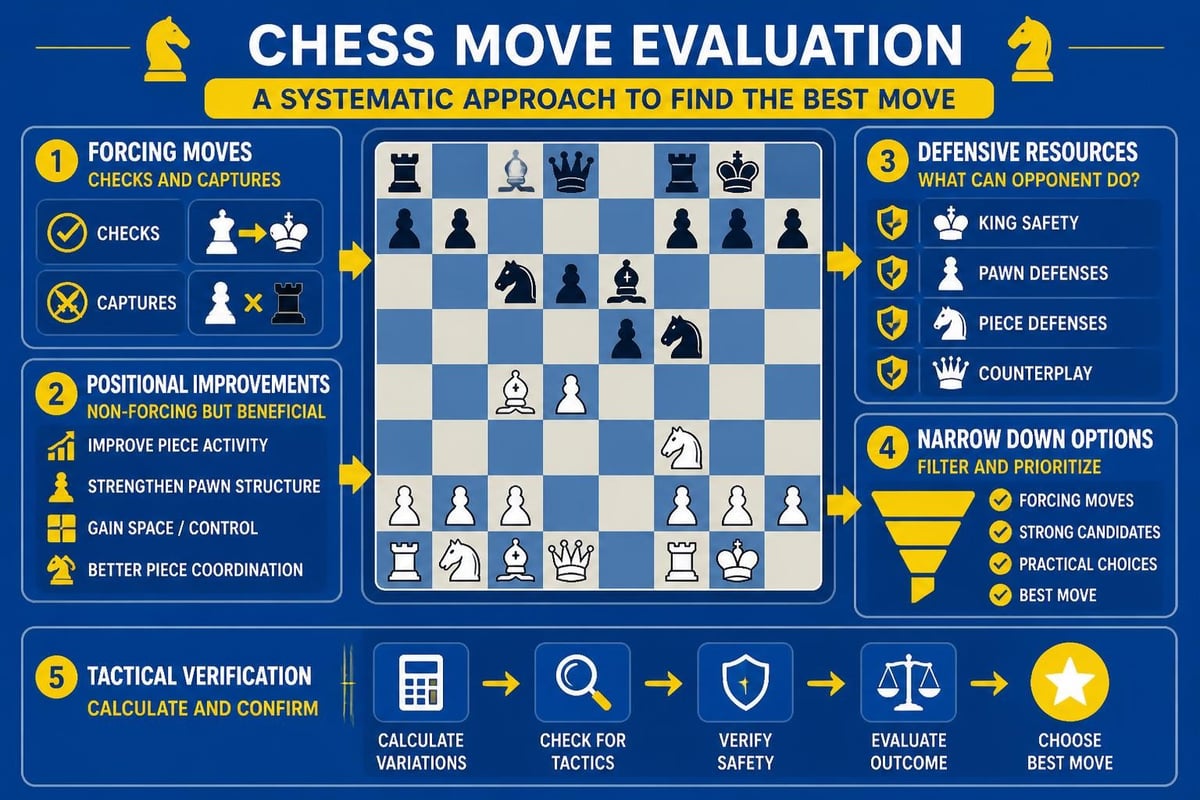
One of the most effective ways to find best move chess options is the candidate move approach. Rather than impulsively playing the first attractive move you spot, you generate a shortlist of possibilities and evaluate each one.
Here's how this works in practice:
- Identify forcing moves first (checks, captures, threats)
- Consider quieter positional improvements (piece repositioning, pawn breaks)
- Look for defensive resources if you're under pressure
- Evaluate each candidate for tactical soundness and strategic merit
This systematic approach, detailed in practical candidate move selection methods, prevents you from missing obvious tactics whilst ensuring you don't overlook subtle improvements.
Asking the Right Questions
When evaluating each candidate, ask yourself specific questions rather than vaguely wondering if a move "looks good." Does it improve my worst-placed piece? Does it create threats my opponent must address? Am I leaving anything undefended?
These questions create a mental checklist that becomes automatic with practice. If you're just getting started with chess fundamentals, our comprehensive chess guide provides the foundation you need.
Using Chess Engines Effectively
Chess engines are incredible learning tools, but only if you use them properly. Simply checking what Stockfish says after every move won't help you improve. Understanding how chess engines function helps you interpret their suggestions meaningfully.
The Pre-Analysis Rule
Before checking the engine, spend time analyzing the position yourself. Write down what you think the best moves are and why. This forces you to engage with the position rather than passively consuming computer evaluations.
When you do consult the engine, you'll understand why certain moves work because you've already thought about the position deeply. This method, emphasized in guides on analyzing your chess games, transforms engine checking from passive observation to active learning.
Multi-PV Analysis for Context
Standard engine analysis shows you one "best" move, but chess positions often have multiple reasonable options. Multi-PV analysis displays several candidate moves with their evaluations, helping you understand when a position offers flexibility versus when only one move maintains your advantage.
| Analysis Mode | Best For | Limitation |
|---|---|---|
| Single-line (depth 20+) | Critical positions, tactics | Misses alternative ideas |
| Multi-PV (3-5 lines) | Understanding options, opening prep | Less depth per line |
| Infinite analysis | Complex endgames, study positions | Time-consuming |
This table shows how different analysis approaches serve different purposes. When you're trying to find best move chess solutions in your games, Multi-PV often provides the most educational feedback.
Practical Position Evaluation
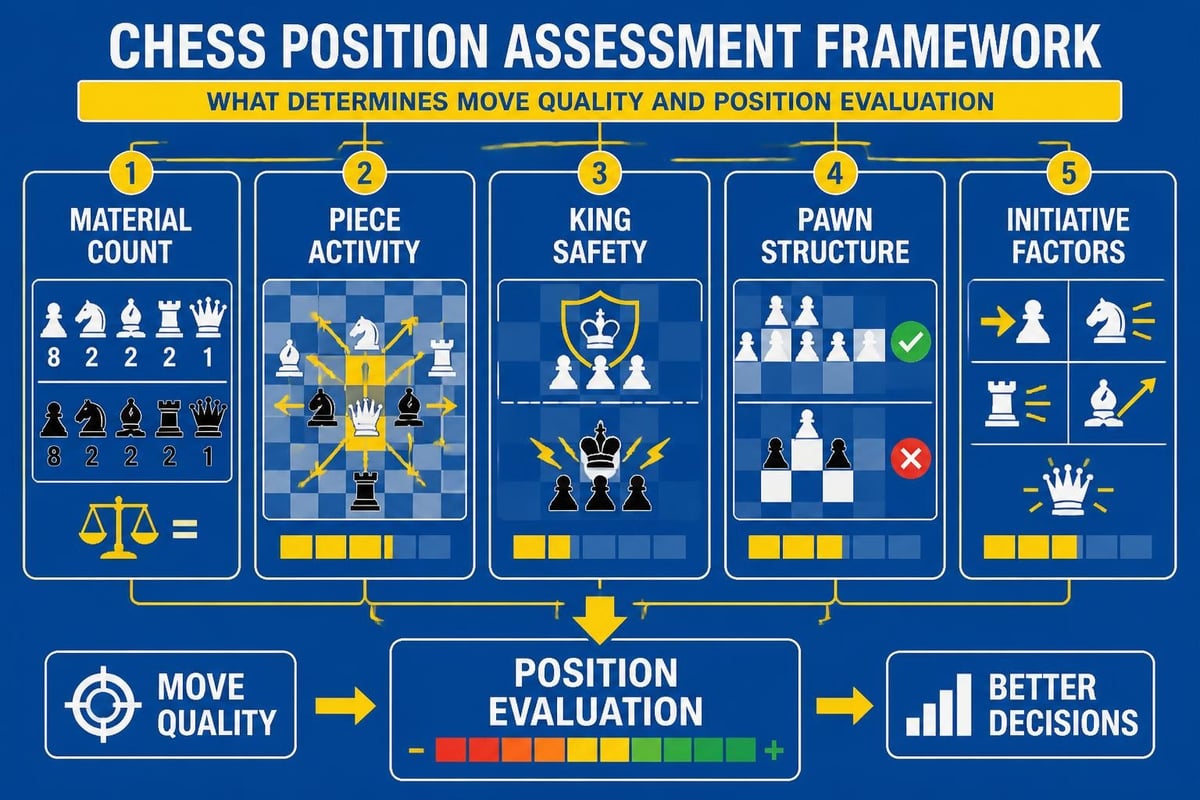
To find best move chess candidates effectively, you need quick position evaluation skills. You can't calculate every possibility, so you must efficiently assess which moves deserve deeper analysis.
The Threat Recognition Framework
Start every position assessment by identifying:
- Immediate threats your opponent is making
- Tactical opportunities available to you
- Vulnerable pieces on both sides
- Key squares that control the position
This framework, outlined in identifying your next chess move, gives you a mental map of the position's critical features. You're not trying to calculate everything-you're finding the tactical and strategic landmarks that matter most.
Material vs Initiative Trade-offs
Sometimes the best move sacrifices material for initiative. Other times, you should simplify into a favorable endgame. Recognizing these trade-offs requires understanding positional compensation.
When you sacrifice a pawn for piece activity, you're making a positional investment. The move is only "best" if the compensation (open lines, piece coordination, attacking chances) justifies the material deficit. This judgment improves with experience and pattern recognition.
Opening Preparation and Best Moves
In the opening phase, finding the best move often means following established theory-but not blindly. Understanding why certain moves are recommended helps you handle transpositions and novelties.
Theory vs Understanding
Let's say you're playing the Sicilian Defense. Memorizing the first 15 moves is one thing, but understanding the strategic ideas behind those moves helps you find best move chess solutions when opponents deviate from known lines.
Similarly, knowing the pros and cons of the Queen's Gambit means you can assess new positions based on whether they align with the opening's strategic goals. You're not guessing-you're applying principles.
Popular openings worth studying include:
- Ruy Lopez for classical strategic play
- Italian Game for tactical sharpness
- London System for solid, flexible structures
- Caro-Kann Defense for solid counterplay as Black
Each opening has characteristic positions where certain moves are thematically strong. Our Italian Game guide and London System overview break down these typical ideas.
Tactical Pattern Recognition
Many "best moves" involve standard tactical patterns. The more patterns you recognize instantly, the faster you'll spot strong continuations without lengthy calculation.
Common Tactical Themes
Here are patterns you should recognize automatically:
- Forks (one piece attacks two targets)
- Pins (piece cannot move without exposing more valuable piece)
- Skewers (forcing more valuable piece to move, exposing lesser piece)
- Discovered attacks (moving one piece reveals attack from another)
- Deflection (forcing defender away from critical square)
- Decoy (luring piece to unfavorable square)
When you spot these patterns quickly, you naturally generate stronger candidate moves. The position practically tells you where to look when you've internalized these themes.
Brilliant Moves Explained
You might have seen chess platforms highlight "brilliant moves" in your games. These are moves that sacrifice material or find the only path in a complex position. Understanding what makes a move brilliant helps you recognize similar opportunities.
A brilliant move often involves:
- Non-obvious sacrifice that engines initially miss
- Only winning continuation in a position with many plausible moves
- Deep calculation proving compensation for material
- Refutation of opponent's best defense
You won't play brilliant moves every game, but understanding the concept helps you recognize when positions might contain hidden tactical shots worth investigating.
Time Management and Move Selection
Finding the best move means nothing if you flag with 10 moves to go. Effective time management balances accuracy with practical necessity.
The Critical Position Concept
Not all positions deserve equal thinking time. Identify critical moments where the evaluation might shift dramatically:
- Tactical complications arising
- Transition points between game phases
- Decisive pawn breaks becoming available
- King safety suddenly compromised
Spend your time budget on these critical positions. In quieter moments, play good moves quickly and save time for when it truly matters. This practical approach helps you consistently find best move chess solutions under time pressure.
| Position Type | Recommended Time | Key Focus |
|---|---|---|
| Opening theory | 10-30 seconds | Pattern recognition |
| Quiet middlegame | 1-2 minutes | Improving worst piece |
| Tactical position | 3-5 minutes | Calculation verification |
| Critical moment | 5-10 minutes | Deep analysis, all candidates |
Post-Game Analysis Techniques
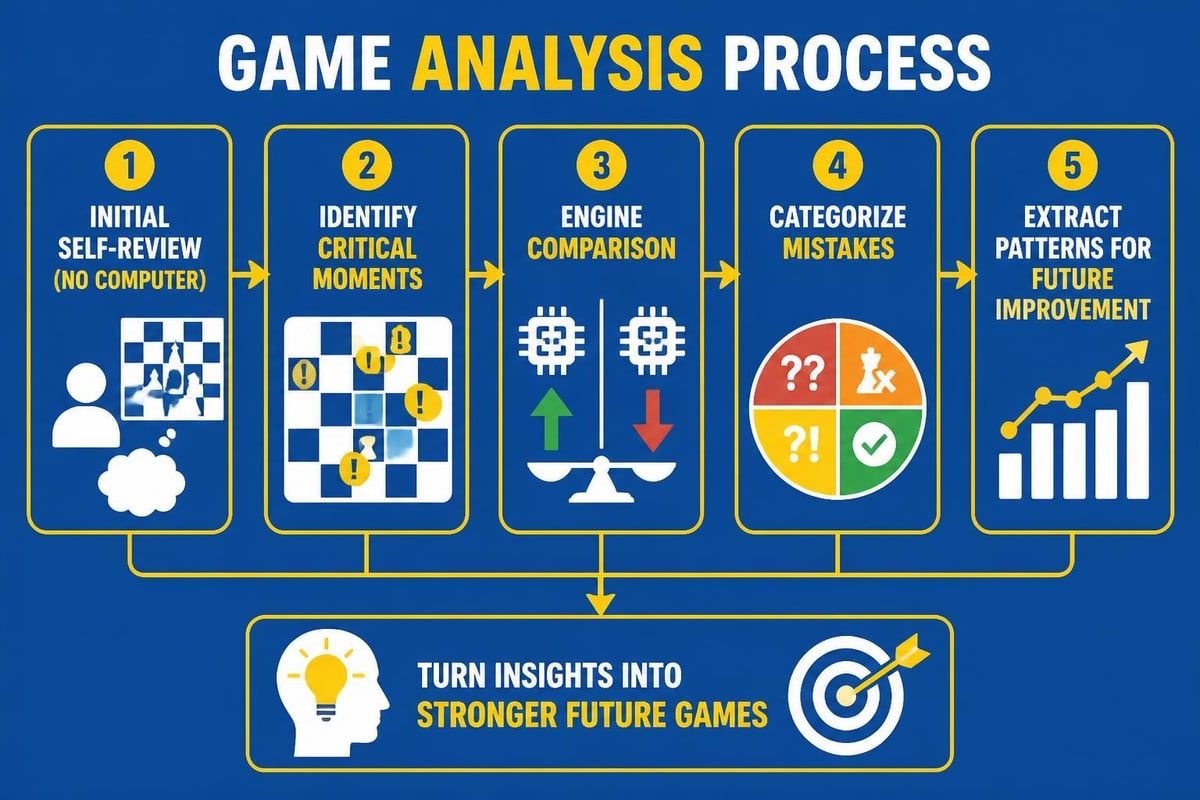
The fastest way to improve at finding best moves during games is rigorous post-game analysis. This is where you compare your thinking with objective reality.
The Two-Pass Analysis Method
First pass: Review the game without engines. Write down where you struggled, what you considered, and what you missed. This self-analysis, recommended in comprehensive game review guides, shows you where your thinking process broke down.
Second pass: Now check with an engine. Compare its suggestions to your analysis. When they differ, understand why. Did you miscalculate? Miss a tactical blow? Misjudge the position? Each discrepancy is a learning opportunity.
Learning from Mistakes
Don't just note that move 23 was wrong. Understand what made you choose it. Were you focused on the wrong part of the board? Did you underestimate opponent's counterplay? Identifying thinking errors is more valuable than simply cataloging move errors.
This is particularly valuable when studying chess master levels-you'll notice that stronger players make different types of mistakes, not necessarily fewer of them.
Training Your Calculation Skills
To find best move chess solutions reliably, you need solid calculation ability. This doesn't mean seeing 20 moves ahead-it means accurately calculating 3-5 move sequences in forcing positions.
Visualization Exercises
Practice calculating without moving pieces. Start with simple tactical puzzles, calculate the solution in your head, then verify. Gradually increase difficulty as your visualization improves.
Key calculation skills include:
- Seeing forcing sequences (checks, captures, threats) clearly
- Counting material accurately after exchanges
- Recognizing when calculation is necessary vs when positional judgment suffices
- Verifying your calculation by looking for defensive resources
Working on chess puzzles that improve positional skills develops both tactical sharpness and strategic understanding simultaneously.
Blunder Checking
Before playing any move, spend 5-10 seconds on blunder checking. Ask: "What does this move allow my opponent to do?" This simple habit catches hanging pieces and tactical oversights that even strong players occasionally miss.
The blunder check shouldn't paralyze you with fear of every move. It's a quick scan for obvious problems before committing to your choice.
Developing Positional Judgment
Not every position requires concrete calculation. Many middlegame and endgame decisions rely on positional judgment-the ability to assess which features matter most in a given position.
Evaluating Imbalances
Positions are rarely perfectly equal. Usually, one side has certain advantages whilst the opponent has different ones. Perhaps you have better pawn structure but your opponent has more active pieces. The best move often depends on which imbalance you can exploit most effectively.
Consider these imbalances:
- Material vs activity
- Space vs piece coordination
- Bishop pair vs pawn structure
- Initiative vs solidity
- Attacking chances vs defensive resources
Understanding these trade-offs, particularly in common structures from openings like the Catalan Opening or Nimzo-Indian Defense, helps you find moves that maximize your position's specific strengths.
Building a Personal Opening Repertoire
Having a solid opening repertoire means you've already done the work to find best move chess solutions in the early game. You can focus mental energy on the middlegame rather than reinventing the wheel every game.
Choosing Openings That Suit Your Style
If you love attacking, the King's Gambit offers sharp tactical play. Prefer positional squeezing? The English Opening might suit you better. Understanding the most common chess openings helps you make informed repertoire choices.
Your repertoire should be:
- Manageable (not too many variations)
- Thematically consistent (similar pawn structures, plans)
- Suitable for your playing style
- Sound at your level
Don't try to memorize everything. Focus on understanding typical positions and plans, then apply those principles when novelties arise.
The Role of Intuition
As you gain experience, you'll develop chess intuition-the ability to "feel" when a move is right without calculating everything. This isn't magic; it's pattern recognition built from thousands of positions.
Trusting Your Gut (Sometimes)
Intuition works best in familiar position types. If you've played similar structures dozens of times, your instinct about the best plan is probably sound. But in sharp tactical positions, verify your intuition with calculation.
The balance between intuition and calculation improves with experience. Beginners should calculate more and trust less. Intermediate players can increasingly rely on pattern recognition in familiar territory whilst calculating in critical moments.
Working with an online chess coach can help calibrate your intuition, showing you when to trust your judgment and when to calculate deeper.
Continuous Improvement Strategies
Getting better at finding best moves isn't a destination-it's an ongoing process. Here's how to maintain steady improvement:
Regular Training Habits
- Daily tactics (15-20 minutes)
- Weekly game analysis (review 2-3 games thoroughly)
- Monthly opening review (update repertoire, patch weaknesses)
- Quarterly assessment (track rating, identify patterns in losses)
This structured approach ensures you're addressing all aspects of move selection: tactics, calculation, positional judgment, and opening knowledge.
Measuring Progress
Track your chess rating over time, but also monitor qualitative improvements. Are you missing fewer tactics? Finding strong moves faster? Making better decisions under time pressure? These indicators often improve before your rating jumps.
Keep a training journal noting what you're working on and what you're learning. Review it monthly to see patterns in your development and adjust your training focus accordingly.
Finding the best move consistently transforms your chess from guesswork into informed decision-making. Whether you're evaluating candidate moves systematically, using engines effectively, or building pattern recognition through study, each method contributes to stronger play. If you're ready to accelerate your improvement with structured learning materials that distill complex concepts into digestible formats, Chess Cheat Sheets provides opening guides, tactical puzzles, and endgame resources designed specifically for players who want to improve efficiently without drowning in endless theory. Start building your chess foundation today with our comprehensive resources.


