

Ever felt overwhelmed by the sheer depth of chess knowledge out there? You're not alone. The beautiful game has been studied for centuries, and the amount of information available can feel paralysing rather than empowering. That's where quality chess guides come in, transforming complex theory into digestible, actionable knowledge that actually improves your play. Whether you're just learning how the pieces move or pushing towards intermediate mastery, the right guidance makes all the difference between spinning your wheels and making genuine progress.
Why Chess Guides Matter More Than Ever
The chess world has exploded in popularity over recent years, and with it, an avalanche of content. YouTube videos, online courses, apps, books, articles-the options are endless. But here's the thing: more isn't always better. Without structure, you'll jump from one shiny resource to another, never building the solid foundation you need.
Quality chess guides provide that structure. They offer curated pathways through the chaos, helping you focus on what actually matters at your current level. Think of them as your personal roadmap, showing you exactly where to direct your energy for maximum improvement.
The Learning Curve Without Proper Guidance
Let me ask you something: have you ever spent hours studying an opening, only to forget everything the moment you sit down to play? That's what happens when you learn without a system. Random study creates random results.
Chess guides solve this by:
- Breaking down complex concepts into manageable chunks
- Providing sequential learning that builds on previous knowledge
- Offering practical application through examples and exercises
- Saving countless hours of trial and error
The difference between struggling for years and making steady progress often comes down to having the right guide at the right time.
Types of Chess Guides You Actually Need
Not all chess guides are created equal, and you definitely don't need them all. Let's break down the essential categories and when you should prioritize each one.
Opening Guides: Your First Move Advantage
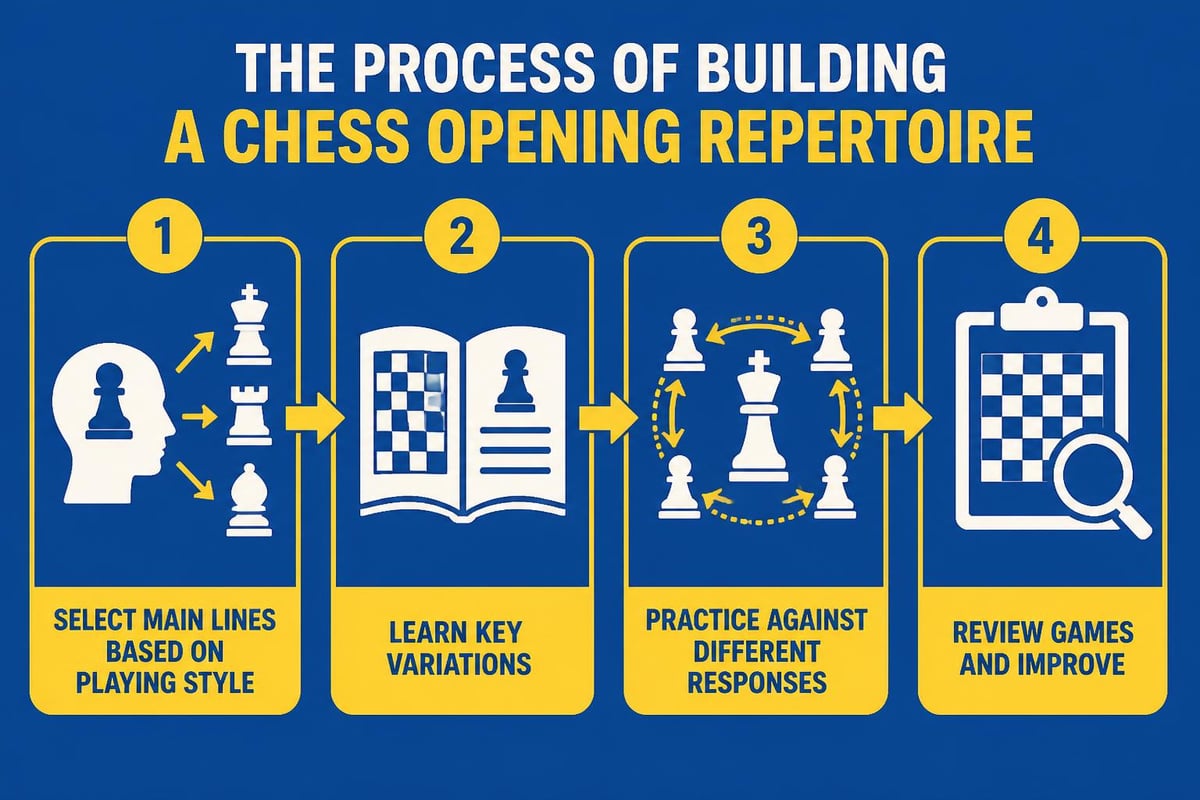
Opening theory can seem intimidating, with thousands of variations and seemingly endless possibilities. But here's a secret: you don't need to know everything. What you need is a solid repertoire that suits your style.
Understanding effective chess openings for white can give you immediate confidence in your games. Similarly, knowing which defences work best when facing white's first move ensures you're never caught off guard.
| Guide Type | Best For | Time Investment |
|---|---|---|
| Quick-start opening guides | Beginners wanting immediate playable lines | 2-4 hours |
| Comprehensive opening courses | Intermediate players building deep knowledge | 20-40 hours |
| Repertoire books | All levels creating a complete system | Ongoing |
| Video series | Visual learners who prefer explanation | 5-15 hours |
The London System, for instance, offers a straightforward approach that doesn't require memorising dozens of variations. It's exactly the type of opening that beginners to intermediate players should consider.
Tactical Training Guides
Tactics win games. Full stop. You can have perfect opening knowledge and deep positional understanding, but if you miss a simple fork or pin, you'll still lose. That's why tactical guides form the backbone of chess improvement.
The best tactical guides don't just throw puzzles at you randomly. They organize patterns into categories:
- Forks and skewers
- Pins and discovered attacks
- Removal of the defender
- Deflection and decoy
- Back rank weaknesses
When you train with organized patterns, you start recognizing them instantly in your games. It's like learning to read-at first, you sound out each letter, but eventually, you recognize whole words at a glance.
Endgame Resources: Where Games Are Won
Here's something most players get wrong: they obsess over openings and ignore endgames. Yet statistically, improving your endgame technique will boost your rating faster than memorizing opening theory.
Why? Because endgames appear in every single game you play to completion. Master the fundamentals, and you'll convert winning positions that others would draw, and save half-points from losing positions.
Essential endgame knowledge includes:
- King and pawn endings (the foundation of all endgames)
- Rook endgames (appearing in roughly 50% of all endings)
- Minor piece endings (bishops vs knights, opposite-colored bishops)
- Queen endgames (surprisingly common and often mishandled)
The beauty of endgame guides is that you can actually master them. Unlike openings, which constantly evolve with new theory, endgame principles remain constant. Learn them once, and they're yours forever.

How to Choose the Right Chess Guides for Your Level
This is crucial. Picking advanced guides when you're still learning basics is like trying to run before you can walk. You need resources that match your current understanding while gently stretching you toward the next level.
For Absolute Beginners
If you're just starting out, you need clear fundamentals on how to play chess before diving into complex theory. Your first guides should cover:
- How each piece moves and captures
- Basic checkmate patterns
- Fundamental opening principles (control the centre, develop pieces, castle early)
- Simple tactical motifs
- Elementary endgames (how to checkmate with queen and rook)
Don't rush this stage. A solid foundation here prevents bad habits that plague players for years.
For Improving Players (1000-1600 Rating)
You've got the basics down, and now you're ready to develop your game more systematically. Structured study plans become essential at this stage.
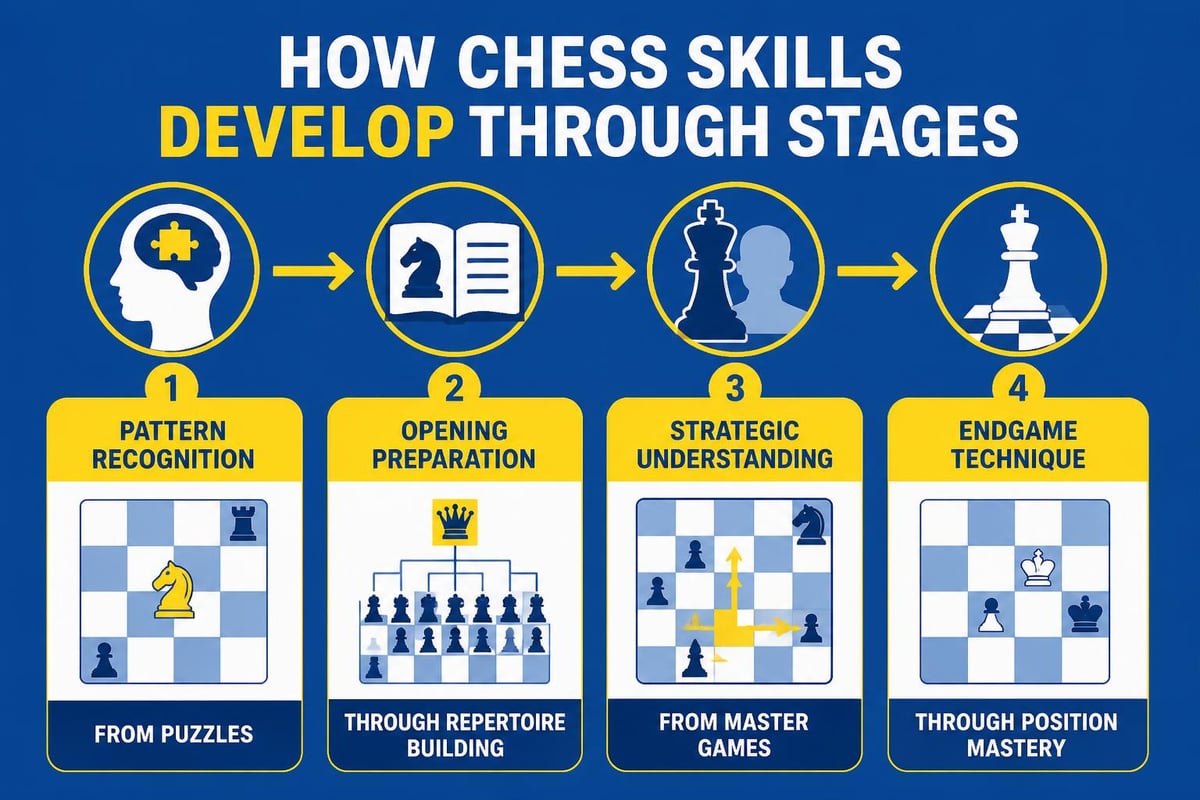
Focus your guide selection on:
- Building a consistent opening repertoire (2-3 openings with white, 2-3 defences for black)
- Intermediate tactics and combination recognition
- Basic positional concepts (pawn structure, weak squares, piece activity)
- Converting advantages in the endgame
- Analyzing your own games effectively
At this level, exploring different opening systems like the English Opening can broaden your understanding without overwhelming you.
For Intermediate Players (1600-2000 Rating)
Now you're playing serious chess. Your guides need to deepen understanding rather than just provide surface knowledge. This is where you might explore advanced chess literature that challenges your thinking.
You should be working with:
- In-depth opening guides that explain plans and ideas, not just moves
- Complex tactical puzzles requiring 3-5 move calculations
- Strategic masterpieces from top players
- Advanced endgame theory
- Psychological aspects of competitive play
Maximizing Your Time with Chess Guides
Let's be honest: you're busy. Between work, family, and everything else, you might have 30 minutes to an hour for chess on a typical day. How do you make that time count?
The 80/20 Principle for Chess Study
Not all study is equally valuable. Research suggests that 20% of your chess knowledge will win you 80% of your games. The trick is identifying that crucial 20%.
For most players, this means:
- Master fundamental tactics (covers about 40% of your crucial knowledge)
- Learn one solid opening system for white and black (20%)
- Study basic endgame positions (20%)
- Analyze your own games regularly (20%)
Notice what's missing? Obscure opening variations, complex theoretical endgames, and memorizing famous games. Those can come later.
Creating Your Personal Study Schedule
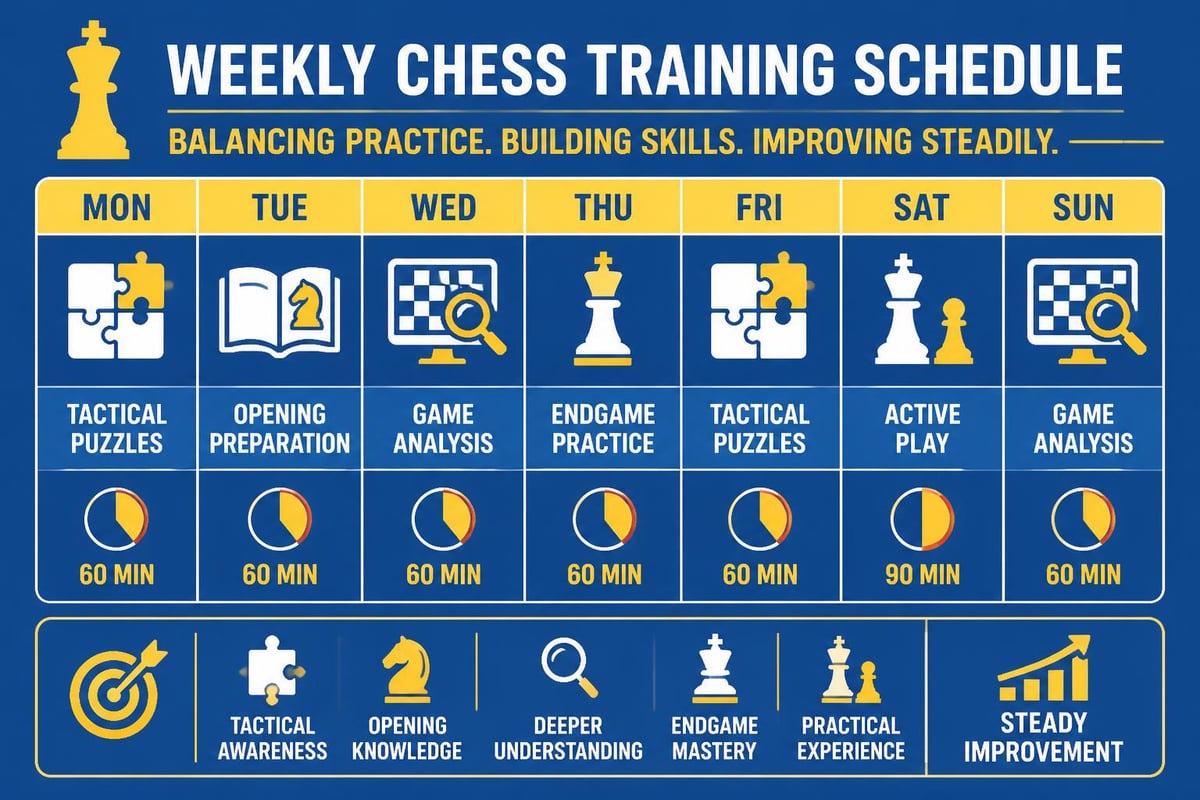
Here's a practical weekly schedule that actually works:
| Day | Focus Area | Time | Activity Type |
|---|---|---|---|
| Monday | Tactics | 30 min | Puzzle solving |
| Tuesday | Opening | 30 min | Repertoire review |
| Wednesday | Playing | 60 min | Slow time control games |
| Thursday | Tactics | 30 min | Pattern recognition |
| Friday | Endgame | 30 min | Position practice |
| Saturday | Analysis | 45 min | Review your games |
| Sunday | Strategy | 30 min | Master game study |
Consistency beats intensity. Thirty minutes daily will improve your chess faster than a six-hour weekend binge session. Why? Because spaced repetition-reviewing concepts multiple times over days and weeks-creates lasting learning.
Common Mistakes When Using Chess Guides
Even with excellent resources, players sabotage their progress through avoidable mistakes. Let me save you some frustration by highlighting the biggest traps.
The Collector's Fallacy
How many chess books sit on your shelf, half-read or never opened? How many courses have you bought but never completed? You're not alone. Many players confuse acquiring knowledge with actually learning it.
One guide thoroughly studied beats ten guides skimmed. Pick your resource, commit to finishing it, and actually do the exercises. That PDF sitting in your downloads folder won't improve your chess until you engage with it.
Skipping the Hard Parts
Here's human nature: we gravitate toward what we already understand and avoid what challenges us. If tactics feel easy but endgames confuse you, guess which one you'll naturally spend more time on?
The problem? Your chess strength is determined by your weakest area, not your strongest. Improving at chess requires honest self-assessment and deliberate practice in uncomfortable areas.
Not Applying What You Learn
Reading about the Sicilian Defense doesn't mean you understand it. You need to play it, make mistakes with it, get crushed using it, and gradually improve. Theory without practice is entertainment, not education.
After studying any guide:
- Play practice games applying the concepts
- Review what went wrong when you lost
- Adjust your understanding based on practical experience
- Repeat the cycle until the knowledge becomes intuitive
Digital vs Physical Chess Guides
In 2026, we're spoilt for choice in format. Should you stick with traditional books, embrace digital resources, or use both? Let's examine the real advantages of each.
The Case for Physical Resources
There's something about holding a chess book that digital can't quite replicate. Physical guides offer:
- Deeper focus without digital distractions
- Better retention through physical interaction
- Easy reference without battery concerns
- Marginal notes and personal annotations
Many strong players still swear by comprehensive physical guides for serious study sessions.
Digital Advantages
That said, digital chess guides have transformed how we learn:
- Instant access to thousands of resources
- Interactive diagrams and analysis boards
- Video explanations showing ideas dynamically
- Regular updates as theory evolves
- Searchability for quick reference
The best approach? Use both strategically. Deep study with physical books, quick reference and practice with digital tools.
Integrating Guides with Actual Play
Here's the ultimate truth: chess guides don't make you better at chess. Playing chess makes you better at chess. Guides just make that improvement faster and more efficient.
The Study-Play-Review Cycle
For every hour you spend studying guides, you should spend at least an hour playing and reviewing. Understanding how to win chess games requires putting theory into practice repeatedly.
The optimal learning cycle looks like this:
- Study a specific concept from your guide (20 minutes)
- Play 2-3 games trying to apply it (60 minutes)
- Review those games, noting successes and failures (20 minutes)
- Return to the guide with specific questions (10 minutes)
- Repeat with the same concept until it becomes natural
This active learning approach embeds knowledge far deeper than passive reading ever could.
Tracking Your Progress
How do you know if your study is working? You need concrete metrics:
- Rating changes over 3-month periods
- Tactical puzzle accuracy and speed
- Win rate with specific openings
- Game quality (fewer blunders, better plans)
- Endgame conversion rate (winning technically won positions)
Keep a simple spreadsheet or journal tracking these metrics monthly. When you see tangible improvement, it motivates continued study. When progress stalls, it signals the need to adjust your approach.
Specialized Guides Worth Exploring
Beyond the basics, certain specialized chess guides can unlock specific aspects of your game that general resources miss.
Opening-Specific Deep Dives
Once you've chosen your repertoire, consider guides dedicated entirely to those systems. The depth of understanding you gain from a 300-page book on the King's Indian Defense far exceeds what a general opening guide can provide.
These specialized resources help you understand:
- Typical middlegame structures arising from your openings
- Strategic plans for both sides
- Tactical patterns specific to the position type
- Move order nuances that avoid opponent's preparation
Thematic Puzzle Collections
Rather than random tactical puzzles, thematic collections focusing on specific patterns accelerate pattern recognition. When you solve 50 examples of the same tactical motif, you start seeing it instantly in games.
High-value themes to study include:
- Weak back ranks
- Knight forks
- Bishop pair advantages
- Pawn breakthroughs
- Piece sacrifices for attack
Positional Guides and Strategy
Tactics get you to intermediate level, but strategy takes you beyond. Positional guides teach you what to do when there's no immediate tactic available, which is actually most of the time in chess.
Understanding chess strategy through structured guides helps you formulate plans, evaluate positions accurately, and make purposeful moves rather than just moving pieces randomly.
Building Your Personal Chess Library
You don't need 100 chess guides. You need the right 10-15, thoroughly studied. Here's how to build a collection that actually serves your improvement.
Core Essentials (Every Player Needs These)
Start with these foundational categories:
- One comprehensive beginner guide covering all basics
- One opening guide for white and one for black
- One tactical puzzle book appropriate to your level
- One endgame manual covering fundamentals
- One strategy book on positional play
That's five resources. Master these before buying anything else.
Expansion Based on Weaknesses
Once you've thoroughly worked through your core guides, expand strategically:
- Struggling with calculation? Add a visualization training guide
- Losing most endgames? Invest in advanced endgame resources
- Getting crushed in your favorite opening? Find a specialized repertoire book
- Making strategic mistakes? Study classic games with annotations
Let your actual game results guide your purchases. Buy guides that solve problems you're actually experiencing.
The right chess guides transform overwhelming complexity into a clear path forward, helping you build skills systematically rather than randomly. Whether you're just starting your chess journey or pushing toward expert strength, quality resources paired with consistent practice create genuine improvement. Chess Cheat Sheets offers streamlined guides, opening cheat sheets, and practical resources specifically designed to help beginners and intermediate players master essential concepts without getting lost in excessive theory. Ready to accelerate your chess improvement with resources that actually work?


