

Are you tired of memorizing endless chess opening lines that never seem to stick? The London System is quickly becoming the go-to weapon for club players and ambitious improvers aiming for consistent, powerful results in 2026.
In this guide, you’ll discover how to master the London System step by step, supported by expert strategies, the latest theory, and a comprehensive london system chess pdf you can download for instant reference.
We’ll walk you through its fascinating origins, essential move orders, modern attacking trends, and practical plans you can use right away. Ready to play with confidence and creativity? Grab your free PDF guide and start dominating your games today.

Understanding the London System: History, Core Concepts, and Why It Matters in 2026
Have you ever wondered how a chess opening from the 19th century became a go-to weapon for modern players? The story of the London System is a fascinating journey through chess history, innovation, and practical mastery. If you’re looking for a london system chess pdf to guide your studies, understanding the roots and philosophy behind this opening will give you a strong foundation.

Origins and Evolution of the London System
The London System first appeared in 1882, in a game between Mason and Blackburne in Vienna. Its name comes from its frequent use in London tournaments during the late 19th and early 20th centuries. This opening quickly caught the attention of greats like Emanuel Lasker, Mikhail Chigorin, Wilhelm Steinitz, and Alexander Alekhine.
What made it so appealing? The London System offered a reliable way to develop pieces and fight for the center without getting lost in endless theory. Over the decades, it found a home in club play and online chess, where players valued its simplicity and effectiveness.
Fast forward to today, and you’ll see top grandmasters like Gata Kamsky and Magnus Carlsen using the London System at the highest levels. Their games have fueled a surge of interest, inspiring many to seek out a london system chess pdf that breaks down the moves and plans. The opening’s evolution reflects the changing landscape of chess, blending classical ideas with modern preparation.
Key Characteristics and Philosophy
So, what makes the London System so special? At its core, it’s a universal system. You can play the main setup against almost any Black defense after 1.d4. The typical structure involves moves like d4, Nf3, Bf4, e3, c3, and Bd3. This approach emphasizes a solid pawn structure, flexibility, and active piece play.
One of the London’s key strengths is that you don’t need to memorize endless lines. Instead, focus on understanding your plans and adapting to what your opponent does. This is why so many players, from beginners to masters, turn to a london system chess pdf for visual guides and step-by-step strategies.
Here’s a quick snapshot of the London System philosophy:
- Develop your dark-square bishop early, outside the pawn chain.
- Control central squares, especially e5.
- Stay flexible—delay castling if it helps your plan.
- Use your queen wisely, often on e2 or b3.
- Be ready to adjust based on Black’s response.
For a deeper dive into these core ideas and practical resources, you might find the London System Opening Guide especially helpful.
Why the London System Remains Effective in 2026
Why is the London System still thriving in 2026? The answer lies in its adaptability and proven results. With the explosion of online chess, players want openings that are easy to learn but hard to break. The london system chess pdf resources now offer up-to-date theory, annotated games, and practical exercises tailored for today’s competitive environment.
Recent computer analysis has uncovered new attacking ideas, making the London more dynamic than ever. Even as Black players come up with “anti-London” setups, the opening’s flexibility lets you adjust and find fresh plans. Experts describe the system as “extremely solid” and “full of poison”—meaning it’s tough to crack but dangerous if underestimated.
Most importantly, the London System gives you room to be creative. You can follow established plans or bring your own ideas into the middlegame. That’s why so many club and tournament players trust it, and why having a reliable london system chess pdf at your side can make all the difference.
Step-by-Step: Building the London System Setup
Ready to bring structure and confidence to your opening play? Let’s walk through the London System setup, step by step. This approach is all about clarity, flexibility, and practical results. Whether you are new to the london system chess pdf resources or looking to polish your repertoire, this guide will help you build a rock-solid foundation.
Chronological Guide to the Main Move Order
The London System shines because its setup is logical and easy to remember. Here’s the classic move order you’ll want to follow:
- 1.d4 – Claim the center and open lines for your pieces.
- 2.Nf3 – Develop your knight, adding flexibility and preparing for Bf4.
- 3.Bf4 – The heart of the London, getting your bishop outside the pawn chain early.
- 4.e3 – Support your center and open lines for your other bishop.
- 5.Nbd2 – Connect your knights and reinforce e4 ideas.
- 6.c3 – Strengthen d4 and prepare for possible c4.
- 7.Bd3 (or sometimes Be2) – Aim your bishop at h7, setting up kingside pressure.
This sequence lets you avoid complex theory and focus on understanding plans, which is why so many players turn to the london system chess pdf guides for quick reference. You can adjust the order based on your opponent’s replies, but this setup works against almost anything Black throws at you.
By following these steps, you keep your position safe and your options open. Many club players find that with a london system chess pdf as a study companion, they remember these moves much faster.
Key Principles for Each Move
Every move in the London has a purpose. Let’s break down the core ideas you should keep in mind:
- Flexibility: Adjust your setup to what Black plays. For example, if Black fianchettos with ...g6, you might delay c3 or consider c4 for more space.
- When to play c4: If you want dynamic positions, c4 can challenge Black’s center. However, sticking with c3 keeps things solid and simple.
- Castling: Many London players castle late. This lets you see where Black is aiming before committing your king.
- Queen placement: Place your queen on e2 or b3, depending on the position. Avoid c2 unless you have a clear reason.
- Light-square bishop: Develop it early to f4 before playing e3. This avoids it getting trapped and keeps your position harmonious.
If you’re working through a london system chess pdf, you’ll notice these principles come up again and again. They help you adapt to different setups and avoid falling into memorization traps.
Remember, the London is about understanding, not just copying moves. The more you internalize these ideas, the more confident you’ll feel in your games. When you see these patterns in your london system chess pdf, practice them on the board to reinforce your learning.
Common Transpositions and Pitfalls
The London System can morph into other openings based on what Black does. Sometimes, your position turns into a Slav, Stonewall, or even Caro-Kann Exchange. Here’s what to look out for:
- Transpositions: Be flexible. If Black plays ...c5 early, you can choose c3 or c4, depending on your comfort.
- Pitfalls: Avoid trading your Bf4 for Black’s bad bishop on f5 unless it helps your plan. Watch out for early queen moves by Black, like ...Qb6, which target your b2 pawn.
- Anti-London setups: If Black tries ...g6 or ...e6, remember your principles. Stick to your setup, but don’t be afraid to tweak move order if needed.
A good london system chess pdf will warn you about these common traps and show you how to sidestep them. Use move order tricks, like delaying Nbd2 or playing h3, to keep your opponent guessing.
Being aware of these nuances helps you avoid giving Black easy equality. The more you study these with a london system chess pdf, the more second nature your reactions become.
Chess Cheat Sheets: Visual Learning for the London System
Visual learning can speed up your mastery of the London. Chess Cheat Sheets offers plug-and-play guides and cheat sheets for the London System, making it easy to review main lines and plans during study or even over the board.

You’ll find concise move summaries, diagrams, and quick-reference tables that bring your london system chess pdf study to life. These resources are perfect for beginners and intermediates who want fast results without getting lost in dense theory.
If you want to build confidence and recall key ideas quickly, take advantage of Chess Cheat Sheets for Openings to supplement your pdf learning. The combination of visual aids and practical tips makes all the difference when you need to play with clarity and speed.
Modern Theory and Trends: How the London System is Played at Every Level
Curious about how the London System has managed to stay at the forefront of chess opening theory in 2026? You’re not alone. Players at all levels are eager to know how this classic system continues to adapt and thrive. Let’s dive into the latest trends and strategies shaping the London System chess pdf guides and real-world play today.

Latest Developments in London System Theory
The London System has experienced a renaissance, thanks in large part to computer engines and massive online databases. Engines like Stockfish and Leela have uncovered subtle move order tricks and fresh attacking plans, which are now featured in every serious london system chess pdf guide. One notable development is the rise of the Jobava-London, where White combines Nc3 and Bf4 for more dynamic play. This hybrid approach often leads to sharp, tactical battles instead of the slow maneuvering once associated with the opening.
You’ll also find more coverage of anti-London setups in modern resources. Black’s early ...c5, ...Qb6, or ...g6 are now met with precise, engine-tested responses. Model games from 2024 and 2025 show White launching quick attacks or switching plans to maintain an edge. For a deeper look at these shifts and statistical trends, check out The Most Recent Opening Trends, which highlights how the London System is evolving at every level.
Recent data from online databases shows the London System holding strong, with win rates for White around 53 percent in club play and even higher in blitz formats. These numbers are reflected in the latest london system chess pdf materials, which emphasize both solid and aggressive lines.
The London System in Online and OTB Chess
If you play on Chess.com or Lichess, you’ve probably noticed the London System in thousands of games, from rapid to blitz and even bullet. Its popularity is no accident. The london system chess pdf resources circulating in 2026 reflect how club and tournament players rely on its universal setup for consistent results.
Club players report that the London lets them avoid deep theoretical battles and focus on understanding plans. Tournament case studies from 2025 show several underdogs using the London System to upset higher-rated opponents. This is especially true in rapid and blitz time controls, where familiarity with the structure gives you an immediate practical advantage.
The London System’s flexibility also means you can stick to your favorite setup, regardless of your opponent’s responses. The latest london system chess pdf guides include annotated games from recent online tournaments, showing how players transition from opening to middlegame with confidence. The opening’s reliability and adaptability are key reasons it’s still a top choice for ambitious improvers.
Adapting Your London System to Opponent’s Choices
One of the reasons the London System stands out is its ability to adapt. In your london system chess pdf, you’ll see guidance on when to play c4 for more dynamic positions or to stick with c3 for solidity. Facing early ...Bf5, ...g6, or ...e6? Each of these setups requires a slightly different plan.
- Against ...Bf5: Consider Qb3 or Nh4 to challenge the bishop.
- Versus ...g6: Prepare for a kingside attack with h4-h5 or expand on the queenside.
- Against the Stonewall: Place your pieces flexibly and look for e4 breaks.
The London System’s plans can shift quickly, letting you attack on the kingside or expand on the queenside as needed. Your london system chess pdf should include model games and practical exercises to help you recognize these transition moments. By integrating these ideas, you’ll be ready for whatever your opponent throws your way.
Essential Plans, Strategies, and Typical Middlegame Ideas
When you dive into the heart of the London System, understanding plans and middlegame ideas is what sets you apart from the crowd. If you have a london system chess pdf at hand, you’ll notice that it always emphasizes strategic thinking over pure memorization. Let’s break down the essentials that will help you transform your games and make the most of your PDF study.
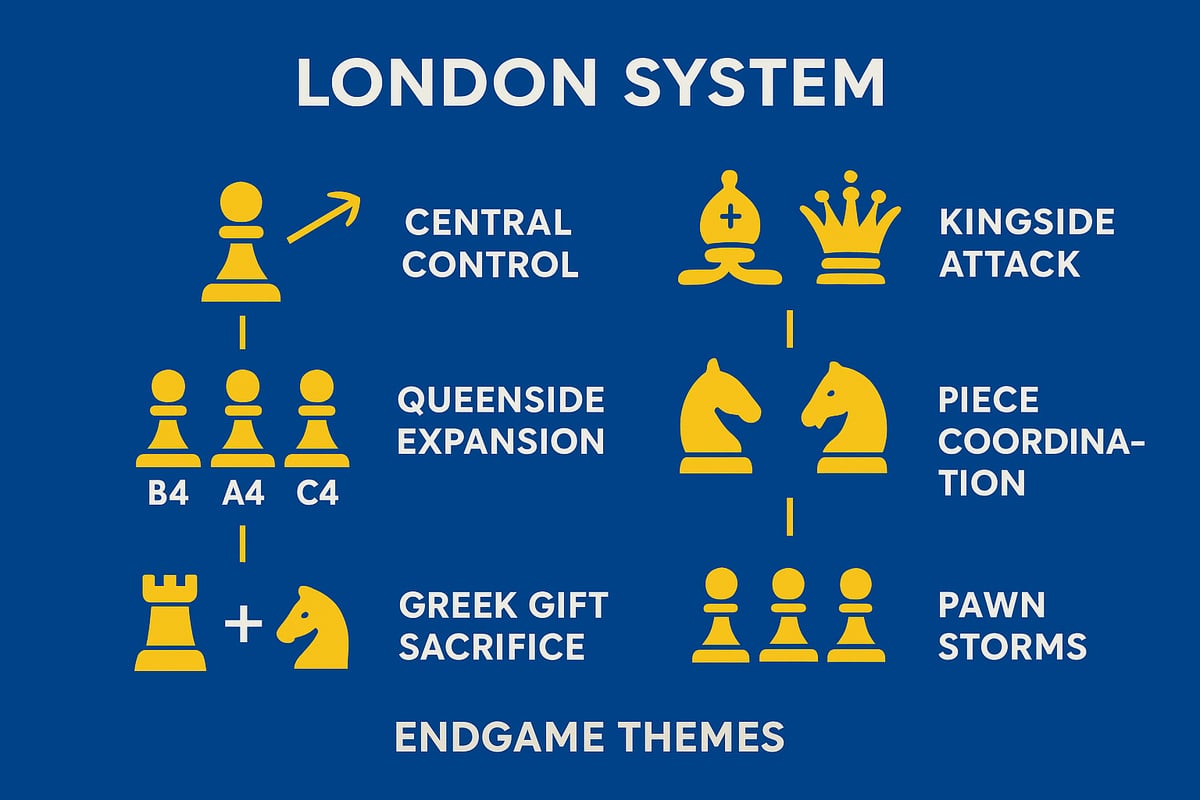
Main Strategic Themes in the London System
The backbone of the London System is its flexible strategic structure. Your london system chess pdf will highlight how White aims to control the center, especially with the e4 and e5 breakthroughs. These central pushes often decide when to switch from maneuvering to attacking.
A classic plan is the kingside attack. After placing your bishop on d3 and queen on e2, you can launch the h4-h5 pawn advance, often supported by a knight on e5. This formation targets Black’s king and forces defensive moves.
Queenside expansion is another strong weapon. Depending on Black’s setup, you might push b4, a4, or c4 to gain space and open lines for your rooks. The system’s piece coordination is key: both knights support central and kingside play, while the light-square bishop, developed early, prevents passive positions.
Here’s a quick table to summarize piece roles:
| Piece | Typical Square | Key Job |
|---|---|---|
| Queen | e2 or b3 | Support attacks, defend |
| Dark-square Bp | d3 or e2 | Pressure h7, defend center |
| Light-square Bp | f4 | Active before e3 |
| Knights | f3, d2, e5 | Central control, attack |
| Rooks | e1, d1, c1 | Central and open files |
By following these plans from your london system chess pdf, you’ll always know where your pieces belong.
Typical Tactical Motifs and Patterns
The London System isn’t just about slow maneuvering. There are sharp tactical ideas that appear again and again. One of the most famous is the “Greek Gift” sacrifice: Bxh7+! This classic tactic, with a follow-up of Ng5+ and Qh5, can punish careless kingside defense.
Pawn storms also feature strongly. If Black castles kingside, advancing h4-h5-g4-g5 can rip open lines and create decisive threats. Watch for weak squares like e5, c6, or h7 — these are frequent targets in your london system chess pdf exercises.
Exchange sacrifices, especially on g3 or f4, can catch Black off guard and shift the balance. Here’s a sample tactic in code-style notation:
1. d4 d5 2. Nf3 Nf6 3. Bf4 c5 4. e3 Nc6 5. Nbd2 Bf5 6. Bd3 Bxd3 7. cxd3 cxd4 8. exd4 Qb6 9. O-O Nxd4 10. Be3 Qxb2 11. Rb1 Qc3 12. Bxd4 Qxd4 13. Nxd4
Keep an eye out for these motifs — your london system chess pdf will often feature puzzles on them.
Common Endgames from the London System
Many games reach the endgame with White enjoying a space advantage or better pawn structure. Your london system chess pdf will teach you to recognize when to trade pieces and when to keep them for attacking chances.
Transitioning to a favorable endgame often involves exchanging off Black’s active pieces while keeping your strong bishop and central pawns. Doubled pawns on the c-file or isolated pawns on d4 can become assets or weaknesses, depending on the position.
Let’s compare common pawn structures:
| Structure | Strengths | Weaknesses |
|---|---|---|
| c3-d4-e3 triangle | Solid, controls center | Passive if static |
| Doubled c-pawns | Open files for rooks | Weak if not supported |
| Isolated d-pawn | Activity for pieces | Target in endgame |
A london system chess pdf helps you drill these structures, so you know exactly how to play them when the time comes.
Mistakes to Avoid and How to Punish Them
Even with good plans, it’s easy to fall into common traps. Overextending on the queenside without enough backup can leave your position vulnerable. Your london system chess pdf will warn you against making unfavorable exchanges, like trading the Bf4 for Black’s bad bishop on d7.
Ignoring Black’s counterplay in the center or on the queenside is a frequent pitfall. Stay alert for moves like ...c5 or ...Qb6, which put pressure on your setup. One way to deepen your understanding is to read the Pros and Cons of the London System, which goes beyond PDF basics and reveals practical insights from real games.
If you catch your opponent making these mistakes, don’t hesitate to seize the initiative and punish them with active play. Your london system chess pdf will give you the tools and examples you need for these critical moments.
Downloading and Using London System Chess PDF Guides Effectively
Are you looking to take your London System skills to the next level? A london system chess pdf can be your secret weapon for structured, focused improvement. Whether you’re new to the opening or refining your repertoire for 2026, using high-quality PDF guides makes learning efficient and enjoyable.
Let’s walk through how to find, use, and maximize the value of these resources—so you can start winning more games with confidence.
Where to Find Reliable London System PDF Resources
Finding the right london system chess pdf can feel overwhelming with so many options online. Start by looking for PDFs from trusted chess publishers, reputable blogs, and established online platforms. Prioritize guides updated for 2026, as recent theory and computer analysis make a difference.
Consider resources like The Agile London System PDF, which is highly regarded for its clear explanations and modern strategies. You might also check out A Comprehensive Guide to the London System for a broader learning experience.
When evaluating a london system chess pdf, use this checklist:
| Criteria | Why It Matters |
|---|---|
| Clear diagrams | Visual learning, easy reference |
| Up-to-date theory | Reflects current trends |
| Actionable advice | Practical plans you can use |
| Model games | See ideas in real situations |
Make sure your chosen guide includes these essentials for maximum value.
How to Use a PDF Guide for Maximum Improvement
Once you’ve picked a quality london system chess pdf, how do you get the most from it? Don’t just skim the main lines—instead, dive into the key plans and model games. Take notes as you go, and try to connect ideas to games you’ve played.
Practice is crucial. After studying a section, set up the positions on a board or use an online tool. Work through puzzles and exercises provided in your PDF. Try annotating your practice games, noting where you followed the guide’s advice and where you deviated.
Here’s a quick workflow you can use:
- Read a chapter or section.
- Play through the sample games and positions.
- Solve related exercises.
- Annotate your own London games for review.
This active approach helps cement the patterns and plans from your london system chess pdf into your over-the-board play.
Building Your Own London System Repertoire
A great london system chess pdf should serve as a foundation, not a rigid script. As you study, start customizing the material to fit your style and typical opponents. Keep a notebook or digital file with your favorite lines, tricky ideas, and results.
For easy tracking, try a simple code block in your notes:
Opponent: Lichess123
Line: 1.d4 d5 2.Nf3 Nf6 3.Bf4 c5 4.e3 Nc6 5.Nbd2
Result: Win
Notes: Used early Qb3, opponent missed e5 push.
Update your repertoire regularly as you learn new ideas or face different responses. Over time, your london system chess pdf becomes a living document, tailored to your growth and experience.
Supplementing PDFs with Other Learning Tools
No london system chess pdf, no matter how good, covers everything. Combine PDF study with other resources like video lessons, interactive trainers, and chess engines for analysis. Try reviewing your games on platforms like Chess.com’s opening explorer to see how your lines perform in practice.
Join online forums or chess clubs to discuss ideas and get feedback. Share annotated games with friends or coaches. This blend of study methods helps reinforce what you learn from your london system chess pdf and keeps your training fresh and motivating.
Keep exploring, experimenting, and updating your knowledge. With the right resources and approach, you’ll find yourself mastering the London System and enjoying your games more than ever.
Frequently Asked Questions About the London System in 2026
Are you curious about the london system chess pdf and how it fits into your chess journey? Here are the most common questions players ask in 2026.
Is the London System suitable for beginners, or should I learn other openings first?
Absolutely. The london system chess pdf is perfect for beginners. Its main ideas are easy to grasp, and you won’t get lost in endless theory. You can start playing real games while gradually improving your understanding.
How does the London System compare to the Queen’s Gambit or Colle System?
Here’s a quick comparison:
| Opening | Complexity | Flexibility | Theory Required |
|---|---|---|---|
| London System | Low | High | Low |
| Queen’s Gambit | Medium | Medium | Medium |
| Colle System | Low | Medium | Low |
The london system chess pdf stands out for its simplicity and universal approach.
What are the best lines for White if Black plays early ...c5 or ...g6?
If you see ...c5, you can play c3 or c4, depending on your style. Against ...g6, stick with your main setup and be ready for kingside play. The london system chess pdf covers these lines with clear, step-by-step advice.
Can the London System be played against all Black defenses?
Yes, the london system chess pdf is designed to work against almost every Black response. Whether Black plays ...d5, ...Nf6, or even ...e6, you’ll have a reliable plan.
How much theory do I really need to memorize?
You don’t need to memorize endless moves. Focus on plans and typical positions. For more on the learning curve, check out How Difficult Is the London System.
Are there any traps or quick wins in the London System?
Yes, there are a few sneaky tricks. Watch for tactical shots like Bxh7+ (the “Greek Gift”) or quick attacks if Black gets careless. Many traps are highlighted in your london system chess pdf resources.
How do I avoid becoming too predictable with the London?
Mix up your move order. Sometimes play c4 for extra tension or delay castling. The london system chess pdf suggests different setups to keep your opponents guessing.
What are the most common mistakes London System players make?
- Rushing queenside expansion without support
- Allowing the wrong exchanges
- Ignoring Black’s central counterplay
Review your games with a london system chess pdf to spot these patterns.
Where can I find annotated games and additional resources for ongoing improvement?
Start with your london system chess pdf, then supplement with video lessons and online databases. Annotated games are often included, so you can see real plans in action.
So, now that you’ve got a clear picture of what makes the London System so practical and powerful, why not take your next step toward mastering it? If you’re excited to put these strategies into practice and see consistent improvement, you don’t have to do it alone. There’s a whole world of opening guides, cheat sheets, and practical tips waiting for you—designed to make learning openings like the London System simple and effective. Ready to boost your confidence and results even more? Start Improving Your Openings and see how much easier chess can feel when you’ve got the right resources by your side.


