

You've probably heard someone mention that chess is more than just a game. Perhaps a teacher, parent, or coach has suggested it's somehow "good for the brain." But what does that actually mean in practical terms? The relationship between chess and education runs far deeper than most people realise, with decades of research revealing how this ancient game transforms the way students think, learn, and approach challenges. Whether you're a parent considering chess lessons for your child, an educator exploring new teaching methods, or simply curious about cognitive development, understanding this connection can open up fascinating possibilities.
The Science Behind Chess and Learning
Research into chess and education has produced some remarkable findings over the past eight decades. Over 40 peer-reviewed studies spanning from 1946 to 2026 have examined how chess impacts children's learning abilities, concentration, critical thinking, and academic achievement.
What makes these findings particularly compelling is their consistency. Students who engage with chess regularly show measurable improvements across multiple cognitive domains. We're not talking about vague, feel-good benefits here, but documented changes in how the brain processes information and solves problems.
Cognitive Benefits That Matter
Let's break down what actually happens when students learn chess:
- Enhanced mathematical reasoning: Chess players develop stronger spatial awareness and pattern recognition
- Improved memory: Remembering positions, moves, and strategies strengthens both short-term and long-term memory
- Better concentration: Following a game from start to finish builds sustained attention spans
- Strategic thinking: Planning several moves ahead translates to better planning skills generally
- Decision-making under pressure: Every move requires evaluation and commitment
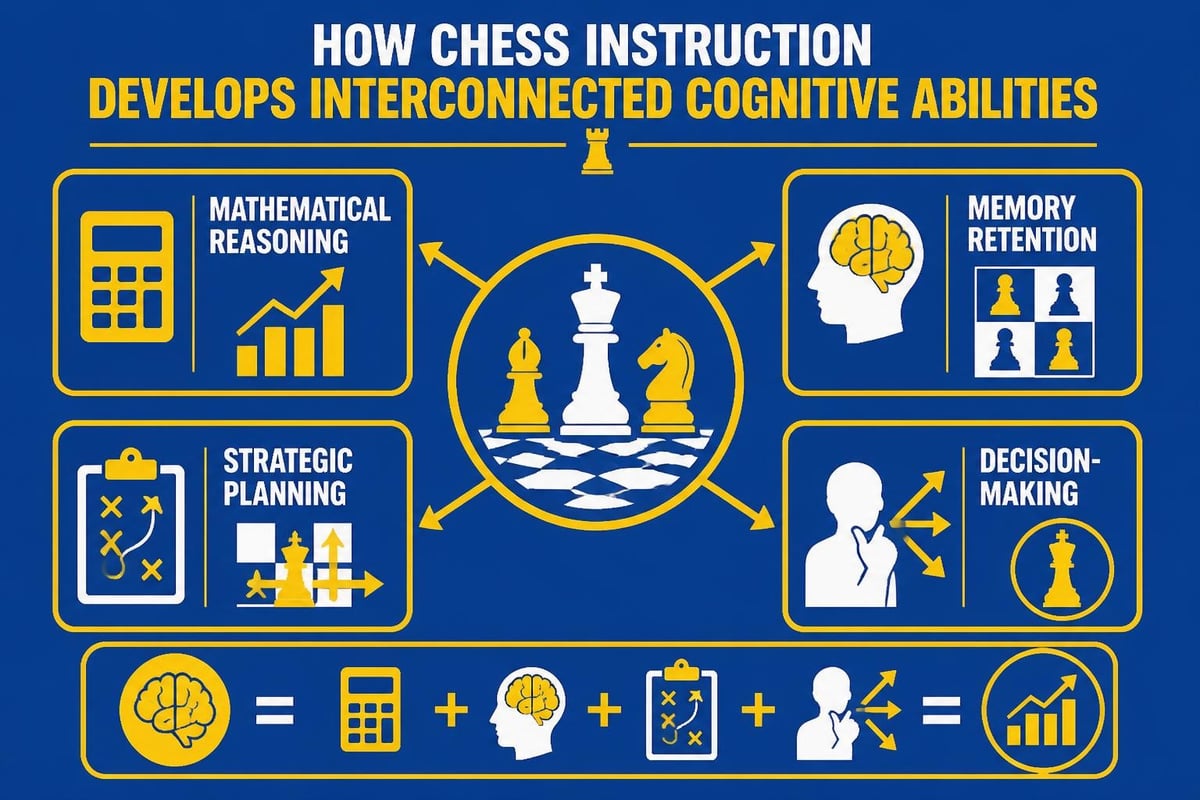
A systematic review examining chess's influence on cognitive functions in schoolchildren provides detailed insights into these educational benefits. The review highlights how chess serves as a unique educational tool that simultaneously engages multiple thinking processes.
Bringing Chess into the Classroom
The theory sounds brilliant, but how does chess and education actually work in practice? Schools around the world have experimented with various approaches, and the results have been enlightening.
Different Implementation Models
| Approach | Description | Best For | Time Commitment |
|---|---|---|---|
| Standalone Subject | Chess taught as its own lesson | Primary schools | 45-60 mins weekly |
| Cross-Curricular | Integrated into maths, literature, history | All ages | Flexible |
| After-School Club | Voluntary participation | Engaged students | 1-2 hours weekly |
| Competition Team | Focus on tournaments | Advanced players | 3+ hours weekly |
The fascinating chess revolution in Corsican schools demonstrates what's possible when chess becomes deeply embedded in educational culture. Their experience shows that success doesn't require enormous resources, just commitment and structured implementation.
Making It Work for Different Ages
Young children benefit from simplified versions and visual learning aids. Resources like a comprehensive how-to-play chess cheat sheet can help beginners grasp fundamental concepts quickly without feeling overwhelmed.
For intermediate players, the focus shifts toward opening principles and tactical awareness. Understanding common patterns through resources covering the most common chess openings helps students develop their repertoire whilst reinforcing pattern recognition skills.
Academic Performance and Chess
Here's where things get really interesting. Does playing chess actually improve marks in traditional subjects? The evidence suggests yes, though perhaps not in the way you'd expect.
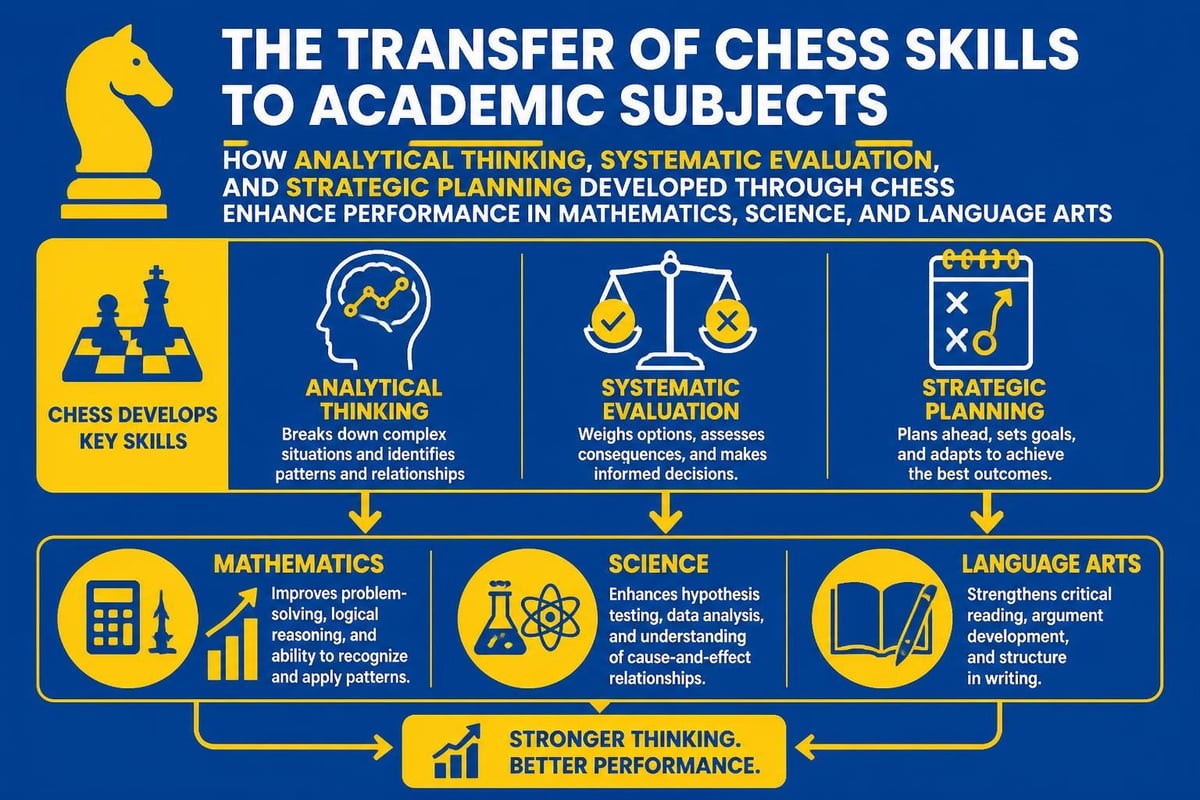
Research investigating whether chess instruction enhances mathematical problem-solving abilities provides experimental evidence on this subject. The connection isn't that chess teaches algebra or geometry directly. Instead, it develops the underlying cognitive skills that make learning those subjects easier.
The Transfer Effect
Think of chess as cognitive cross-training. When students learn to:
- Analyse a chess position systematically
- Consider multiple possibilities before choosing
- Evaluate the consequences of their decisions
- Adjust their strategy based on feedback
They're developing transferable skills. These same mental processes apply when tackling a complex maths problem, writing an essay, or conducting a science experiment.
Students who regularly engage with chess puzzles develop particularly strong problem-solving habits. Puzzles isolate specific tactical patterns, allowing learners to master one concept at a time before combining them in actual games.
Beyond Test Scores: Social and Emotional Learning
Chess and education intersect in ways that transcend academic metrics. The social-emotional benefits deserve equal attention.
Building Character Through Chess
Every chess player faces defeat. Frequently. Learning to lose gracefully whilst maintaining motivation to improve builds resilience that serves students throughout their lives. You can't blame bad luck, teammates, or referees in chess. This accountability fosters emotional maturity.
Key social-emotional benefits include:
- Learning to win and lose with grace
- Developing patience and impulse control
- Building confidence through measurable improvement
- Practising respectful competition
- Understanding that mistakes are learning opportunities
The beauty of chess is its objectivity. When you blunder, the board doesn't lie. This immediate, honest feedback helps students develop a growth mindset, understanding that abilities improve through effort and practice.
Practical Resources for Educational Chess
Right, so you're convinced chess has educational value. What's next? Implementation doesn't need to be complicated or expensive.
Starting Points for Different Contexts
For Parents:
- Begin with basic rules and simple games
- Use visual guides and simplified explanations
- Focus on fun rather than competition initially
- Consider working with an online chess coach for structured guidance
- Celebrate small victories and improvements
For Teachers:
- Start with a small pilot group
- Integrate chess into existing subjects where possible
- Use chess examples when teaching problem-solving
- Create a supportive, non-threatening environment
- Track progress to demonstrate value to administrators
For Students:
- Learn one opening well rather than many poorly
- Work through tactical puzzles daily
- Play regularly against opponents of similar strength
- Review your games to understand mistakes
- Join a club or community for motivation
Understanding chess rating systems helps students set realistic goals and track their progress objectively, which reinforces the connection between effort and improvement.
The Neuroscience Perspective
Recent advances in neuroscience have added another dimension to our understanding of chess and education. Brain imaging studies reveal that chess activates both hemispheres simultaneously, engaging logical and creative thinking in concert.
Research on cognitive skills development through chess instruction discusses how chess enhances attention, strategic planning, and metacognitive awareness. Metacognition, thinking about thinking, represents a crucial educational skill that helps students become independent learners.
What Happens in the Brain
| Brain Region | Function | How Chess Engages It |
|---|---|---|
| Prefrontal Cortex | Planning, decision-making | Evaluating moves and strategies |
| Hippocampus | Memory formation | Remembering positions and patterns |
| Parietal Lobe | Spatial reasoning | Visualising the board and piece relationships |
| Temporal Lobe | Pattern recognition | Identifying tactical motifs |
This whole-brain engagement explains why chess proves so effective as an educational tool. You're not just memorising facts or practising isolated skills, you're integrating multiple cognitive processes simultaneously.
Age-Appropriate Chess Education
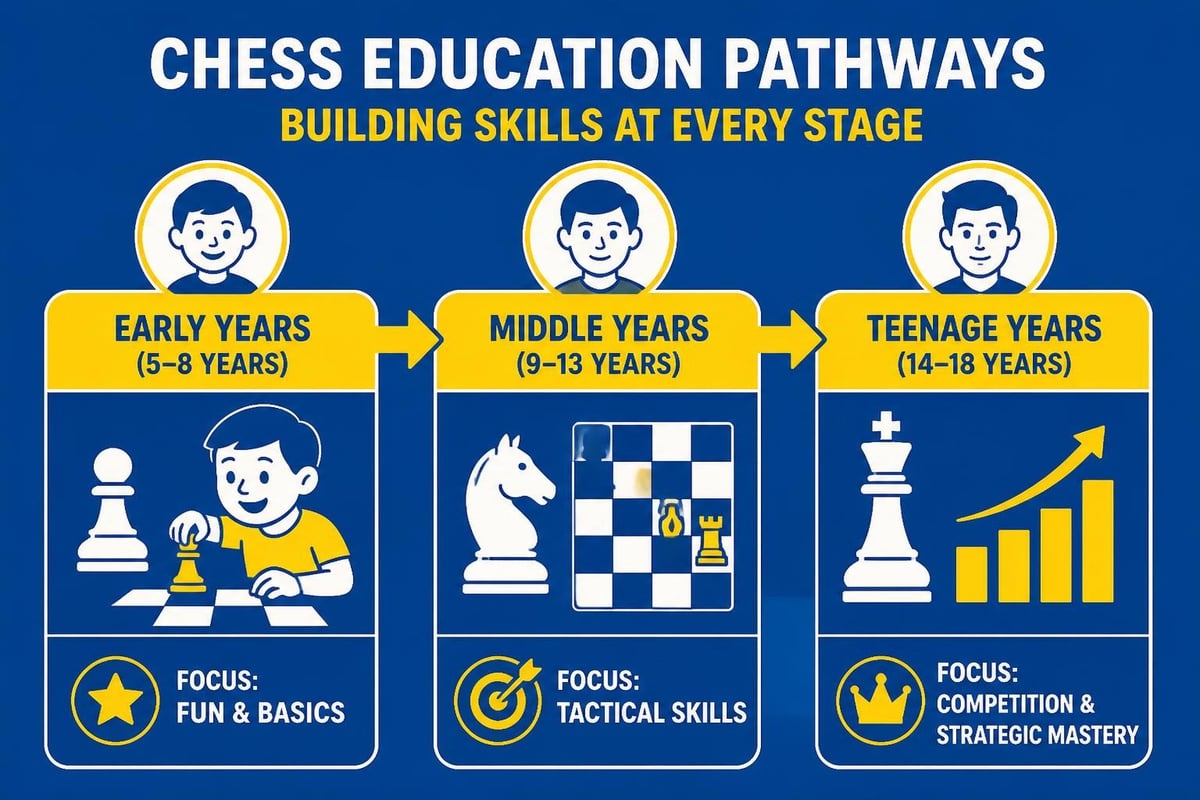
The approach to chess and education must adapt to developmental stages. What works for a six-year-old differs dramatically from what challenges a teenager.
Early Years (Ages 5-8)
Focus on enjoyment and basic concepts. Children this age benefit from:
- Large, colourful pieces and boards
- Simplified rules (perhaps starting with just pawns and kings)
- Short sessions (15-20 minutes maximum)
- Story-based learning
- Immediate rewards and positive reinforcement
Middle Years (Ages 9-12)
Students can handle more complexity and begin serious skill development:
- Introduction to complete opening systems
- Tactical pattern recognition
- Basic endgame principles
- Tournament play experience
- Beginning of strategic thinking
Teenage Years (Ages 13+)
Teenagers can engage with chess at nearly adult levels, benefiting from:
- Deep opening preparation
- Complex strategic concepts
- Serious competition
- Study of master games
- Understanding of different master levels and rating progressions
Addressing Common Concerns
When discussing chess and education, certain questions arise repeatedly. Let's tackle them directly.
"Won't chess take time away from core subjects?"
The evidence suggests chess enhances rather than detracts from traditional learning. The cognitive skills developed transfer across subjects, potentially making study time more efficient overall.
"What if my child isn't naturally talented at chess?"
Chess rewards effort more than innate ability. The structured nature of improvement makes it ideal for building growth mindset. Even modest chess ability develops valuable thinking skills.
"Is chess too difficult for struggling students?"
Actually, chess can particularly benefit students who find traditional academic work challenging. The visual, concrete nature of the game provides an alternative path to developing critical thinking skills.
"How much time needs to be invested to see benefits?"
Research suggests even modest engagement (one hour weekly) produces measurable cognitive improvements. More time accelerates progress but isn't strictly necessary for educational benefits.
Integration Strategies That Work
Successful chess and education programmes share certain characteristics. They don't simply add chess as an isolated activity but weave it into the broader educational fabric.
Cross-Curricular Connections
Mathematics:
- Calculate material advantage
- Explore geometric patterns on the board
- Study probability in various positions
- Analyse statistical data from games
Language Arts:
- Write game analysis and annotations
- Read chess history and biographies
- Discuss strategy using precise vocabulary
- Create chess-themed stories or poems
History:
- Study famous historical matches
- Explore chess's cultural evolution
- Examine chess during different historical periods
- Investigate chess as geopolitical tool
Science:
- Apply scientific method to improving play
- Study pattern recognition and neural pathways
- Explore artificial intelligence in chess
- Investigate decision-making psychology
Resources covering specific openings like the Sicilian Defense or Italian Game can introduce historical context whilst teaching chess concepts, creating natural cross-curricular opportunities.
Measuring Educational Impact
How do we know chess and education initiatives actually work? Proper assessment matters, both for justifying programmes and improving them.
Quantitative Measures
- Standardised test score comparisons
- Chess rating progression
- Attendance and engagement metrics
- Time-on-task observations
- Academic performance in specific subjects
Qualitative Indicators
- Student self-reported confidence
- Teacher observations of behaviour changes
- Parent feedback on home behaviour
- Peer interaction quality
- Problem-solving approach sophistication
A comprehensive review of chess instruction effects on cognitive and academic skills discusses current research methodologies and theoretical challenges in this area. The complexity of isolating chess's specific contribution from other factors makes research challenging but not impossible.
The Long-Term Perspective
Perhaps the most compelling aspect of chess and education isn't what happens during childhood but how early chess exposure shapes lifelong learning patterns.
Adults who learned chess young often report that it influenced their approach to complex problems throughout their careers. The habit of thinking several steps ahead, considering multiple possibilities, and learning from mistakes extends far beyond the chessboard.
Whether students continue playing chess into adulthood matters less than whether they internalise its lessons: systematic thinking, emotional regulation, respect for intellectual challenge, and the satisfaction of continuous improvement.
Future Directions
As we look ahead in 2026, chess and education seem poised for even deeper integration. Online platforms make high-quality instruction accessible regardless of location. Artificial intelligence provides personalised training that adapts to individual learning needs. Virtual reality may soon offer immersive chess learning experiences.
The fundamental value proposition remains constant though: chess offers a structured, engaging way to develop thinking skills that serve students across their entire educational journey and beyond. As educational systems worldwide grapple with preparing students for an uncertain future, chess provides a timeless tool for building adaptable, analytical minds.
The relationship between chess and education continues to reveal new depths as research progresses, but the core benefits remain clear: enhanced cognitive abilities, improved academic performance, and valuable life skills. Whether you're starting from absolute beginner level or looking to develop more advanced strategic understanding, having the right resources makes all the difference. Chess Cheat Sheets provides streamlined guides, puzzles, and opening resources that help learners of all ages master chess concepts efficiently, building both chess skills and the broader thinking abilities that make chess such a powerful educational tool.


