

Learning beginner chess piece moves is the foundation of your entire chess journey. Without understanding how each piece travels across the board, you can't develop strategies, execute tactics, or even play a legal game. The good news? Chess piece movements follow logical patterns that become second nature with practice. Whether you've just opened your first chess set or you're looking to solidify your fundamental knowledge, grasping these movement rules will transform you from confused observer to confident player. Let's explore how each piece commands its space on the 64 squares.
Understanding the Chess Army
Before diving into specific movements, you need to know what you're working with. Each player starts with 16 pieces: eight pawns, two rooks, two knights, two bishops, one queen, and one king. These pieces work together like a coordinated team, each with distinct capabilities and limitations.
The value of pieces varies significantly. Pawns are your foot soldiers, worth about one point in traditional scoring. Knights and bishops are minor pieces, valued at roughly three points each. Rooks are major pieces at five points, whilst the queen reigns supreme at nine points. Your king? Infinitely valuable because losing it means losing the game.
Understanding how chess pieces move gives you the tactical vocabulary needed to develop your game beyond random moves.
The Humble Pawn's Journey
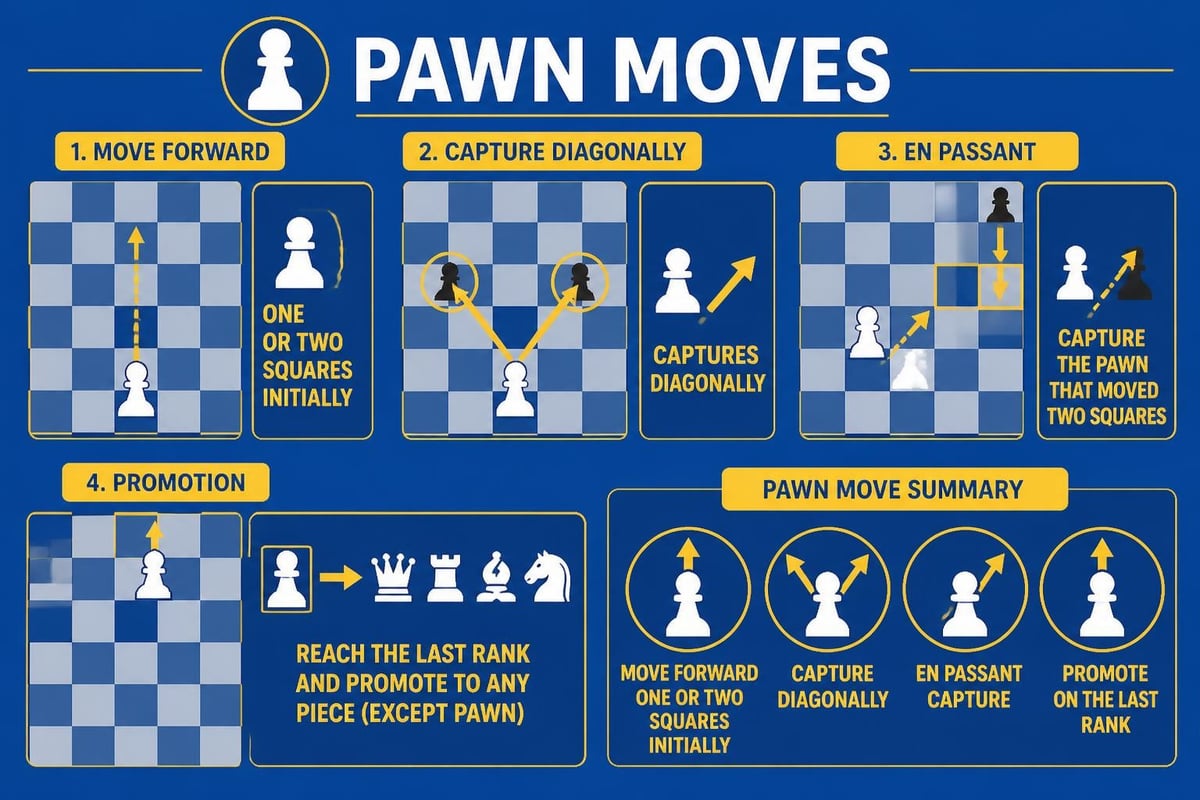
Pawns are deceptively simple yet strategically complex. These pieces can only move forward, never backward or sideways. On their very first move from their starting position, pawns have the option to advance either one or two squares. After that initial move, they're limited to a single square forward at a time.
Here's where beginner chess piece moves get interesting: pawns capture differently than they move. Whilst they advance straight ahead, they capture diagonally, one square forward and to either side.
Special Pawn Abilities
Pawns possess two unique moves that often surprise newcomers:
- Promotion: When a pawn reaches the opposite end of the board, it transforms into any piece you choose (except a king), typically a queen
- En passant: A special capture that occurs when an opponent's pawn advances two squares from its starting position, landing beside your pawn
- Controlling space: Even without moving, pawns control the diagonal squares in front of them, influencing where opponent pieces can safely travel
The en passant rule confuses many beginners. You can capture an enemy pawn that has just moved two squares forward as if it had only moved one square. This capture must happen immediately on your next turn or the opportunity vanishes.
The Knight's Unique L-Shape
Knights move in an L-shaped pattern that makes them the only pieces capable of jumping over others. They travel two squares in one direction (horizontal or vertical) and then one square perpendicular to that, or vice versa. This creates eight possible destinations from any central position.
What makes knights particularly valuable for beginners? They can't be blocked. Whilst rooks, bishops, and queens need clear paths, knights leap directly to their destination regardless of what pieces stand in between.
| Knight Strengths | Knight Weaknesses |
|---|---|
| Jumps over pieces | Slower to cross the board |
| Excellent in closed positions | Limited range compared to bishops/rooks |
| Can reach any square colour | Requires multiple moves for distant squares |
| Controls up to 8 squares | Vulnerable on board edges |
Knights work brilliantly in crowded positions where other pieces struggle to manoeuvre. They're particularly effective in the centre of the board where they command the maximum number of squares. Place a knight on the rim, though, and its power diminishes significantly.
Bishops and Their Diagonal Highways
Bishops travel diagonally any number of squares, but here's a crucial limitation: each bishop is forever confined to the colour square it started on. You begin the game with one light-squared bishop and one dark-squared bishop. They'll never meet on the same colour.
This characteristic means bishops work best in pairs, complementing each other's weaknesses. A single bishop controls only half the board's squares, but together they dominate both colour complexes. Beginners often underestimate bishops, but understanding their movement patterns reveals their long-range power.
Maximising Bishop Potential
Bishops thrive in open positions where their diagonal paths aren't blocked by pawns. Consider these principles:
- Keep central pawns mobile to maintain diagonal clarity
- Position bishops where they aim toward your opponent's position
- Avoid blocking your own bishops with immobile pawns
- Use bishops to control key squares from a distance
The bishop's range increases dramatically as the board opens up. In the opening phase, bishops might only control a few squares, but in the middlegame, a well-placed bishop can influence both sides of the board simultaneously.

Rooks: The Straight-Line Powerhouses
Rooks move horizontally or vertically any number of squares along ranks and files. They're your heavy artillery, particularly devastating on open files where no pawns block their path. Each player starts with rooks tucked away in the corners, making their activation a key early-game objective.
The power of rooks increases as pieces leave the board. In the opening, they're often trapped behind pawns. By the endgame, they dominate empty ranks and files with devastating effect. Many games are won by the player who activates their rooks first.
Rooks work exceptionally well when doubled on a file or positioned on the seventh rank, where they attack opponent pawns still on their starting positions. This coordination multiplies their effectiveness beyond their individual power. You can explore comprehensive resources at Chess Cheat Sheets to deepen your understanding of how rooks contribute to various opening strategies.
The Queen: Ultimate Flexibility
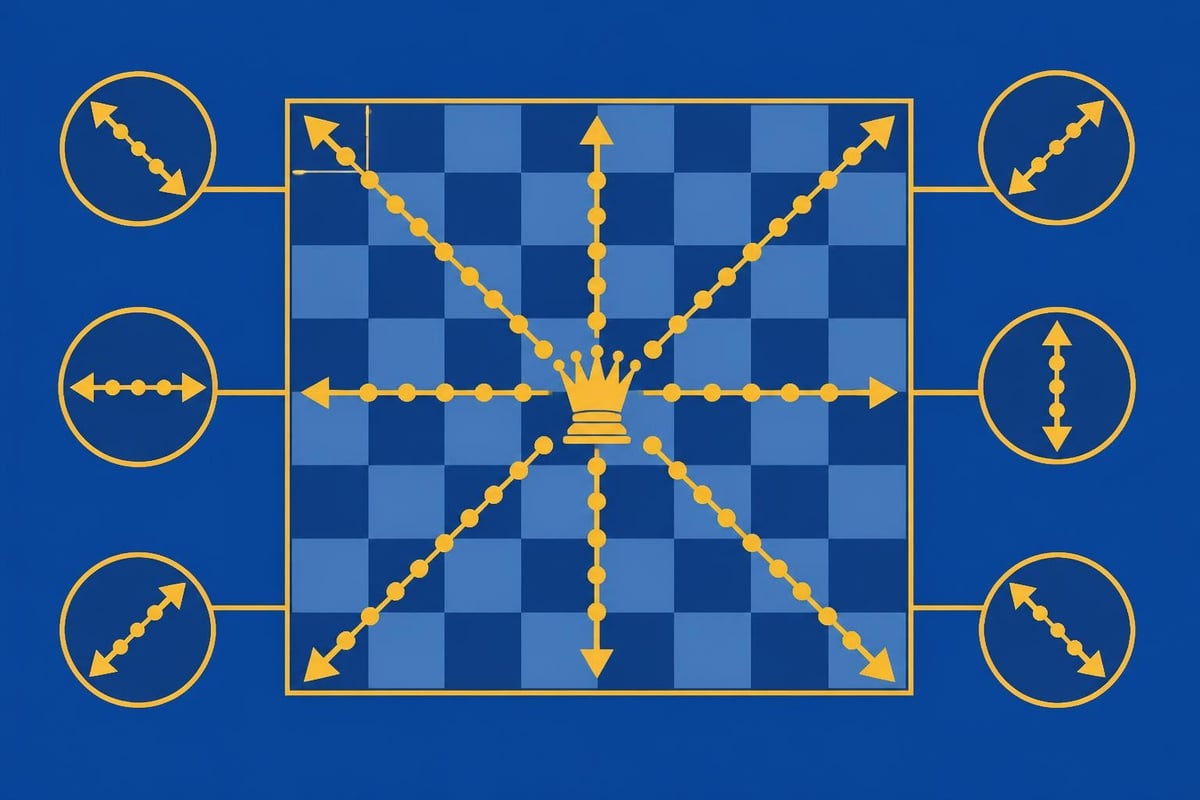
Your queen combines the movement capabilities of both rooks and bishops. She travels any number of squares horizontally, vertically, or diagonally, making her the most powerful piece on the board. This versatility means she can reach more squares than any other piece from most positions.
Despite her power, the queen isn't invincible. Beginners often make the mistake of bringing their queen out too early, only to find her chased around the board by less valuable pieces. Each time your opponent attacks your queen with a knight or bishop, you lose valuable development time moving her to safety whilst they continue developing their army.
Queen deployment guidelines:
- Develop minor pieces (knights and bishops) before activating your queen
- Keep your queen protected by other pieces
- Use her flexibility for multi-purpose moves that attack and defend simultaneously
- Don't trade your queen for lesser pieces unless you gain significant compensation
The queen excels at delivering checkmate, particularly when working with other pieces. Her range and flexibility make her the perfect coordinator, but she needs support to avoid becoming a target. Learning proper beginner chess piece moves means understanding when to unleash your queen and when to keep her safely positioned.
The King: Protected Monarch
Your king moves one square in any direction: horizontally, vertically, or diagonally. He's the slowest piece on the board, but protecting him is your primary objective. Lose your king, and the game ends immediately.
The king plays different roles depending on the game phase. During the opening and middlegame, safety is paramount. You'll typically castle early to tuck your king behind a wall of pawns. As pieces leave the board and the endgame approaches, your king transforms from liability to active piece, marching forward to support pawns and control key squares.
Castling: The King's Special Move
Castling is the only move allowing you to move two pieces simultaneously. The king slides two squares toward a rook, and that rook jumps over the king to the adjacent square. This move serves two purposes: it safeguards your king and activates your rook.
You can only castle if:
- Neither your king nor the chosen rook has moved previously
- No pieces stand between your king and rook
- Your king isn't currently in check
- Your king doesn't pass through or land on a square under attack
Castling kingside (with the rook closer to the centre) happens more frequently because it requires moving fewer pieces out of the way. Queenside castling offers different strategic benefits but takes longer to prepare. Understanding these fundamental rules helps you make better decisions about king safety.
Putting Movement Into Practice
Knowing beginner chess piece moves theoretically differs vastly from applying them practically. You need to visualise how pieces interact, anticipate threats, and coordinate your army effectively. Each piece doesn't operate in isolation but works as part of a larger system.
Start by practising piece movements individually. Set up a board with just pawns and practise advancing them, capturing, and promoting. Add knights and work on their unique L-shaped jumps. Gradually introduce each piece until you're comfortable with the entire army. The how to play chess cheat sheet provides a visual reference you can consult whilst practising.
| Practice Method | Benefit | Time Investment |
|---|---|---|
| Piece isolation drills | Master individual movements | 10-15 minutes daily |
| Simple puzzles | Learn tactical patterns | 15-20 minutes daily |
| Playing complete games | Apply integrated knowledge | 30+ minutes per session |
| Reviewing your games | Identify movement mistakes | 10 minutes post-game |
Common Movement Mistakes Beginners Make
Even after learning the rules, beginners consistently make predictable errors. Recognising these patterns in your own play accelerates improvement dramatically. The most frequent mistake? Moving pieces without purpose. Every move should accomplish something: develop a piece, control key squares, threaten your opponent, or improve your position.
Another common error involves ignoring basic development principles. Beginners often move the same piece multiple times in the opening whilst leaving others on their starting squares. Your knights, bishops, and rooks can't contribute if they never leave home. Those exploring most common chess openings will notice this principle repeated consistently.
Pieces Working Together
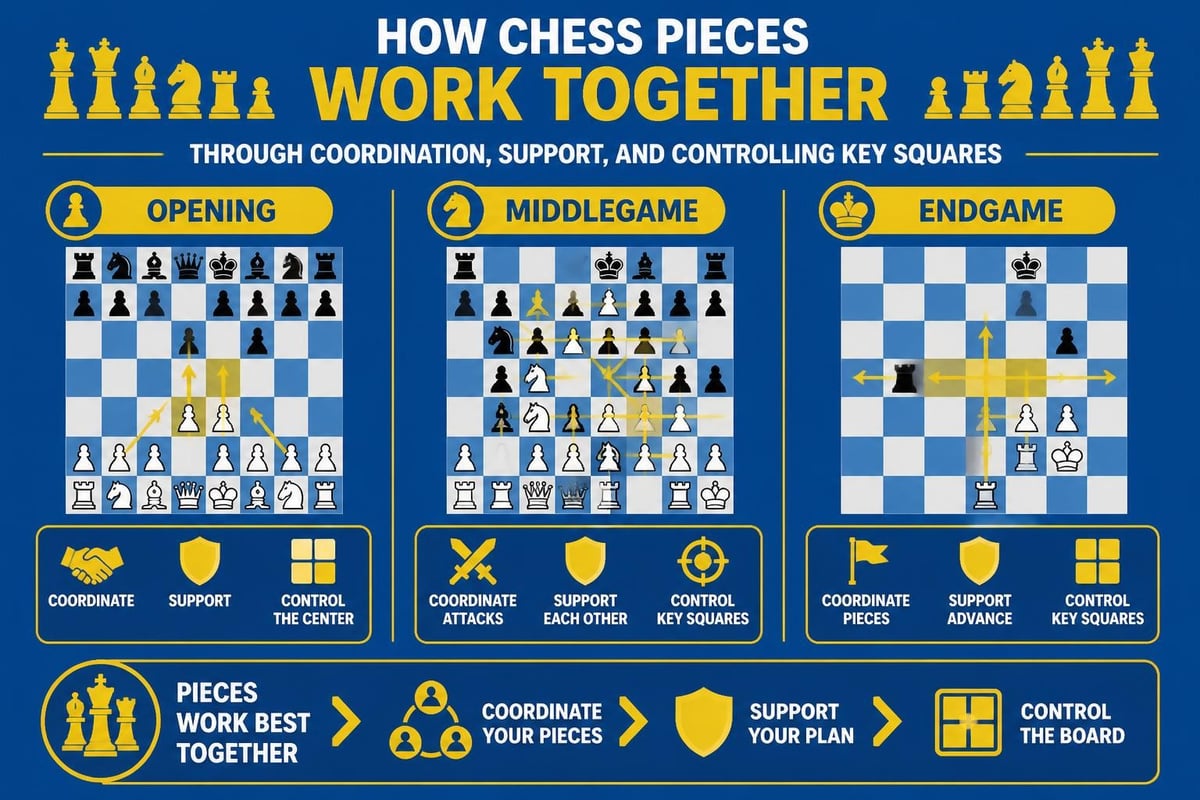
Chess isn't about individual pieces but coordinated action:
- Support attacking pieces with defenders
- Control key squares with multiple pieces
- Create threats your opponent can't address simultaneously
- Coordinate pieces toward common objectives
Understanding these principles transforms random moves into purposeful strategy. When you grasp how pieces complement each other, you start thinking several moves ahead, anticipating your opponent's responses and preparing counter-measures.
Developing Your Movement Intuition
Mastery of beginner chess piece moves comes through repetition and pattern recognition. Your brain needs to internalise these movements until they become automatic. This frees your conscious mind to focus on strategy rather than basic legality.
Play regularly against opponents at your level. Each game reinforces movement patterns whilst introducing new tactical situations. When you blunder a piece, analyse why. Did you miscalculate a knight's range? Forget a diagonal your bishop controlled? These mistakes become valuable learning opportunities.
Online resources can significantly accelerate your learning curve. Websites like Chess.com offer interactive tutorials where you can practise movements with immediate feedback. Combined with physical board practice, digital tools reinforce concepts through multiple sensory channels.
Advanced Movement Concepts for Beginners
Once you've mastered basic movements, you can start exploring more sophisticated concepts. Piece activity measures how effectively your pieces control important squares. A rook on an open file is more active than one trapped behind pawns. A centralised knight outperforms one stuck on the edge.
Mobility relates to how many squares a piece controls. Bishops in open positions enjoy high mobility, whilst those blocked by pawn chains suffer restricted movement. Your strategic decisions should aim to maximise your pieces' mobility whilst restricting your opponent's options.
Consider these advanced movement principles:
- Outposts: Squares where your pieces can't be attacked by opponent pawns
- Weak squares: Squares your opponent struggles to control or defend
- Piece harmony: Ensuring your pieces don't obstruct each other's movements
- Tempo: Gaining time by forcing your opponent to respond to threats
These concepts build naturally upon your understanding of basic movements. As you play more games, you'll recognise positions where these principles apply, deepening your strategic comprehension beyond simple piece movements.
Special Situations and Edge Cases
Chess contains several special rules that catch beginners off guard. We've discussed en passant and castling, but other situations require attention. Stalemate occurs when a player has no legal moves but isn't in check-the game ends in a draw. This often surprises beginners who thought they were winning.
Insufficient material creates another draw condition. If neither player has enough pieces to deliver checkmate (like king versus king, or king and knight versus king), the game ends immediately. Understanding these situations prevents confusion during actual games.
The threefold repetition rule allows either player to claim a draw if the exact same position occurs three times with the same player to move. This prevents players from endlessly repeating moves without making progress. Similarly, the fifty-move rule permits a draw claim if fifty moves occur without a pawn move or capture.
Building Your Opening Repertoire
Once you're comfortable with beginner chess piece moves, you can start developing an opening repertoire. Openings are standardised sequences of moves that efficiently develop your pieces whilst controlling the centre. Popular beginner openings like the Italian Game or Scotch Game follow logical development principles.
The beauty of studying openings is that they reinforce proper piece movement whilst teaching strategic concepts. You'll understand why certain moves work better than others, why piece placement matters, and how to coordinate your army effectively. Resources focusing on chess for beginners often emphasise opening principles alongside movement rules.
Don't memorise lengthy opening variations initially. Instead, understand the principles: control the centre, develop pieces efficiently, safeguard your king, and connect your rooks. These guidelines work across all openings and naturally lead to strong positions.
Tracking Your Progress
Improvement in chess comes gradually through consistent practice. Track your progress by reviewing games and identifying movement errors. Did you miss a tactical opportunity because you didn't visualise a piece's range correctly? Flag these moments for focused practice.
Set specific goals related to piece movement. Perhaps you want to stop hanging pieces (leaving them undefended) for an entire week. Maybe you'll focus on improving your knight placement. Concrete objectives make progress measurable and maintain motivation.
Many players find working with structured resources accelerates their development. Puzzle collections targeting specific pieces help internalise movement patterns through repetition. The 1.5 million chess openings puzzles pack offers extensive practice material organised by opening type, allowing you to master piece movements within various positional contexts.
The Journey Beyond Basic Movements
Understanding beginner chess piece moves is just the beginning of your chess education. As these movements become automatic, you'll shift focus toward tactics, strategy, and positional understanding. The pieces become tools for expressing your ideas on the board rather than obstacles requiring conscious thought.
Your chess journey will take you through various stages of development. You might explore chess master levels and understand what separates beginners from intermediate players from masters. Each level builds upon the foundation of proper piece movement, adding layers of complexity and sophistication.
Remember that even grandmasters occasionally miscalculate piece movements in complex positions. The difference is that they've internalised these patterns so thoroughly that errors become increasingly rare. You're building that same intuition, one game at a time, one move at a time.
Consider supplementing your self-study with guidance from experienced players. Exploring options for the best online chess coach can provide personalised feedback on your piece movements and strategic decisions, accelerating your improvement beyond what solo study achieves.
Mastering beginner chess piece moves creates the foundation for everything else in chess, from simple tactics to sophisticated strategic plans. As you internalise these movement patterns, you'll find yourself thinking less about legality and more about effectiveness, planning combinations and coordinating your pieces toward victory. Whether you're just starting or reinforcing fundamentals, Chess Cheat Sheets offers comprehensive guides, puzzles, and resources designed to help you master chess efficiently without overwhelming study sessions. Start building your chess skills today with streamlined resources that make improvement accessible and enjoyable.


