

You've probably wondered what would happen if your physical chess board could teach you, analyse your moves, and help you improve your game without needing a screen in front of you. That's exactly what an automatic chess board does, and it's quickly becoming one of the most innovative tools for chess education in 2026. These remarkable devices merge traditional over-the-board play with modern technology, creating an experience that feels familiar yet enhanced. For players looking to improve their skills without abandoning the tactile pleasure of moving real pieces, these boards represent a significant leap forward in how we learn and practise chess.
What Makes a Chess Board "Automatic"?
An automatic chess board isn't just a regular board with fancy lights. It's a sophisticated piece of technology that detects your moves, validates them according to chess rules, and often connects to chess engines or online platforms to provide feedback.
The core technology typically involves sensors underneath each square that detect when pieces are moved. Some boards use magnetic sensors, whilst others employ optical systems or pressure-sensitive technology. The board then communicates this information to accompanying software, which can be on your phone, tablet, or computer.
What sets these boards apart from simply playing on a screen is the physical interaction. You're still moving real pieces with your hands, developing muscle memory and spatial awareness that's crucial for tournament play. Yet you're getting all the benefits of digital chess: analysis, opponent matching, and instructional feedback.
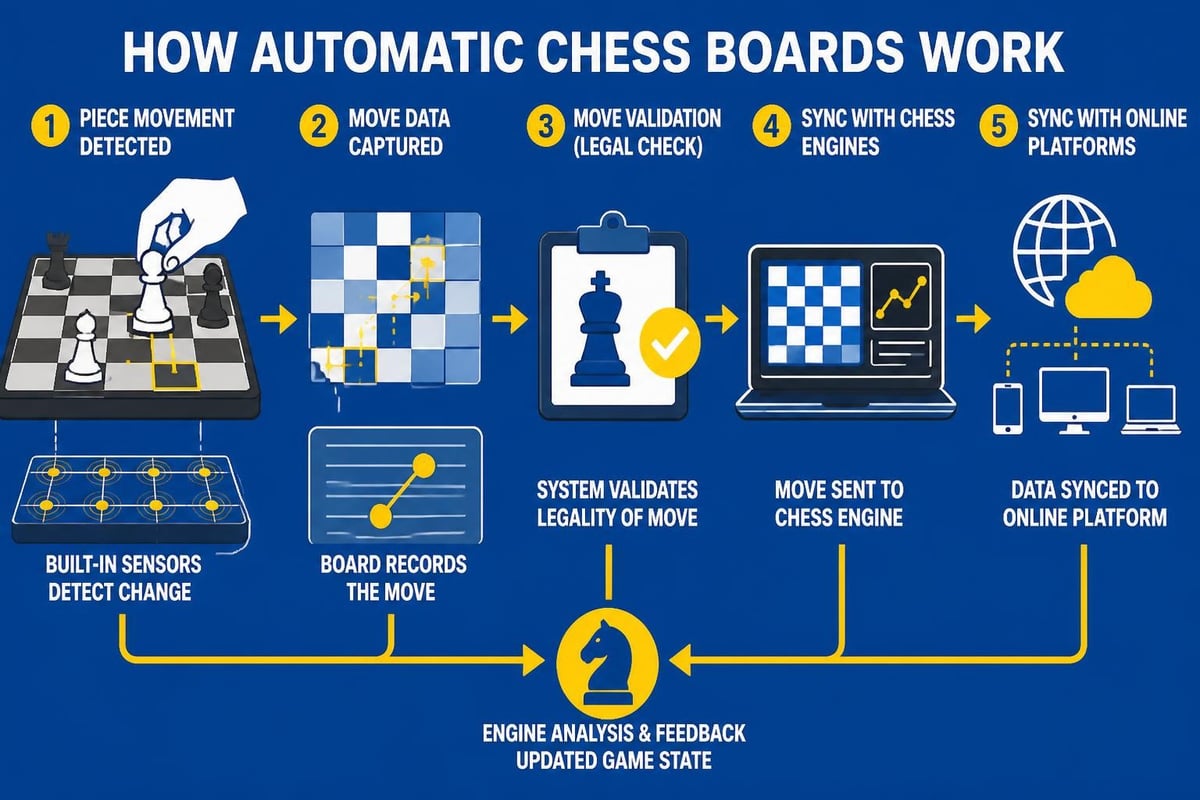
Key Technologies Behind the Scenes
The engineering that makes these boards possible has evolved dramatically. Early prototypes were clunky and unreliable, but modern automatic chess boards use refined systems that rarely miss a move.
Detection methods include:
- Hall effect sensors that detect magnetic pieces
- LED grids that track piece shadows
- Pressure sensors beneath each square
- Computer vision systems using overhead cameras
Research into automatic chess recording systems using photoreflectors has shown how optical technology can accurately track games without requiring specialised pieces. This advancement has made automatic boards more versatile and user-friendly.
Some innovative designs feature voice-controlled chessboards with self-moving pieces, integrating voice commands and artificial intelligence to create an interactive playing experience. Imagine calling out "Knight to f3" and watching the piece glide across the board automatically!
Benefits for Chess Learners and Educators
Why should you care about an automatic chess board when you could just play online or use a regular board? The answer lies in how these devices enhance the learning process.
Traditional chess study often means flipping between a physical board, books, and computer screens. It's disjointed and can break your concentration. An automatic board consolidates everything into one seamless experience.
Enhanced Learning Features
| Feature | Benefit for Learners | Practical Application |
|---|---|---|
| Move Validation | Prevents illegal moves instantly | Reinforces rules without needing supervision |
| Position Analysis | Shows tactical opportunities in real-time | Highlights missed tactics during casual play |
| Opening Guidance | Suggests book moves during openings | Helps memorise common chess openings |
| Puzzle Mode | Presents tactical puzzles on physical board | Develops pattern recognition with real pieces |
When you're working through chess puzzles, there's something special about solving them on a physical board rather than clicking squares on a screen. The tactile feedback helps cement patterns in your memory.
For intermediate players specifically, automatic boards excel at highlighting mistakes in real-time. You might think you've found a brilliant move, only for the board to gently indicate a tactical oversight. This immediate feedback loop accelerates improvement far more effectively than post-game analysis alone.
Popular Types of Automatic Chess Boards in 2026
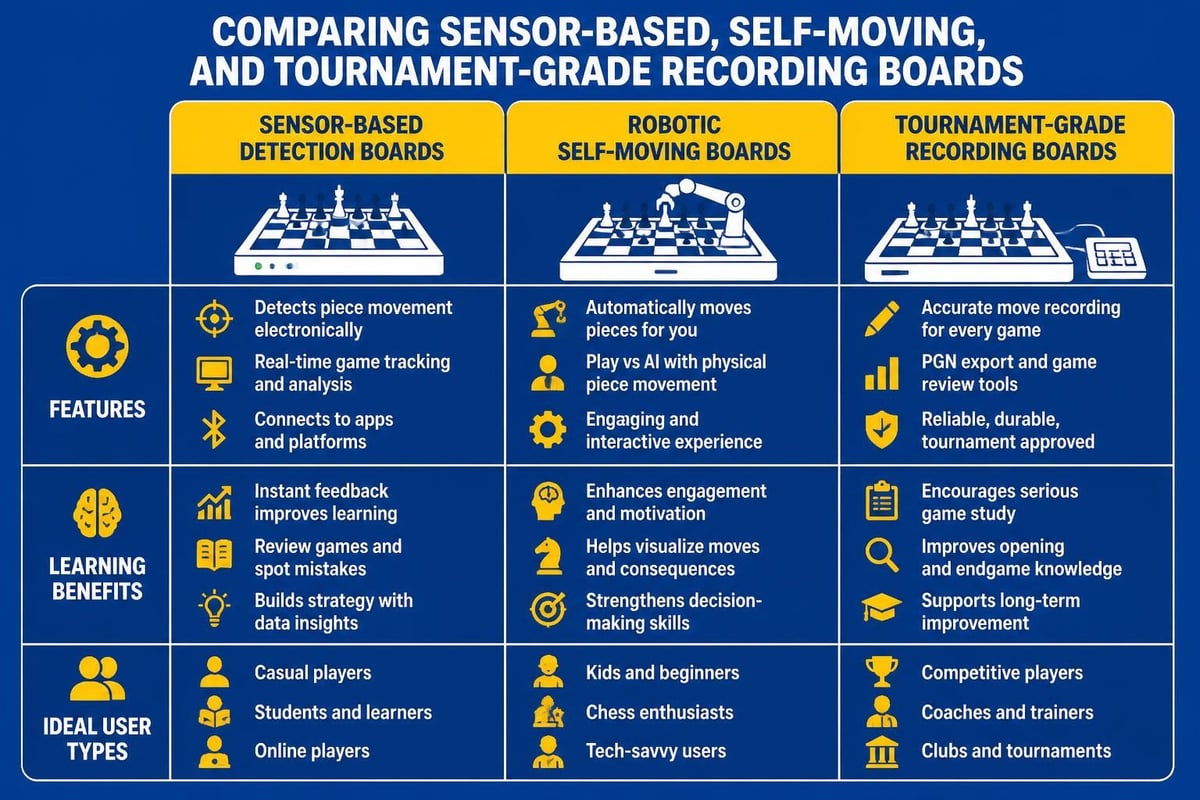
The market has exploded with options, each targeting different needs and budgets. Understanding the categories helps you choose what's right for your learning journey.
Sensor-based boards are the most common. They detect when you lift and place pieces, registering your moves automatically. These work with physical piece sets you already own (or pieces that come with the board) and typically connect via Bluetooth to your devices.
Robotic boards take things further by moving the opponent's pieces for you. Projects like this automatic chess-playing robot demonstrate how electromagnets and gantry systems can physically move pieces, allowing you to play against a chess engine whilst maintaining the over-the-board feel.
Smart tournament boards prioritise accuracy and official game recording. These are built to tournament standards and automatically record games in standard notation, perfect for players preparing for rated competitions.
DIY vs Commercial Solutions
The maker community has embraced automatic chess boards enthusiastically. Platforms like Arduino have enabled hobbyists to build sophisticated systems. This Arduino and Python-powered automatic chessboard showcases how electromagnets and sensor arrays can create a fully functional board at a fraction of commercial costs.
However, DIY solutions require technical skills and time. For most learners focused on chess improvement rather than electronics projects, commercial boards offer reliability and polish that's hard to match at home.
Considerations when choosing:
- Budget - Commercial boards range from £200 to over £1,000
- Compatibility - Does it work with your preferred chess platform?
- Portability - Some fold up easily; others are substantial pieces of furniture
- Power source - Battery-powered boards offer more flexibility
- Piece quality - Weighted, Staunton pieces feel better than cheap plastic
Integration with Chess Software and AI
The true power of an automatic chess board emerges when it connects to sophisticated chess engines and training platforms. You're not just playing against the board itself; you're accessing the collective knowledge of chess databases and the analytical power of modern AI.
Most automatic boards support popular chess platforms, allowing you to play rated games against online opponents whilst moving physical pieces. The experience feels more authentic than clicking a mouse, yet you're still building your online rating and accessing global competition.
AI-Powered Learning
The integration of deep learning in chess has reached remarkable levels. Research into end-to-end deep neural networks for automatic learning in chess has produced AI systems that play at grandmaster level without any programmed chess knowledge. When you connect your automatic chess board to such engines, you're essentially playing against world-class opposition that can adjust its strength to match your level.
What's particularly valuable for learning is the analysis capability. After each game, the AI can show you where you deviated from optimal play. For openings specifically, the board can guide you through mainlines, helping you master systems like the Scotch Game or the Catalan Opening with immediate feedback on your move choices.
Some boards even feature automated commentary systems. Research on automated chess commentators powered by neural engines has shown how AI can generate human-like explanations of chess positions, helping you understand not just what moves are best, but why they're superior.
Practical Applications for Different Skill Levels
Are you wondering whether an automatic chess board suits your current playing strength? The beauty of these devices is their adaptability across skill levels.
For beginners, the board serves as a patient teacher that never gets frustrated. It prevents illegal moves, suggests better alternatives, and introduces tactical concepts gradually. Understanding chess basics becomes more intuitive when the board guides you through each principle with real pieces.
Intermediate players benefit most dramatically. You're past the beginner stage where simple move legality is the focus, but you're still developing pattern recognition and opening repertoires. The board becomes a training partner that's always available, always prepared, and always operating at exactly the right difficulty level for productive struggle.
Training Scenarios That Work Best
Here are specific ways intermediate players can leverage automatic boards:
- Opening preparation: Play through your repertoire with the board checking accuracy and suggesting improvements
- Tactical training: Solve puzzles physically, engaging different cognitive pathways than screen-based solving
- Endgame practice: Work through theoretical positions with move validation ensuring you're learning correct technique
- Blitz training: Improve your speed whilst maintaining the tactile connection to pieces
Advanced players and coaches find value too. Tournament preparation becomes more realistic when you can play against engines on a physical board. Coaches can review student games that were automatically recorded, with every move logged for later analysis.
The Technology Behind Position Recognition
Have you ever wondered how these boards actually "know" where each piece is? The technology has become remarkably sophisticated, incorporating computer vision and machine learning techniques.
Modern systems use convolutional neural networks for chess piece classification, allowing cameras to identify not just that a piece is on a square, but which specific piece it is. This technology enables boards to recognise positions even when pieces are placed arbitrarily, not just tracking moves from the starting position.
Some cutting-edge applications include augmented reality chess analysis, where you can point your phone at a physical board and receive real-time analysis overlays. This bridges the gap between physical and digital chess in fascinating ways.
| Technology | Accuracy | Cost Impact | Setup Complexity |
|---|---|---|---|
| Magnetic Sensors | 99%+ | Medium | Low |
| Optical Sensors | 97%+ | Low | Medium |
| Computer Vision | 95%+ | Low (software) | High |
| Pressure Sensors | 98%+ | High | Low |
The reliability of these systems has improved dramatically. Early automatic boards frustrated users with missed moves and false registrations. Current models rarely make errors, creating a smooth experience that doesn't interrupt your concentration during critical moments.
Choosing the Right Automatic Chess Board for Your Needs
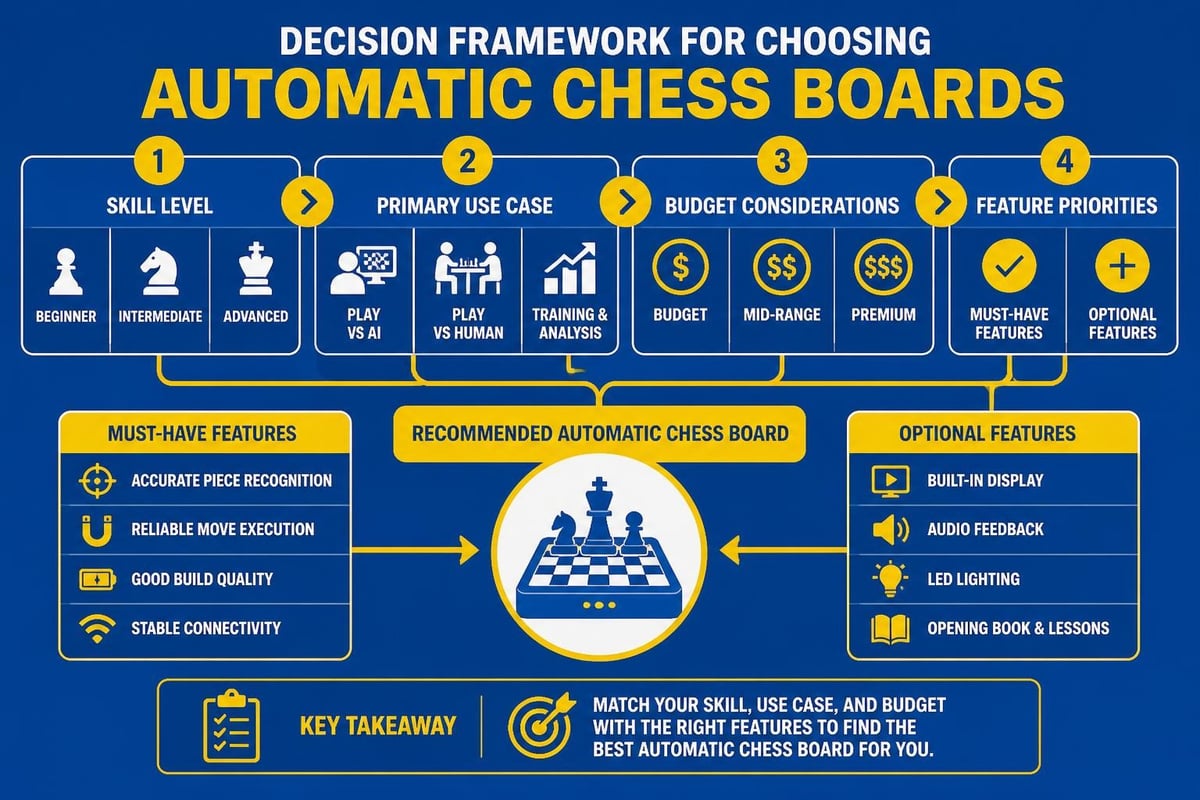
With dozens of options available in 2026, how do you select the board that will actually enhance your chess journey? Start by honestly assessing your priorities.
Ask yourself these questions:
- Do you primarily play alone or with others in person?
- How important is portability versus having a permanent setup?
- Will you use it mainly for study or for playing complete games?
- What's your realistic budget, including any required subscriptions?
- Do you prefer playing against AI, online opponents, or local players?
Features Worth Paying Extra For
Not all features justify their price premium. Here's what actually matters for serious improvement:
Essential features that directly enhance learning include move validation, position analysis, and compatibility with major chess platforms. These are non-negotiable if you're buying an automatic board primarily for improvement rather than novelty.
Nice-to-have features like LED indicators showing legal moves can speed up learning for beginners but become less valuable as you improve. Self-moving pieces are impressive but don't significantly enhance the learning experience for most players.
Overlooked features that deserve more attention include build quality (a board you'll use for years justifies higher cost), battery life (nothing kills momentum like constant recharging), and the quality of included software. Some boards come with excellent training apps whilst others require separate purchases.
Much like how finding the best online chess coach requires matching teaching style to learning preferences, selecting an automatic board means prioritising features that align with how you actually study chess.
Integrating Automatic Boards into Your Training Routine
Owning an automatic chess board won't magically improve your game. You need a structured approach to leverage its capabilities effectively.
Consider incorporating the board into specific parts of your training schedule rather than using it for everything. Physical boards excel at certain activities whilst digital platforms remain superior for others.
A balanced weekly schedule might include:
- Monday & Thursday: Opening study on the automatic board, playing through your repertoire with move validation
- Tuesday & Friday: Tactical puzzles on the board, engaging physical memory
- Wednesday: Slow classical games against the engine, followed by analysis
- Weekend: Blitz sessions mixing board play and online competition
The automatic board shines brightest when you're working on material that benefits from physical reinforcement. Understanding how difficult the English Opening is to play becomes clearer when you physically play through its key positions repeatedly, building muscle memory alongside theoretical knowledge.
Avoiding Common Pitfalls
Many players make the mistake of using their automatic board exactly as they would a computer screen: clicking through moves rapidly without deep thought. This wastes the board's potential.
Instead, slow down deliberately. The physical nature of the board encourages contemplation. When you must physically reach out and move a piece, you naturally pause an extra moment. Use that moment to double-check tactics and confirm your calculation.
Another mistake is neglecting the board's recording capabilities. Review your games! The automatic recording feature is useless if you never analyse what you've played. Schedule weekly review sessions where you examine games from the past week, identifying patterns in your mistakes.
The Future of Automatic Chess Education
Where is this technology headed? The trajectory suggests even more seamless integration between physical and digital chess experiences.
We're likely to see boards that provide haptic feedback, gently vibrating pieces when you hover over squares involved in tactical sequences. Imagine physically feeling the board guide your attention to hanging pieces or discovered attacks.
Voice integration will become more sophisticated, allowing natural conversation with your board. Rather than navigating menus, you'll simply ask "What's the main line in this position?" and receive spoken analysis whilst studying the physical board.
Emerging trends to watch:
- Multiplayer networking allowing physical boards in different locations to sync automatically
- Adaptive difficulty that adjusts not just engine strength but training focus based on your weaknesses
- Integrated coaching with GM commentary accessible through the board during analysis
- Tournament streaming where your home games broadcast to spectators with automatic notation
Whether you're striving to improve your chess Elo rating or simply seeking a more engaging way to enjoy the game, automatic boards represent a significant advancement in how we interact with chess.
Interestingly, the focus and discipline required to improve at chess through automatic board training shares similarities with productivity tools. Just as platforms like Padumu help users maintain concentration during work sessions with virtual companions, automatic chess boards create an immersive environment that reduces distractions during study. The parallels between focused practice in chess and focused work in other domains highlight how structured environments enhance learning across disciplines.
For those who enjoy strategy games beyond chess, the analytical thinking developed through chess training translates well to other pursuits. Players who enhance their strategic decision-making at the chess board often find their skills applicable elsewhere, whether in competitions like those on Googly11 where tactical planning proves valuable, or in professional contexts requiring strategic thinking.
Making the Most of Your Investment
An automatic chess board represents a significant investment in your chess development. Maximise its value by treating it as a comprehensive training system rather than an expensive toy.
Set specific improvement goals before purchasing. Are you trying to expand your opening repertoire? Improve tactical vision? Strengthen endgame technique? Different boards excel at different applications, and knowing your priorities helps you choose wisely and use the board effectively once you own it.
Create accountability around your board usage. Track how many hours you spend on it weekly and which activities you're completing. Many players find that the novelty wears off after a few weeks, and their expensive board becomes an underutilised showpiece. Combat this by integrating it into your routine before the initial excitement fades.
Maximising long-term value:
- Join online communities of other automatic board users to share training ideas
- Regularly update the board's software to access new features and improvements
- Experiment with different training modes to find what accelerates your improvement most
- Consider using it for teaching others, reinforcing your own understanding through explanation
- Maintain the board properly to ensure years of reliable service
The most successful users view their automatic board as one component of a comprehensive training programme. They supplement board work with resources like detailed opening guides and cheat sheets, video lessons, and live play. The board enhances these other elements rather than replacing them.
Automatic chess boards have transformed from futuristic novelties into practical learning tools that bridge traditional over-the-board play with modern analytical capabilities. They offer intermediate players a unique advantage: the ability to combine the tactile, contemplative nature of physical chess with instant feedback and sophisticated analysis. As you continue developing your chess skills, remember that technology is merely a tool to enhance your understanding of chess fundamentals. Whether you invest in an automatic board or prefer traditional methods, consistent practice with quality resources remains the foundation of improvement. Chess Cheat Sheets provides streamlined guides, puzzles, and opening resources that complement any training approach, helping you master chess efficiently without getting overwhelmed by excessive study demands.


