

You've probably heard the phrase "playing three dimensional chess" used to describe someone who's thinking several steps ahead. But what if you could actually play chess in three dimensions? It's not just science fiction anymore. Three dimensional chess takes the game we all know and adds vertical complexity, creating an entirely new challenge that tests spatial reasoning and strategic depth in ways a traditional board never could. Whether you're curious about the concept or ready to dive into the deep end, understanding how this fascinating variant works can transform the way you think about chess altogether.
What Is Three Dimensional Chess?
Three dimensional chess extends the standard 8x8 board into vertical space, creating a playing field that operates across multiple levels. Rather than moving pieces solely forward, backward, and sideways, you now need to consider upward and downward movements as well.
The concept has existed since the early 20th century, with mathematician Dr. Ervand Kogbetliantz developing one of the first serious three-dimensional chessboards. His work laid the foundation for numerous variants that followed, each adding their own twist to the vertical dimension.
The Basic Concept
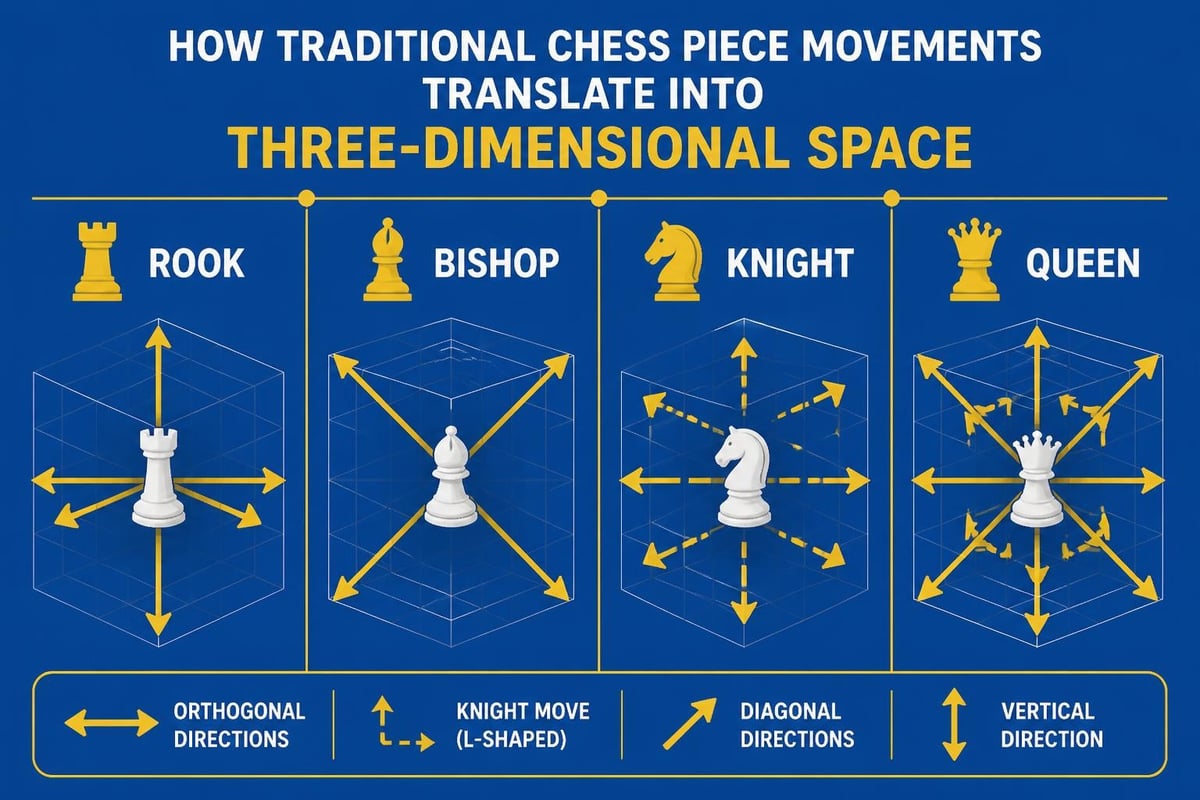
Think about how a rook moves on a traditional board. It travels in straight lines horizontally or vertically across the flat surface. In three dimensional chess, that same rook can now move up or down between levels, maintaining its characteristic straight-line movement but in three axes instead of two.
This fundamental shift changes everything:
- Bishops can move diagonally across levels, not just across a single plane
- Knights gain additional movement options with vertical jumps
- Queens become even more powerful with three-dimensional diagonal and straight-line movement
- Pawns face new promotion possibilities and capture mechanics
The king remains the ultimate target, but protecting it becomes exponentially more complex when threats can come from above or below.
Popular Variants and Rule Sets
Not all three dimensional chess games follow the same rules. Several variants have emerged over the decades, each with devoted followings and unique characteristics.
Star Trek's Tri-Dimensional Chess
Perhaps the most famous version appeared in Star Trek, where characters like Spock played on a visually striking multi-level board. While the show never fully explained the rules, the iconic design inspired real-world implementations.
The Star Trek variant typically features:
- Seven boards at different heights
- Four movable "attack boards" that can be repositioned
- Modified piece movements to accommodate the unique board structure
- Complex rules for board connectivity
If you're interested in other chess variants from popular culture, you might enjoy reading about the Star Wars chess game and how different franchises have reimagined the classic game.
Raumschach (Space Chess)
Created by Ferdinand Maack in 1907, Raumschach represents one of the earliest serious attempts at three dimensional chess. This variant uses a 5x5x5 cubic board with 125 squares total.
| Feature | Specification |
|---|---|
| Board Size | 5x5x5 cube |
| Total Squares | 125 |
| Piece Set | Standard pieces plus Unicorn |
| Movement Style | Three-axis adaptation of standard moves |
The game introduces the Unicorn, a piece that moves triagonally (diagonally through the cube's three dimensions). This addition creates fascinating tactical possibilities unique to the three-dimensional environment.
Digital Implementations
Modern technology has made three dimensional chess more accessible than ever. Chess³ᵈ offers a free browser-based version that lets you experience an 8x8x8 board with immersive 3D visuals. Meanwhile, Ziggurat 3D Chess on Steam provides a polished digital experience combining traditional chess movements with unique 3D mechanics.
These platforms remove the physical barrier of needing a complex three-dimensional board, making experimentation much more practical.

Strategic Differences from Traditional Chess
Playing three dimensional chess requires rethinking everything you know about chess strategy. The skills you've developed on a flat board still matter, but they need significant adaptation.
Spatial Awareness Becomes Critical
In standard chess, you can scan the entire board at a glance. Every piece is visible, every threat apparent (with sufficient skill). Three dimensional chess removes this convenience entirely.
You must now track:
- Horizontal threats on each level
- Vertical attacks between levels
- Diagonal combinations spanning multiple planes
- Piece coordination across different heights
This dramatically increases the cognitive load. Even experienced chess players find themselves struggling to visualize all possible attacks when pieces can strike from above or below.
Opening Theory Needs Reinvention
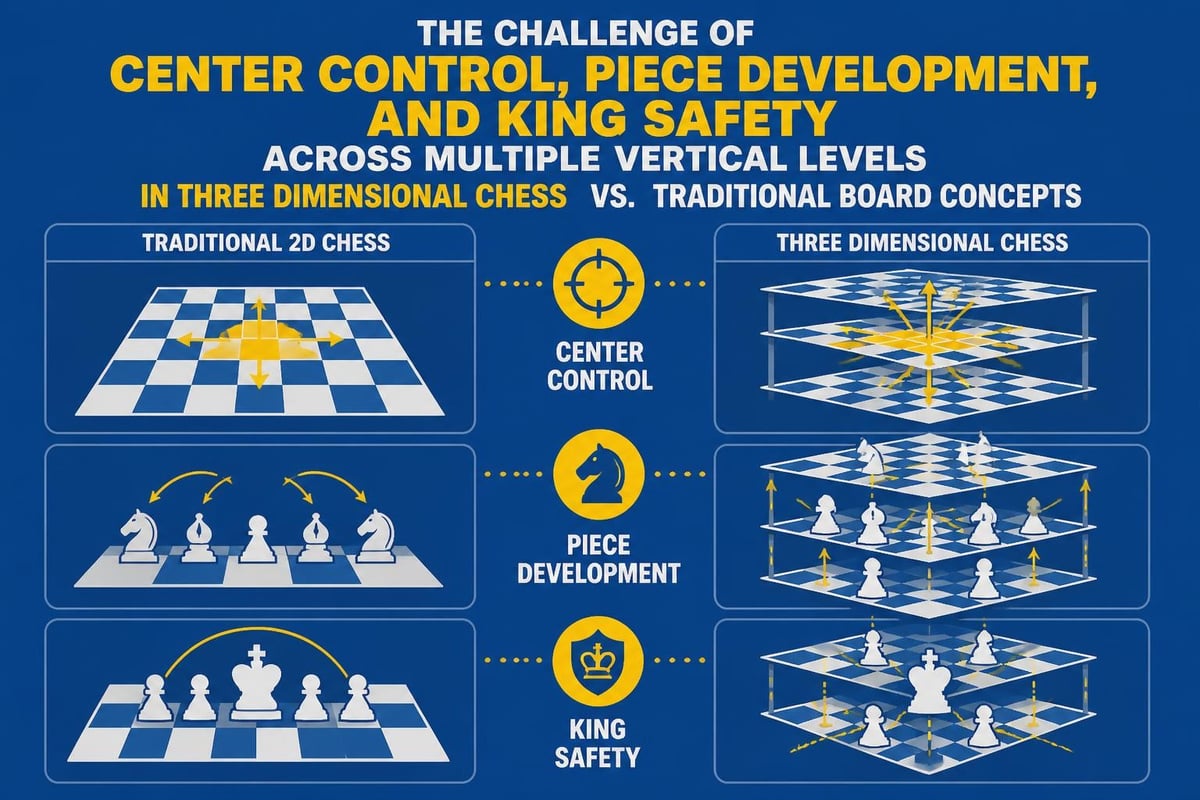
The chess openings you've memorized for traditional chess don't directly translate. While principles like controlling the center remain important, defining "the center" becomes more complex when you have multiple levels.
Some fundamental questions arise:
- Which level should you prioritize for piece development?
- How do you establish pawn structures across vertical space?
- What constitutes "center control" in three dimensions?
Players developing three dimensional chess theory are essentially starting from scratch, creating new opening systems based on the unique properties of vertical play.
Tactical Complexity Multiplies
If you thought knight forks were tricky in regular chess, wait until you encounter them in three dimensions. A knight positioned on the middle level can potentially attack pieces on the level above, below, and on its own level simultaneously.
Common tactical motifs transform:
- Pins: A piece can be pinned vertically to a king on a different level
- Skewers: Rooks and queens create skewer threats through multiple planes
- Discovered attacks: Moving a piece vertically can open attacking lines horizontally
- Double attacks: Pieces can threaten multiple targets across different levels
The mathematical complexity of piece movements in three-dimensional chess has been studied extensively, revealing just how much the game tree expands compared to traditional chess.
Learning Three Dimensional Chess as a Traditional Player
Should you invest time in learning three dimensional chess? That depends on what you're hoping to achieve.
Benefits for Traditional Chess Skills
Practicing three dimensional chess can actually improve your regular chess game in surprising ways. The mental gymnastics required to visualize three-dimensional positions strengthen your spatial reasoning abilities.
You develop:
- Enhanced visualization skills that carry over to calculating long variations
- Improved pattern recognition across complex board states
- Stronger tactical awareness from tracking multiple attack vectors
- Better decision-making under uncertainty
These skills directly benefit your traditional chess performance, similar to how solving chess puzzles sharpens your tactical vision.
The Learning Curve Challenge
Let's be honest: three dimensional chess is significantly harder to learn than standard chess. The rules themselves aren't necessarily more complicated, but the practical application requires substantial mental effort.
Expect these challenges:
- Initial disorientation when tracking piece positions
- Difficulty calculating even simple tactics
- Slower game pace while you process three-dimensional threats
- Frustration with unexpected attacks you didn't see coming
Most players need dozens of games before they develop basic competence in visualizing the three-dimensional board.
Practice Strategies
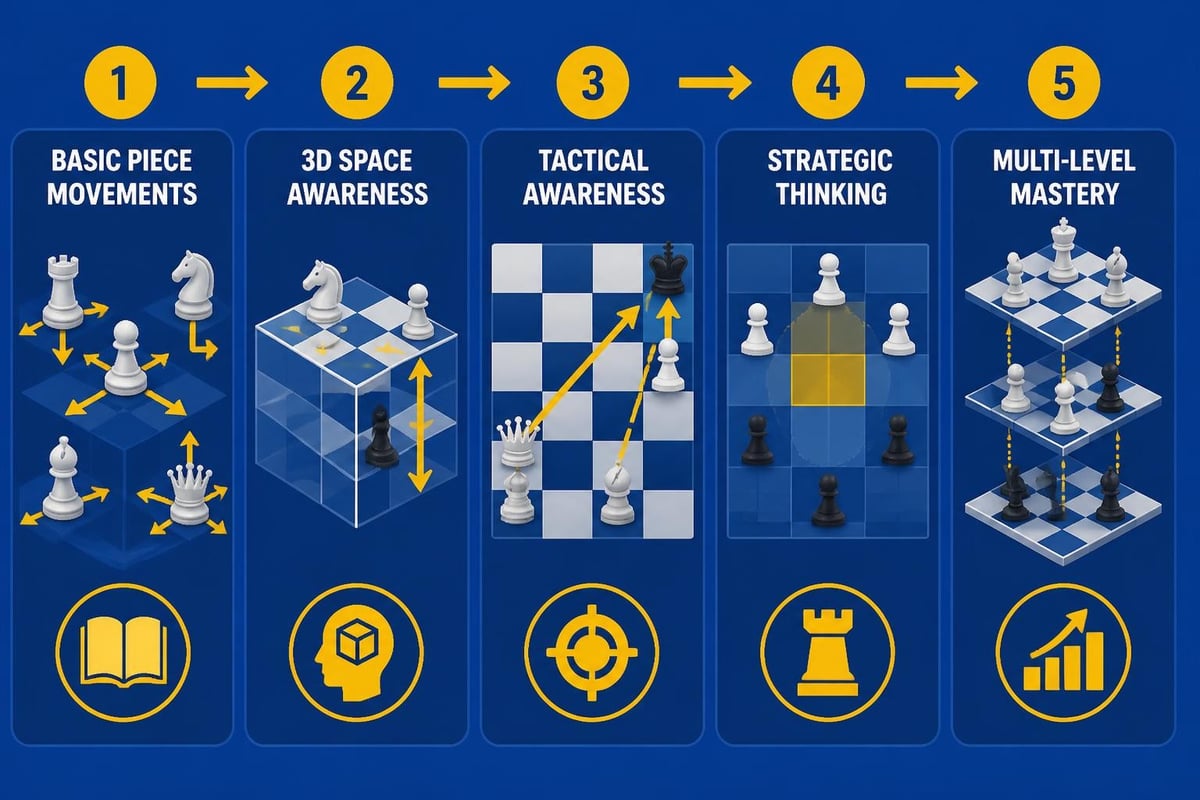
If you're serious about learning three dimensional chess, approach it systematically rather than diving straight into full games.
Start with these exercises:
- Single piece drills: Place one piece on the board and identify all its legal moves
- Threat recognition: Set up simple positions and find all attacking pieces
- Checkmate patterns: Learn basic mating combinations in three dimensions
- Endgame studies: Master simple king and rook versus king endings
This methodical approach mirrors how you might learn traditional chess, breaking complex concepts into manageable chunks.
The Cognitive Science Behind Three Dimensional Chess
Why does adding a vertical dimension make chess so much harder? The answer lies in how our brains process spatial information.
Working Memory Limitations
Research into chess cognition shows that even grandmasters rely heavily on pattern recognition rather than pure calculation. They've memorized thousands of board patterns and can quickly identify which pieces are well-placed or under threat.
Three dimensional chess breaks these patterns. Your brain can't rely on familiar visual cues, forcing you to process each position more analytically. This overwhelms working memory, which can typically hold only 4-7 chunks of information simultaneously.
| Cognitive Resource | Traditional Chess | Three Dimensional Chess |
|---|---|---|
| Pattern Recognition | High utility | Limited utility |
| Working Memory Load | Moderate | Very high |
| Calculation Depth | 3-5 moves typical | 1-2 moves typical |
| Visual Processing | 2D scanning | 3D reconstruction |
Developing New Mental Models
Becoming proficient at three dimensional chess requires building entirely new mental representations of the board. You need to internalize how pieces move through vertical space until it feels as natural as horizontal movement.
This process takes time and repetition. Just as beginners gradually learn to see tactical patterns in standard chess, three dimensional chess players must develop their own library of three-dimensional patterns.
The research on state tracking in chess provides insights into how players maintain mental models of complex game states, which becomes even more relevant in three-dimensional variants.
Resources and Communities for Three Dimensional Chess
Unlike traditional chess, which has massive infrastructure for learning and competition, three dimensional chess remains a niche interest. However, dedicated communities do exist.
Online Platforms
Several websites offer free three dimensional chess experiences. Various three-dimensional chess variants like CubeChess provide different approaches to the concept, each with unique board configurations and rule sets.
These platforms typically include:
- Play against computer opponents
- Online multiplayer matching
- Tutorial modes explaining piece movements
- Saved game analysis (limited compared to traditional chess tools)
The quality varies significantly, so you may need to try several before finding one that suits your preferences.
Learning Materials
Finding comprehensive guides for three dimensional chess proves challenging. The Wikipedia article on three-dimensional chess offers a solid starting point, covering various rule systems and historical development.
However, unlike traditional chess where you can find detailed resources like those at Chess Cheat Sheets covering every opening imaginable, three dimensional chess lacks standardized learning materials. Most knowledge gets passed informally through community forums and experimental play.
Competitive Play
Organized three dimensional chess tournaments are rare, though online platforms occasionally host casual competitions. The lack of a unified rule set makes standardized competition difficult, as players must first agree on which variant they'll use.
Some chess clubs have experimented with three dimensional chess as a novelty event, but it hasn't achieved mainstream competitive status. The game remains primarily a recreational pursuit for chess enthusiasts seeking novel challenges.
Is Three Dimensional Chess Worth Your Time?
You're probably wondering whether three dimensional chess deserves a place in your chess journey. The answer depends entirely on your goals and interests.
When It Makes Sense
Three dimensional chess offers value if you're:
- Looking for a fresh mental challenge beyond traditional chess
- Interested in chess variants and alternative rule sets
- Working to improve spatial reasoning and visualization skills
- Seeking a conversation piece and unique gaming experience
- Already comfortable with standard chess and wanting something different
The game provides genuine cognitive benefits, even if you never become highly skilled at it. The mental workout alone justifies occasional play.
When to Focus Elsewhere
Skip three dimensional chess if you're:
- Still learning the fundamentals of standard chess
- Focused on improving your chess Elo rating in traditional play
- Short on time and wanting maximum return on study investment
- Frustrated by steep learning curves and prefer gradual improvement
- Seeking competitive play with established tournament structures
Your time would be better spent mastering common chess openings or working through tactical exercises in standard chess.
Integrating Three Dimensional Thinking into Regular Chess
Even if you never play a full game of three dimensional chess, the concept can enhance your standard chess thinking.
Visualization Exercises
Practice visualizing your regular chess board as if it had vertical levels. When calculating variations, try to mentally "stack" the position at different points in your calculation, treating each move as a new level.
This technique helps you:
- Track multiple variations simultaneously
- Visualize complex tactical sequences more clearly
- Maintain awareness of pieces across different parts of the board
- Develop stronger calculation discipline
Expanding Your Tactical Vision
Three dimensional chess forces you to consider attack vectors you'd never think about in standard chess. Bringing this expanded awareness back to traditional chess makes you notice more tactical opportunities.
You begin seeing:
- Unconventional piece coordination possibilities
- Hidden attacking lines you previously missed
- Creative tactical combinations outside standard patterns
- Deeper calculation branches in complex positions
These skills complement traditional study methods and can accelerate your chess improvement when combined with focused opening preparation.
The Future of Three Dimensional Chess
Where is three dimensional chess headed? The game faces both opportunities and challenges as we move through 2026 and beyond.
Artificial Intelligence Development
Machine learning approaches to chess have revolutionized traditional chess analysis. Applying similar AI techniques to three dimensional chess could finally solve some of the theoretical questions that have puzzled players for decades.
Potential AI contributions include:
- Optimal opening theory development across different variants
- Tactical training tools that highlight three-dimensional combinations
- Strong computer opponents to practice against
- Analysis engines to review and improve your games
As AI becomes more sophisticated, three dimensional chess could benefit from the same analytical revolution that transformed traditional chess over the past decade.
Virtual Reality Integration
VR technology seems perfectly suited for three dimensional chess. Rather than struggling to visualize multiple levels on a flat screen or physical board, VR could present the full three-dimensional playing field in an intuitive, immersive environment.
Imagine being able to walk around the board, examining positions from different angles, and naturally reaching out to move pieces through three-dimensional space. This could make three dimensional chess dramatically more accessible to new players.
Standardization Efforts
The biggest barrier to three dimensional chess gaining wider adoption remains the lack of a universally accepted rule set. If the community could coalesce around a single variant as "official" three dimensional chess, it would enable:
- Consistent learning resources and tutorials
- Meaningful rating systems and rankings
- Organized competitive play
- Strategic theory development
- Commercial development of quality chess sets
Until standardization happens, three dimensional chess will likely remain a fascinating curiosity rather than a serious competitive game.
Three dimensional chess transforms the familiar game into something genuinely novel, offering mental challenges that stretch even experienced players' abilities. While it's not for everyone, the unique perspective it provides on spatial reasoning and strategic thinking makes it worth exploring, at least casually. If you're looking to strengthen your foundation in traditional chess first, Chess Cheat Sheets provides comprehensive guides and resources designed to help you master openings and improve your game efficiently, giving you the solid base you need before venturing into more exotic chess variants.


