

You've probably seen it happen: White plays 1.e4, confidently pushing their king's pawn forward, and Black immediately strikes back with 1...d5. This bold response is the scandinavian defense, one of the most straightforward and aggressive ways to meet White's most popular first move. Unlike other defences where Black might develop pieces first or create pawn chains, the Scandinavian Defense immediately challenges White's central control. It's refreshingly simple to learn, making it perfect for players who want a reliable weapon without memorizing countless variations. But don't let its simplicity fool you - this opening packs a serious punch and has been trusted by grandmasters for decades.
What Makes the Scandinavian Defense Different
The scandinavian defense stands out from other Black openings because it breaks several traditional chess principles, yet somehow works brilliantly. After 1.e4 d5 2.exd5, Black must recapture immediately, typically bringing their queen out early with 2...Qxd5. Yes, you read that right - the queen moves on the second move, something beginners are usually warned against.
This early queen development actually serves a purpose. Black clears the center, develops quickly, and avoids the theoretical mazes of the Sicilian Defense or Caro-Kann Defense. The trade-off? White gains time by attacking your queen, forcing it to move again.
The Main Continuation
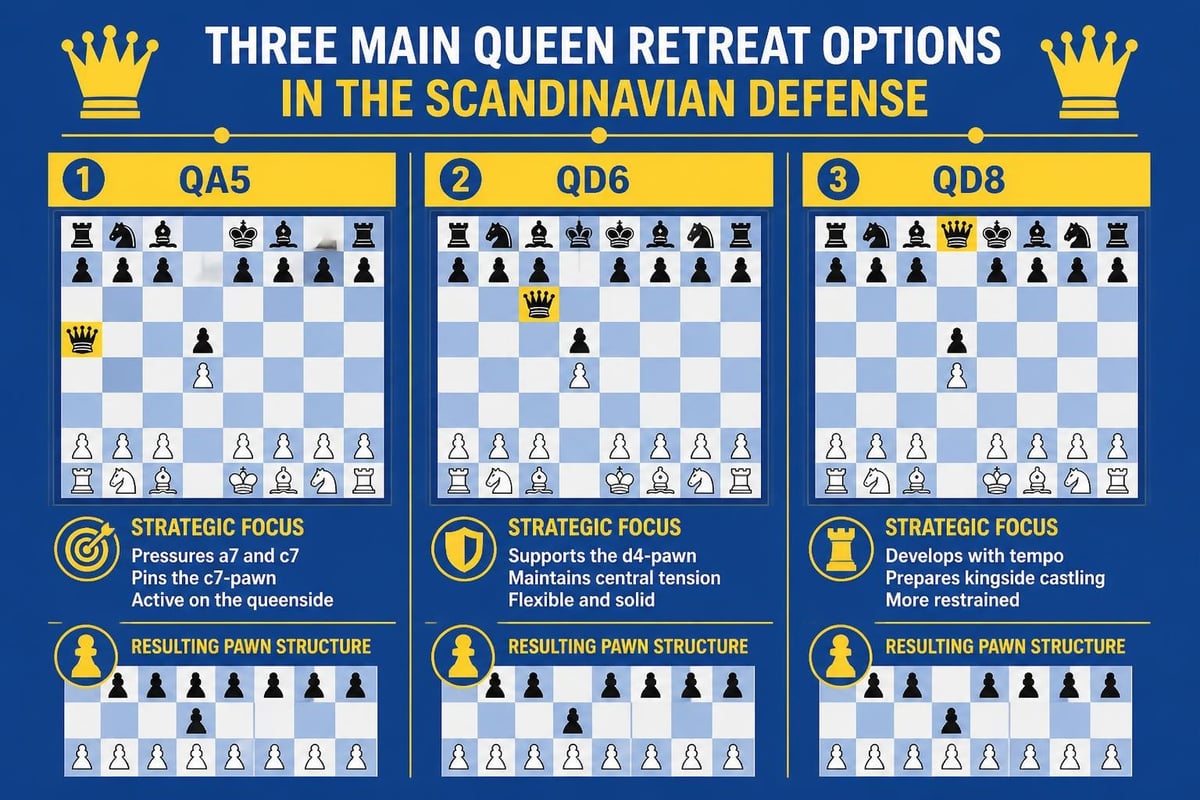
After 1.e4 d5 2.exd5 Qxd5 3.Nc3, Black faces their first major decision. The most popular choice is 3...Qa5, moving the queen to safety while maintaining flexibility. This position forms the backbone of modern Scandinavian theory.
Some players prefer 3...Qd6 or even 3...Qd8, retreating the queen immediately. Each move has its merits, but 3...Qa5 offers the best balance between activity and safety.
Key Strategic Ideas You Need to Know
Understanding the strategic themes behind the scandinavian defense transforms it from a simple opening into a powerful weapon. Let's break down what you're actually trying to achieve.
Central Control and Development
Black willingly gives up central pawns to achieve rapid development. Your pieces spring into action quickly:
- Knights typically go to f6 and d7 (or sometimes c6)
- Bishops aim for f5 or g4, putting immediate pressure on White
- Castling happens relatively quickly, usually kingside
- Rooks connect early due to the open center
This development plan differs significantly from closed openings like the Caro-Kann Classical Variation, where pawn structures dictate piece placement.
The Bishop Pair Advantage
One hidden gem in the scandinavian defense is Black's potential to maintain both bishops while White often trades their light-squared bishop. This becomes powerful in the middlegame when open lines appear.
According to the comprehensive Wikipedia overview, many strong players adopted this defense precisely because of these long-term compensation factors.
Popular Variations Breakdown
The beauty of the Scandinavian lies in its manageable number of variations. You won't need to memorize 20 different lines just to survive the opening.
The Modern Variation (3...Qa5)
| Move Order | White's Plan | Black's Response |
|---|---|---|
| 1.e4 d5 2.exd5 Qxd5 3.Nc3 Qa5 | Develop naturally, gain space | Nf6, Bf5, e6 setup |
| 4.d4 Nf6 5.Nf3 | Control center, develop | Bf5 or Bg4 |
| 4.d4 Nf6 5.Bc4 | Aggressive kingside pressure | c6, Bf5, e6 |
This variation gives Black excellent piece activity. The queen on a5 pins White's c3 knight, limiting White's options. You'll typically follow up with Nf6, Bf5 (or Bg4), e6, and Nbd7.
The Portuguese Variation (3...Qd6)
Here's something interesting: 3...Qd6 keeps the queen centralized while avoiding immediate harassment. The trade-off? The queen blocks the bishop's natural development square.
After 4.d4 Nf6 5.Nf3, Black usually plays c6 and Bg4, creating a solid structure reminiscent of positions from the most common chess openings.
Early Queen Retreat (3...Qd8)
Some players prefer 3...Qd8, admitting the queen sortie gained nothing. Sounds passive, right? Actually, this "Scandinavian Gambit" approach leads to unique positions where Black compensates with rapid development.
Practical Tips for Playing Black
Right, let's get into the nitty-gritty of actually playing this opening at the board. These tips come from practical experience and will save you headaches.
Development Priorities
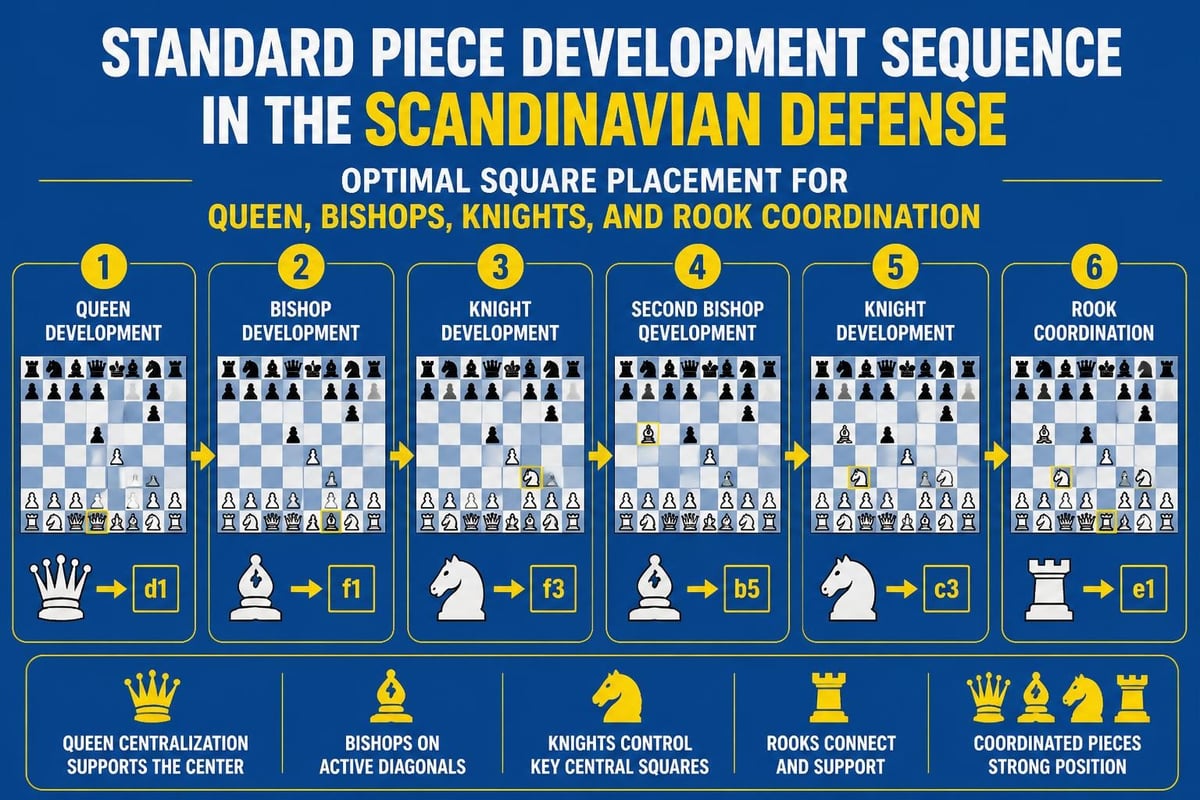
- Move your queen to safety (usually a5) after White plays Nc3
- Develop your light-squared bishop to f5 or g4 before playing e6
- Get your king's knight out to f6, attacking White's center
- Castle kingside within the first 10 moves
- Connect your rooks and activate them on open files
Notice how this differs from what you might find in the Ruy Lopez opening guide? The Scandinavian's straightforward development makes it easier to remember.
Common Tactical Themes
The scandinavian defense creates specific tactical patterns you should recognize:
- Pin tactics involving the queen on a5 and White's knight on c3
- Bishop pair exploitation in open positions
- Central pawn breaks with c5 or e5 at the right moment
- Queenside pressure along the a-file and c-file
Avoiding Common Mistakes
Don't let these typical errors derail your games:
- Moving the queen too many times in the opening (two moves maximum is ideal)
- Neglecting king safety while chasing activity
- Allowing White's d4-d5 push without proper preparation
- Trading pieces aimlessly when you have the bishop pair
What White Will Try Against You
Understanding White's typical plans helps you prepare appropriate responses. Your opponent has several sensible approaches to combat the scandinavian defense.
The Space-Grabbing Approach
White often pushes d4 and c4, claiming maximum central space. They're banking on your lack of central pawns becoming a long-term weakness. Counter this by:
- Creating active piece play
- Targeting White's extended pawns
- Opening lines for your bishops
- Maintaining flexibility with pawn breaks
The Development Race
Some White players focus on rapid development with Nf3, Bc4, and 0-0, trying to launch a kingside attack before you've consolidated. This approach appears in various forms across different chess openings.
The Theoretical Battle
Well-prepared opponents might know 15-20 moves of theory in critical lines. Here's the good news: the Scandinavian's positions are typically straightforward enough that you can find decent moves using general principles, even when you're "out of book."
Middlegame Plans and Strategies
The opening transitions smoothly into the middlegame, where your plans become clearer. Let's explore what you're aiming for.
When You Have the Bishop Pair
Your bishops become monsters in open positions. Target weaknesses on both flanks:
- Use your dark-squared bishop to control key central squares
- Activate your light-squared bishop along long diagonals
- Create threats on opposite sides of the board
- Trade knights when advantageous
Pawn Structure Considerations
| Structure Type | Black's Approach | Key Squares |
|---|---|---|
| Isolated d4 pawn | Blockade and pressure | d5, c5, e5 |
| Hanging pawns | Attack or undermine | c4, d4 areas |
| Open center | Activate bishops, control files | Central files |
Creating Counterplay
Don't just react to White's plans. Generate your own threats:
- Push c5 to challenge White's center
- Create queenside pressure with a5-a4
- Use your queen actively (it's already developed!)
- Look for tactical shots involving your active pieces
The detailed breakdown at Chess.com shows how top players create dynamic counterplay from seemingly quiet positions.
Why the Scandinavian Works at Your Level
Here's something you might be wondering: if the scandinavian defense breaks traditional principles, why does it work so well for improving players?
Psychological Advantages
Your opponent expects 1...e5, 1...c5, or 1...e6. The Scandinavian surprises them, potentially taking them out of their preparation. This psychological edge matters more than you'd think in practical games.
Many club players have limited experience against it because it's less common than mainstream defenses. You're fighting on your territory, not theirs.
Reduced Preparation Time
Compare learning the Scandinavian to mastering the Caro-Kann Defense. Both are solid, but the Scandinavian requires significantly less theoretical knowledge to play competently.
Clear Plans and Ideas
The scandinavian defense offers concrete development schemes and middlegame plans. You're not drowning in theory - you're learning chess principles through practical play.

Advanced Concepts for Improvement
Ready to take your Scandinavian to the next level? These advanced ideas separate casual players from serious practitioners.
The Fianchetto Setup
Some variations involve fianchettoing the dark-squared bishop to g7. This setup, particularly after 3...Qd6, creates a hybrid structure combining Scandinavian and Pirc Defense elements.
Dynamic Piece Sacrifices
The scandinavian defense occasionally allows for spectacular tactical sequences:
- Knight sacrifices on e4 or d5
- Bishop sacrifices to destroy White's kingside
- Exchange sacrifices to activate your pieces
- Queen sacrifices (rare but devastating when they work)
Endgame Transitions
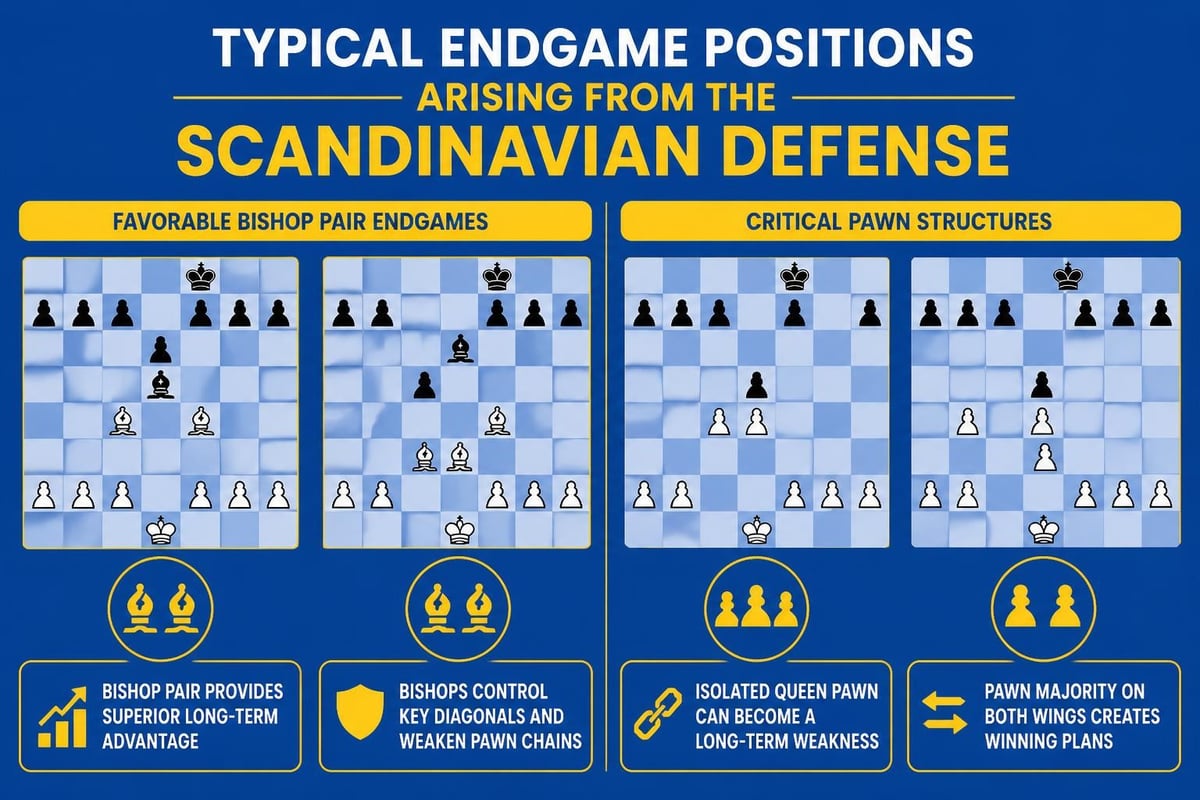
Know when to trade into favorable endings:
- Bishop endgames often favor you with the bishop pair
- Queen endgames can be tricky but manageable
- Rook endgames require precise technique
- Minor piece endgames demand understanding of your structure's strengths
Training Resources and Next Steps
So you're convinced the scandinavian defense deserves a place in your repertoire. Brilliant! Here's how to actually master it.
Study Methods That Work
- Play through master games in the Scandinavian to absorb typical plans
- Solve tactical puzzles from Scandinavian positions
- Practice against computers set to play critical White responses
- Analyse your own games to identify recurring mistakes
- Review key theoretical positions regularly
The comprehensive guide at Chess Flare offers excellent examples of typical positions and plans worth studying.
Building Your Personal Repertoire
Don't try to learn every variation simultaneously. Start with:
- Main line with 3...Qa5 as your primary weapon
- One solid setup against 4.d4 Nf6 5.Nf3 (the most common continuation)
- One backup plan for early deviations (like 3.c4 or 3.Nf3)
Tracking Your Progress
Monitor these metrics to gauge improvement:
- Percentage of games where you equalize from the opening
- Quality of your piece placement by move 15
- Win rate in resulting middlegames
- Reduction in time spent during the opening phase
Handling White's Sidelines
Not everyone plays the main lines. Here's how to handle alternatives.
The 2.c4 Smith-Morra Style
After 1.e4 d5 2.c4, White gambits a pawn for quick development. Simply accept with 2...dxc4 and hold onto the pawn with moves like e6, Nf6, and a6.
The 2.Nc3 Approach
This move order tries to avoid giving Black the initiative. After 2...dxe4 3.Nxe4, you reach similar positions but with slightly different move orders.
The 3.c4 Panov Attack
When White plays 3.c4 after 1.e4 d5 2.exd5 Nf6, they're transposing to Caro-Kann Panov-Botvinnik structures. If this concerns you, stick with the queen recapture on move 2.
Historical Perspective and Modern Usage
Understanding the scandinavian defense's evolution adds depth to your appreciation of the opening.
Classical Roots
The opening traces back centuries, with early adopters appreciating its direct nature. The historical development detailed at Chess.com shows how the defense evolved from a curiosity to a respected system.
Modern Grandmaster Practice
Today's super-GMs occasionally employ the Scandinavian as a surprise weapon or when needing a safe draw with Black. Players like Magnus Carlsen have used it in rapid and blitz formats, validating its soundness.
Theoretical Developments
Recent years have seen refinements in move orders and piece placements. The opening isn't static - new ideas emerge regularly, keeping it fresh and challenging for White players.
Comparing to Similar Openings
How does the scandinavian defense stack up against other Black responses to 1.e4?
| Opening | Theoretical Depth | Early Activity | King Safety | Learning Curve |
|---|---|---|---|---|
| Scandinavian | Moderate | High | Good | Easy |
| Caro-Kann | High | Moderate | Excellent | Moderate |
| French | Very High | Low | Good | Difficult |
| Sicilian | Extreme | High | Variable | Very Difficult |
The Scandinavian offers an attractive middle ground: enough theory to stay interesting, but not so much that you'll drown in preparation.
When to Choose the Scandinavian
This defense particularly suits players who:
- Want a reliable, low-maintenance Black repertoire
- Prefer active piece play over closed pawn structures
- Enjoy surprising opponents with offbeat but sound openings
- Need a backup defense when their main repertoire fails
- Value practical chances over theoretical perfection
Studying Specific Lines Efficiently
Right, let's talk about efficient study methods. You don't have infinite time to learn chess openings.
The 80/20 Approach
Focus on the 20% of lines that occur 80% of the time:
- Critical position after 4.d4 Nf6 5.Nf3 Bf5 (this appears constantly)
- White's early Bc4 systems (popular at club level)
- The position after 6.Bd2 (common in the main line)
Pattern Recognition Over Memorization
Instead of memorizing specific move sequences, learn these patterns:
- How to handle White's space advantage
- When to push c5 versus maintaining flexibility
- Typical bishop placement in different structures
- Queen repositioning based on White's setup
The resources at Chess Cheat Sheets break down these patterns beautifully, making them accessible for players at all levels.
Creating Reference Positions
Build a collection of 5-10 "reference positions" you understand deeply. When your games reach similar structures, you'll know exactly what to do. This approach works across all openings and is more valuable than knowing 50 moves of a single variation.
The scandinavian defense offers everything an improving player needs: clear plans, solid positions, and practical chances against any opponent. Whether you're building your first serious opening repertoire or adding a reliable backup system, this defense delivers results without demanding endless theoretical study. Ready to add this powerful weapon to your arsenal? Chess Cheat Sheets provides comprehensive guides, visual cheat sheets, and training resources specifically designed to help you master the Scandinavian Defense and other essential openings quickly and effectively.


