

Teaching chess to students of any age requires the right tools, and nothing matters more than selecting an appropriate teaching chess board. Whether you're a coach running group sessions, a parent introducing your child to the game, or a teacher integrating chess into your curriculum, the board you choose shapes the entire learning experience. The right board doesn't just display the game-it transforms abstract concepts into tangible understanding, making complex strategies accessible to beginners and intermediates alike.
Why Your Teaching Chess Board Matters More Than You Think
You might assume any chess board will do for instruction, but that's simply not the case. The board you use directly impacts how well students absorb information, maintain focus, and develop their understanding of the game.
A proper teaching chess board needs to be visible to everyone in your teaching space. If students in the back row can't distinguish a knight from a bishop, they're already falling behind. Beyond visibility, the board should facilitate demonstration without causing disruption. When you're explaining the most common chess openings, you need to move pieces smoothly while maintaining eye contact with your students.
Key Features to Look For
- Size appropriate for your space: Demonstration boards typically range from 20 to 36 inches square
- Clear piece differentiation: High contrast between light and dark squares
- Durable construction: Materials that withstand repeated handling
- Portability considerations: Weight and storage requirements for your teaching environment
- Magnetic or peg systems: Pieces that stay put during vertical demonstrations
The material composition affects both longevity and instructional quality. Vinyl boards offer affordability and portability, whilst wooden boards provide aesthetic appeal and weight that prevents sliding during lessons.
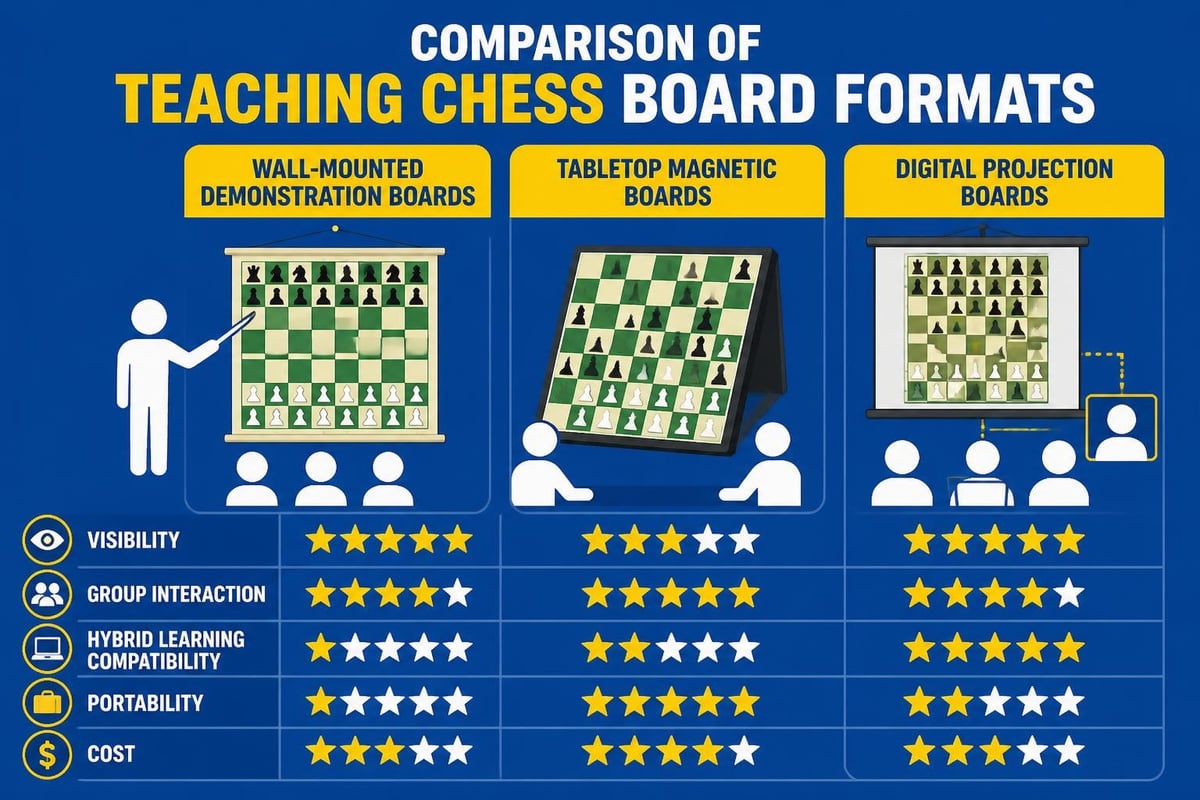
Different Teaching Chess Board Types for Different Situations
Not every teaching environment demands the same setup. Your choice depends on class size, student age, and instructional goals.
Demonstration Boards for Group Instruction
When you're teaching children how to play chess in groups, a wall-mounted or standing demonstration board becomes essential. These oversized boards, visible from 20 feet away, transform your explanations into shared visual experiences.
Demonstration boards work brilliantly for:
- Opening theory presentations
- Famous game analysis
- Tactical pattern recognition
- Endgame technique demonstrations
Many coaches prefer magnetic demonstration boards because pieces don't fall off when the board is vertical. This stability matters when you're mid-explanation and need to focus on your students rather than retrieving dropped pieces.
Student Practice Boards
Whilst you might use a large teaching chess board for demonstrations, your students need their own boards for hands-on practice. The selection of appropriate chess boards for coaching requires balancing budget constraints with quality requirements.
For student boards, consider:
| Feature | Beginner Focus | Intermediate Focus |
|---|---|---|
| Square Size | 1.5-2 inches | 2-2.25 inches |
| Board Material | Vinyl or mousepad | Vinyl or wood |
| Piece Weight | Lightweight plastic | Weighted plastic or wood |
| Portability | High priority | Medium priority |
Younger students benefit from slightly larger pieces that are easier to manipulate, whilst older learners appreciate tournament-standard proportions that prepare them for competitive play.

Digital and Interactive Boards
Modern chess instruction increasingly incorporates technology. Digital teaching chess boards connect to projectors or interactive whiteboards, allowing you to demonstrate positions whilst tracking variations simultaneously. A digital chess demonstration board offers unique advantages in classroom settings.
These technological solutions enable you to:
- Save and recall positions instantly
- Show multiple variations without resetting pieces
- Integrate video analysis with live demonstrations
- Connect with online chess databases and engines
The trade-off? Digital boards require technical setup and can face connectivity issues. Many experienced instructors maintain both traditional and digital options.
Structuring Your Lessons Around Your Teaching Board
Having the right teaching chess board means nothing if you don't use it effectively. Your instructional approach should maximize the board's potential whilst accommodating different learning styles.
The Opening Sequence
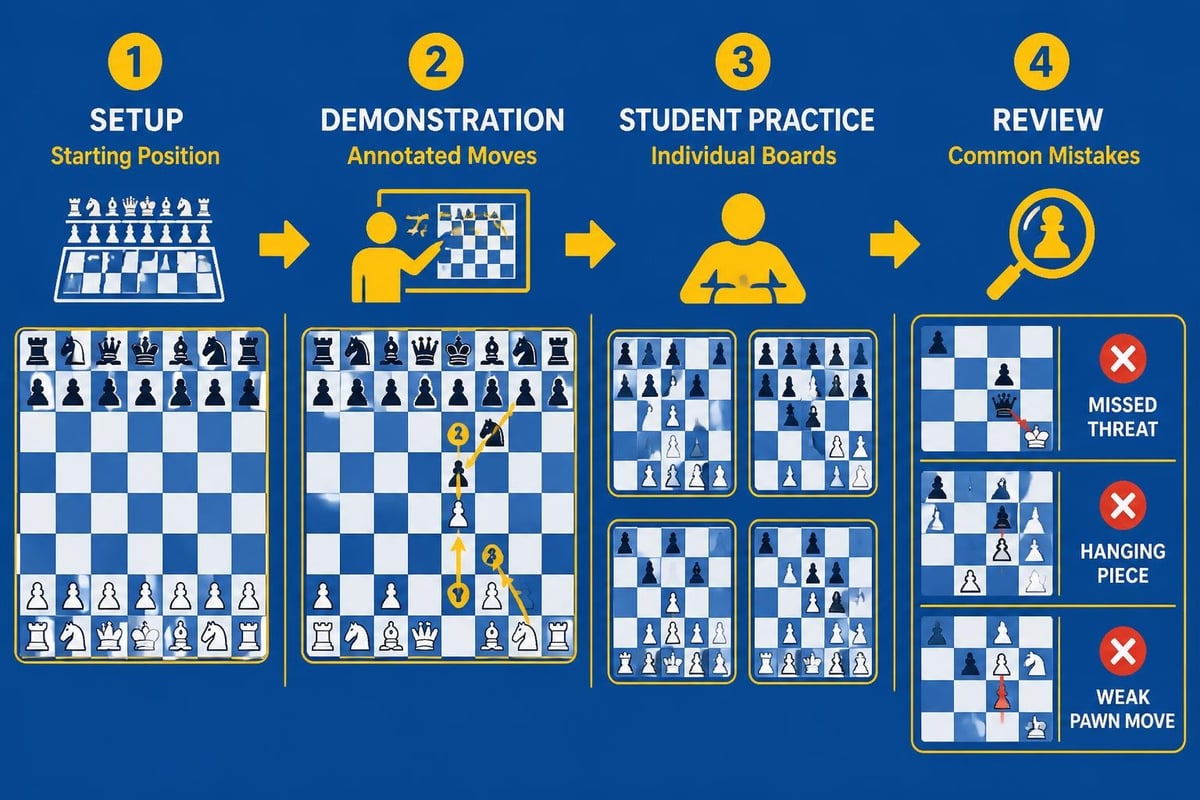
Start each lesson by setting up a clear, focused position on your teaching chess board. Don't begin with the complexity of a middlegame position-that overwhelms beginners. Instead, introduce concepts progressively.
When teaching chess openings for white, demonstrate the first three to four moves, then pause. Ask students what they notice. This interactive approach, rather than lecturing whilst moving pieces rapidly, embeds learning more effectively.
Age-Appropriate Adaptations
Your teaching chess board strategy must adapt to student age. The age-specific approaches to teaching chess vary significantly.
For children aged 5-8:
- Use storytelling with pieces as characters
- Demonstrate one piece type per session initially
- Employ colour coding or stickers for reinforcement
- Keep board demonstrations under 10 minutes
For students aged 9-13:
- Introduce basic tactical themes
- Challenge them to spot the next move during demonstrations
- Incorporate puzzle-solving from the teaching board
- Gradually increase demonstration complexity
For teenagers and adults:
- Focus on strategic concepts using demonstration positions
- Analyze master games on the teaching board
- Encourage debate about alternative moves
- Connect positions to opening theory
The Demonstration-Practice Cycle
Effective chess instruction follows a rhythm: demonstrate on the teaching chess board, then have students replicate on their own boards. This cycle reinforces learning through multiple modalities.
After showing a tactical pattern on your demonstration board, immediately have students find similar patterns on their individual boards. This structured approach to conducting lessons ensures concepts stick.
Common Teaching Chess Board Mistakes to Avoid
Even experienced instructors sometimes undermine their effectiveness through avoidable errors. Recognising these pitfalls helps you teach more successfully.
Visibility Failures
You've probably experienced this: demonstrating a brilliant combination whilst half your students squint uselessly at a board they can't properly see. Position your teaching chess board with sightlines in mind. Test visibility from every student position before your lesson begins.
Lighting matters enormously. Glare on a demonstration board renders it useless. Position boards perpendicular to windows and overhead lights to minimize reflection.
Moving Too Quickly
Chess instructors often forget they're experts. What seems obvious to you-why a particular move creates a threat-isn't obvious to beginners. After placing each piece on your teaching chess board, pause. Let students absorb the new position before continuing.
Research in chess education resources consistently shows that pacing affects retention more than any other instructional variable. Slower demonstrations with strategic pauses outperform rapid-fire explanations every time.
Neglecting Student Board Alignment
When students practice on their own boards, they must orient them correctly. White on the right, remember? This seemingly trivial detail becomes crucial when you're demonstrating on your teaching chess board and students attempt to replicate positions.
Walk around during practice segments. A student whose board is rotated 90 degrees is learning nothing useful from your demonstration.
Supplementing Your Teaching Chess Board with Other Resources
Your teaching chess board forms the foundation, but supplementary materials enhance instruction significantly. The key is integration rather than replacement.
Printed Reference Materials
Visual learners benefit from take-home materials that reinforce your board demonstrations. Quick-reference guides showing piece movements, basic tactical patterns, and opening principles bridge the gap between lessons.
For students working on specific openings, resources like the Italian Game guide or Scandinavian Defense strategies provide structured frameworks they can study alongside practical board work.
Video Integration
Whilst nothing replaces hands-on board work, chess videos for beginners offer valuable supplementary instruction. Show short video segments on your teaching chess board setup if you're using a digital system, or recommend specific videos for homework.
The combination of in-person demonstration on your teaching chess board plus video reinforcement creates multiple learning pathways.
Puzzle Collections
After demonstrating concepts on your teaching chess board, solidify understanding through targeted puzzles. Students who've just learned about knight forks need to solve knight fork puzzles immediately, not next week.
Resources like the 1.5 Million Chess Openings Puzzles Pack provide endless practice opportunities categorised by theme and difficulty.
Setting Up Your Teaching Space for Maximum Impact
The physical environment surrounding your teaching chess board affects learning outcomes. Small adjustments create dramatically better results.
Seating Arrangements
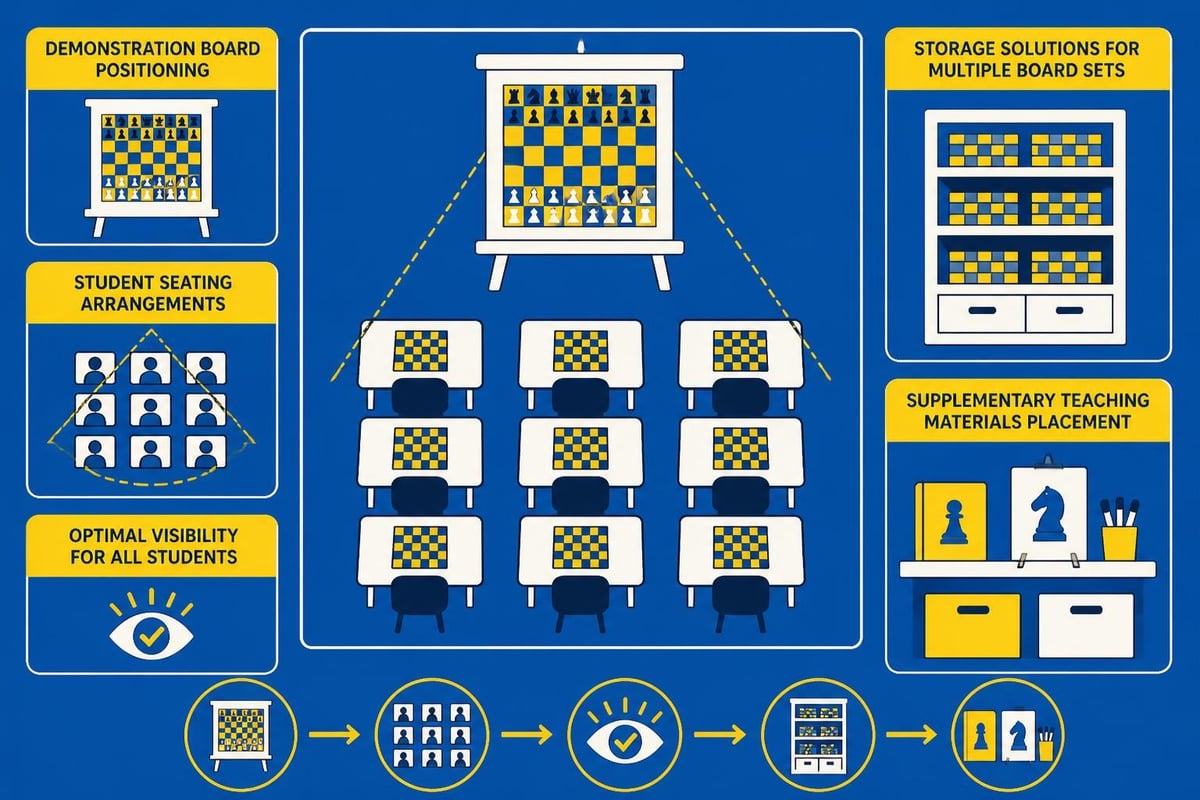
Semi-circular seating around your demonstration board ensures every student has adequate sightlines. Avoid straight rows-they work for lectures but fail for interactive chess instruction.
For smaller groups (under eight students), a U-shape configuration allows you to reach each student's practice board quickly whilst maintaining clear demonstration board visibility.
Multiple Board Stations
Advanced instructors sometimes set up multiple teaching chess boards showing different concepts simultaneously. One board displays the current lesson position, another shows a related tactical pattern, and a third might show how the position could evolve.
This approach works brilliantly for mixed-ability groups. Stronger students examine the advanced positions whilst beginners focus on fundamental concepts.
Storage and Preparation
Nothing kills instructional momentum faster than fumbling with equipment. Organise your teaching chess boards and pieces for instant deployment. Label storage containers, maintain piece sets separately from boards, and keep demonstration boards in easily accessible locations.
Create a pre-lesson checklist:
- Board cleaned and positioned
- Pieces sorted and counted
- Starting position verified
- Supplementary materials ready
- Student boards distributed
Adapting Your Teaching Chess Board for Remote Instruction
The shift toward online education hasn't bypassed chess. Your physical teaching chess board requires adaptation for virtual environments, but the core principles remain.
Camera Positioning
When teaching via video, your camera must capture your teaching chess board clearly without distortion. Overhead mounting works best, showing the entire board in proper perspective. Side angles create visual confusion as squares appear trapezoidal rather than square.
Invest in adequate lighting. Shadows obscure piece positions and frustrate remote students who already face technical barriers to engagement.
Hybrid Approaches
Many instructors now combine physical demonstration boards with digital tools. Show your actual teaching chess board via camera whilst simultaneously sharing an online board that students can manipulate themselves.
This redundancy helps. When your camera freezes or connection drops, students still have the digital board. When the software glitches, your physical board provides backup.
Digital Board Software
Online teaching platforms offer built-in chess boards, but standalone software often provides better functionality. Look for programs allowing you to:
- Preset multiple positions for quick switching
- Highlight squares and arrows during explanations
- Save lesson positions for future reference
- Share board control with students for interactive problem-solving
The limitation? Digital boards lack the tactile experience that helps younger students develop board awareness. Balance screen time with recommendations for physical practice.
Measuring Success with Your Teaching Chess Board
How do you know your teaching chess board approach is working? Concrete assessment metrics reveal instructional effectiveness.
Observable Student Behaviours
Watch for these indicators during board demonstrations:
- Visual tracking: Students' eyes follow piece movements
- Anticipatory reactions: Visible responses before you complete a move
- Spontaneous questions: Students raise hands mid-demonstration with tactical queries
- Replication accuracy: Ability to set up demonstrated positions independently
These behaviours signal engagement and comprehension. Their absence suggests you need to adjust pace, board positioning, or explanation clarity.
Progress Benchmarking
Establish simple benchmarks tied to your teaching chess board demonstrations:
| Skill Level | Board Vision | Pattern Recognition | Setup Speed |
|---|---|---|---|
| Beginner | Identifies all pieces | Spots one-move tactics | 2-3 minutes for starting position |
| Intermediate | Visualizes two moves ahead | Recognizes common patterns | Under 1 minute for any position |
| Advanced | Calculates multi-move sequences | Anticipates strategic themes | Instant position recreation |
Track individual student progress through these stages. Students who struggle with board vision need more demonstration time and closer board proximity.
Building Your Teaching Chess Board Collection Over Time
You don't need every board type immediately. Strategic acquisition builds a comprehensive teaching toolkit gradually.
Essential Starting Set
Begin with these fundamentals:
- One quality demonstration board (magnetic wall-mounted or standing)
- Six to eight student practice sets (vinyl boards with weighted plastic pieces)
- One digital board solution (software or app)
- Basic supplementary materials
This foundation supports classes of up to eight students effectively. As your programme grows, add specialised equipment.
Growth Priorities
Expand your teaching chess board collection based on actual needs:
Second priority additions:
- Portable demonstration board for different teaching locations
- Higher-quality wooden student sets for advanced players
- Interactive whiteboard integration
- Additional piece sets for simultaneous exhibitions
Later enhancements:
- Outdoor giant chess sets for engagement events
- Specialised endgame boards with reduced piece sets
- Custom boards with coordinate grids for notation practice
- Electronic boards with move sensors for instant feedback
Budget constraints? Seek grants, sponsorships, or parent contributions. Many communities enthusiastically support chess education initiatives when presented with specific equipment needs.
Maintaining Your Teaching Chess Boards for Longevity
Quality chess boards represent significant investments. Proper maintenance extends their useful life dramatically whilst ensuring consistent instructional quality.
Cleaning and Storage
Vinyl boards require periodic cleaning with damp cloths and mild soap. Avoid harsh chemicals that degrade material over time. Store rolled boards with the playing surface outward to prevent permanent creasing.
Wooden boards need different care. Dust regularly with soft, dry cloths. Apply wood conditioner annually to prevent drying and cracking. Never store wooden boards in damp locations-moisture causes warping that ruins board flatness.
Piece Management
Missing pieces sabotage lessons. Establish strict accountability:
- Count pieces after every session
- Assign students responsibility for their practice sets
- Maintain spare piece collections for replacements
- Use distinctive markers or colours to identify complete sets
Create a simple tracking system. A clipboard checklist near your storage area takes 30 seconds after class but prevents frustrating equipment shortages.
Repair and Replacement Strategies
Even well-maintained teaching chess boards eventually wear out. Plan replacement cycles based on usage intensity:
- Heavy use (daily classes): Replace vinyl boards every 2-3 years
- Moderate use (weekly clubs): Replace every 4-5 years
- Light use (occasional instruction): Replace every 6-8 years
Demonstration boards last longer but eventually lose magnetic strength or develop visual wear. Budget for major equipment replacement every five years to maintain instructional quality.
Your teaching chess board serves as more than just equipment-it's the foundation of effective chess instruction that transforms abstract concepts into concrete understanding for students at every level. By selecting appropriate boards, structuring lessons thoughtfully, and maintaining your equipment properly, you create learning experiences that develop both tactical skill and strategic thinking. Whether you're helping students master fundamental piece movements or exploring sophisticated opening theory, Chess Cheat Sheets provides comprehensive guides, puzzles, and resources that complement your board instruction perfectly, giving your students the tools they need to advance their chess understanding efficiently and confidently.


