

Have you ever wanted to throw your Sicilian Defence opponents off balance right from the opening? The smith morra gambit offers exactly that opportunity. This aggressive weapon allows White to sacrifice a pawn early for rapid development, open lines, and relentless attacking chances. It's perfect for club players who want to dictate the game's tempo without memorising endless theoretical variations. Whether you're tired of facing the Sicilian or simply want to expand your opening repertoire, understanding this gambit can transform your approach to 1.e4.
What Makes the Smith Morra Gambit Special
The smith morra gambit arises after the moves 1.e4 c5 2.d4 cxd4 3.c3. It's one of the most direct ways to challenge Black's Sicilian Defence. Rather than entering complex theoretical battles, White offers a pawn to accelerate piece development and create immediate threats.
The Smith–Morra Gambit has a fascinating history that dates back to the 19th century. Pierre Morra, a French player, and Ken Smith, an American chess enthusiast, both championed this opening in different eras. Smith even published extensive materials promoting the gambit, helping it gain popularity amongst club players worldwide.
The Core Idea Behind the Sacrifice
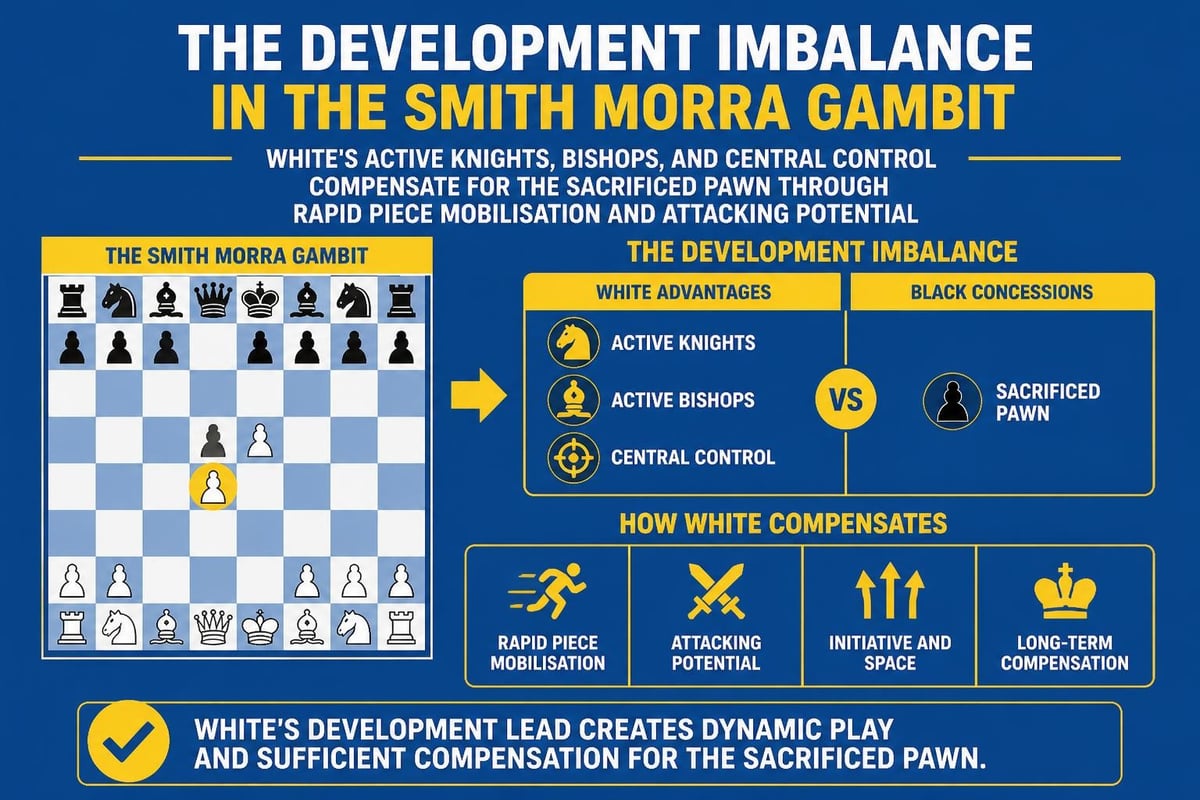
When you play 3.c3, you're making a simple proposition to your opponent. Accept the pawn, and I'll punish you with superior development. The typical continuation runs 3...dxc3 4.Nxc3, and suddenly White has:
- Both knights developed towards the centre
- An open d-file for the queen or rook
- Potential to quickly castle and launch an attack
- A lead in development worth more than a pawn
Black gets material but must defend accurately. One careless move, and White's pieces swarm the kingside with devastating effect.
Essential Variations You Need to Know
Understanding the main lines helps you navigate the critical positions with confidence. Let's break down the key variations that appear most frequently in practice.
The Accepted Variation
After 1.e4 c5 2.d4 cxd4 3.c3 dxc3 4.Nxc3, Black must decide how to develop. The most popular setups include:
- 4...Nc6 5.Nf3 d6 - The Classical approach
- 4...Nc6 5.Nf3 e6 - The Paulsen formation
- 4...e6 5.Nf3 Nc6 - A flexible setup
Each system has distinct characteristics. The Classical variation with ...d6 creates a solid structure but allows White to build pressure. The Paulsen with ...e6 keeps options open but can lead to passive positions if Black isn't careful.
Here's a comparison of Black's main defensive structures:
| Setup | Pawn Structure | Strengths | Weaknesses |
|---|---|---|---|
| Classical (d6) | Solid centre | Stable, hard to break | Slightly passive |
| Paulsen (e6) | Flexible | Dynamic options | Potential weakness on d6 |
| Accelerated (Nf6) | Active pieces | Quick development | Less central control |
The Declined Variation
Not everyone accepts your generous pawn offer. After 3.c3, Black can decline with 3...Nf6 or 3...d5. These lines transpose into different openings altogether, sometimes reaching positions similar to the Alapin Sicilian.
When Black declines, you haven't lost anything. You've simply reached a different type of game where you maintain material equality but still enjoy decent central presence.
Strategic Plans for White
Playing the smith morra gambit isn't just about knowing moves. You need to understand the strategic themes that make this opening dangerous. Let's explore what you should aim for in the middlegame.
Piece Placement and Development
Your pieces belong on active squares. Here's your typical setup:
- Knights: Nc3 and Nf3, with potential jumps to d5 or b5
- Bishops: Bc4 targeting f7, and Bg5 or Bf4 depending on Black's setup
- Queen: Often moves to e2 or d1-d4, supporting central breaks
- Rooks: One rook to d1 controlling the open file, the other supporting kingside attacks
Speed matters enormously. Every tempo counts when you're a pawn down. Castle quickly, connect your rooks, and don't waste time on unnecessary pawn moves.
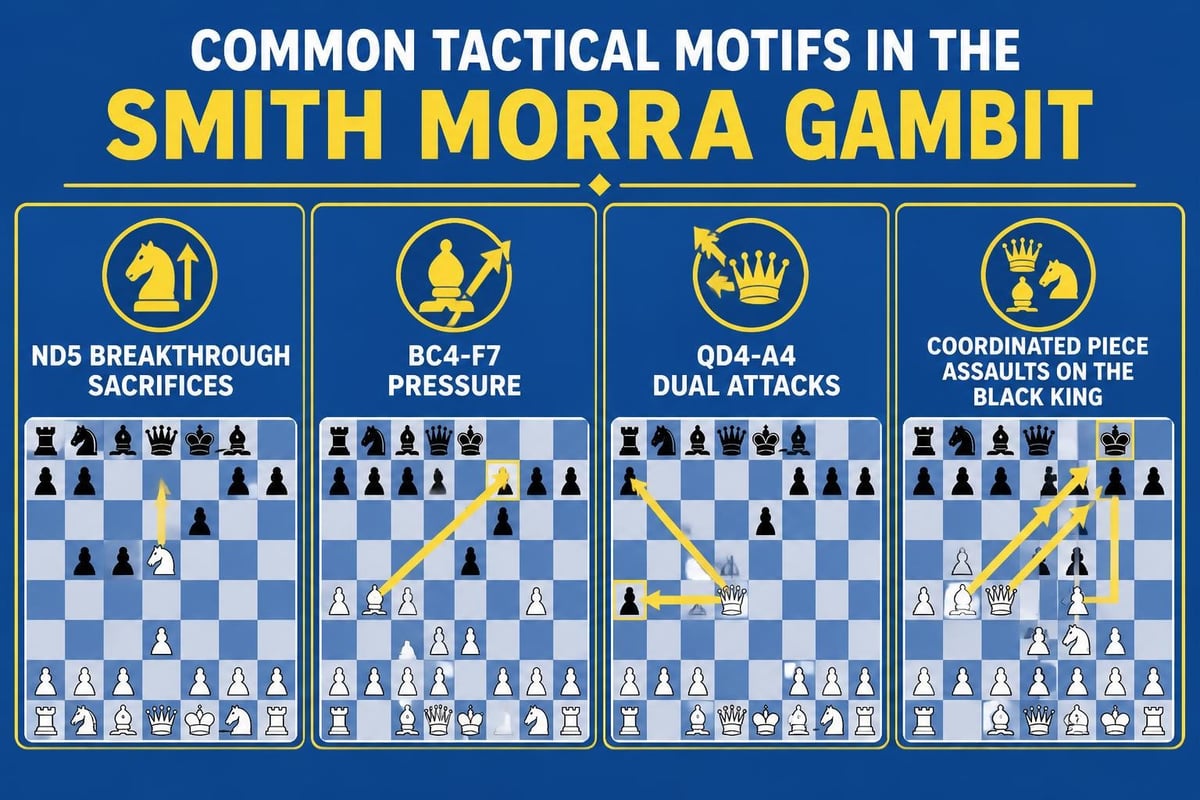
Creating Tactical Opportunities
The smith morra gambit thrives on tactics. You're constantly looking for combinations involving:
- Sacrifices on e6 or d5
- Knight forks from d5 or b5
- Pin combinations along the d-file
- Kingside pawn storms after successful piece placement
Understanding common chess openings helps you recognise when tactical themes emerge naturally from the position.
How Black Should Defend
To truly master this gambit, you must understand both sides of the board. Knowing Black's defensive resources makes you a better attacker because you'll anticipate your opponent's plans.
Sound Defensive Principles
Black needs to prioritise several key concepts:
- Complete development before counterattacking
- Create pawn breaks with ...d5 or ...b5 at the right moment
- Exchange pieces when ahead in material
- Avoid weakening the kingside unnecessarily
The biggest mistake Black players make? Getting greedy. Trying to hold onto the extra pawn whilst leaving the king exposed usually ends badly. Trading pieces and reaching an endgame is Black's safest path to victory.
Critical Defensive Lines
Against 5.Nf3 and 6.Bc4, Black often plays ...e6, ...a6, ...b5, and ...Bb7. This setup aims to:
- Challenge White's bishop on c4
- Prepare queenside counterplay
- Develop the light-squared bishop actively
- Create space for pieces on the queenside
If you're facing the smith morra gambit as Black, studying defensive techniques in similar Sicilian structures proves invaluable.
Practical Tips for Club Players
Theory is wonderful, but what about over-the-board play? Here's what actually matters when you're sitting across from an opponent with the clock ticking.
Managing the Clock
Time pressure often favours White in the smith morra gambit. Black must calculate defensive resources carefully whilst White can often play natural developing moves. Use this psychological edge:
- Play confidently and quickly in the opening
- Force your opponent to find accurate defensive moves
- Don't spend excessive time on obvious developing moves
- Save your thinking time for critical tactical moments
When the Gambit Works Best
This opening performs brilliantly against opponents who:
- Know Sicilian theory but haven't prepared the Morra specifically
- Tend towards passive play
- Struggle under pressure
- Haven't studied tactical positions deeply
It's less effective against:
- Well-prepared opponents with specific anti-Morra systems
- Players who happily trade pieces
- Solid positional players who don't mind defending
- Those who've studied gambit positions extensively
Building Your Opening Repertoire
Should the smith morra gambit become your main weapon against the Sicilian? That depends on your playing style and goals. Consider these factors before committing.
Advantages for Your Game
Quick learning curve: Compared to mastering the Open Sicilian's countless variations, the Morra offers a streamlined approach. You learn patterns and themes rather than memorising 25 moves of theory.
Psychological impact: Many Sicilian players prepare main lines extensively but haven't studied the Morra. This surprise factor wins games at the club level.
Exciting chess: You'll rarely face boring positions. The Morra generates sharp, tactical battles where both sides must play accurately.
Universal setup: Unlike some openings that vary drastically based on Black's responses, the Morra leads to similar middlegame structures in most lines.
Potential Drawbacks
| Aspect | Consideration |
|---|---|
| Theoretical soundness | Objectively equal with best defence |
| Material deficit | Must justify the pawn sacrifice |
| High-level play | Rare at master level |
| Preparation required | Opponents can neutralise with study |
Understanding chess master levels reveals that whilst grandmasters rarely employ the Morra, it remains highly effective below 2200 rating.

Training with the Smith Morra Gambit
How do you actually improve your practical results with this opening? Simply knowing the moves isn't enough. You need deliberate practice and focused study.
Essential Study Methods
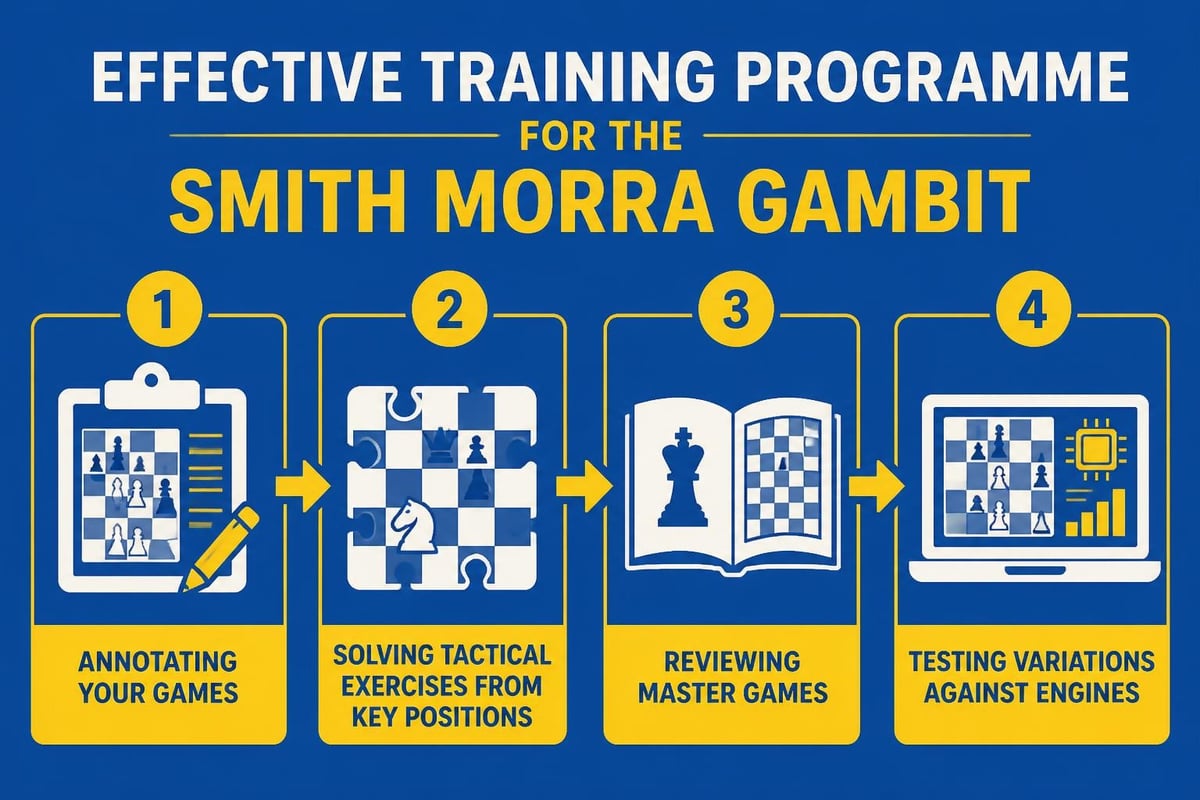
Start by reviewing master games in the opening. Chess.com's comprehensive analysis provides numerous annotated examples showing typical plans and tactical themes.
Then move to active training:
- Solve tactical puzzles from Morra positions
- Play practice games against computer engines
- Review your games to identify recurring mistakes
- Study your opponents' defensive tries
Improving your positional skills through puzzles complements your tactical training perfectly.
Creating a Personal Database
Maintain notes on your smith morra gambit games. Record:
- Which defensive setups gave you trouble
- Tactical patterns that appeared repeatedly
- Middlegame positions you reached frequently
- Endgames arising from piece trades
This personalised approach beats memorising generic opening books. You're learning what actually occurs in your games at your rating level.
Comparing the Morra to Other Anti-Sicilian Systems
You have several options for avoiding the main-line Sicilian. How does the smith morra gambit stack up against alternatives like the Alapin, Closed Sicilian, or Grand Prix Attack?
Gambit vs Positional Systems
The fundamental difference is philosophical. Positional anti-Sicilian systems (Closed, Alapin) aim for safe, equal positions. The Morra seeks immediate complications and attacking chances.
Choose the Morra if you:
- Enjoy tactical, sharp positions
- Want to pressure opponents from move one
- Don't mind taking calculated risks
- Learn patterns better than pure theory
Choose positional systems if you:
- Prefer strategic manoeuvring
- Want to maintain equilibrium
- Avoid theoretical debates entirely
- Build long-term advantages gradually
Similar to exploring the pros and cons of the Queen's Gambit, understanding your temperament guides your opening choices.
Advanced Concepts and Refinements
Once you're comfortable with basic patterns, these refinements elevate your Morra play to the next level. These concepts separate casual Morra players from true specialists.
Evaluating Pawn Sacrifices
Not every position justifies the initial pawn sacrifice. Sometimes you'll need to sacrifice additional material to maintain the initiative. Recognising when to invest more resources versus when to consolidate requires experience.
Key questions to ask:
- Is my development advantage significant enough?
- Can Black return the material to neutralise my attack?
- Do I have concrete tactical justification for another sacrifice?
- What happens if my attack fails?
Transitioning to Endgames
What happens when pieces trade off and your attack fizzles? Being a pawn down in the endgame isn't ideal, but it's not automatically lost either. Your piece activity and Black's potential weaknesses can compensate.
Focus on:
- Creating passed pawns quickly
- Activating your king
- Targeting Black's pawn weaknesses
- Maintaining piece activity
Resources for mastering chess openings include endgame training that helps you navigate these transitions successfully.
Modern Developments and Computer Analysis
Chess engines have revolutionised opening theory. What do they tell us about the smith morra gambit in 2026? The verdict is nuanced and more optimistic than older assessments suggested.
Engine Evaluations
Top engines assess the Morra as roughly equal with accurate defence, typically showing evaluations between +0.3 and +0.5 for White. That's hardly refuted! Compare this to some "sound" openings that engines evaluate similarly.
The critical point? These evaluations assume perfect play from both sides. At human levels, especially below master strength, the practical winning chances often favour White due to:
- The complexity of defensive requirements
- Time pressure favouring the attacker
- Psychological pressure of defending accurately
- The natural flow of White's piece coordination
Recent Theoretical Developments
New ideas continue emerging. Recent innovations include:
- Earlier ...h6 and ...g5 pawn storms by Black in certain lines
- White's Qe2 setups maintaining flexibility
- Improved defensive resources with early ...Qc7
- Computer-recommended piece placements that deviate from classical patterns
Staying current with theory matters, but remember that understanding core principles trumps memorising the latest computer lines.
Why Club Players Love This Opening
Let's be honest about why the smith morra gambit remains popular despite its objective evaluation. The reasons go beyond computer assessments and venture into practical, human chess.
The Enjoyment Factor
Chess should be fun. Playing the Morra delivers excitement:
- Immediate tactical complexity
- Clear plans and objectives
- Frequent attacking chances
- Decisive results rather than drawn-out positional grinds
Many players would rather score 55% with an opening they enjoy than 58% with one they find tedious. The psychological benefit of looking forward to your games shouldn't be underestimated.
Building Tactical Skills
Regularly playing gambit positions sharpens your calculation abilities. You'll improve at:
- Spotting tactical combinations
- Evaluating compensation for material
- Managing time pressure
- Calculating forcing sequences
These skills transfer to other areas of your chess. Even if you eventually abandon the Morra, the tactical training proves invaluable throughout your chess career.
Practical Game Examples
Understanding abstract principles means little without seeing them in action. Let's examine how typical games unfold and what you can learn from common patterns.
White Wins Through Superior Development
In a typical successful game, White castles kingside by move 6-7, develops all pieces by move 10-12, and launches a decisive attack before Black completes development. The extra pawn sits unused on Black's queenside whilst White's pieces coordinate beautifully around the enemy king.
The lesson? Speed of development matters more than material when kings remain in the centre.
Black Holds with Accurate Defence
When Black defends well, they trade pieces at every opportunity, complete development without creating weaknesses, and simplify into a favourable endgame. White's compensation evaporates around move 20-25, and the extra pawn becomes decisive.
The lesson? Piece trades neutralise attacking potential, making them Black's best defensive tool.
Avoiding Common Pitfalls
Both sides make recurring mistakes:
White's typical errors:
- Attacking prematurely before completing development
- Allowing unnecessary piece trades
- Neglecting king safety in pursuit of attack
- Miscalculating tactical sequences
Black's typical errors:
- Grabbing additional pawns instead of developing
- Creating kingside weaknesses unnecessarily
- Delaying castling too long
- Failing to exchange pieces when ahead
Learning from these patterns helps you avoid repeating them in your own games.
The smith morra gambit offers an exciting, practical weapon against the Sicilian Defence that rewards preparation and tactical awareness. Whether you adopt it as your main response or use it occasionally for variety, understanding its key themes and patterns will strengthen your overall chess understanding. Ready to take your opening preparation to the next level? Chess Cheat Sheets provides comprehensive guides, streamlined cheat sheets, and practical resources that help you master the Smith Morra Gambit and dozens of other openings without endless memorisation, giving you the confidence to face any opponent across the board.


