

You've been studying chess openings, running through tactics puzzles, and you're serious about improving your game. But here's a question: are you still playing on that flimsy set you've had since childhood? If you're investing time in becoming a better player, you deserve a nice chess set that matches your commitment. The right set doesn't just make your games more enjoyable, it can actually influence how you think about the board, recognise patterns, and engage with the game itself. Let's explore what transforms an ordinary chess set into something truly worthwhile.
Why Your Chess Set Actually Matters
Many players overlook the importance of their physical chess set, especially in our digital age where online platforms dominate. But there's something fundamentally different about moving real pieces across a wooden board. The tactile experience helps cement opening patterns in your memory in ways that clicking a mouse simply can't replicate.
When you're playing the game of chess at a physical board, you're engaging multiple senses simultaneously. You see the position, feel the weight of the pieces, and hear the satisfying sound of wood on wood. This multisensory engagement creates stronger neural pathways, making it easier to recall positions and tactical patterns during actual gameplay.
A nice chess set becomes an investment in your chess education. Think of it this way: you wouldn't try to learn piano on a toy keyboard, would you? The same principle applies here. Quality equipment supports quality practice.
The Historical Standard: Staunton Design
If you're shopping for a nice chess set, you'll quickly encounter the term "Staunton design." This isn't just chess jargon, it's the gold standard that's dominated tournament play since the mid-19th century. The history of the Staunton chess set reveals why this design has remained virtually unchanged for nearly two centuries.
The Staunton pattern succeeded because it solved a crucial problem: piece recognition. Earlier sets often featured ornate, decorative pieces that looked beautiful but caused confusion during rapid play. The Staunton design prioritised functionality, creating distinct silhouettes for each piece type that players could identify instantly, even in their peripheral vision.
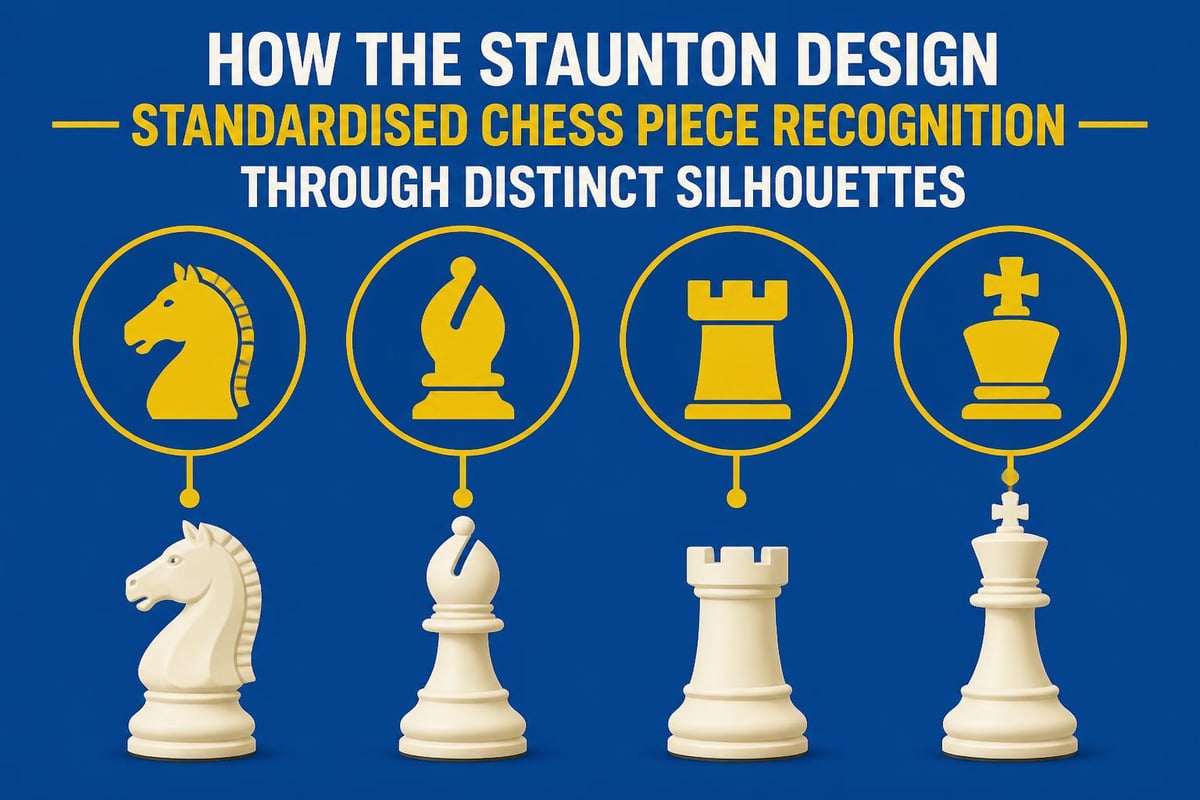
This matters enormously when you're working through opening preparation or analysing positions. Clear, recognisable pieces reduce cognitive load, allowing you to focus on strategy rather than piece identification.
Materials That Define Quality
What separates a nice chess set from a mediocre one? The materials make an enormous difference, both in durability and playing experience.
Wood Types and Their Characteristics
Premium chess sets typically use these woods:
- Ebony: Dense, dark, and luxurious with excellent weight
- Rosewood: Rich reddish-brown tones with beautiful grain patterns
- Boxwood: Traditional light-coloured wood with fine, even texture
- Sheesham: Budget-friendly alternative with good durability
- Maple: Light, sturdy, and commonly used for boards
The best wooden chess sets balance aesthetic appeal with practical durability. You'll notice that quality sets often pair contrasting woods, like ebony and boxwood, creating visual clarity that helps you read the position at a glance.
Here's what to look for when evaluating wood quality:
| Quality Indicator | What to Check | Why It Matters |
|---|---|---|
| Grain consistency | Even, tight grain patterns | Indicates proper wood selection and prevents warping |
| Weight distribution | Pieces feel balanced, not top-heavy | Improves stability and prevents tipping |
| Finish quality | Smooth, even coating | Protects wood and ensures pieces glide smoothly |
| Felt base | High-quality felt, securely attached | Prevents board damage and reduces noise |
Alternative Materials Worth Considering
Wood isn't your only option for a nice chess set. Modern materials offer compelling advantages:
Weighted plastic pieces might sound underwhelming, but tournament-quality plastic sets are surprisingly excellent. They're virtually indestructible, easy to replace if pieces go missing, and often feature the same Staunton design as wooden sets. Many serious players keep both wooden sets for home study and plastic sets for casual or outdoor play.
Metal sets create a distinctive playing experience. Brass, aluminium, or pewter pieces have substantial heft that many players love. However, they can be noisy on hard boards and might scratch wooden surfaces, so pairing them with a leather or felt board is essential.
Stone sets offer unmatched aesthetic appeal. Marble, onyx, or alabaster sets become conversation pieces and decorative elements. But be warned: they're heavy, expensive, and the smooth surfaces can make pieces difficult to grip during rapid play.

Size and Proportion: Getting the Balance Right
You've probably seen those giant decorative sets in parks or tiny travel sets that fit in your pocket. But for serious study and play, size matters tremendously.
The standard tournament specification calls for a king height between 3.75 and 4.25 inches. This isn't arbitrary. It's based on ergonomics and board visibility. Pieces this size are comfortable to handle for extended periods whilst remaining visually distinct.
The Square Size Formula
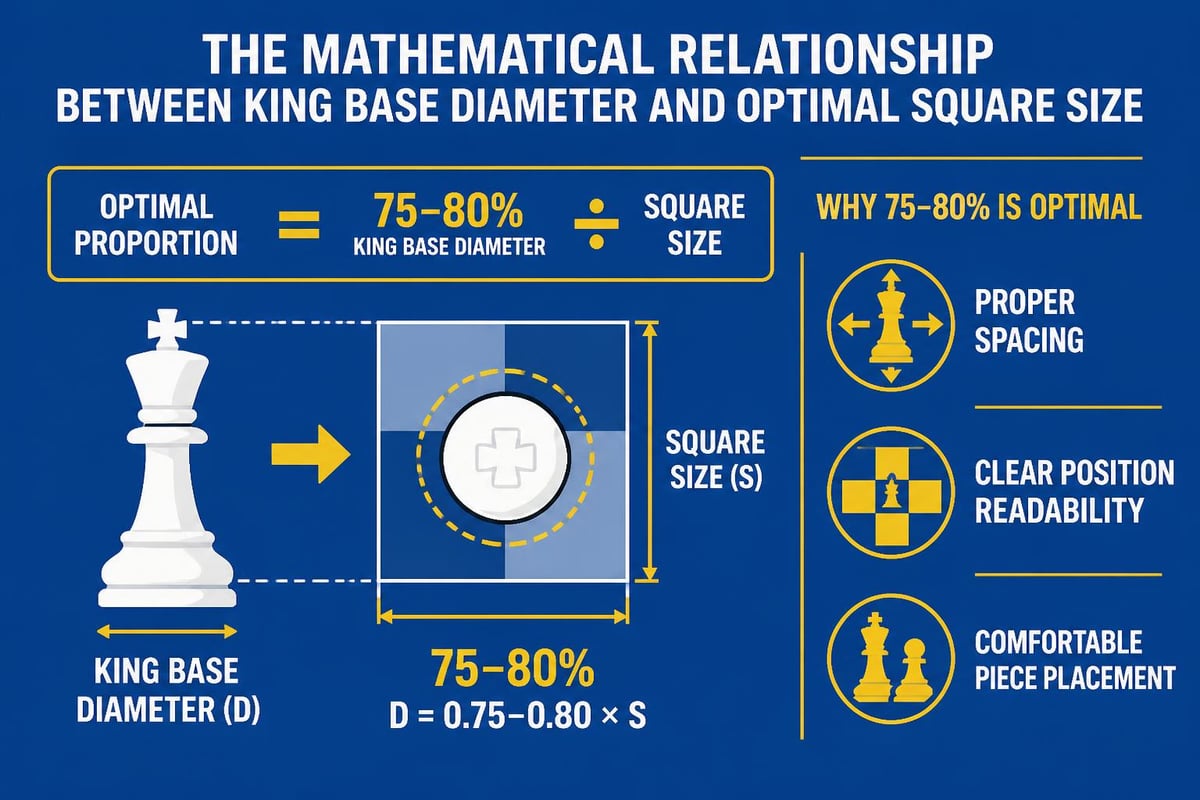
Here's a rule that separates nice chess sets from poorly proportioned ones: the king's base diameter should be 75-80% of the square size. Let me put that in practical terms:
- Measure your king's base (the felt-covered bottom)
- Divide that measurement by 0.75
- The result is your ideal square size
So if your king has a 1.5-inch base diameter, you want squares that are approximately 2 inches. This proportion ensures pieces sit comfortably within squares without crowding, making positions easier to read and reducing accidental piece displacement.
Board size follows logically from square size. Tournament boards typically measure 18-21 inches square, providing eight rows of 2-2.5 inch squares with a comfortable border. Smaller boards feel cramped during complex middlegame positions, whilst oversized boards create too much distance between pieces, slowing your play.
Features That Enhance Your Playing Experience
When evaluating a nice chess set, certain features separate the exceptional from the merely adequate.
Weighted Pieces
Quality sets include lead weights in the piece bases. This serves two purposes: stability and "feel." Weighted pieces don't tip over easily when you're rapidly moving pieces during analysis, and they provide tactile feedback that helps you develop muscle memory for piece positions.
The weight difference is immediately noticeable. A standard wooden piece might weigh 20-30 grams, whilst a properly weighted tournament piece reaches 40-60 grams. That extra heft translates to confidence in your moves.
Board Construction
Your board deserves as much attention as your pieces. Here's what distinguishes superior boards:
- Solid wood construction rather than veneer over particle board
- Inlaid squares instead of printed or painted surfaces
- Adequate thickness (minimum 0.5 inches) to prevent warping
- Smooth, matte finish that reduces glare under lighting
- Notation (algebraic coordinates) around the border for game recording
Folding boards offer portability but introduce a centre crease that can interfere with piece placement. If you're serious about practice and analysis, invest in a solid, non-folding board. You can always keep a travel set separately for when you need portability.
Understanding the Investment Range
Let's talk money. What should you expect to spend on a nice chess set?
| Price Range | What You Get | Best For |
|---|---|---|
| £30-50 | Basic weighted plastic tournament sets, simple wooden sets | Beginners starting serious study |
| £50-100 | Quality wooden sets with weighted pieces, tournament boards | Intermediate players, regular practice |
| £100-250 | Premium woods (ebony/rosewood), superior craftsmanship | Dedicated players, presentation |
| £250+ | Collector pieces, artisan sets, exotic materials | Chess enthusiasts, display pieces |
For most improving players, the £50-100 range offers the sweet spot. You're getting genuine quality without paying for exotic materials or collector value. These sets will last decades with proper care and provide an excellent playing experience.
Remember, you're not just buying decorative items. You're investing in tools that support your chess development. Just as you might invest in comprehensive chess resources to improve your theoretical knowledge, a quality set supports your practical understanding.
Matching Your Set to Your Practice Routine
Different aspects of chess improvement benefit from different set characteristics. Let's break this down practically.
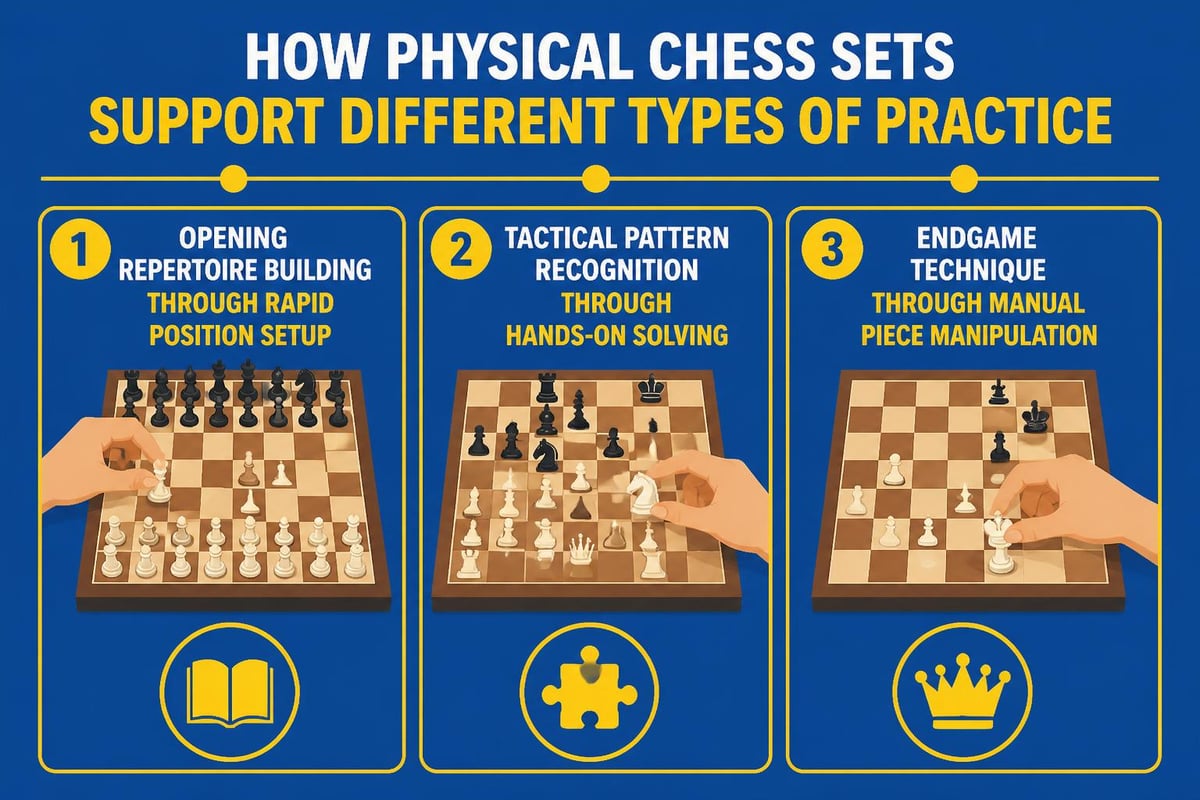
Opening Study and Analysis
When you're working through complex opening variations, perhaps exploring common chess openings or studying specific systems, you need a set that supports rapid piece movement and position changes.
For this work:
- Prioritise smooth piece bases that glide easily across the board
- Choose medium-sized pieces (3.75-4 inch kings) that you can move quickly
- Ensure clear colour contrast between light and dark pieces
- Consider a board with coordinates to match notation in your study materials
You'll be setting up positions, testing variations, and resetting frequently. A nice chess set designed for this purpose makes the process efficient rather than frustrating.
Tactical Practice
Working through tactics puzzles with physical pieces reinforces pattern recognition differently than digital solving. The history of chess demonstrates that players developed their skills through over-the-board practice long before computers existed, and that hands-on approach still offers unique benefits.
For tactical training:
- Set up the puzzle position from your training materials
- Physically move the pieces through the solution
- Reset and try variations
- Note how the physical movement helps cement the pattern
This kinaesthetic learning complements your digital practice. When you physically execute a tactical sequence, you're building motor memory alongside visual recognition.
Game Analysis
After playing online or over the board, replaying your games with physical pieces offers insights you might miss on screen. A nice chess set makes this analysis session productive and enjoyable.
Set up the position where you went wrong, then explore alternative moves physically. The tactile engagement often triggers ideas that don't emerge when clicking through moves digitally. Many strong players maintain that their deepest insights come from this kind of hands-on analysis.
Care and Maintenance for Longevity
You've invested in quality. Now protect that investment with proper care.
For wooden pieces:
- Wipe with a slightly damp cloth, never soak
- Apply mineral oil or beeswax annually to prevent drying
- Store in a climate-controlled environment to prevent cracking
- Keep away from direct sunlight, which fades colours
For wooden boards:
- Clean with wood-safe cleaners only
- Store flat, never on edge, to prevent warping
- Maintain consistent humidity (ideally 40-60%)
- Refinish every few years if the surface becomes worn
For storage:
- Use individual compartments for pieces to prevent scratching
- Ensure pawns don't bear weight from heavier pieces
- Keep sets away from moisture and extreme temperatures
- Consider felt-lined storage boxes for premium sets
Proper care means your nice chess set will serve you for decades, potentially becoming an heirloom you pass to the next generation of players in your family.
Where Design Meets Functionality
The aesthetic appeal of a nice chess set shouldn't be dismissed as superficial. Beautiful equipment creates an environment that encourages regular practice. When your set looks magnificent on your desk or study table, you're more likely to sit down and work through positions.
However, beauty must serve function. Those ornate themed sets (medieval warriors, famous battles, historical figures) might look impressive on a shelf, but they're terrible for actual play. The decorative elements make piece identification difficult and interfere with pattern recognition.
The evolution of chess set designs shows how form and function have gradually merged. The most successful designs throughout history have been those that balanced aesthetic appeal with practical playability.
Special Considerations for Teaching and Learning
If you're using your set for teaching others or learning with a coach, certain features become especially valuable.
Demonstration boards with larger pieces help when explaining concepts to students. The increased size makes it easier for multiple people to view positions simultaneously.
Notation-friendly boards with algebraic coordinates help beginners learn to read and write chess notation, an essential skill as they progress. When you're studying resources about chess openings for white or any theoretical material, the ability to quickly locate squares by coordinate accelerates learning.
Durable materials matter more when sets are handled frequently by multiple people. Tournament plastic sets withstand heavy use better than delicate wooden sets.
The Tournament Standard
Many serious players eventually participate in over-the-board tournaments. Familiarity with tournament-standard equipment provides a competitive advantage.
Official tournament specifications from FIDE (the World Chess Federation) establish strict requirements:
- Staunton-pattern pieces
- King height: 95mm (approximately 3.75 inches)
- Square size: 50-65mm (approximately 2-2.5 inches)
- High contrast between light and dark squares
- Non-reflective board surface
Practising with equipment that meets these specifications means no adjustment period when you play in formal competitions. Your home set becomes your training ground for tournament conditions.
Beyond the Board: Complete Chess Setup
A truly nice chess set extends beyond pieces and board. Consider these complementary elements:
Chess clock: Essential for serious practice and mimicking tournament conditions. Digital clocks with increment settings help you develop time management skills.
Score sheet and notation materials: Recording your games supports post-game analysis and builds a personal database of positions.
Proper lighting: Good illumination prevents eye strain during long study sessions and ensures accurate piece and square identification.
Comfortable seating: You'll spend hours at your set. Invest in ergonomic seating that supports focused practice without physical discomfort.
These elements together create an environment that supports serious chess improvement. The best chess learning sites provide theoretical knowledge, but your physical setup determines how effectively you can apply that knowledge.
Making Your Final Decision
Choosing a nice chess set ultimately comes down to understanding your specific needs and priorities. Let me give you a decision framework:
Start with your budget: Determine what you can reasonably spend, then find the best quality within that range. Don't stretch for exotic materials if it means compromising on fundamental quality.
Consider your space: Measure where you'll use and store the set. A beautiful but oversized set serves no purpose if it doesn't fit your playing area.
Think long-term: A quality set at a higher price point often proves more economical than replacing cheaper sets repeatedly.
Test if possible: Visit chess specialty shops or clubs where you can handle different sets. The feel of pieces in your hand and the sound they make on the board are impossible to judge from photographs.
Read reviews: The experiences of other players, particularly those at your skill level, provide valuable insights. Resources like guides to various chess sets help you compare options systematically.
Remember that no single set is perfect for everyone. Your ideal nice chess set balances quality, functionality, aesthetics, and budget in proportions that match your unique situation.
Finding a nice chess set that truly serves your chess development requires understanding how materials, design, and proportions affect your practice and play. Whether you're working through opening repertoires, solving tactical puzzles, or analysing your games, the right equipment supports better learning and deeper engagement with the game. Ready to complement your physical practice with structured learning? Chess Cheat Sheets offers comprehensive guides, puzzles, and opening resources that work perfectly alongside quality board practice, helping you master chess efficiently without endless study. Start building your complete chess improvement system today.


