

Have you ever felt lost in the middlegame, unsure of what plan to follow once your opening knowledge runs out? You're not alone. For decades, chess players struggled with this exact problem until Aron Nimzowitsch published his groundbreaking work that changed how we understand chess strategy forever. My system chess introduced a revolutionary approach to positional play that remains just as relevant in 2026 as it was nearly a century ago. Whether you're working through good beginner chess books or advancing your strategic understanding, grasping these timeless concepts will transform your chess thinking and help you formulate winning plans in any position.

What Makes My System Chess Revolutionary
When Nimzowitsch first introduced his ideas in the 1920s, chess players primarily focused on tactical combinations and material gain. My system chess turned this thinking on its head by emphasising long-term strategic planning, piece coordination, and pawn structure over immediate tactical shots.
The beauty of my system chess lies in its structured approach to understanding positions. Rather than relying on intuition alone, Nimzowitsch provided concrete principles that any player could learn and apply. This systematic framework gave club players and masters alike a common language for discussing chess strategy.
The Core Principles That Define the System
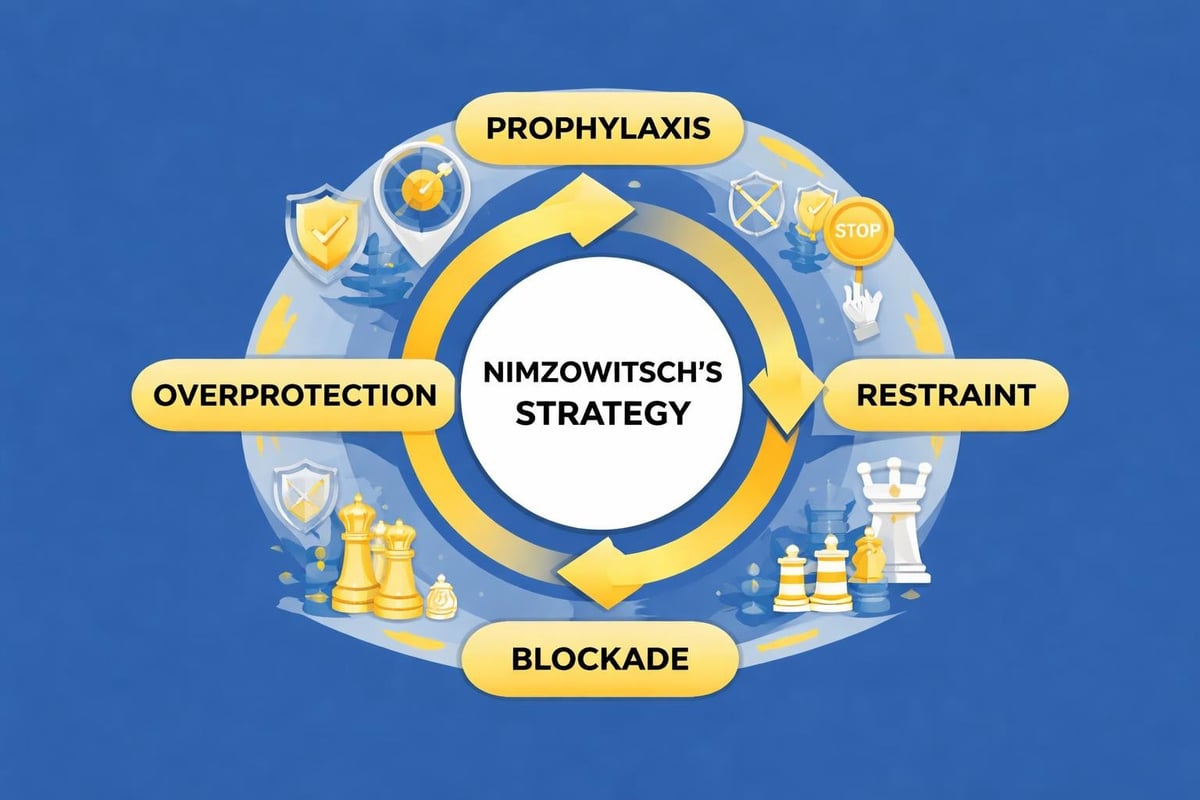
Nimzowitsch built my system chess around several interconnected concepts that work together harmoniously. Understanding these principles individually helps, but the real magic happens when you see how they complement each other in actual games.
The five pillars of my system chess include:
- The Centre: Control it, occupy it, or destroy it based on your position
- Prophylaxis: Prevent your opponent's plans before executing your own
- Overprotection: Defend key squares and pieces multiple times
- Blockade: Stop passed pawns with well-placed pieces, particularly knights
- Restraint: Limit your opponent's pawn breaks and piece activity
Each concept addresses a specific aspect of positional chess, yet they all contribute to the same goal: achieving a superior position through strategic understanding rather than tactical tricks alone.
Understanding Prophylaxis in Modern Chess
Perhaps no concept from my system chess has influenced modern play more than prophylaxis. This principle asks a simple but profound question: what does my opponent want to do?
Before making your own plans, you identify your opponent's threats and ideas, then take preventive measures. This defensive thinking actually creates offensive opportunities because you're anticipating problems before they arise.
Let's say you're playing the Sicilian Defense for beginners and White wants to launch a kingside attack. Prophylactic thinking suggests you might play moves like h6 to prevent Ng5, or start counterplay on the queenside before White's attack materialises.
Practical Prophylaxis Examples
Common prophylactic moves you'll encounter:
- Preventing back rank mates with h3 or h6
- Stopping knight outposts with pawn moves like a6 or h6
- Controlling key squares before your opponent can occupy them
- Trading pieces that would strengthen your opponent's position
The challenge with prophylaxis is finding the balance. Too much defensive thinking can make you passive, whilst ignoring your opponent's ideas leads to tactical disasters. My system chess teaches you to weave prevention into your overall strategy naturally.
The Art of Overprotection
Whilst most chess principles tell you not to waste time, my system chess introduces a seemingly counterintuitive idea: overprotecting certain pieces and squares. Nimzowitsch argued that key elements of your position deserve multiple defenders.
Think about a strong central pawn or a piece occupying a critical square. Rather than defending it just once, you pile on additional protection. This serves multiple purposes beyond mere safety.
| Benefit | Explanation | Example |
|---|---|---|
| Flexibility | Pieces can leave to attack whilst the point remains defended | Knight leaves c3 but the d5 pawn has three other defenders |
| Deterrence | Opponents avoid exchanges when you have overwhelming protection | Black avoids trading on e4 when it's defended four times |
| Activity | Defenders often improve their position whilst protecting | Bishop moves to e3, defending d4 whilst eyeing the kingside |
Your pieces gain activity through their defensive roles. A rook on e1 might protect the e4 pawn whilst simultaneously preparing to shift to the kingside or queenside as needed.
Mastering the Blockade Strategy
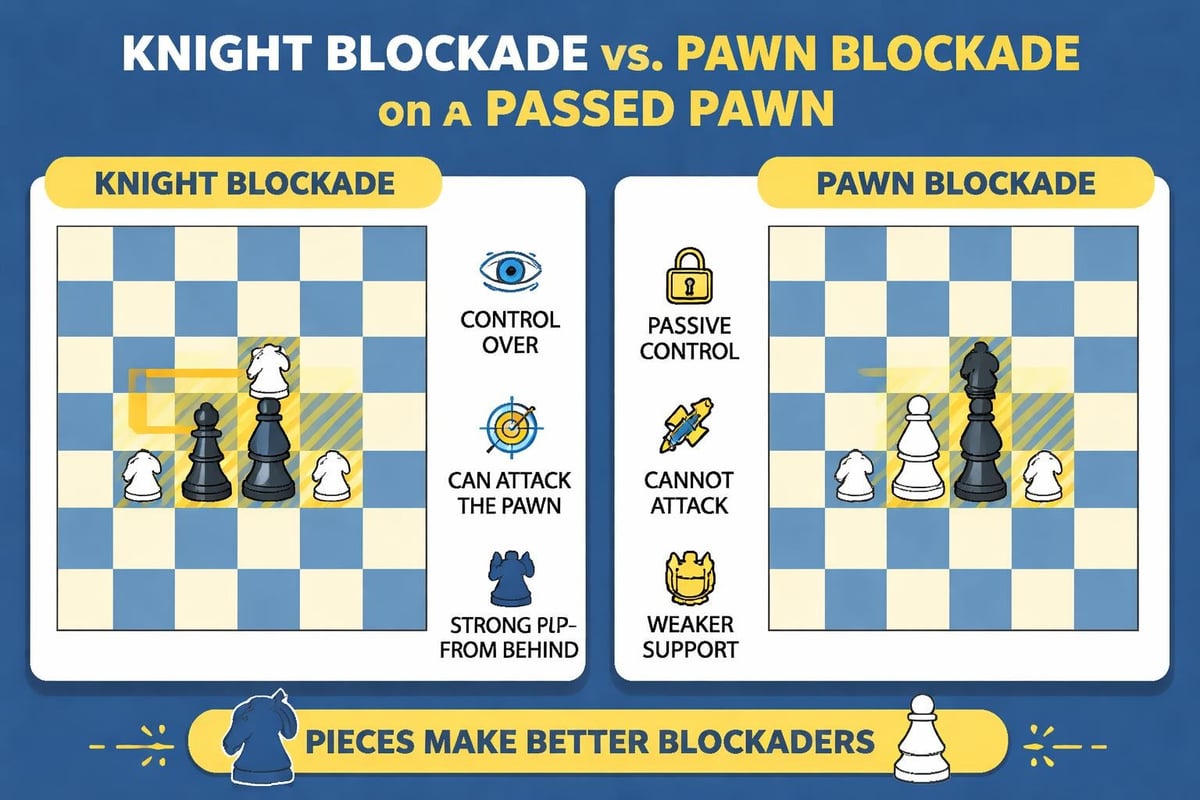
My system chess elevated the blockade from a simple defensive technique to a fundamental strategic weapon. When your opponent has a passed pawn, the traditional response was to stop it with your own pawns. Nimzowitsch showed that pieces, especially knights, make superior blockaders.
Why do pieces work better than pawns for blockades? A knight sitting on a blockade square not only stops the pawn but radiates influence across the board. It can jump to other squares, support your own attacks, and generally remains more flexible than a static pawn.
Choosing Your Blockader
Best pieces for blockading, ranked:
- Knight: Most flexible, controls squares the pawn can't attack
- Bishop: Good on long diagonals, but less flexible than knights
- Rook: Powerful but often needed elsewhere
- Queen: Too valuable to tie down except in endgames
- Pawn: Last resort when pieces aren't available
The concept appears frequently in the Queen's Gambit, where central pawn blockades determine the entire character of the position. Black's d5 pawn often becomes a blockader against White's potential d4-d5 break, whilst White might blockade Black's c5 or e5 advances.
Restraint and Mobility in Positional Chess
Restraint represents another cornerstone of my system chess that focuses on restricting your opponent's pawn breaks and piece mobility. Before advancing your own pawns or launching attacks, you first limit what your opponent can do.
This principle connects closely with prophylaxis but operates on a broader strategic level. You're not just preventing individual threats but systematically reducing your opponent's options.
Consider a position where your opponent wants to play e5 to free their position. Rather than waiting for this break and dealing with it tactically, restraint involves playing moves like Nd4 or f4 that make e5 impossible or unfavourable.
Creating Lasting Restrictions
The difference between temporary and permanent restraint matters enormously. Temporary restraint might delay your opponent's plans for a few moves. Permanent restraint, achieved through superior pawn structure or piece placement, can last the entire game.
Techniques for achieving lasting restraint:
- Fix opponent's pawns on the wrong colour squares for their bishops
- Control key central squares with pieces they can't challenge
- Create pawn chains that limit their pawn breaks
- Establish knights on outposts they can't evict with pawns
When studying chess resources, you'll notice how modern players combine restraint with other my system chess principles to dominate opponents positionally.
The Centre Debate: Classical vs Hypermodern
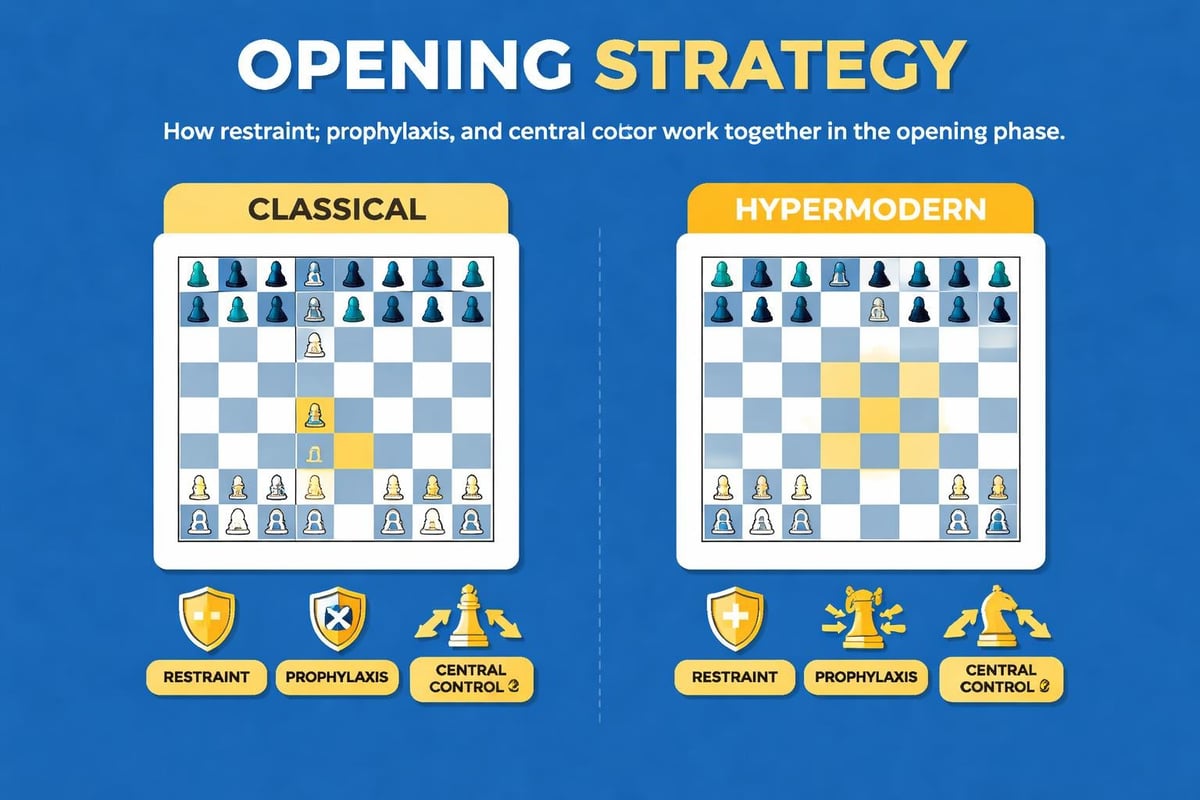
My system chess significantly contributed to the hypermodern revolution in chess thinking. Classical theory insisted on occupying the centre with pawns immediately. Nimzowitsch and other hypermodern pioneers showed that controlling the centre from afar could be equally effective.
This doesn't mean my system chess rejects central pawns entirely. Rather, it offers a more nuanced understanding: the centre is crucial, but how you treat it depends on your position and style.
| Approach | When to Use | Example Openings |
|---|---|---|
| Occupy | Strong development, opponent can't challenge | Italian Game, Ruy Lopez |
| Control from distance | Pieces ready to strike, opponent overextends | King's Indian, Nimzo-Indian |
| Destroy | Opponent's centre is weak or overextended | Sicilian Defense, Alekhine's Defense |
The King's Indian Defense perfectly illustrates hypermodern central strategy. Black allows White to build an imposing pawn centre, then systematically attacks and destroys it.

Applying My System Chess to Your Openings
Understanding my system chess principles transforms how you approach your opening repertoire. Instead of memorising variations mechanically, you grasp the strategic ideas behind each move.
Take the Nimzo-Indian Defense, named after Nimzowitsch himself. This opening embodies my system chess concepts beautifully: Black pins the knight (restraint), controls e4 from a distance, and prepares to blockade White's central pawns.
Opening Principles from My System
When selecting your openings, my system chess suggests considering these strategic factors:
Key questions to ask:
- Does this opening allow me to restrain my opponent's breaks?
- Can I establish effective blockades if needed?
- Am I controlling or occupying the centre appropriately?
- Do my pieces have prophylactic value in their positions?
Even when playing aggressive openings, these principles apply. The best openings for Black often incorporate my system chess ideas, whether you're playing the solid Caro-Kann or the dynamic Sicilian.
Common Misconceptions About My System Chess
Despite its influence, my system chess often suffers from misunderstandings that prevent players from fully benefiting from Nimzowitsch's insights. Let's clear up some confusion.
It's Only for Positional Players
Many believe my system chess only suits slow, positional players who avoid tactics. Nothing could be further from the truth. Understanding positional chess actually helps you create better tactical opportunities because you're positioning your pieces optimally.
Tactical players who study my system chess often find their combinations become more forcing and effective. You're not choosing between tactics and strategy but combining both more effectively.
It's Too Theoretical and Abstract
Nimzowitsch's writing style can seem dense, but the concepts themselves are highly practical. Every principle in my system chess translates directly to moves on the board. According to this Chess.com review of My System, modern players still find the ideas immediately applicable to their games.
The key is studying positions where these principles appear clearly, then gradually recognising them in your own games.
Modern Chess Has Moved Beyond It
Computer analysis has certainly changed chess, but my system chess principles remain as valid in 2026 as ever. Engines actually confirm many of Nimzowitsch's insights about prophylaxis, restraint, and central control.
Modern grandmasters explicitly mention my system chess concepts in their annotations. The language of positional chess that Nimzowitsch developed forms the foundation for how we discuss strategy today.
Studying My System Chess Effectively
Simply reading about my system chess won't improve your game much. You need an active study approach that transforms theory into practical understanding. How can you make these concepts part of your chess thinking?
Creating a Study Plan
Recommended study approach:
- Read the original: My System by Aron Nimzowitsch remains the definitive source
- Study annotated games: Find games where masters explain their use of these principles
- Practice with puzzles: Solve positions requiring prophylactic or restrictive thinking
- Review your games: Identify where you could have applied my system chess concepts
- Test in play: Consciously apply one principle per game until it becomes natural
Don't try mastering all concepts simultaneously. Focus on one principle, like prophylaxis, for several weeks. Once it feels natural, add another layer like restraint or overprotection.
Recommended Resources for Deeper Study
Beyond Nimzowitsch's original work, modern interpretations can help clarify his sometimes complex prose. The best chess books often include updated explanations of my system chess concepts with contemporary examples.
Video courses and interactive platforms now teach these classical concepts with modern technology, making them more accessible to today's players. The principles remain unchanged, but the presentation methods have evolved significantly since 1925.
Integrating My System Into Your Training
Knowledge without application remains sterile. How do you move from understanding my system chess intellectually to applying it instinctively during games?
The transition requires deliberate practice and patience. Your first attempts at prophylactic thinking might slow your play as you consciously consider your opponent's plans. This awkward phase is normal and necessary.
Practical Exercises for Improvement
Start each training session by reviewing a master game annotated with my system chess principles. Don't just play through the moves but pause at critical moments and ask yourself what restraint, prophylaxis, or overprotection looks like in that specific position.
Daily practice routine:
- Spend 15 minutes analysing one master game through the lens of my system chess
- Solve 3-5 strategic puzzles focusing on positional concepts
- Play one slow game where you consciously apply a specific principle
- Review that game, noting where you successfully applied concepts
Working with chess puzzles specifically designed for positional training accelerates your progress. Unlike tactical puzzles with one correct solution, strategic puzzles teach you to evaluate plans and identify superior approaches.
The Legacy of My System Chess in 2026
Nearly a century after its publication, my system chess continues shaping how players think about strategy. Modern openings reflect Nimzowitsch's influence everywhere, from hypermodern defences to prophylactic move orders in classical systems.
Top grandmasters in 2026 still reference my system chess concepts in their analysis. Computer engines, for all their tactical prowess, often confirm the positional wisdom Nimzowitsch articulated through pure chess understanding.
The Wikipedia article on My System details how this work influenced generations of players, from world champions to club enthusiasts. Its impact extends beyond individual concepts to fundamentally changing how we discuss and teach chess strategy.
Why These Ideas Remain Relevant
Chess fundamentals don't change despite advances in theory and technology. The principles of my system chess address eternal strategic questions: How should I treat the centre? How can I restrict my opponent whilst improving my position? What plans will work in this pawn structure?
These questions matter equally whether you're playing over the board in 2026, analysing with an engine, or studying classical games from the 1920s. My system chess provides a framework for answering them consistently and effectively.
Combining Modern and Classical Approaches
The best players in 2026 don't choose between my system chess and modern computer-aided preparation. They integrate both, using Nimzowitsch's strategic framework to understand computer recommendations and identify which engine suggestions align with sound positional principles.
This synthesis creates deeper understanding than either approach alone. My system chess gives you the 'why' behind moves, whilst modern analysis provides the 'what' with concrete variations and evaluations.
When studying your chess openings, try this combined approach. Learn the theoretical moves, but also understand the strategic ideas in terms of restraint, prophylaxis, and central control. Your preparation becomes more flexible and your middlegame understanding improves dramatically.
Mastering my system chess takes time and dedicated study, but the positional understanding you gain transforms your entire approach to chess strategy. Whether you're focusing on specific openings, middlegame planning, or endgame technique, these timeless principles provide a solid foundation for improvement. Chess Cheat Sheets offers streamlined guides and resources that help you apply these classical concepts efficiently, allowing you to enhance your strategic understanding without overwhelming yourself with extensive theory. Start building your positional foundation today and watch your results improve consistently.


