

You've probably faced 1.e4 countless times as Black, and if you're tired of the same old Sicilian or French Defense lines, it might be time to explore something different. The modern defense with 1 e4 offers a refreshing alternative that catches many White players off guard. This hypermodern approach lets your opponent build a classical centre whilst you prepare to strike from the flanks, creating dynamic, unbalanced positions that reward creativity and strategic understanding. Whether you're looking to expand your opening repertoire or seeking a flexible system that adapts to various White setups, the Modern Defense deserves serious consideration.
What Makes the Modern Defense Unique
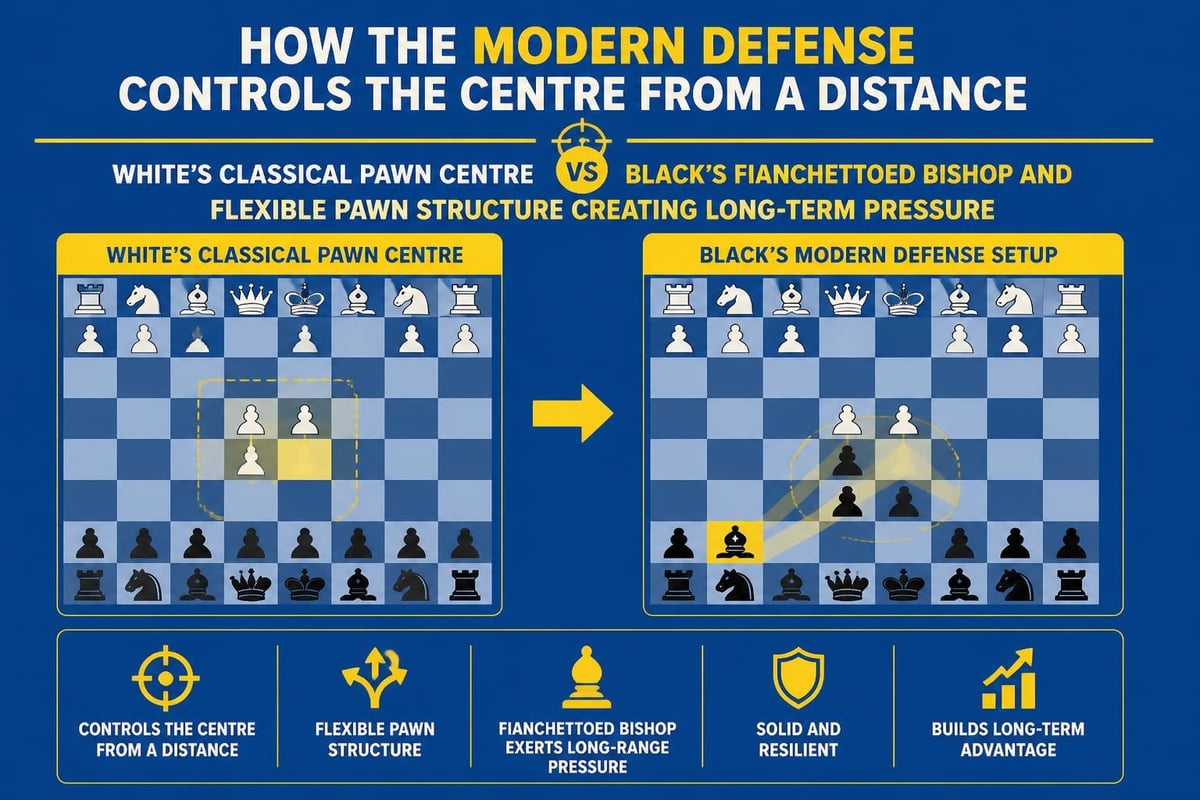
The modern defense with 1 e4 stands apart from traditional chess openings through its hypermodern philosophy. Rather than immediately contesting the centre with pawns, Black allows White to establish pawns on e4 and potentially d4, then aims to undermine this structure later.
After 1.e4, Black typically responds with 1...g6, signalling intentions to fianchetto the kingside bishop. This move might seem passive at first glance, but it's actually quite ambitious. You're setting up a powerful bishop on g7 that will eye the long diagonal and put pressure on White's centre.
The Hypermodern Philosophy Behind the Opening
The Modern Defense embodies hypermodern chess principles that revolutionized opening theory in the early 20th century. Instead of occupying the centre immediately, you control it from a distance.
Here's what makes this approach powerful:
- Flexibility: You can transpose into various setups depending on White's plans
- Psychological pressure: Many players struggle against hypermodern systems
- Strategic richness: The positions offer deep middlegame plans
- Element of surprise: It's less common than mainstream defences
The key difference between the Modern Defense and the closely related Pirc Defense lies in move order and early pawn structure decisions, though they often transpose into similar positions.
Key Variations and Strategic Plans
The modern defense with 1 e4 branches into several important variations, each with distinct characteristics and strategic goals. Understanding these branches helps you choose the right path for your playing style.
The Main Line: 1.e4 g6 2.d4 Bg7
This represents the most common continuation. White establishes the ideal pawn centre whilst you complete your kingside development. After 3.Nc3, you have several options:
| Black's Response | Strategic Idea | Typical Continuation |
|---|---|---|
| 3...d6 | Solid setup, preparing ...Nf6 | 4.Nf3 Nf6 5.Be2 O-O |
| 3...c6 | Preparing ...d5 to challenge centre | 4.Nf3 d5 with immediate action |
| 3...a6 | Modern Pterodactyl variation | 4.Nf3 b5 with queenside expansion |
The main line continuation typically proceeds 3.Nc3 d6 4.Nf3 Nf6, and now White must decide how aggressively to pursue the attack. Similar strategic concepts appear in other hypermodern defences, such as Alekhine's Defense, where Black provokes White's pawns forward to create targets.
Early ...d6 Systems
When you play ...d6 early, you're committing to a solid, flexible structure. This approach works brilliantly against players who don't know how to generate threats against the Modern Defense.
Your typical plan involves:
- Fianchettoing the kingside bishop
- Castling kingside for safety
- Developing the knight to d7 or a6 (depending on the position)
- Preparing central breaks with ...e5 or ...c5
The ...d6 systems are particularly forgiving for players still learning the nuances of the opening, making them ideal for those using resources like chess opening guides to build their repertoire.
The Delayed Fianchetto Approach
Some players prefer 1.e4 d6 2.d4 g6, delaying the bishop development by one move. This subtle difference can steer the game into slightly different waters, particularly if White has prepared specific lines against the immediate 1...g6.
This move order offers extra flexibility because you haven't committed your kingside bishop yet. If White plays an unusual third move, you might even abandon the fianchetto entirely and switch plans.
Common White Setups and How to Counter Them
Understanding White's most popular systems against the modern defense with 1 e4 prepares you for what you'll face in actual games. Let's examine the main approaches and your best responses.
The Austrian Attack
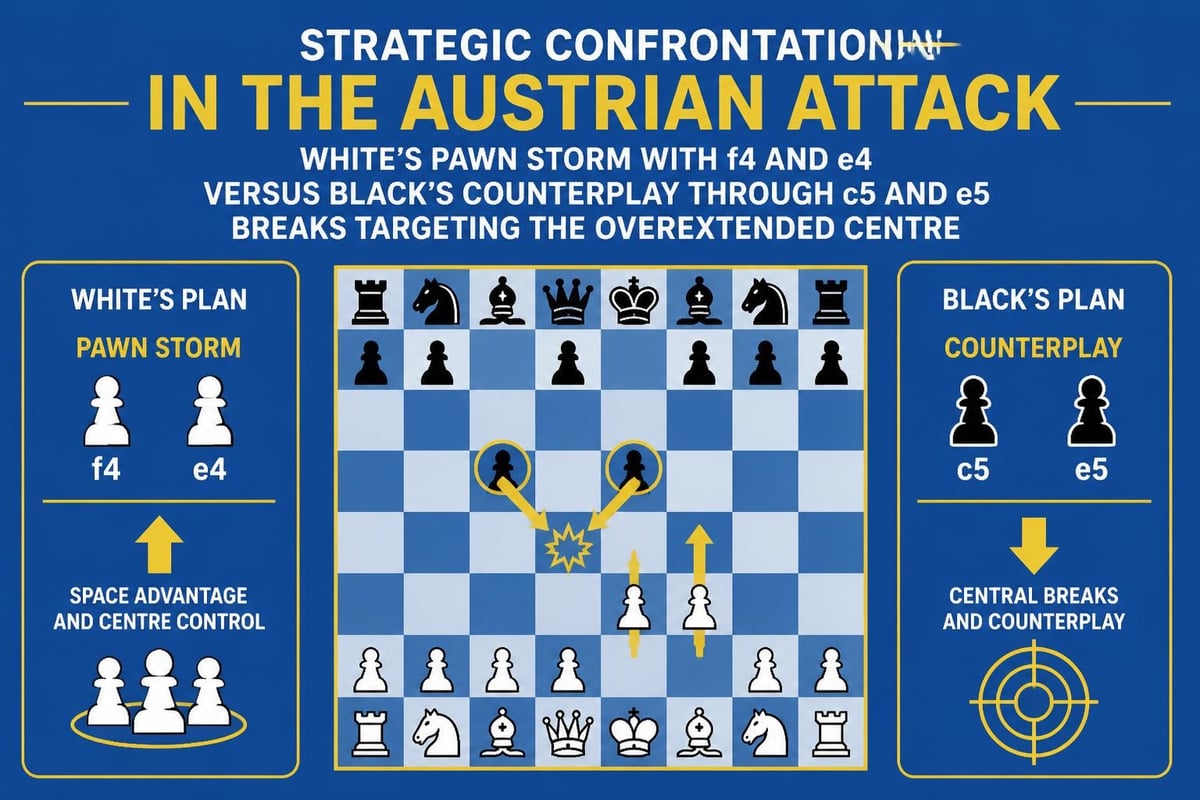
White's most aggressive try involves f2-f4, building a massive pawn centre and preparing a kingside assault. After 1.e4 g6 2.d4 Bg7 3.Nc3 d6 4.f4, you're facing the Austrian Attack.
Your counter-strategy:
- Develop quickly with ...Nf6 and ...O-O
- Prepare ...c5 to strike at White's centre
- Consider ...Nc6 or ...Na6 depending on tactics
- Look for ...e5 breaks when White's centre becomes overextended
Don't panic when facing this aggressive setup. White's pawns can become targets if they advance too far without adequate piece support.
The Classical 150 Attack
When White plays 1.e4 g6 2.d4 Bg7 3.Nc3 d6 4.Be3, you're seeing the 150 Attack. This system aims for slow buildup with Qd2, potentially O-O-O, and a kingside pawn storm.
Here's your defensive and counter-attacking framework:
- Castle kingside quickly
- Develop with ...Nf6, ...O-O, ...c6
- Prepare ...b5 if White castles queenside
- Keep an eye on central breaks with ...e5
The 150 Attack requires patience. White builds slowly, so you have time to organize your pieces and prepare counterplay on whichever flank White weakens.
Simple Development Systems
Not every White player knows specialized systems. Many simply develop naturally with Nf3, Be2, O-O, and perhaps Re1 or Bf4. Against these straightforward approaches, the modern defense with 1 e4 offers excellent equalizing chances.
Your recipe for success includes equalizing in the centre, completing development smoothly, and gradually improving your piece positions. According to expert chess strategies, the Modern Defense particularly suits positional players who enjoy gradual maneuvering.
Middlegame Plans and Typical Structures
Successfully navigating the opening is just the beginning. Understanding typical middlegame structures helps you convert your opening into a strong position.
The Pawn Break Strategy
Your main strategic weapons involve well-timed pawn breaks. The most important are:
- ...c5: Challenges White's d4 pawn and opens lines for your pieces
- ...e5: Creates central tension and activates your dark-squared bishop
- ...b5: Queenside expansion when appropriate
Timing these breaks correctly separates strong Modern Defense players from weak ones. Push too early, and you create weaknesses. Wait too long, and White consolidates.
Piece Coordination Patterns
Your pieces work together in specific ways within Modern Defense structures. The g7 bishop is your star player, exerting pressure along the long diagonal. Support it with knights on f6 and d7, ready to jump to active squares.
| Piece | Typical Squares | Strategic Role |
|---|---|---|
| King's Bishop | g7 | Long diagonal pressure, centre control |
| Queen's Bishop | e6, g4, or f5 | Central support or kingside pressure |
| Knights | f6, d7, c5, e5 | Central outposts, tactical operations |
| Rooks | c8, e8 | Support pawn breaks, control open files |
| Queen | c7, b6 | Support breaks, connect rooks |
Understanding these typical piece placements accelerates your decision-making during games, much like how chess puzzles train pattern recognition.
Converting Advantages
When your strategy succeeds and White's centre crumbles, you need to convert your advantage. Look for:
- Central pawn breaks that open lines for your bishops
- Knight outposts on strong central squares
- Tactical opportunities along the long diagonal
- Endgames where your bishop pair dominates
The transition from middlegame to endgame often favours Black in the Modern Defense when you've successfully undermined White's centre. Your bishops typically have more scope in the resulting positions.

Common Mistakes to Avoid
Even experienced players make errors when handling the modern defense with 1 e4. Learning from these common mistakes saves you painful lessons.
Neglecting Development
The biggest trap for Modern Defense players involves excessive pawn pushing whilst neglecting piece development. Yes, you want to undermine White's centre with ...c5 or ...e5, but not before your pieces are ready to support these breaks.
Always castle before launching major pawn advances. Your king's safety must be secured first, especially since many White players will try to punish slow development with quick attacks.
Playing Too Passively
Another frequent error involves excessive passivity. The Modern Defense isn't about simply surviving. You're allowing White to build a centre because you plan to attack it later. If you never challenge White's structure, you're just playing a worse position.
Red flags that you're too passive:
- Allowing White to complete development unopposed
- Never preparing ...c5 or ...e5 breaks
- Reacting to every White threat instead of creating your own
- Failing to activate your pieces
Balance is crucial. Respect White's threats but maintain your counter-attacking spirit.
Misjudging Pawn Breaks
Timing your central breaks requires precision. Push ...c5 too early against certain setups, and White's pieces pour through the gaps. Delay it too long, and White consolidates an unassailable position.
Study master games to develop intuition for when these breaks work. Resources like online chess courses often include annotated games showing proper timing in the Modern Defense.
Comparing the Modern Defense to Related Openings
Understanding how the modern defense with 1 e4 relates to similar systems helps you appreciate its unique characteristics and choose when to employ it.
Modern Defense vs Pirc Defense
The Pirc Defense shares significant DNA with the Modern Defense. Both involve ...g6, ...Bg7, and ...d6. The main difference lies in whether Black plays an early ...Nf6 (Pirc) or delays it (Modern).
This distinction affects how White can attack. In the Pirc, White can target the f6 knight with moves like Bc4 and Ng5. In the Modern, Black maintains more flexibility about where the knight goes.
Modern Defense vs King's Indian Defense
The King's Indian typically arises after 1.d4, but both openings share hypermodern principles. Both fianchetto the kingside bishop and aim to counter-attack against White's centre.
The key difference involves White's central formation. Against 1.e4, you face different attacking plans than in typical King's Indian structures arising from 1.d4.
When to Choose the Modern Defense
Consider employing the modern defense with 1 e4 when:
- You want to avoid heavily analyzed main lines
- Your opponent plays aggressively against the Sicilian
- You enjoy strategic, positional battles
- You're comfortable in unbalanced positions
- You want a flexible system that's difficult to prepare against
If you prefer sharp tactical battles with concrete variations, the Sicilian might suit you better. If you enjoy maneuvering and strategic complexity, the Modern Defense offers rich possibilities.
Training Resources and Improvement Tips
Mastering any opening requires dedicated study and practice. Here's how to accelerate your learning curve with the modern defense with 1 e4.
Study Master Games
Watch how grandmasters handle typical positions. Search databases for games by players who specialize in this opening. Look for:
- How they time their central breaks
- Piece placement patterns in different structures
- Tactical ideas specific to Modern Defense positions
- Endgame techniques that arise from the opening
GM Mihail Marin's comprehensive Modern Defense course provides deep theoretical insights for serious students of the opening.
Build Your Repertoire Systematically
Don't try to learn everything at once. Start with one main variation against each White setup, then gradually expand. A systematic approach might look like:
- Week 1-2: Learn the main line after 1.e4 g6 2.d4 Bg7 3.Nc3 d6 4.Nf3 Nf6
- Week 3-4: Study the Austrian Attack (4.f4)
- Week 5-6: Add the 150 Attack (4.Be3)
- Week 7-8: Review and practice all variations
This structured approach helps information stick better than random study.
Practice with Purpose
Playing games is essential, but analyze them afterwards. When you lose, understand why. When you win, verify your decisions were sound, not just lucky.
Track your results by variation to identify weaknesses in your understanding. If you consistently struggle against the Austrian Attack, dedicate extra study time to that specific line.
Use Quality Resources
Your learning speed depends partly on resource quality. Chess opening guides designed specifically for the Modern Defense provide structured learning paths that prevent the overwhelm of studying scattered sources.
Create a cheat sheet with critical positions, key moves, and main ideas. Having this reference accelerates pattern recognition and helps during post-game analysis.
Practical Tips for Tournament Play
Theory is wonderful, but practical considerations matter when you're sitting across from an opponent in tournament conditions.
Time Management Considerations
The modern defense with 1 e4 can lead to complex middlegames requiring calculation. Budget your time wisely, especially in faster time controls.
Time-saving strategies:
- Know your first 8-10 moves in main lines
- Understand typical plans so you're not calculating from scratch
- Identify forcing variations that require deep calculation
- Develop pattern recognition through regular practice
Don't spend excessive time on early moves unless your opponent plays something genuinely unexpected. Save your time for critical middlegame decisions.
Psychological Factors
Many players dislike facing the Modern Defense because it doesn't fit their prepared systems. Use this psychological edge. When opponents leave their preparation early, they often make inaccurate moves.
Stay alert for errors. Players unfamiliar with Modern Defense patterns frequently misjudge the position, either overestimating their advantage or underestimating your counterplay.
Adapting to Your Opponent's Style
Against aggressive players, the Modern Defense's solid structure provides excellent defensive resources whilst you prepare counter-strikes. Against positional players, the strategic complexity often equalizes easily.
Adjust your approach based on:
- Your opponent's rating and likely preparation depth
- Their typical playing style (from database research)
- Time control (faster = simpler plans, slower = deeper strategy)
- Tournament situation (do you need a win or is a draw acceptable?)
Flexibility is one of the Modern Defense's greatest strengths. Don't rigidly follow one plan when the position calls for adaptation.
The modern defense with 1 e4 provides a sophisticated, flexible weapon for Black players seeking to avoid mainstream theory whilst maintaining excellent practical chances. By understanding its hypermodern principles, mastering key variations, and developing proper timing for critical pawn breaks, you'll surprise opponents and create rich, strategically complex positions. Whether you're building your opening repertoire from scratch or adding a new dimension to your existing arsenal, Chess Cheat Sheets offers comprehensive guides and resources to accelerate your mastery of the Modern Defense and other essential openings, helping you improve your game efficiently without overwhelming study demands.


