

Playing chess against a computer is one thing, but when you step into the multiplayer arena, everything changes. The psychological warfare, the unpredictability of human opponents, and the pressure of real-time competition create an entirely different experience. If you're looking to master chess multiplayer games, you'll need more than just theoretical knowledge. You'll need practical strategies, adaptable opening repertoires, and the mental fortitude to handle whatever your opponents throw at you.
Understanding the Multiplayer Chess Landscape
The world of online chess has evolved dramatically over the past few years. Gone are the days when you'd only find chess clubs in dusty community centres. Now, you can challenge players from Tokyo to Toronto without leaving your bedroom.
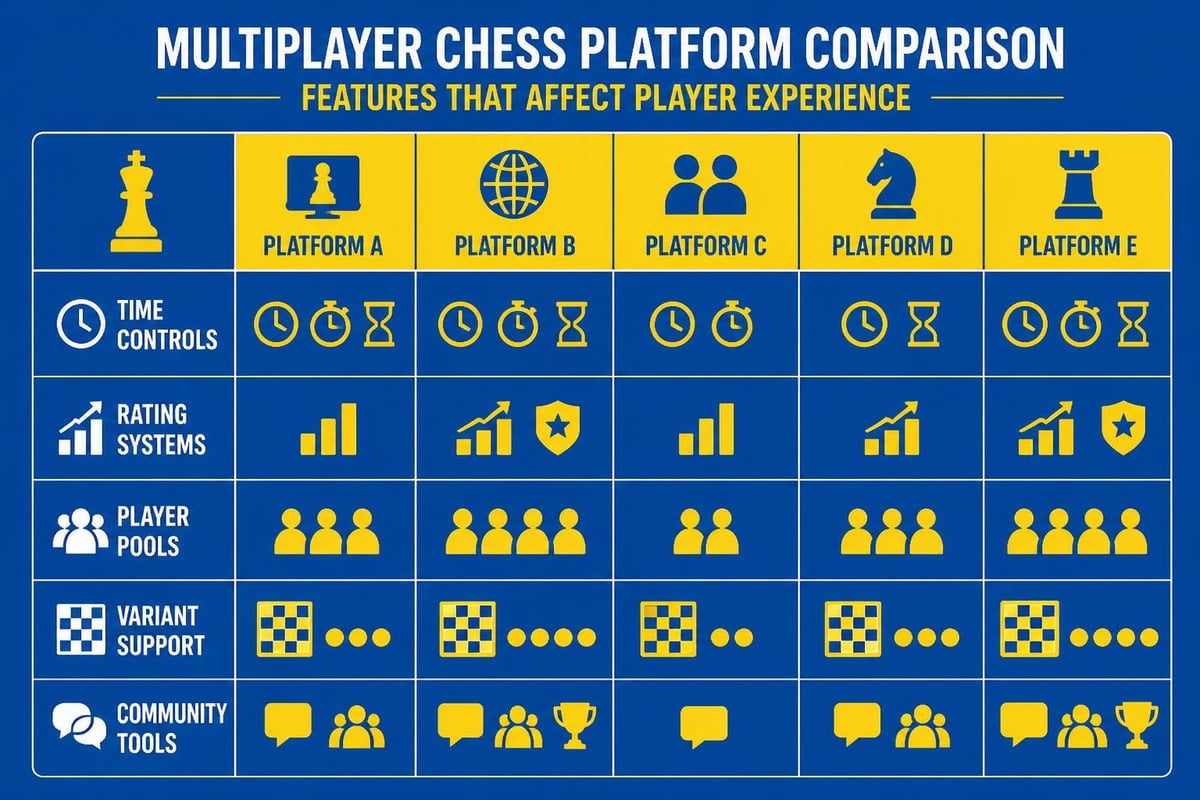
When you're exploring best online platforms to play chess, you'll discover a vast ecosystem. Each platform offers different time controls, rating systems, and player pools. Some favour rapid games, others specialise in blitz or bullet chess. Understanding where you fit in this landscape is your first step to mastering multiplayer chess.
Choosing Your Battleground
Not all chess platforms are created equal. Here's what you should consider:
- Time control preferences: Are you a classical thinker or a bullet speedster?
- Rating pools: Do you want balanced matchmaking or challenging uphill battles?
- Community features: Does live chat and analysis matter to you?
- Variant options: Are you interested in Chess960 or traditional formats only?
Different platforms cater to different playing styles. PawnSquare offers frictionless browser-based play with various variants, whilst LetsChess introduces a unique massively multiplayer experience on a giant shared board. Understanding these options helps you choose environments where you'll thrive.
Building Your Opening Repertoire for Competitive Play
Here's the truth: you can't master chess multiplayer without solid opening preparation. When you're facing real opponents, they'll exploit every weakness in your opening knowledge.
Your opening repertoire acts as your foundation. Think of it as building a house. You wouldn't start with the roof, would you? Similarly, you need most common chess openings as your starting point before exploring exotic variations.
White's Weapon Arsenal
| Opening Choice | Strength | Ideal For | Learning Curve |
|---|---|---|---|
| Queen's Gambit | Positional control | Strategic players | Moderate |
| English Opening | Flexibility | Adaptive players | High |
| Italian Game | Quick development | Tactical players | Low |
| Ruy López | Long-term pressure | Patient players | Moderate-High |
When you're playing white in multiplayer games, you control the narrative. Understanding what are the pros and cons of the Queen's Gambit gives you a powerful weapon for solid, positional chess. Meanwhile, the English Opening offers tremendous flexibility for players who prefer keeping their opponents guessing.
Defensive Mastery as Black
Playing black requires a different mindset. You're responding to white's initial thrust whilst seeking equality and counterplay opportunities.
Top defensive frameworks:
- Sicilian Defence (aggressive counterplay)
- French Defence (solid structure with tension)
- Caro-Kann Defence (safe and sound)
- King's Indian Defence (dynamic attacking chances)
The beauty of multiplayer chess lies in adapting your defences to your opponent's style. Against aggressive players, solid defences work wonders. Against positional grinders, dynamic counterattacking systems shine.
Tactical Pattern Recognition in Real-Time Games
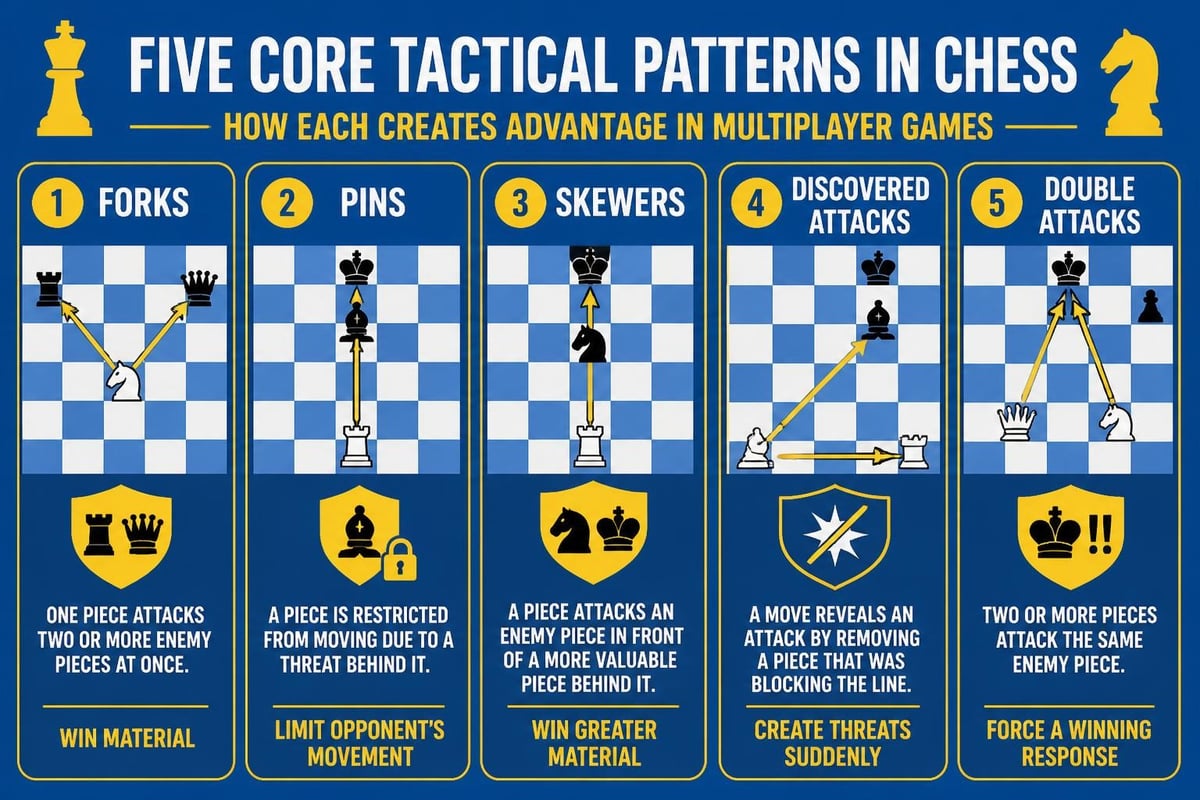
Pattern recognition separates decent players from those who truly master chess multiplayer environments. When you've got three minutes on the clock and your opponent just sacrificed a piece, you don't have time for deep calculation. You need instant recognition.
Think about it this way: professional footballers don't consciously think about every movement. They've trained muscle memory through thousands of repetitions. Chess works similarly. The more tactical patterns you've absorbed, the faster you'll spot opportunities.
Essential Tactical Motifs
- Forks: Attacking two pieces simultaneously
- Pins: Restricting piece movement
- Skewers: Forcing a valuable piece to move
- Discovered attacks: Unleashing hidden power
- Double attacks: Creating multiple threats
Training these patterns requires dedicated practice. Chess opening puzzles specifically target these tactical themes within opening contexts, helping you recognise opportunities before they fully develop.
Time Management Strategies for Different Formats
Mastering time controls might be the most underrated skill in competitive chess. You could be the strongest positional player in the world, but if you flag with a winning position, you've still lost.
Time Control Breakdown
| Format | Time Control | Strategy Focus | Skill Emphasis |
|---|---|---|---|
| Bullet | 1-2 minutes | Intuition | Speed, patterns |
| Blitz | 3-5 minutes | Quick tactics | Balance |
| Rapid | 10-15 minutes | Sound strategy | Calculation |
| Classical | 30+ minutes | Deep planning | Precision |
Each format demands different preparation. In bullet chess, you're playing on instinct and pattern recognition. Calculation takes a backseat to quick, sound moves. In classical games, you have luxury for deep analysis.
When you're working to master chess multiplayer across formats, consider specialising initially. Becoming excellent at rapid chess builds skills that transfer to other formats. Trying to master everything simultaneously often leads to mediocrity everywhere.
Psychology and Opponent Adaptation
Here's something they don't teach in opening books: half of multiplayer chess happens in your opponent's head. Understanding psychological dynamics gives you an edge beyond pure calculation.
Reading your opponent involves:
- Observing time usage patterns
- Noting opening choices and deviations
- Recognising comfort zones and weaknesses
- Adapting your play style accordingly
Against aggressive opponents who love tactics, solid positional play frustrates them. Against cautious positional players, creating complications forces them out of comfort zones. This adaptability comes from experience and conscious observation.
Research into AlphaZero modifications for multiplayer environments demonstrates how even advanced AI systems must adapt strategies based on opponent behaviour. If artificial intelligence requires adaptation algorithms, you certainly need adaptation strategies too.
Advanced Strategic Concepts for Multiplayer Excellence
Once you've mastered fundamentals, advancing your game requires understanding deeper strategic concepts. These aren't flashy tactics that win games in ten moves. They're subtle positional advantages that accumulate into winning endgames.
Positional Elements That Matter
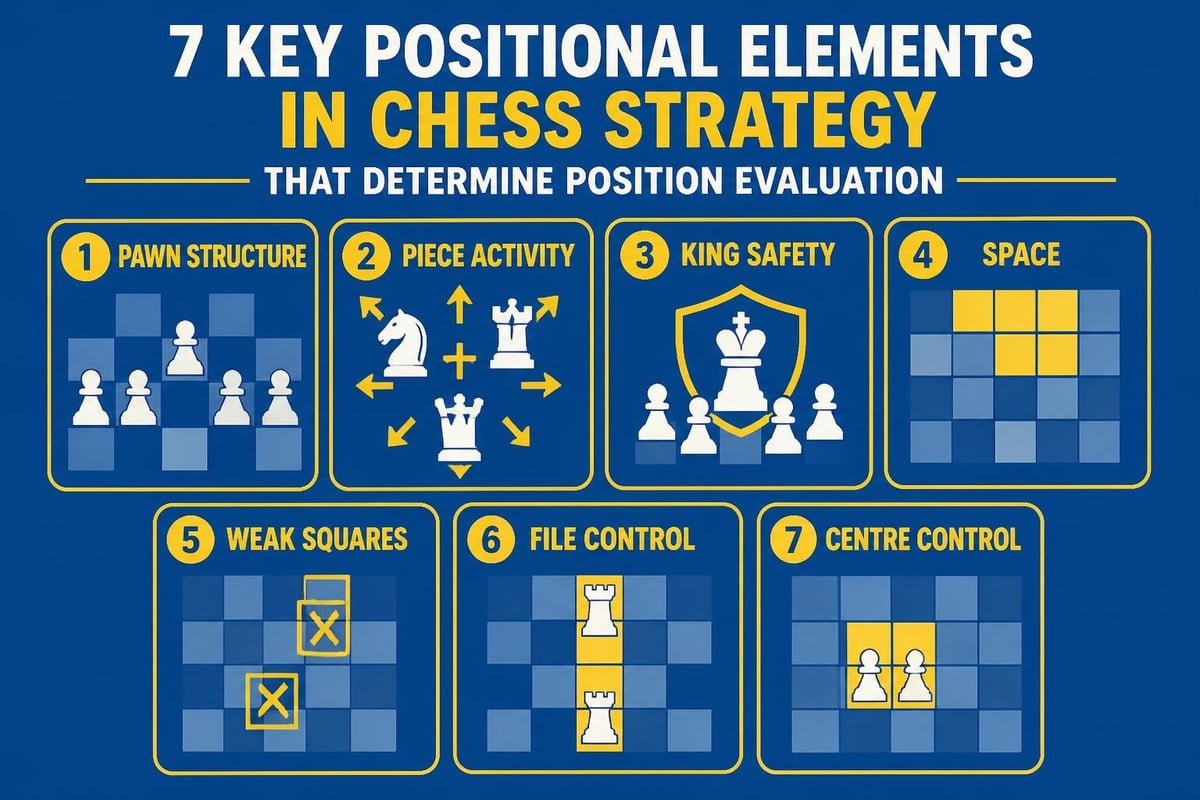
The seven critical positional factors separate strong players from masters:
- Pawn structure: Determines long-term plans
- Piece activity: Active pieces create threats
- King safety: Your first defensive priority
- Space advantage: Controls opponent options
- Weak squares: Permanent positional targets
- File control: Rook activity routes
- Centre domination: Strategic command post
Understanding these elements helps you evaluate positions objectively. When you're unsure about a position, mentally reviewing these factors provides clarity. Is your opponent's bishop better than your knight? That's piece activity. Do they control the e-file? That's file control creating future threats.
Training Routines for Consistent Improvement
Want to know the secret to sustained improvement? Consistency beats intensity every single time. Players who practice thirty minutes daily outpace those who cram four hours on weekends.
Daily Training Structure
Morning routine (15 minutes):
- Five tactical puzzles at your level
- One opening line review
- Quick endgame position
Evening routine (15 minutes):
- Analyse one game you played
- Study one master game
- Review problem areas
This structure ensures you're touching all aspects of chess daily. Free online chess courses supplement structured practice with theoretical knowledge, whilst opening puzzles reinforce your repertoire choices.
Studies on Monte-Carlo Tree Search with opponent models reveal how strategic decision-making improves through repeated pattern exposure. Your brain builds similar neural pathways through consistent practice.

Analysing Your Games for Maximum Growth
Here's where most players fail: they play hundreds of games but rarely analyse them properly. Playing without analysis is like reading without comprehension. You're going through motions without extracting lessons.
Effective game analysis process:
- Play the game without engine assistance
- Immediately note your thought process on critical moves
- Identify three positions where you felt uncertain
- Use engine analysis only after forming your own opinions
- Create flashcards for mistakes and alternative moves
The Chess Cheat Sheets approach emphasises extracting maximum value from every learning opportunity. Rather than memorising endless variations, focus on understanding principles behind moves. This understanding transfers across positions.
Platform-Specific Strategies and Features
Different platforms offer unique features that can enhance your training. Chess Arena provides built-in video chat, transforming online games into social experiences whilst maintaining competitive intensity. This human connection often leads to deeper analysis discussions post-game.
Meanwhile, innovations in massively multiplayer formats create entirely new strategic considerations. Research into learning approaches in multiplayer symmetric games explores how strategy evolves when multiple players interact simultaneously, rather than traditional one-on-one formats.
Leveraging Platform Features
| Feature | Benefit | Application |
|---|---|---|
| Game databases | Pattern study | Review master games in your openings |
| Analysis engines | Mistake identification | Post-game improvement |
| Puzzle rush | Tactical training | Daily pattern reinforcement |
| Tournaments | Competitive practice | Real pressure simulation |
Understanding chess master levels helps you set realistic progression goals. You're not competing against Magnus Carlsen tomorrow. You're building skills systematically, one game at a time.
Developing Your Endgame Technique
Many players focus obsessively on openings whilst neglecting endgames. That's backwards. Openings get you into games. Endgames win them.
Critical endgame knowledge:
- King and pawn versus king (essential technique)
- Rook endgames (most common practical endings)
- Queen versus pawn endgames (crucial defensive knowledge)
- Knight versus bishop endings (understanding piece values)
- Opposite-coloured bishops (drawing technique)
The beautiful thing about endgames? They're concrete. Unlike middlegame positions with infinite possibilities, endgames often have definite evaluations. This makes them learnable through systematic study rather than pure intuition.
Maintaining Mental Stamina During Sessions
You've probably experienced this: your first three games are brilliant, then performance nosedives. Mental fatigue affects chess performance more than physical tiredness affects running.
Research on evolutionary dynamics in repeated multiplayer games highlights how decision-making quality degrades with repetition fatigue. Recognising your mental limits prevents rating-damaging losing streaks.
Mental stamina tips:
- Limit serious games to 3-4 per session
- Take five-minute breaks between games
- Stay hydrated throughout play
- Avoid playing when emotionally tilted
- End sessions after big wins or losses
Quality matters more than quantity. Three focused games with proper analysis teach more than ten mindless speed matches.
Creating Your Personal Improvement Plan
Generic advice only takes you so far. To truly master chess multiplayer, you need personalised improvement strategies based on your strengths, weaknesses, and goals.
Self-Assessment Questions
- What time controls do I genuinely enjoy?
- Where do most of my games go wrong (opening/middlegame/endgame)?
- Am I stronger tactically or positionally?
- Do I lose more games on time or mistakes?
- What's my realistic rating goal for this year?
Honest answers guide focused improvement. If you're losing tactical games, more opening study won't help. You need tactical training. If time trouble causes losses, playing longer formats whilst building speed gradually makes sense.
The systematic resources available through comprehensive platforms help structure this improvement journey without overwhelming you with information.
Mastering chess multiplayer combines opening preparation, tactical awareness, psychological understanding, and consistent practice into a comprehensive skill set. Whether you're just learning the fundamentals or pushing towards expert level, improvement comes from deliberate, focused effort across all game phases. Chess Cheat Sheets provides the streamlined guides, targeted puzzles, and opening resources you need to accelerate this journey without getting lost in endless theory, helping you build confidence and skills efficiently as you progress through competitive multiplayer chess.


