

When you think about chess sets, what comes to mind? Probably the classic Staunton design with its recognisable knights and bishops, right? But what happens when a surrealist artist decides to completely reimagine the game? That's exactly what Man Ray did in the 1940s, creating a chess set that's become as legendary in art circles as the Sicilian Defense is in chess strategy. The man ray chess set represents a fascinating collision between fine art and one of the world's oldest games, challenging everything we think we know about how chess pieces should look.
The Artist Behind the Iconic Design
Man Ray wasn't your typical chess set designer. Born Emmanuel Radnitzky in 1890, he became one of the most influential artists of the Dada and Surrealist movements. His work spanned photography, painting, sculpture, and experimental film. But here's the thing: Man Ray was also a passionate chess player. He didn't just appreciate the game aesthetically; he understood it deeply, which made his approach to redesigning chess pieces particularly intriguing.
During the 1920s and 1930s, Man Ray spent considerable time in Paris, mingling with other chess-enthusiast artists like Marcel Duchamp. This combination of artistic vision and genuine chess knowledge set the stage for something truly unique. When he created his chess set in the mid-1940s, he wasn't just making art for art's sake. He was solving what he saw as a fundamental problem with traditional chess sets.
The Philosophy of Form
What bothered Man Ray about conventional chess pieces? He felt they were too ornate, too distracting. Think about it: when you're deep in the middle game, trying to calculate a complex tactical sequence, do you really need your bishop looking like a medieval religious figure? Man Ray believed the pieces should reflect their function, not tell a story.
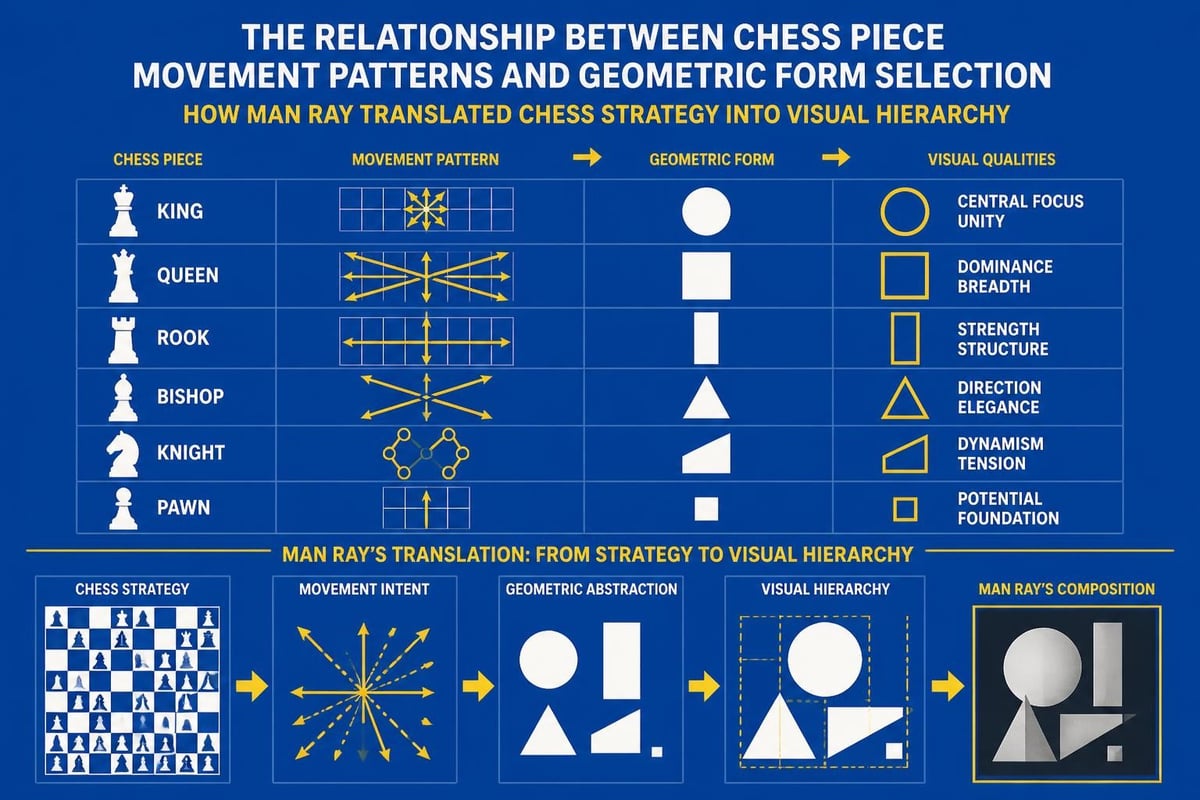
His solution was radical simplicity. Each piece in the man ray chess set became a pure geometric form:
- Pawns: Simple pyramids or cones
- Rooks: Solid cubes
- Knights: Elegant scrolls or curved forms
- Bishops: Minimalist pyramids, taller than pawns
- Queens: Slender pyramids with ornamental tops
- Kings: The tallest pieces with distinctive crowns
This wasn't random abstraction. Man Ray assigned shapes based on the piece's movement and value in the game. The more powerful the piece, the more visually prominent it became.
Design Variations and Materials
Here's where it gets interesting for collectors and chess enthusiasts alike. Man Ray actually created multiple versions of his chess set, each with subtle differences in execution. The 1947 aluminium version offered by Christie's showcases the industrial aesthetic he favoured during that period. The metal construction gave the pieces a modern, almost futuristic quality that was revolutionary for its time.
But there's also a wooden version from 1946 that presents an entirely different character. The warmth of wood softens the geometric severity, making the set feel more approachable whilst maintaining the same conceptual foundation. Both versions demonstrate Man Ray's attention to how materials communicate different aspects of the chess experience.
Material Choices and Player Experience
| Material | Aesthetic Quality | Weight/Feel | Historical Context |
|---|---|---|---|
| Aluminium | Industrial, modern | Substantial yet cool to touch | Post-war innovation period |
| Wood | Warm, traditional | Varied depending on wood type | Classic craftsmanship |
| Resin (modern reproductions) | Accessible, versatile | Lighter, consistent | Contemporary availability |
The choice of material wasn't merely aesthetic. When you pick up a piece during a game, its weight and texture affect your connection to the board. Man Ray understood this tactile dimension. Just as mastering chess openings requires understanding subtle positional nuances, appreciating the man ray chess set demands attention to these physical details.
Playing Chess with Art
Now, you might be wondering: can you actually play chess with these pieces? Absolutely, though it presents unique challenges and opportunities. The geometric simplicity means you need to rely more on position and board location to identify pieces rather than their decorative details. For experienced players, this can actually enhance focus on the position itself rather than the pieces.
Some players find the abstract forms liberating. Without the traditional knight's horse head or the rook's castle battlements, you're forced to think about what each piece does rather than what it represents. It's a bit like how studying the London System changes your perspective on opening development.

Practical Considerations for Gameplay
Using a man ray chess set for serious play requires an adjustment period. Here's what changes:
- Piece recognition speed: Initially slower, but improves with familiarity
- Tactical visualization: Some players report enhanced abstract thinking
- Teaching opportunities: Excellent for explaining piece values to beginners
- Aesthetic enjoyment: Transforms the chess experience into something more meditative
The minimalist design also reduces visual clutter. When you're calculating a complicated variation, fewer decorative elements mean fewer distractions. It's similar to how studying chess move by move helps you focus on essential patterns rather than superficial details.
The Modern Legacy and Reproductions
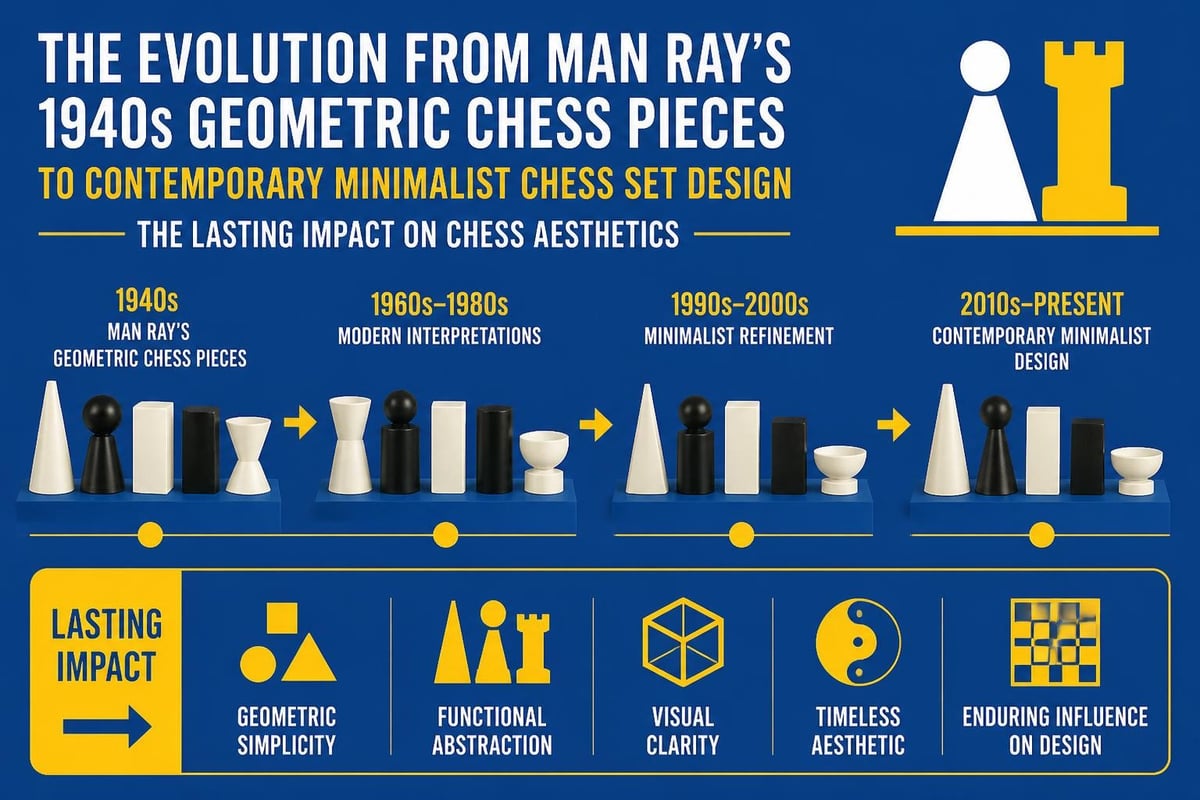
Original Man Ray chess sets are now museum pieces and collector's items, but his design lives on through various reproductions. The San Diego Museum of Art offers a re-edition that honours the original specifications whilst making it accessible to contemporary enthusiasts. These modern versions allow ordinary players to experience Man Ray's vision without needing a Christie's budget.
World Chess Shop provides detailed reproductions that emphasise the geometric precision of the original design. They've worked to ensure that the proportions and relationships between pieces maintain Man Ray's intended hierarchy. It's fascinating how a design from the 1940s still feels contemporary today.
Comparing Original and Contemporary Versions
| Aspect | Original (1940s) | Modern Reproductions | Considerations |
|---|---|---|---|
| Availability | Extremely rare | Widely available | Originals only in museums/private collections |
| Price Range | £50,000+ at auction | £200-800 typically | Reproductions democratise the design |
| Craftsmanship | Hand-finished by artist | Manufactured to specifications | Quality varies by producer |
| Playability | Museum display primarily | Designed for actual use | Modern versions more practical |
Design Within Reach discusses how the set fits into broader mid-century modern design movements. This context helps us understand why the man ray chess set remains relevant. It's not just a quirky artistic experiment; it's part of a larger conversation about function, form, and how we interact with everyday objects.
Influence on Chess Culture and Design
Man Ray's approach influenced how subsequent generations thought about chess set design. You'll see echoes of his geometric minimalism in countless modern sets. But beyond aesthetics, he challenged the assumption that chess pieces must follow established conventions. This rebellious spirit resonates with players who approach the game creatively.
Think about how chess openings evolve. The most common chess openings we study today were once considered radical departures from established wisdom. Similarly, Man Ray's design showed that respecting the game's essence doesn't mean being bound by its traditional visual language.
What We Can Learn for Our Chess Practice
The man ray chess set offers surprising lessons for improving your game:
- Embrace abstraction: Sometimes removing familiar patterns helps you see positions more clearly
- Function over decoration: Focus on what pieces do, not just what they look like
- Question assumptions: Just because something's traditional doesn't mean it's optimal
- Balance aesthetics and practicality: Your study environment affects your learning
When you're working through complex positions or studying a new opening system like the Caro-Kann Defense, the environment matters. Some players find that minimalist aesthetics reduce mental clutter, allowing deeper concentration.
Collecting and Appreciating Man Ray's Chess Vision
For those interested in owning a piece of this chess history, options exist across various price points. Fake World Inc. explores modern reproductions and discusses the artist's ongoing influence on contemporary design. These accessible versions let you experience the design philosophy without museum-level investment.
Collectors should consider several factors:
- Authenticity and provenance: Is it an original, authorized reproduction, or inspired design?
- Build quality: How well does it match Man Ray's specifications?
- Material choice: Which version aligns with your preferences?
- Intended use: Display piece or functional chess set?
- Investment value: Some reproductions appreciate, others remain decorative
Even if you're not collecting, understanding the man ray chess set enriches your appreciation of chess culture. It demonstrates how the game inspires creativity across disciplines, much like how mastering the Ruy Lopez opens up entire strategic landscapes.
The Intersection of Art and Strategy
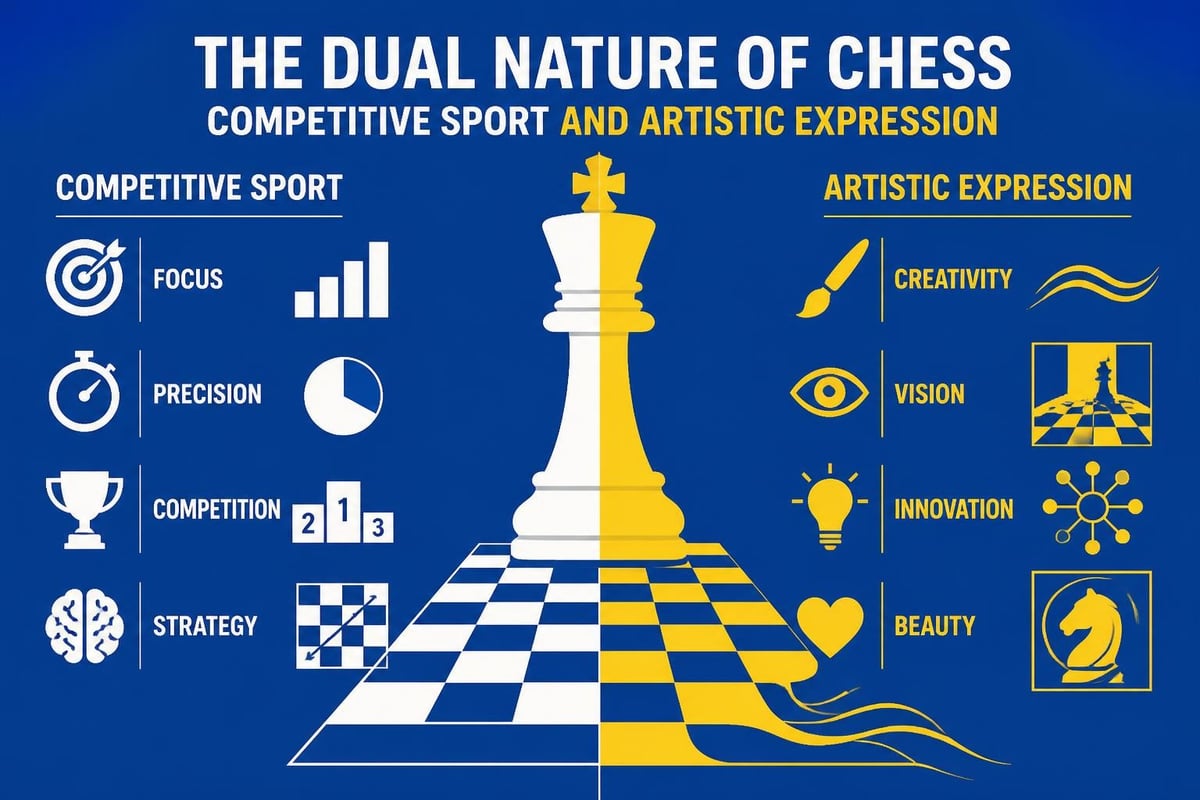
What makes the man ray chess set so compelling is how it embodies chess's dual nature. Chess is simultaneously a rigorous intellectual competition and a beautiful abstract system. Man Ray's design honours both aspects. The pieces work perfectly well for serious play whilst elevating the board to an art object.
This duality mirrors the chess learning journey itself. You need practical knowledge-openings, tactics, endgames-but you also develop an aesthetic sense for positions. Beautiful chess isn't just about winning; it's about the elegance of the solution. When you solve a puzzle or find a brilliant combination, there's an artistic satisfaction beyond the practical outcome.
Applying Minimalist Thinking to Your Chess
The principles behind Man Ray's design can inform how you approach chess improvement:
- Strip away unnecessary complexity: Focus on fundamental principles
- Understand essential functions: Know what each piece excels at
- Create visual clarity: Organize your mental chess board efficiently
- Balance form and function: Study methods should be both effective and enjoyable
Many chess students bog themselves down with excessive detail. They memorize 30 moves deep in obscure variations without understanding basic middlegame plans. Man Ray's chess set reminds us that simplicity and clarity often serve us better than baroque complexity. This doesn't mean avoiding deep study-it means ensuring your foundation remains solid and comprehensible.
Display and Cultural Significance
Even if you never play a game with it, the man ray chess set serves as a conversation piece and cultural artifact. It represents a moment when chess transcended its board game origins and entered fine art discourse. Museums worldwide display versions of it not in games sections but alongside paintings and sculptures.
This cultural elevation of chess aligns with its growing recognition as both sport and art form. When chess appears in galleries and design exhibitions, it validates what players have always known: this game possesses unique aesthetic and intellectual properties that transcend mere entertainment.
For chess educators and enthusiasts, having a man ray chess set in your space makes a statement. It says chess isn't just about calculation and memorization; it's about beauty, creativity, and thinking differently. These are precisely the qualities that separate mechanical play from genuine chess mastery.
Personal Connection Through Design
Your relationship with chess extends beyond the moves you make. The physical pieces, the board, even the environment where you study-all these elements shape your experience. Some players prefer traditional Staunton sets for their familiarity and clarity. Others find inspiration in modern or artistic designs that reimagine the game's visual language.
The man ray chess set appeals to those who see chess as more than a competitive pursuit. If you've ever paused during a game to admire a particularly elegant position, or felt genuine aesthetic pleasure in a clean tactical solution, you understand what Man Ray was capturing. He made visible the abstract beauty that chess players feel but struggle to articulate.
This perspective can transform your practice. When you approach studying opening theory as exploring beautiful patterns rather than memorizing dry sequences, your engagement deepens. The positions become more memorable because you're connecting with their aesthetic logic, not just their theoretical correctness.
The man ray chess set reminds us that chess exists at the intersection of art, intellect, and play. Whether you're drawn to its minimalist elegance, its philosophical approach to design, or simply its status as a unique cultural artifact, it offers a fresh perspective on the ancient game. If you're looking to deepen your chess understanding with the same clarity and focus that Man Ray brought to piece design, Chess Cheat Sheets provides streamlined guides that cut through complexity and help you master essential concepts efficiently. Sometimes the most powerful improvements come from simplifying and focusing on what truly matters.


