

You've probably heard it called the "boring" opening, the "safe" choice, or perhaps the system that "doesn't teach you real chess." Yet the London System continues to be one of the most popular openings at every level, from club players to super-grandmasters. Why? Because it works. This reliable opening allows you to build a solid position without memorising endless variations, giving you the freedom to focus on understanding chess principles rather than frantically trying to recall move 17 of an obscure line. Whether you're just starting your chess journey or looking to add a dependable weapon to your repertoire, understanding this opening can transform your results and confidence at the board.

What Makes the London System Special
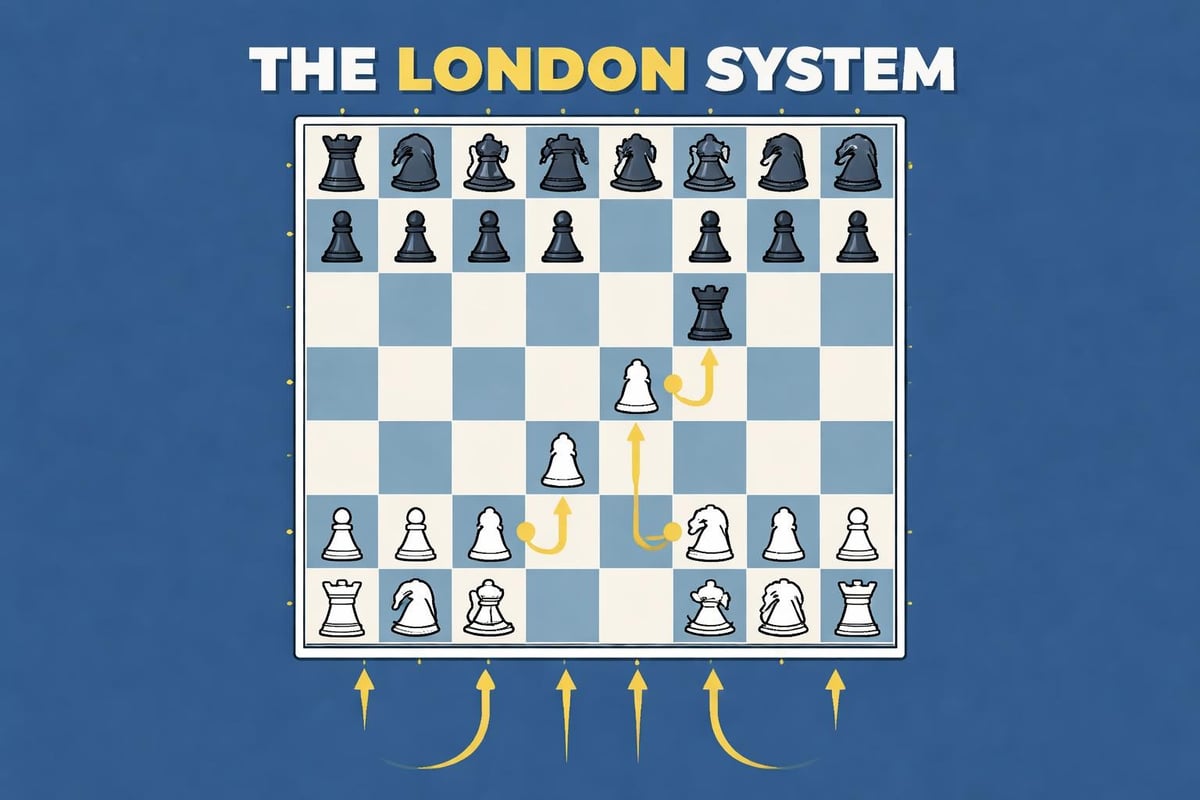
The beauty of this opening lies in its simplicity and flexibility. Unlike sharp tactical openings that demand precise move orders, the London System lets you develop your pieces to natural squares regardless of what your opponent does. You start with 1.d4, follow up with 2.Bf4 (or 2.Nf3 and then 3.Bf4), and continue with e3, Nf3, Bd3, Nbd2, and c3. This setup creates a rock-solid foundation that's incredibly difficult to crack.
But don't mistake simplicity for weakness. The London System offers strategic depth that becomes apparent as you gain experience. You're not just moving pieces randomly; you're constructing a position with specific goals in mind.
The Standard Setup and Move Order
Here's what your ideal London System setup looks like:
- d4 controlling the centre
- Bf4 developing the bishop outside the pawn chain
- e3 supporting the d4 pawn and preparing kingside castling
- Nf3 developing the knight and controlling key central squares
- Bd3 aiming at the h7 square
- Nbd2 supporting the centre and preparing e4
- c3 reinforcing the d4 pawn and potentially preparing b4
The move order can vary depending on Black's response, which is precisely the point. You're not forced into rigid variations. If Black plays ...c5, you respond accordingly. If they choose ...e6, you adapt. The structure remains the same.
Strategic Ideas That Win Games
Understanding why pieces go where they do transforms you from someone who just "plays the London" to someone who genuinely understands it. Let's break down the key strategic concepts that make this opening effective.
The Bishop on f4: Your Secret Weapon
That light-squared bishop on f4 is more important than it looks. By developing it before playing e3, you've solved one of White's biggest problems in d4 openings: the "bad" light-squared bishop. This piece controls key dark squares, particularly e5, and can quickly swing to h2 if Black tries to chase it with ...Nh5.
Many beginners wonder whether to retreat the bishop to g3 or g5 when challenged. The answer depends on the position, but Bg3 is usually safer, maintaining flexibility and keeping the bishop aimed at Black's kingside.
Central Control Without Central Tension
Unlike openings where pawns clash in the centre immediately, the London System maintains what's called "central control without central tension." Your d4 pawn is solidly supported, but you're not rushing to create pawn exchanges. This approach gives you time to complete development and only then decide how to open the position.
When you do push e4, it's usually devastating. Black often isn't prepared for the sudden opening of lines, and your better-developed pieces can exploit this advantage quickly.
Common Variations You'll Face
Black has several ways to respond to the London System, but the good news is that your setup remains largely unchanged. Here's how to handle the most common responses:
| Black's Setup | Key Characteristics | Your Main Plan |
|---|---|---|
| ...d5 and ...Nf6 (Classical) | Solid, symmetrical structure | Build slowly, aim for e4 break |
| ...c5 (challenging d4) | Creates central tension early | Maintain centre, consider dxc5 |
| ...e6 and ...c5 (Queen's Gambit-style) | Flexible pawn structure | Keep tension, develop smoothly |
| ...g6 (King's Indian setup) | Fianchetto development | Control centre, prepare e4 push |
Against the classical setup with ...d5 and ...Nf6, you'll often see Black try ...Bf5, mirroring your bishop development. Don't panic. Your structure is still sound, and you can continue with your plan. Some players prefer h3 and g4 to chase the bishop, whilst others simply continue developing with Nbd2 and castle.
Dealing with Early Aggression
What happens when Black tries ...c5 immediately, challenging your centre? This is actually one of the critical moments in the opening. You have choices: maintain the tension with c3, exchange with dxc5, or even ignore it temporarily and continue developing. Understanding these strategic elements separates strong London System players from weak ones.
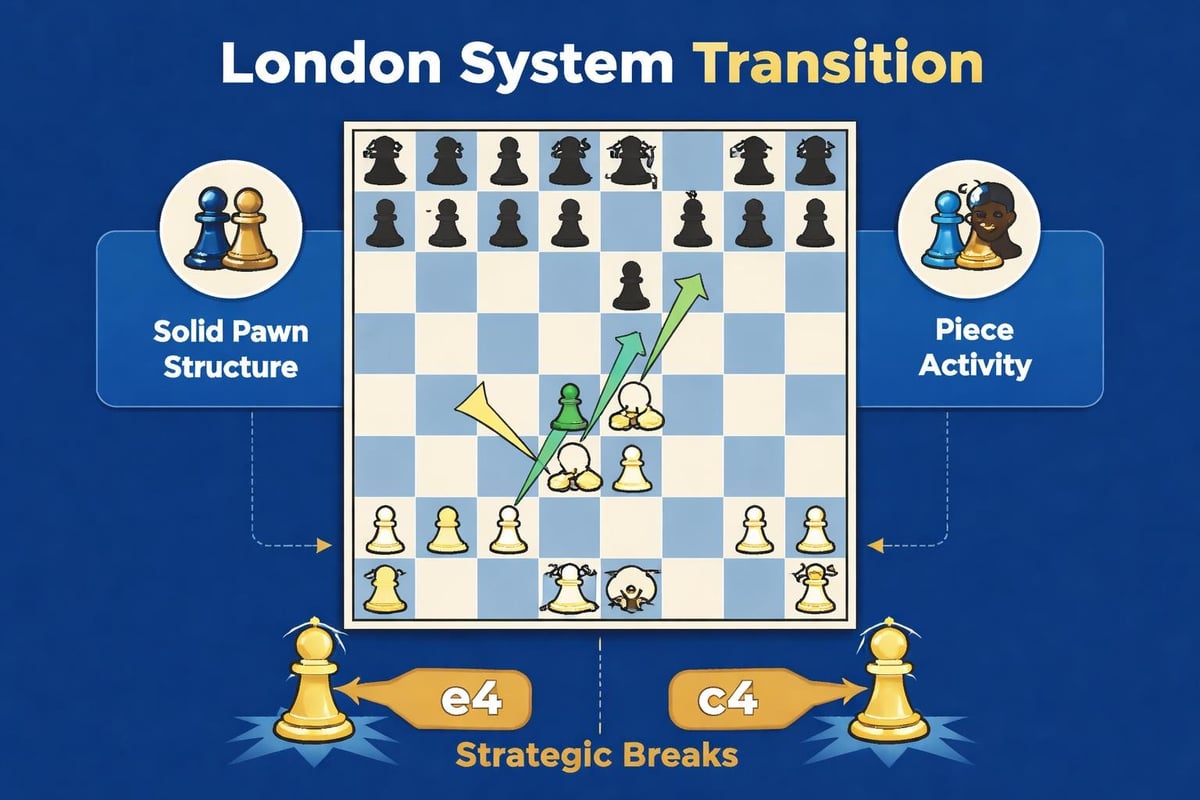
The position after 1.d4 d5 2.Bf4 c5 3.e3 Nc6 4.c3 Nf6 5.Nf3 is typical. You've maintained your centre, and Black's pieces don't have obvious squares to create immediate threats. Your plan might involve Bd3, Nbd2, and preparing e4 or simply castling and maintaining the position.
Typical Middlegame Plans
Once you've completed your development and castled kingside, what next? The London System isn't about forcing immediate tactics; it's about gradually improving your position until your opponent cracks. Here are your main middlegame strategies.
The Kingside Attack
With your bishop on d3 aimed at h7 and your knights potentially jumping to e5 or g5, a kingside attack is often in the cards. The classic plan involves:
- Complete development and castle
- Play Ne5, controlling key squares
- Manoeuvre Nbd2-f3-g3 or Nbd2-f3-e5
- Push h4-h5 if Black has castled kingside
- Consider Qf3 or Qe2 to join the attack
This isn't a reckless assault. You're building pressure gradually, forcing Black to make defensive moves whilst you improve your position piece by piece.
The Central Break
The e4 push is your dream move in many London System positions. When you achieve it comfortably, you've essentially won the opening battle. Your pieces spring to life, with the bishop on d3 suddenly becoming a monster and your knights finding perfect central squares.
Timing this break correctly requires judgment. Push too early and you might weaken your position. Wait too long and Black consolidates. Look for moments when Black's pieces are slightly uncoordinated or when trading pawns would open lines favouring your better-placed pieces.
The Queenside Minority Attack
Sometimes your opponent's setup makes a kingside attack impractical. No worries. The London System is flexible enough for queenside play too. After playing c3, you can prepare b4-b5, creating weaknesses in Black's queenside structure. Combined with pressure down the c-file and control of the d5 square, this plan can be equally effective.
Why Critics Miss the Point
You'll hear experienced players dismiss the London System as "boring" or claim it "doesn't teach proper chess." These criticisms misunderstand what makes an opening valuable for improving players. Let's address these concerns directly.
The Learning Curve Argument
Critics argue that because the London System is "too easy," it prevents you from learning complex positions. But think about it differently. When you're not drowning in theoretical variations, you can focus on understanding pawn structures, piece coordination, and strategic planning. These skills transfer to every opening, every position, every game you'll ever play.
Many of the most common chess openings require extensive memorisation. The London System frees you from this burden initially, letting you develop genuine chess understanding. You can always add sharper openings later once you've built this foundation.
Professional Credibility
Still think the London System is only for beginners? Grandmasters like Magnus Carlsen, Viswanathan Anand, and Vladimir Kramnik have all employed it in important games. When the world's best players trust an opening in high-stakes situations, perhaps it deserves more respect than "boring but playable."
The difference between a weak London System player and a strong one isn't the opening itself. It's the depth of strategic understanding behind the moves.

Practical Tips for Improvement
You want to get better with this opening, not just play it mechanically. Here's how to deepen your understanding and boost your results.
Study Model Games
Watching how strong players handle typical positions teaches you patterns you can apply in your own games. Look for games where White achieved the e4 break successfully. Notice how they prepared it, what Black tried to prevent it, and how the position changed afterward.
Pay particular attention to games where Black tried different setups against the London System. The London System chess opening guide can provide structured examples of how professionals handle various responses.
Recognise Key Patterns
Certain patterns repeat constantly in London System games:
- The Nh5 challenge to your Bf4 and your Bg3 response
- The ...c5 central challenge and how to maintain tension
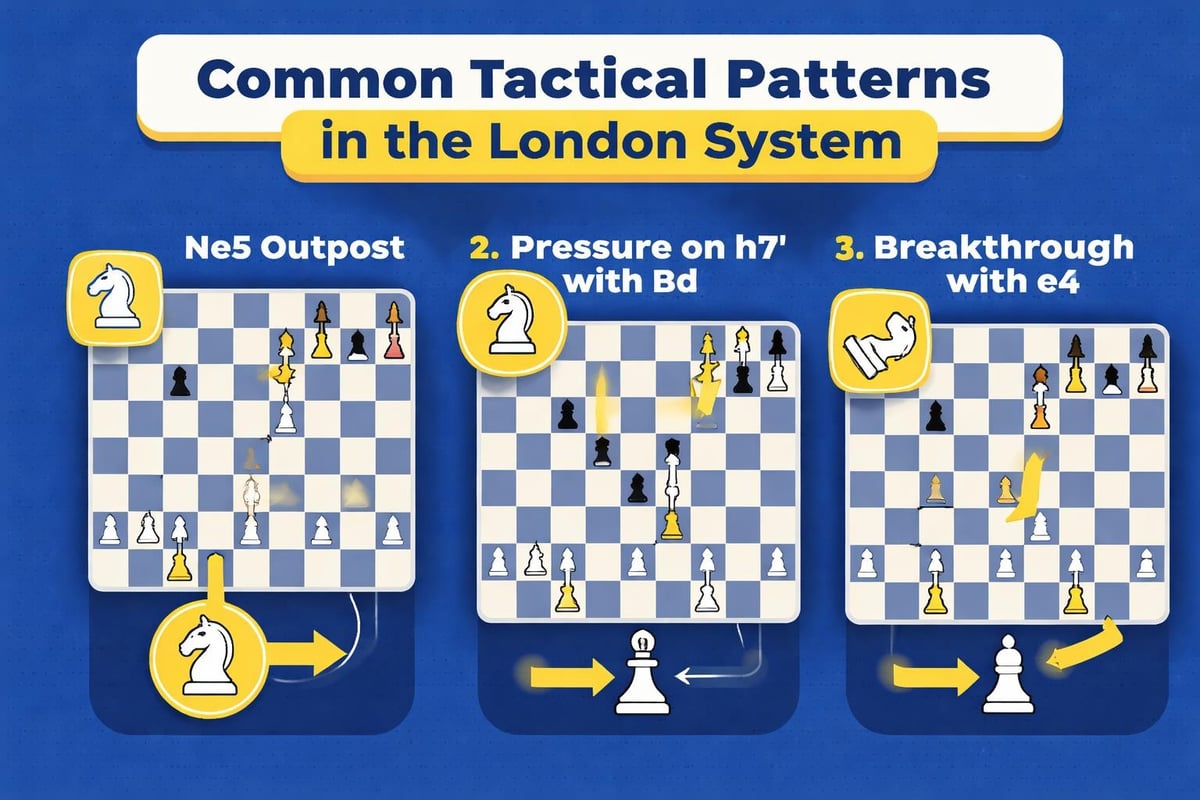
- The Ne5 outpost and when to trade or maintain it
- The f3-e4 pawn advance to support your centre
- The Qe2 or Qf3 manoeuvre to support attacks
Avoid Common Mistakes
Even though the London System is relatively forgiving, certain errors can ruin your position quickly:
- Moving the f4 bishop too many times - Develop your other pieces first
- Pushing e4 prematurely - Make sure it's genuinely strong, not just hopeful
- Neglecting king safety - Castle before launching attacks
- Ignoring Black's counterplay - The opening is solid but not invincible
- Playing on autopilot - Adapt your setup to Black's specific choices
Combining the London System with Your Overall Repertoire
One question many players ask is whether the London System should be your only opening as White. The honest answer is that it can be, especially whilst you're building your chess foundation. However, understanding how it fits with other openings enriches your chess education.
Transposing to Related Systems
The London System shares DNA with several other openings. The Torre Attack (with Bg5 instead of Bf4) and the Colle System (Bf4 comes later or not at all) use similar strategic ideas. Understanding these relationships helps you recognise familiar patterns even in unfamiliar positions.
If you're curious about expanding your opening repertoire systematically, checking out resources for good beginner chess books can provide structured learning paths that complement your London System knowledge.
When to Choose the London System
Against every opponent in every situation? Not necessarily. The London System excels when you want to:
- Avoid opponent's preparation in sharp lines
- Play for a slow, strategic advantage
- Keep the position under control
- Focus on outplaying rather than out-preparing your opponent
Against weaker opponents, sharper openings might win faster. Against stronger opponents, the London System can neutralise their theoretical advantage.
Training Methods to Master This Opening
Simply playing games isn't enough to truly master any opening. You need focused practice that builds specific skills and understanding.
Position-Specific Puzzles
Look for tactical puzzles arising from typical London System positions. These aren't random tactics; they're patterns you'll actually encounter. Practice spotting when Ne5 wins material, when the e4 break creates tactics, or when your bishops coordinate for an attack on h7.
The puzzles and resources available at Chess Cheat Sheets can help you develop pattern recognition specific to your opening repertoire.
Analysing Your Games
After each game with the London System, ask yourself:
- Did I achieve my ideal setup? If not, why?
- When did I push e4? Was the timing correct?
- How did my opponent try to counter my plan?
- Which pieces were most effective?
- What would I do differently next time?
This reflection builds understanding faster than playing a hundred games without thought.
Structured Study Approach
| Study Method | Time Investment | Benefit |
|---|---|---|
| Model games | 2-3 games per week | Learn typical plans |
| Opening theory | 15 minutes daily | Understand move order |
| Tactical puzzles | 10-15 puzzles weekly | Spot opportunities |
| Game analysis | After every game | Personalised learning |
| Positional exercises | 2-3 positions weekly | Deepen understanding |
This balanced approach prevents the common mistake of either playing without studying or studying without playing. Both are essential.
Adapting to Modern Defensive Ideas
Chess theory evolves constantly, and Black players have developed sophisticated responses to the London System. Rather than seeing this as a problem, view it as an opportunity to deepen your understanding.
The Accelerated Development Approach
Modern defenders often develop rapidly with moves like ...Nf6, ...e6, ...Be7, and ...0-0, completing development before committing to a specific pawn structure. Against this setup, your strategic patience becomes crucial. Don't rush. Complete your development, maintain flexibility, and only commit to a plan once you've seen Black's full setup.
The Early ...c5 Challenge
We've mentioned this briefly, but it deserves deeper consideration. When Black challenges d4 immediately with ...c5, they're testing whether you understand central tension. Maintaining it with c3 is often correct, keeping maximum flexibility. Trading with dxc5 can be fine too, but make sure you're not giving Black easy equality.
Understanding these strategic elements and tactical traps helps you respond confidently rather than hoping your opponent doesn't know the refutation.
Building Confidence Game by Game
Perhaps the London System's greatest strength for improving players isn't theoretical at all. It's psychological. When you sit down at the board knowing you have a reliable opening that works regardless of your opponent's choices, you approach the game with confidence rather than anxiety.
That confidence matters. How many games have you lost not because you played badly but because you panicked after your opponent's third move threw you out of your prepared lines? With this opening, that doesn't happen. You know where your pieces belong, you understand the plans, and you can focus on playing good chess rather than trying to remember theory.
From Beginner to Intermediate
The London System can genuinely take you from beginner to intermediate level. It teaches you about piece development, pawn structures, strategic planning, and gradual advantage accumulation. These aren't opening-specific skills; they're fundamental chess understanding that applies everywhere.
As you progress, you'll naturally develop preferences for specific variations and plans within the system. Perhaps you'll favour kingside attacks, or maybe queenside pressure suits your style better. The opening accommodates both, letting your chess personality emerge naturally.
The Next Steps
Eventually, you might want to expand beyond the London System. That's excellent! But you'll find that the strategic foundations you've built serve you well in every new opening you learn. Understanding pawn structures from your London System games helps you grasp the Queen's Gambit more quickly. Knowing how to coordinate pieces for gradual pressure makes learning the English Opening easier.
Your time with this opening isn't a detour from "real" chess openings. It's a foundation that supports everything else you'll learn. Exploring other chess openings becomes easier when you've already developed solid positional understanding through this system.
The Jobava London Variation
Before we finish, let's briefly mention a more aggressive cousin: the Jobava London System. This variation features an early Nc3 and Bf4, creating a more aggressive setup that can transpose to various positions. It's named after Georgian grandmaster Baadur Jobava, who's employed it with devastating effect.
The main difference is that with Nc3 instead of Nbd2, you're committing to a more forcing approach. The knight on c3 eyes e4 and supports a quick e4 push, but you've blocked the c-pawn which might be needed for central support.
Is it better than the standard London System? Not necessarily. It's different, offering more immediate tactics at the cost of some positional flexibility. Many players use both, choosing based on their mood or their opponent's style.
The London System offers a remarkable pathway to chess improvement, combining strategic depth with practical accessibility. By focusing on understanding rather than memorisation, you can build genuine chess skills that translate to better results across all phases of the game. If you're ready to master this opening along with other essential chess concepts, Chess Cheat Sheets provides comprehensive guides, cheat sheets, and resources specifically designed to help you improve efficiently without drowning in endless theory. Start building your chess confidence today with tools that actually work for real players at your level.


