

You've probably felt that moment of panic when your opponent plays an unfamiliar move in the opening. Your mind races, uncertainty creeps in, and suddenly you're on the back foot before the middlegame even begins. Learning chess openings doesn't have to feel overwhelming, though. Whether you're a beginner looking to build a solid foundation or an intermediate player seeking to expand your repertoire, understanding how to approach chess opening theory efficiently can transform your game and boost your confidence at the board.
Why Learning Chess Openings Matters
Let's be honest: you could memorise fifty moves of the Sicilian Dragon and still lose spectacularly if you don't understand what you're doing. That's the trap many players fall into when they learn chess openings without grasping the underlying principles.
The opening phase sets the stage for everything that follows. A strong opening gives you comfortable positions, active pieces, and clear plans. A weak one leaves you defending, cramped, and reactive.
The Real Purpose of Opening Study
Think of openings as your entrance into the conversation of chess. You're establishing your argument, claiming space, and setting the tone. When you learn chess openings properly, you're not just memorising moves; you're absorbing patterns, understanding pawn structures, and recognising typical piece placements.
Key benefits include:
- Developing pieces efficiently to active squares
- Controlling the centre of the board
- Keeping your king safe through timely castling
- Creating harmonious piece coordination
- Avoiding early tactical disasters
Research shows that understanding the strategic importance of openings has evolved significantly over chess history, with modern players benefiting from centuries of accumulated knowledge.
Start with Universal Opening Principles
Before diving into specific variations, you need to master the fundamental principles that guide almost every opening. These are your foundation, the bedrock upon which all your opening knowledge will rest.
Control the Centre
The centre (e4, d4, e5, d5) is the heart of the battlefield. Pieces placed in or controlling these squares have maximum influence across the board. Your opening should fight for this vital real estate.
- Occupy the centre with pawns (e4, d4) when possible
- Control central squares with pieces when occupation isn't ideal
- Challenge your opponent's central control
- Avoid moving the same piece multiple times unnecessarily
Develop Your Pieces Rapidly
Every move in the opening should contribute to getting your army into the game. Knights before bishops usually makes sense, as bishops have more flexibility in where they belong.
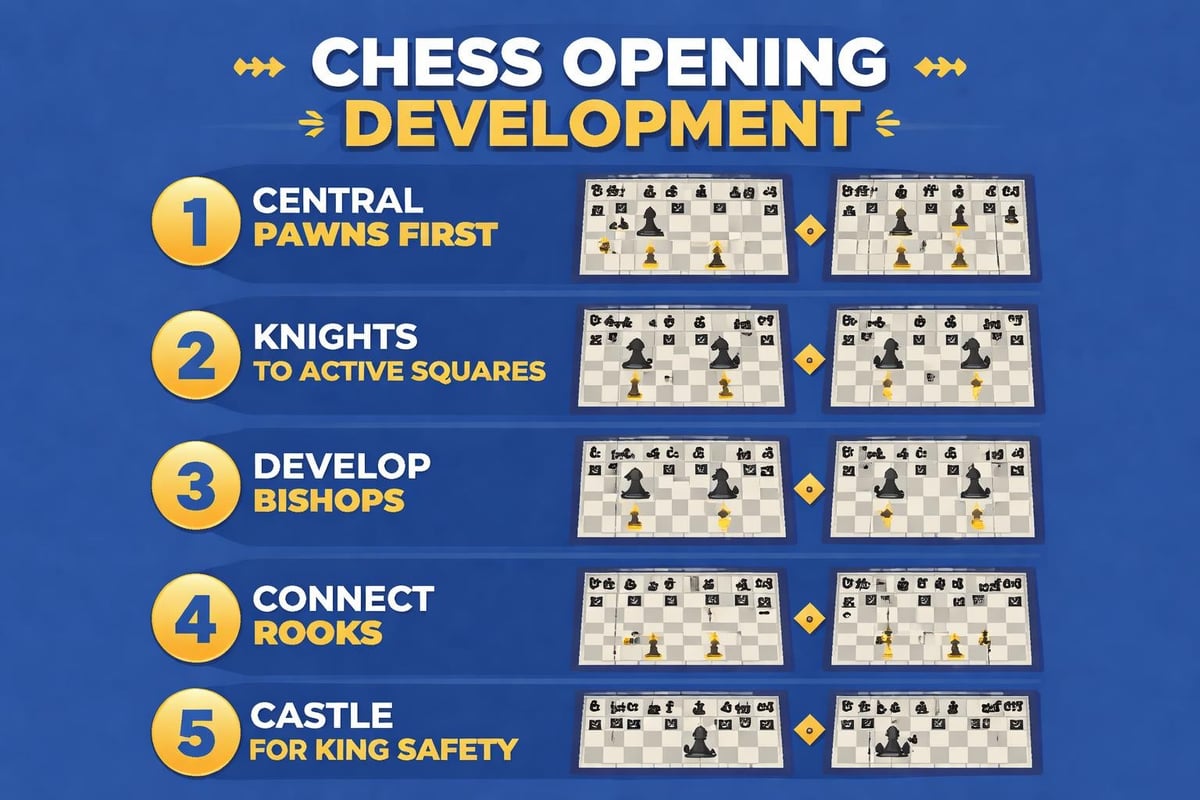
| Development Priority | Typical Moves | Why It Matters |
|---|---|---|
| Central pawns | e4, d4, e5, d5 | Control centre, open lines |
| Knights | Nf3, Nc3, Nf6, Nc6 | Flexible, effective from centre |
| Bishops | Bc4, Bg5, Bc5, Bf5 | Long-range influence |
| Castle | 0-0 or 0-0-0 | King safety |
| Queen | Later development | Avoid early attacks |
Keep Your King Safe
Castling early should be high on your priority list. An exposed king becomes a target that overshadows any other advantages you might have.
Building Your Opening Repertoire
Now comes the practical question: which openings should you actually learn? You can't study everything, and trying to do so will leave you knowing nothing well.
Choose Openings That Match Your Style
Are you aggressive or positional? Do you prefer sharp tactics or quiet manoeuvring? When you learn chess openings, pick systems that complement your natural playing style.
For aggressive players:
- King's Gambit as White
- Sicilian Defense as Black
- Open games with early confrontation
For positional players:
- The English Opening as White
- Caro-Kann Defense as Black
- Closed structures with long-term plans
For versatile players:
- Italian Game as White
- Various defences depending on opponent's approach
Start with One or Two Openings Per Colour
This might sound limiting, but depth beats breadth every time when you're learning. Master one opening as White and one as Black before expanding.
Your initial repertoire might look like:
- As White: e4 followed by Italian Game or Ruy Lopez
- As Black against e4: French or Caro-Kann Defense
- As Black against d4: King's Indian or Queen's Gambit Declined
Check out this comprehensive guide on most common chess openings to see what you'll face most frequently.
Effective Study Methods for Opening Theory
Knowing what to study is half the battle. Knowing how to study efficiently is the other half. Let's talk about methods that actually work.
Use the Right Learning Resources
Gone are the days when studying chess openings meant poring over dusty tomes in solitude. Modern players have incredible resources at their fingertips, but quality matters more than quantity.
Effective resource types:
- Streamlined cheat sheets for quick reference
- Video courses for visual learners
- Opening databases for exploring variations
- Practice puzzles focusing on opening tactics
- Annotated games by strong players
The Encyclopaedia of Chess Openings remains the standard classification system, but you don't need to study it exhaustively.
Practice Against Real Opposition
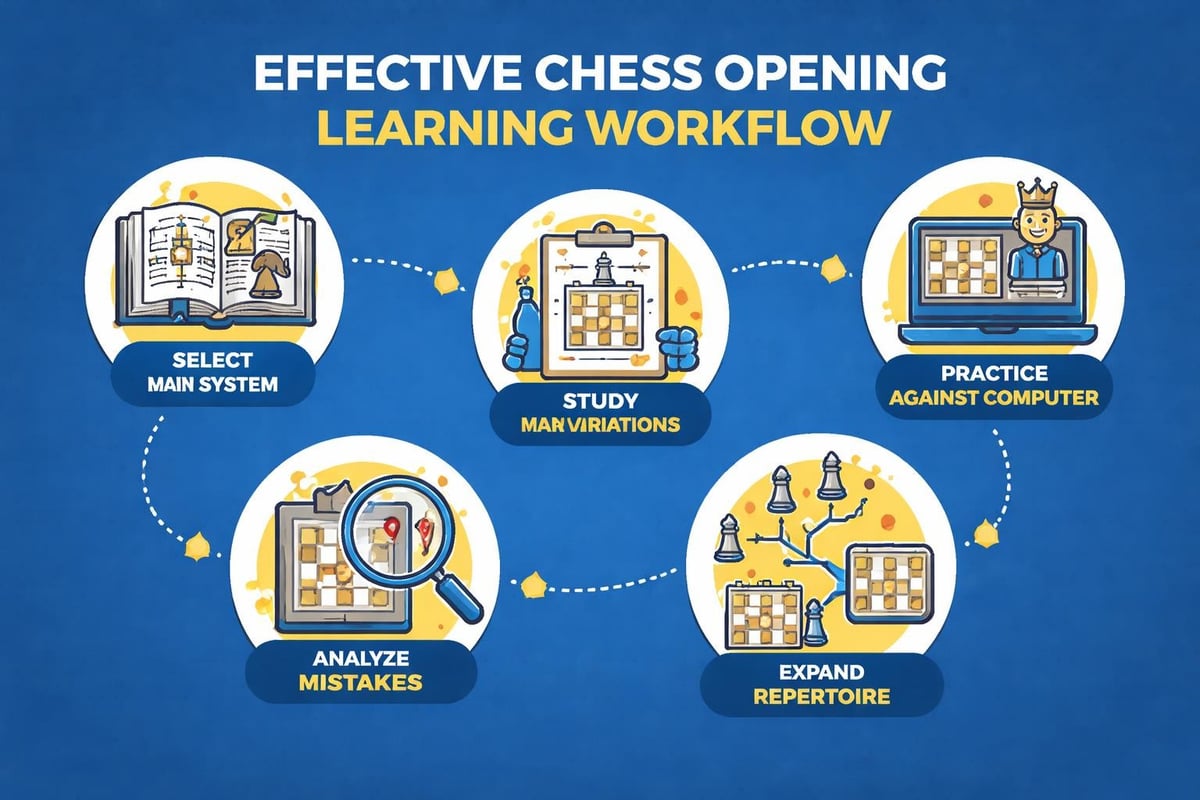
Theory means nothing until you test it over the board. When you learn chess openings, you must play them in actual games.
- Start with longer time controls to think through moves
- Review your games to spot where you deviated
- Note which opponent responses surprised you
- Study those specific variations more deeply
- Repeat the cycle with refined understanding
Create a Personalised Cheat Sheet
Don't just consume information; organise it in a way that works for you. Creating your own reference materials reinforces learning and gives you quick access during study.
| Section | What to Include | Purpose |
|---|---|---|
| Main line | Key moves with brief explanations | Quick reminder before games |
| Critical positions | Diagrams of important moments | Visual pattern recognition |
| Common mistakes | Pitfalls you've encountered | Avoid repeating errors |
| Transpositions | How your opening connects to others | Flexibility in move orders |
Understanding Rather Than Memorising
Here's the uncomfortable truth: you'll forget specific move orders. That's completely normal and not actually a problem if you understand the ideas behind those moves.
Focus on Pawn Structures
The pawn structure determines the character of the position. Pawns can't move backwards, making them the skeleton upon which your strategy hangs.
When you learn chess openings, pay special attention to:
- Which pawn breaks are desirable
- Where your pieces belong in each structure
- Which squares become weak or strong
- What endgames typically arise
For instance, the Caro-Kann Defense creates a solid but slightly cramped structure with potential for pawn breaks at c5 or e5.
Learn Typical Piece Placements
In the Italian Game, the bishop on c4 eyes the f7 square. In the French Defense, Black's light-squared bishop often struggles to find activity. These patterns repeat across countless games.
Instead of memorising "move 8 is Bg5," understand "in this structure, the bishop belongs on g5 to pressure the knight defending the centre."
Recognise Move Order Subtleties
Sometimes the sequence matters more than the final position. Move orders can avoid certain opponent options or maintain flexibility about your own plans.

Common Mistakes When Learning Openings
We all make mistakes, but knowing the common pitfalls helps you avoid them. Let me share the traps I see repeatedly.
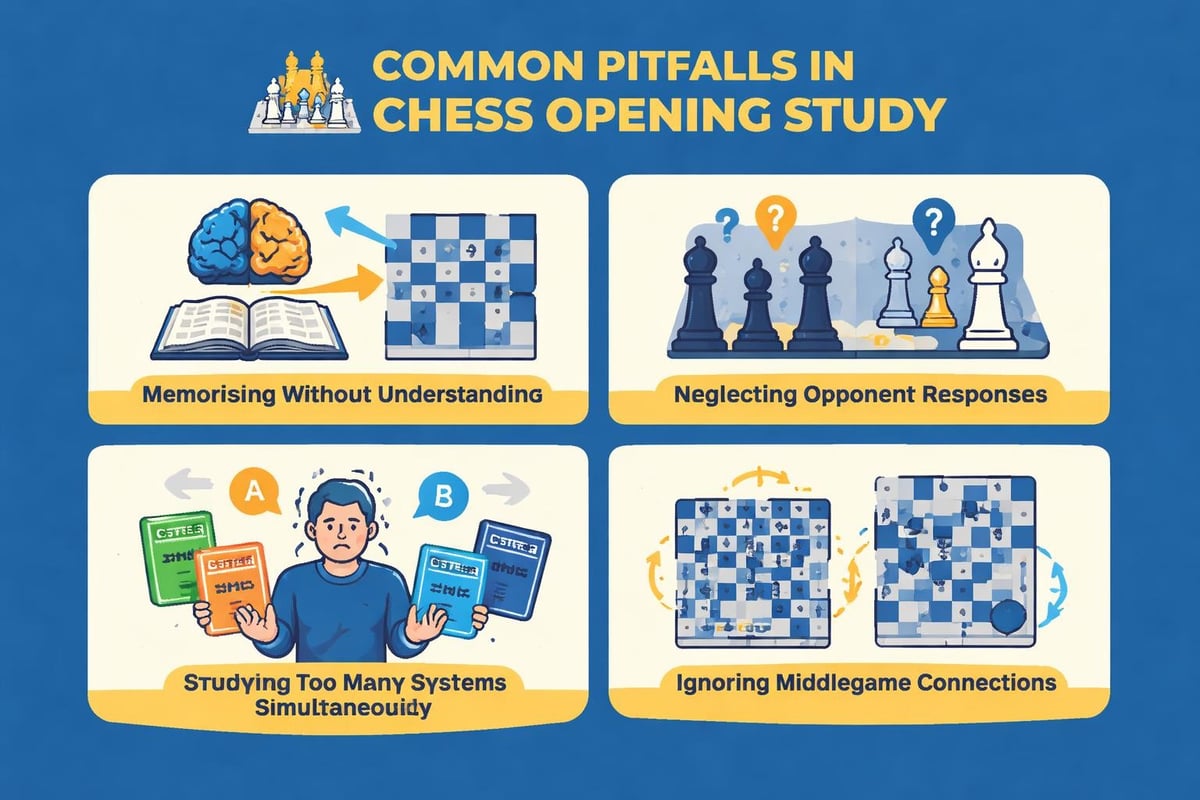
Studying Too Many Openings at Once
Your brain has limited capacity for pattern recognition. Spreading your attention across ten different openings means you'll know none of them well.
Better approach:
- Master one opening deeply
- Understand all major variations
- Learn typical middlegame plans
- Only then add a second opening
Neglecting Your Opponent's Options
You can't play chess alone. When you learn chess openings, you must study both sides of the position.
What happens if your opponent doesn't play the main line? Many players freeze because they've only studied one narrow path. Understanding your opponent's best defensive options makes you far more flexible.
Ignoring the Transition to Middlegame
Openings don't exist in isolation. The goal isn't reaching move 15; it's reaching a favourable middlegame position.
- Study games that continue past the opening
- Understand typical plans in resulting positions
- Practice the middlegames that arise
- Connect your opening knowledge to broader strategy
Advanced Opening Study Techniques
Once you've mastered the basics, you can refine your approach with more sophisticated methods.
Analyse Grandmaster Games
Watch how the world's best players handle your chosen openings. They don't always play the "main line," but their deviations are instructive.
When studying these games:
- Note the move where theory ends
- Observe how they handle the resulting position
- Look for creative ideas you hadn't considered
- Check if they exploit opponent's inaccuracies
Study Thematic Games Collections
Rather than random games, focus on collections organised by opening. This concentrated exposure builds pattern recognition faster than scattered study.
Use Computer Analysis Wisely
Engines are powerful tools but terrible teachers if misused. Don't just memorise what the computer suggests; understand why those moves work.
Productive engine use:
- Check if your planned moves have tactical flaws
- Explore forcing variations you might have missed
- Verify your positional assessment
- Find refutations to dubious opponent tries
Unproductive engine use:
- Memorising computer moves without understanding
- Trusting evaluations without context
- Discarding human plans for sterile computer lines
Maintaining and Updating Your Repertoire
Your opening repertoire isn't static. As you grow as a player, your openings should evolve with you.
Regular Review Sessions
Schedule time to revisit your openings, even those you think you know well. Memory fades, and refreshing key variations keeps them sharp.
Monthly review checklist:
- Play through main lines
- Test yourself on critical positions
- Update with any new ideas you've learned
- Remove variations that don't suit you
Stay Current with Theory
Opening theory evolves constantly as strong players discover new ideas. You don't need to follow every novelty, but significant developments in your repertoire matter.
Adapt Based on Your Results
Track which openings win games for you and which don't. If you consistently struggle with a particular variation, it might not suit your style regardless of its objective merit.
| Opening System | Win Rate | Common Issues | Action Needed |
|---|---|---|---|
| Italian Game | 65% | None | Keep refining |
| Caro-Kann | 45% | Struggle in closed positions | Study typical plans |
| Queen's Gambit | 55% | Forget move orders | Create better notes |
Building Confidence Through Preparation
The psychological advantage of solid opening preparation can't be overstated. Walking into a game knowing you're ready for whatever comes creates a completely different mindset.
Prepare for Specific Opponents
If you know who you're playing, research their favourite openings. This targeted preparation often yields enormous dividends.
- Check databases for their games
- Note their most frequent responses
- Prepare something they haven't faced
- Have a backup if they deviate
Develop Secondary Options
Even with a solid main repertoire, having alternative systems available adds valuable flexibility. Perhaps you've prepared the Italian Game but also know the Scotch Game for variety.
Trust Your Preparation
Once you've done the work to learn chess openings properly, believe in your knowledge. Second-guessing yourself at the board wastes time and creates opportunities for mistakes.
Balancing Opening Study with Overall Chess Improvement
Here's something crucial: openings are just one aspect of chess. Don't let them consume all your study time.
Balanced study plan:
- 30% opening study and review
- 30% tactics and calculation
- 20% endgame technique
- 20% strategy and planning
You might adjust these percentages based on your specific weaknesses, but opening study should never dominate entirely. A strong tactical foundation and solid endgame skills matter more than knowing theory to move 20.
Learning chess openings effectively transforms your game from uncertain and reactive to confident and purposeful. By focusing on understanding principles rather than memorising moves, choosing systems that match your style, and maintaining a balanced study approach, you'll build a repertoire that serves you well for years. Chess Cheat Sheets provides exactly the streamlined guides and resources you need to master openings efficiently, with comprehensive cheat sheets that distil complex theory into practical, actionable knowledge. Whether you're just starting to build your repertoire or looking to refine your existing openings, you'll find the tools to accelerate your improvement without overwhelming study demands.


