

What if I told you that genius isn't something you're born with, but something you can deliberately create? That's precisely what László Polgár set out to prove in one of the most fascinating educational experiments of the 20th century. This Hungarian educational psychologist didn't just theorize about raising geniuses-he actually did it, transforming his three daughters into chess champions who would shake up the male-dominated world of competitive chess. His story offers invaluable lessons for anyone looking to accelerate their learning journey, whether you're tackling chess openings or any other complex skill.
The Revolutionary Theory Behind the Polgár Experiment
Before László Polgár became famous for raising chess prodigies, he was already thinking deeply about education and human potential. Born in Hungary in 1946, he developed a controversial theory: that any healthy child could be turned into a genius with the right training, started early enough, and pursued intensively enough. Unlike most theorists who merely write papers, laszlo polgar decided to put his ideas to the ultimate test with his own children.
His approach wasn't based on hoping for natural talent to emerge. Instead, he believed that focused, deliberate practice in a specific domain, begun in early childhood, would produce exceptional results. When he married Klara, a teacher, they agreed to homeschool their future children and raise them to become experts in a chosen field.
Why Chess Became the Laboratory
You might wonder why laszlo polgar chose chess as the domain for his experiment. The decision was quite strategic:
- Objective measurement: Chess ratings provide clear, quantifiable progress markers
- International recognition: Success in chess would be undeniable and globally acknowledged
- Early specialization: Chess allows young children to compete meaningfully against adults
- Mental development: The game develops analytical thinking, pattern recognition, and strategic planning
Chess also had the practical advantage of being accessible. You didn't need expensive equipment, special facilities, or even physical advantages. The Polgár sisters' training approach demonstrated how systematic practice could overcome traditional barriers in the game.
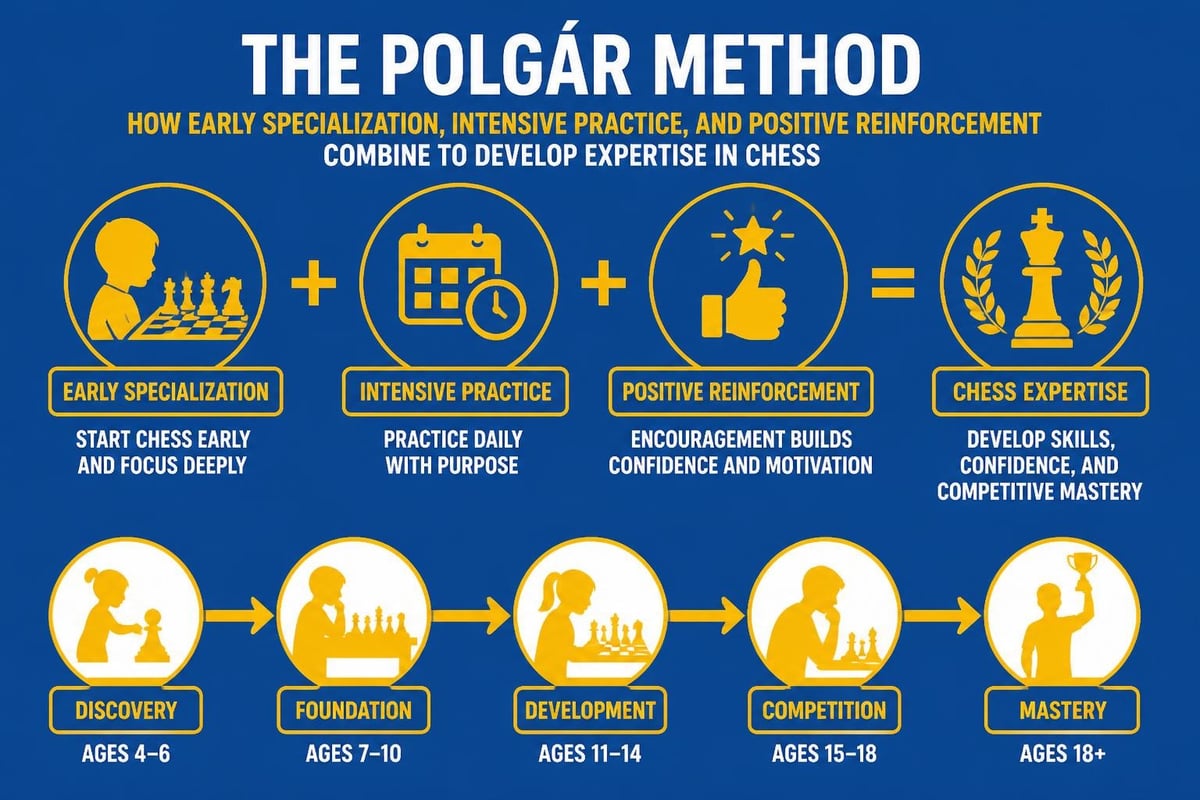
The Training Methodology That Changed Chess Forever
The methods László Polgár employed weren't about pushing children relentlessly or creating pressure-cooker environments. Instead, they focused on making chess enjoyable whilst maintaining rigorous standards. He created a highly structured learning environment at home, where chess wasn't just a game but a way of life.
Here's how his daily training routine typically looked:
- Morning sessions: Tactical puzzles and opening study (2-3 hours)
- Afternoon practice: Playing against stronger opponents or analyzing master games
- Evening review: Discussing games, mistakes, and strategic concepts
- Weekend tournaments: Regular competitive experience against diverse opponents
The key wasn't just the hours-though his daughters practiced chess for 5-6 hours daily-but the quality and variety of practice. Much like how modern players use chess puzzles to sharpen their tactical vision, laszlo polgar incorporated diverse training methods to prevent monotony and maintain engagement.
The Psychological Framework
What set his approach apart was the psychological foundation. He maintained that:
- Positive reinforcement was more effective than criticism
- Early successes built confidence and motivated further effort
- Competitive experience should be gradual and age-appropriate
- Parental support needed to be unconditional beyond chess results
This meant celebrating small victories, analyzing losses as learning opportunities rather than failures, and ensuring his daughters genuinely enjoyed the process. According to educational psychology principles he championed, intrinsic motivation matters far more than external pressure.

The Remarkable Results: Three Daughters, Three Champions
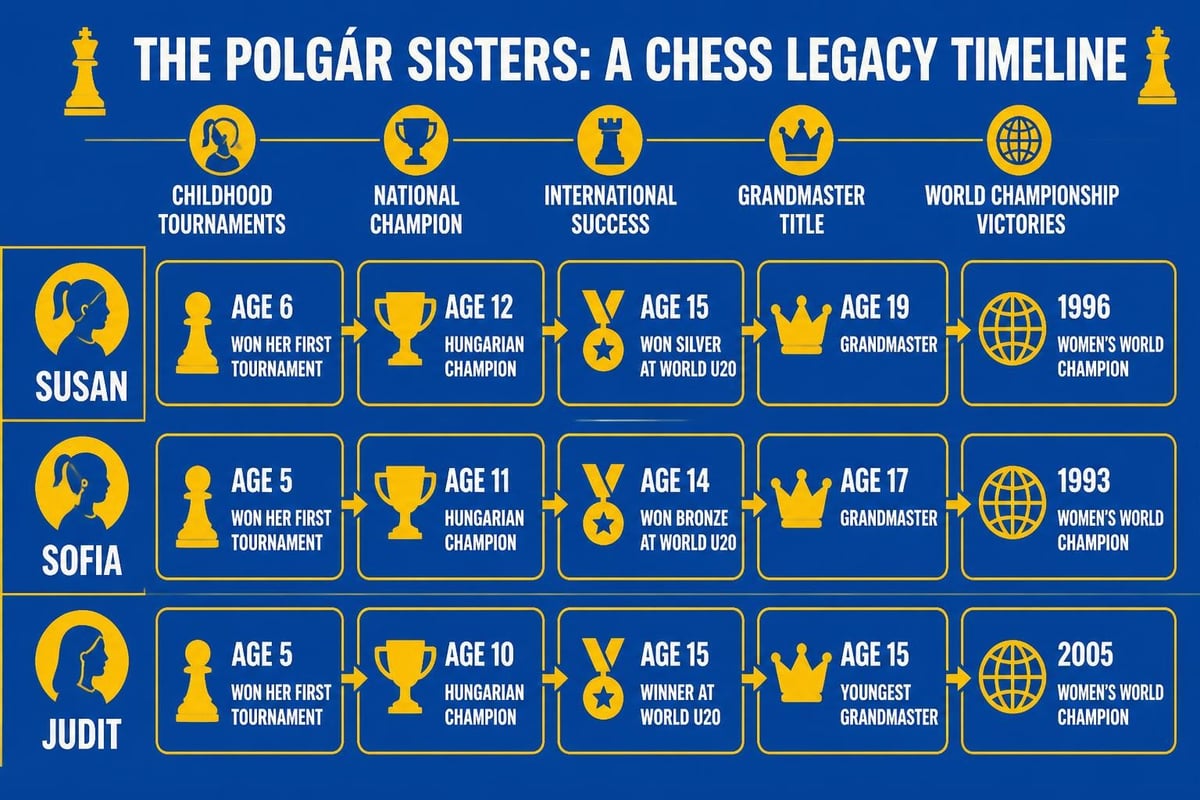
The proof, as they say, is in the pudding. László Polgár's experiment produced not one but three exceptional chess players, each achieving remarkable success:
| Daughter | Peak Rating | Notable Achievement | Career Highlight |
|---|---|---|---|
| Susan | 2577 | Women's World Champion (1996) | First woman to earn Grandmaster title through tournament play |
| Sofia | 2505 | Women's Grandmaster | Famous "Sac, Sac, Mate" game at Rome 1989 |
| Judit | 2735 | Ranked #8 in world (peak) | Strongest female player in history, defeated 11 world champions |
Judit's achievements are particularly stunning. She never competed in women-only events, preferring to prove herself in open competition against the world's best male players. Her peak rating of 2735 made her the only woman to break into the top 10 players globally.
Susan Polgár now runs educational programs based on her father's principles, demonstrating the lasting impact of his methods. She's written extensively about chess instruction, including comprehensive guides that reflect the systematic training she received.
Lessons for Modern Chess Students
What can today's chess improvers learn from laszlo polgar's methods? Quite a lot, actually, even if you're not starting at age four or practicing six hours daily.
Structure Your Practice Deliberately
Random practice won't cut it. You need a systematic approach to improvement. Just as the Polgár sisters had structured daily routines, you should create a practice schedule that covers:
- Opening preparation: Study a limited repertoire deeply rather than knowing many openings superficially
- Tactical training: Daily puzzle solving to sharpen calculation skills
- Endgame study: Regular work on fundamental endgame positions
- Game analysis: Review your games to identify recurring mistakes
This structured approach mirrors how comprehensive chess resources break down complex concepts into manageable, systematic study materials. When you're tackling the most common chess openings, having a clear learning path makes all the difference.
Focus on Quality Over Quantity
László Polgár didn't just have his daughters play endless blitz games. He emphasized deep study of master games, careful analysis of positions, and understanding the reasoning behind moves. This principle remains crucial in 2026.
When you're studying an opening system, don't just memorize moves. Understand:
- The strategic ideas behind the opening
- Typical middlegame plans that arise
- Common tactical patterns
- How stronger players have handled critical positions
This deeper engagement produces better retention and more flexible understanding. Whether you're exploring chess openings for white or the best openings for black, focus on comprehension rather than rote learning.
Embrace Competition as a Learning Tool
The Polgár sisters competed regularly from young ages, gaining valuable experience and learning to handle pressure. You should seek out competitive opportunities appropriate to your level:
- Join a local chess club for regular over-the-board games
- Participate in online tournaments to test your preparation
- Play against stronger opponents to identify weaknesses
- Review tournament games more carefully than casual games
Each competitive game provides data about what's working in your preparation and what needs adjustment. Think of tournaments as tests that reveal which parts of your study need more attention.
The Controversy and Criticism
Not everyone applauded László Polgár's approach. Critics raised several concerns about his experiment:
Was it ethical? Some questioned whether deciding a child's life path before birth was appropriate. Did his daughters truly choose chess, or was the choice made for them?
What about childhood? Others worried that intensive chess training robbed the sisters of normal childhood experiences, friendships, and varied interests.
Survivorship bias? Skeptics pointed out that we only know about the successful cases. What about families who tried similar approaches and failed?
Generalizability? Could these results be replicated, or did the Polgár sisters possess exceptional natural abilities that would have emerged regardless?
László Polgár consistently maintained that his daughters were happy, well-adjusted, and genuinely loved chess. They traveled extensively, learned multiple languages, and developed social skills through chess circles worldwide. The sisters themselves have largely defended their upbringing whilst acknowledging its uniqueness.
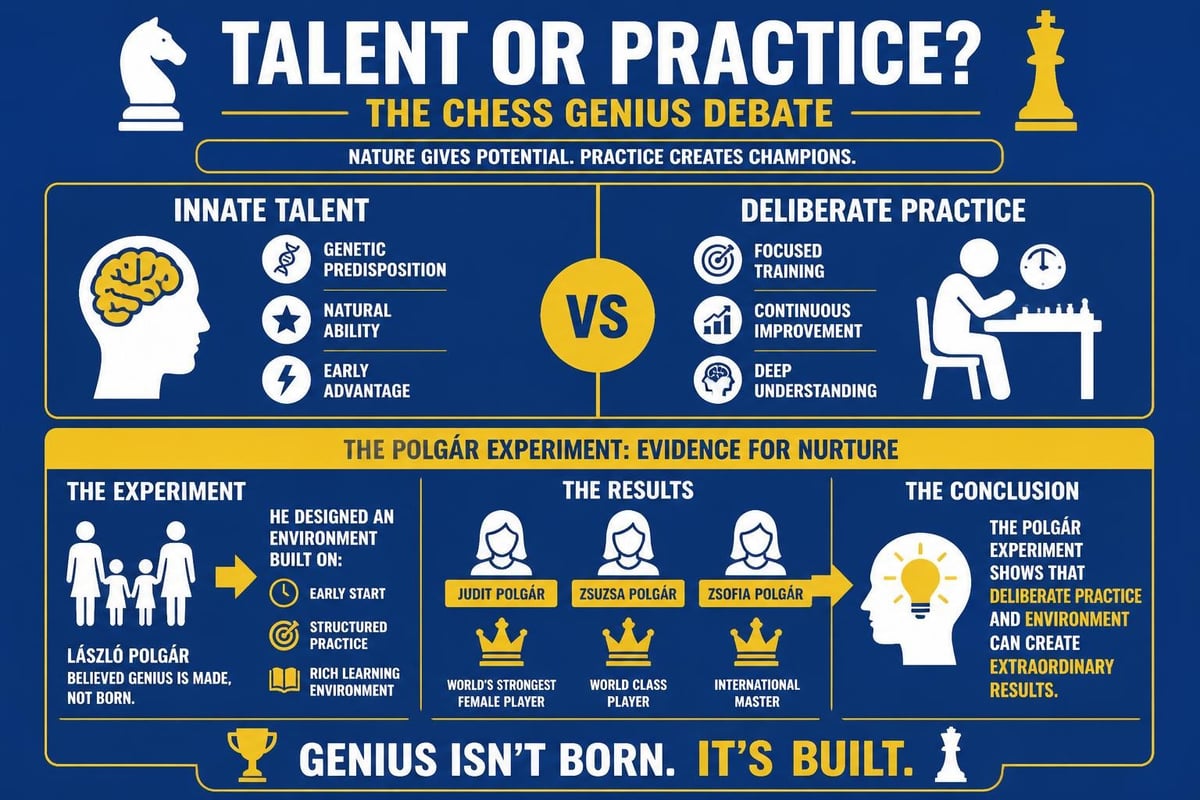
Applying Polgár Principles Without the Intensity
You don't need to quit your job, homeschool your children, or practice six hours daily to benefit from laszlo polgar's insights. Here are practical adaptations for typical chess improvers in 2026:
Create a Chess-Rich Environment
- Keep a chess set visible and accessible in your living space
- Follow top tournaments and discuss interesting games with chess friends
- Subscribe to chess content that keeps the game top-of-mind
- Join online communities where chess discussion is regular
Establish Consistent Practice Habits
Rather than sporadic marathon sessions, aim for consistent daily practice:
| Time Available | Recommended Activities |
|---|---|
| 15 minutes | Tactical puzzles, quick opening review |
| 30 minutes | One rapid game with analysis, or endgame study |
| 60 minutes | Slow game with thorough analysis, or opening deep-dive |
| 2+ hours | Tournament play, multiple study sessions, video lessons |
Specialize Strategically
Laszlo polgar believed in deep specialization. For chess students, this means building a focused opening repertoire rather than dabbling in everything. Choose openings that suit your style and learn them thoroughly.
If you're developing your repertoire, resources like opening guides help you specialize efficiently without getting overwhelmed by options. Similarly, studying what openings successful players like Bobby Fischer preferred can inform your own repertoire choices.
Track Progress Objectively
The beauty of chess ratings is that they provide objective feedback. Monitor your progress through:
- Rating graphs: Track your rating over time across different time controls
- Opening statistics: Note which openings produce your best results
- Mistake patterns: Categorize errors (tactical oversights, time pressure, endgame technique)
- Study logs: Record what you practice and test whether it translates to games
This data-driven approach echoes laszlo polgar's emphasis on measurable results and continuous refinement.
The Lasting Legacy in Chess Education
The impact of László Polgár's experiment extends far beyond his own family. His work influenced how we think about chess education and talent development generally. Modern chess academies incorporate elements of his methodology:
- Early introduction to competitive chess
- Structured curricula that build systematically
- Emphasis on making chess enjoyable to sustain long-term engagement
- Regular assessment and adjustment of training methods
Various chess training methodologies draw inspiration from the Polgár approach, adapting his intensive methods for group settings and varied learning contexts.
His daughters now contribute to chess education themselves. Susan runs chess programs emphasizing critical thinking development. Judit established a foundation promoting chess in schools. They've taken their father's methods and evolved them for broader application.
What the Experiment Tells Us About Learning
Beyond chess specifically, laszlo polgar demonstrated several universal learning principles:
- Early start advantages: Beginning young allows more total practice hours and neuroplasticity benefits
- Deliberate practice matters: Random exposure produces far weaker results than structured, focused training
- Positive environment: Supportive, encouraging atmospheres enable better learning than high-pressure ones
- Expertise is domain-specific: Excellence in chess doesn't automatically transfer to other fields
These insights apply whether you're studying endgame techniques or any other complex skill. The path to mastery follows similar patterns across domains.
Modern Perspectives on the Polgár Method
In 2026, with decades of hindsight, how do chess educators view László Polgár's contribution? The consensus acknowledges both the remarkable success and the limitations of directly replicating his approach.
Most modern chess education programs borrow selectively from his methods:
- Systematic progression through concepts of increasing complexity
- Regular competitive experience as essential for development
- Positive reinforcement and celebration of progress
- Deep rather than broad study of positions and concepts
However, contemporary approaches also incorporate elements Polgár didn't emphasize:
- Technology integration: Computer analysis, online training platforms, and chess engines
- Peer learning: Study groups and collaborative analysis
- Cross-training: Physical fitness, psychology, and other performance factors
- Flexibility: Adapting to individual learning styles and preferences
The detailed experiment analysis reveals both the revolutionary aspects of his work and areas where modern methods have evolved beyond his original framework.
Practical Takeaways for Your Chess Improvement
So how do you actually apply these lessons to your chess study today? Here's a concrete action plan inspired by laszlo polgar's principles:
This week:
- Choose one opening to study deeply rather than several superficially
- Solve 10-15 tactical puzzles daily at a consistent time
- Play at least two slow games with thorough post-game analysis
- Review one master game in your chosen opening
This month:
- Establish a regular practice schedule you can maintain consistently
- Enter one tournament or serious competitive event
- Study one endgame type thoroughly until you understand the key principles
- Track your rating and analyze what types of positions cause you trouble
This quarter:
- Build a complete opening repertoire for White or Black based on related systems
- Complete a structured endgame course or book
- Analyze all your tournament games and identify three recurring weaknesses
- Adjust your study focus based on competitive results
This systematic approach mirrors how laszlo polgar structured his daughters' development whilst remaining realistic for players with other commitments. Whether you're using opening cheat sheets or specialized puzzle collections, consistency and structure matter more than total hours invested.
László Polgár proved that genius can be cultivated through systematic training, early specialization, and positive reinforcement-principles that remain relevant for chess improvers in 2026. Whether you're working on your opening repertoire or sharpening your tactical vision, applying his emphasis on structured, deliberate practice will accelerate your progress. Chess Cheat Sheets provides the streamlined guides and resources you need to implement these principles efficiently, helping you master openings and improve your game without overwhelming study sessions.


