

When you push your king's pawn two squares forward on your first move, you're joining a tradition that spans centuries. The move 1.e4 isn't just popular because it looks aggressive-it's the foundation of some of chess's most dynamic and exciting opening systems. Whether you're picking up your first chess opening guide or refining your existing repertoire, understanding e4 openings will transform how you approach the game. This guide explores the strategic ideas, major variations, and practical tips you need to build a solid foundation with White's most ambitious first move.
Why E4 Openings Dominate Modern Chess
The King's Pawn Game has been analysed for hundreds of years, yet it remains the most popular choice at every level. But why does this single pawn move generate so much interest?
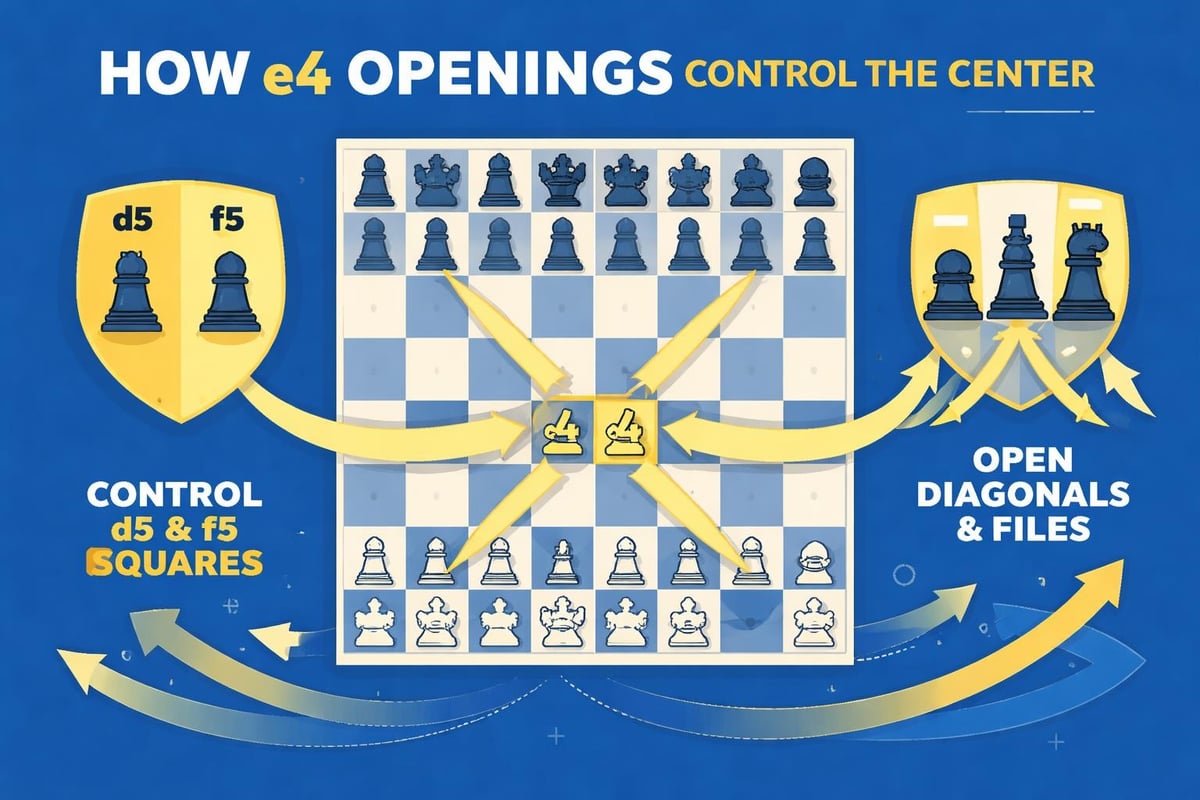
Moving your e-pawn two squares forward immediately stakes your claim in the centre. You're controlling both the d5 and f5 squares whilst simultaneously opening lines for your light-squared bishop and queen. This creates tactical opportunities from the very first move.
The strategic benefits of e4 openings include:
- Direct central control with tempo
- Rapid piece development possibilities
- Open lines for both bishops
- Early initiative and attacking chances
- Clear tactical patterns to study
Beyond the immediate tactical advantages, e4 openings teach fundamental chess principles better than any other first move. You learn about piece coordination, central control, and the balance between development and aggression. These lessons carry through to every phase of the game.
The Psychological Edge
There's something to be said for choosing an opening that signals your intentions clearly. When you play 1.e4, you're telling your opponent that you're ready for a fight. This psychological dimension shouldn't be underestimated, especially in faster time controls where confidence matters enormously.
Breaking Down Black's Main Responses
After 1.e4, Black faces a crucial decision that shapes the entire game. Each response leads to fundamentally different positions with unique strategic themes. Let's examine the most common chess openings that arise from this position.
The Symmetric Response: 1...e5
When Black mirrors your pawn move with 1...e5, you enter the realm of "Open Games." This classical approach leads to some of chess's oldest and most studied positions.
| Opening Name | Key Move | Strategic Theme | Difficulty Level |
|---|---|---|---|
| Italian Game | 3.Bc4 | Central pressure, quick development | Beginner-friendly |
| Ruy López | 3.Bb5 | Long-term pressure, positional play | Intermediate |
| Scotch Game | 3.d4 | Direct confrontation, tactical | Intermediate |
| King's Gambit | 2.f4 | Aggressive sacrifice, rapid attack | Advanced |
The Italian Game deserves special attention because it perfectly embodies the principles of e4 openings. You develop your bishop to its most active square, maintain pressure on f7, and keep your options open for castling and central breaks.
The Asymmetric Challenge: 1...c5
The Sicilian Defence immediately fights for central control from a different angle. Rather than matching you move for move, Black stakes a claim on the d4 square and prepares counterplay on the queenside.
This leads to sharp, unbalanced positions where both sides have chances for the initiative. The Sicilian Defense contains dozens of variations, each with its own character:
- Open Sicilian (2.Nf3 and 3.d4): The main lines where White accepts sharp play
- Closed Sicilian (2.Nc3 and 3.g3): A positional approach avoiding theory
- Alapin Variation (2.c3): A solid system that simplifies the position
Solid Defensive Systems
Not everyone wants tactical complications. Several defensive setups allow Black to establish a solid position without excessive risk.
The Caro-Kann Defense (1...c6) and French Defence (1...e6) both prepare ...d5, challenging your central pawn directly. These defences typically lead to closed positions where strategic understanding matters more than tactical calculation.
Meanwhile, the Scandinavian Defense (1...d5) challenges your e4 pawn immediately, though this comes at the cost of allowing White easy development.

Building Your E4 Opening Repertoire
You can't possibly learn every variation that stems from 1.e4. Instead, you need a practical repertoire that covers Black's main responses whilst fitting your playing style. How do you build one that actually works over the board?
Start With One Response Against Each Defence
Pick a single system against each of Black's main defences. This focused approach prevents you from drowning in theory whilst ensuring you have a playable position in every game.
Recommended starting repertoire:
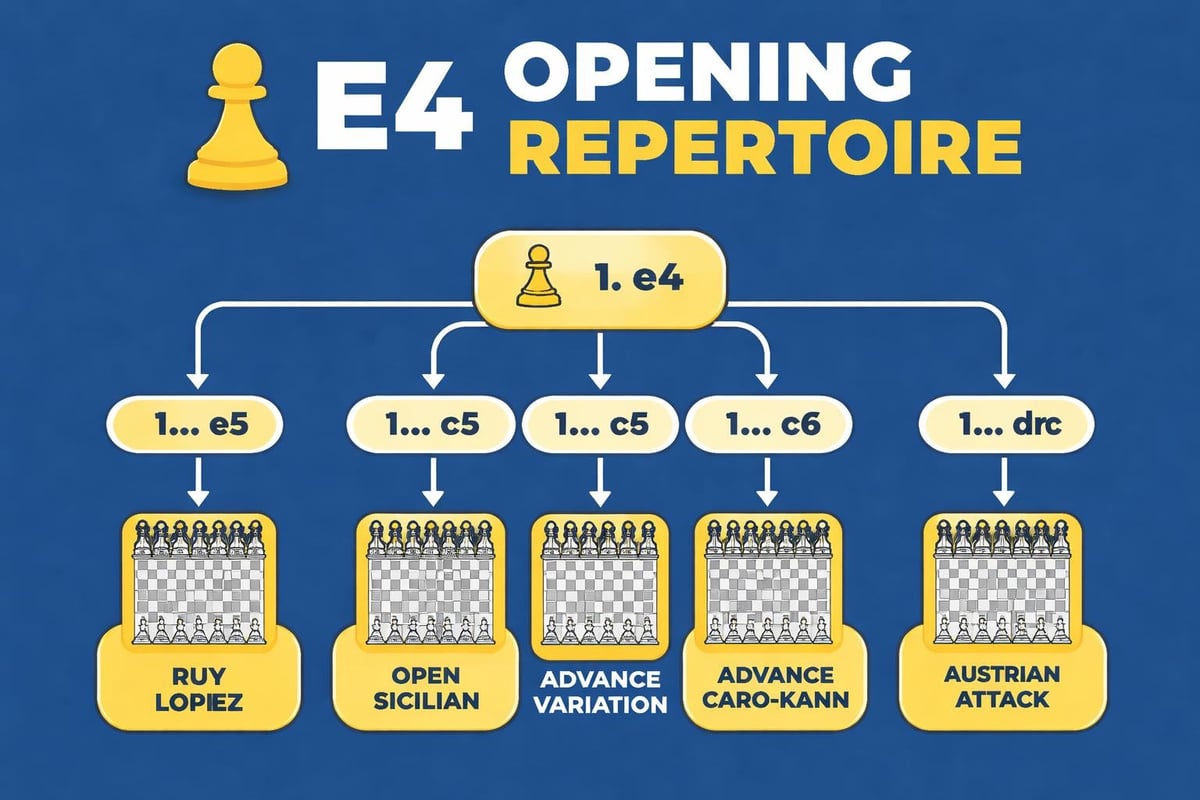
- Against 1...e5: Italian Game or Ruy López
- Against 1...c5: Alapin Variation or Open Sicilian
- Against 1...e6: Advance Variation or Tarrasch
- Against 1...c6: Advance Variation or Exchange
- Against irregular defences: Classical development principles
The beauty of e4 openings lies in their interconnected ideas. Once you understand central control and rapid development in one variation, these concepts transfer naturally to others.
Study Complete Games, Not Just Opening Moves
Opening theory only makes sense when you see where it leads. Watch how grandmasters transition from the opening into the middlegame, and you'll start recognising the deeper strategic patterns.
Tactical Patterns in E4 Openings
Every opening system contains recurring tactical motifs. When you recognise these patterns, you spot opportunities your opponents miss. Let's explore the tactics that appear repeatedly in e4 openings.
Scholar's Mate and Its Cousins
The infamous four-move checkmate (1.e4 e5 2.Bc4 Nc6 3.Qh5 Nf6 4.Qxf7#) rarely works against experienced players, but the underlying idea-attacking f7-appears throughout e4 openings. This weakness shapes White's entire strategy in many variations.
In the Italian Game, your bishop on c4 and knight on f3 both eye this square. Even when you can't deliver immediate checkmate, the pressure forces Black to make defensive concessions.
Central Breaks and Pawn Tactics
The move d4 appears again and again as a central break for White. Whether you're playing the Scotch Game, attacking in the Ruy López, or opening lines in the King's Gambit, this pawn thrust creates immediate threats.
Common tactical themes include:
- Discovered attacks when bishops open diagonals
- Knight forks exploiting centralised pieces
- Pin tactics along the e-file after castling
- Sacrifices on e5 or f7 for rapid development
Piece Coordination Tactics
E4 openings excel at creating harmony between your pieces. Your bishops sweep along open diagonals, knights jump to central outposts, and your queen and rooks coordinate along files.
Watch for positions where your pieces can double up their pressure. When your bishop on c4 and queen on the same diagonal both attack f7, you're creating multiple threats simultaneously. Your opponent must address all of them or face tactical punishment.
Common Mistakes in E4 Openings
Even experienced players fall into predictable traps when playing e4 openings. Recognising these mistakes helps you avoid them whilst exploiting them when your opponents err.
Developing Too Slowly
The biggest advantage of e4 openings is rapid development, yet many players squander this by moving the same piece twice or bringing out their queen prematurely. Every move in the opening should contribute to development or central control.
Consider this common mistake: 1.e4 e5 2.Nf3 Nc6 3.Bc4 Bc5 4.Ng5? This knight move looks aggressive because it attacks f7, but it violates the principle of developing pieces once before moving them again. Black simply plays 4...Nh6, defending the weakness whilst continuing development.
Ignoring King Safety
When positions open up quickly, castling becomes crucial. Delaying this defensive measure can prove fatal, especially in tactical variations like the Open Sicilian or King's Gambit.
| Mistake | Why It Fails | Better Alternative |
|---|---|---|
| Delaying castling | King becomes target in centre | Castle by move 8-10 |
| Weakening kingside pawns early | Creates permanent weaknesses | Keep pawn structure solid |
| Bringing queen out early | Becomes target for attacks | Develop minor pieces first |
| Moving pawns instead of pieces | Slows development | Develop pieces to active squares |
Playing Without a Plan
Understanding chess opening principles matters more than memorising specific moves. When you know what you're trying to achieve-central control, rapid development, king safety-you can navigate unfamiliar positions with confidence.
Strategic Themes Across E4 Systems
Whilst each e4 opening has its unique characteristics, certain strategic themes appear consistently. Mastering these ideas elevates your play across your entire repertoire.
The Battle for Central Squares
Control of d4 and d5 determines the character of most e4 openings. When you maintain a pawn on e4 supported by a pawn on d3 or d4, you control vital central territory and restrict Black's pieces.
Black's main defensive systems (French, Caro-Kann, Sicilian) all challenge this central dominance from different angles. Your task is maintaining central influence whilst developing your pieces harmoniously.
Piece Placement Principles
Certain squares naturally suit specific pieces in e4 openings:
- Bishops: c4 or b5 for kingside pressure, often fianchettoed on g2 in closed variations
- Knights: f3 and c3 initially, then advancing to d5 or e5 in many variations
- Queen: Usually developed later to d2, e2, or sometimes d1-h5 in attacking setups
- Rooks: Typically on e1 and d1, supporting central files
Understanding Pawn Structures
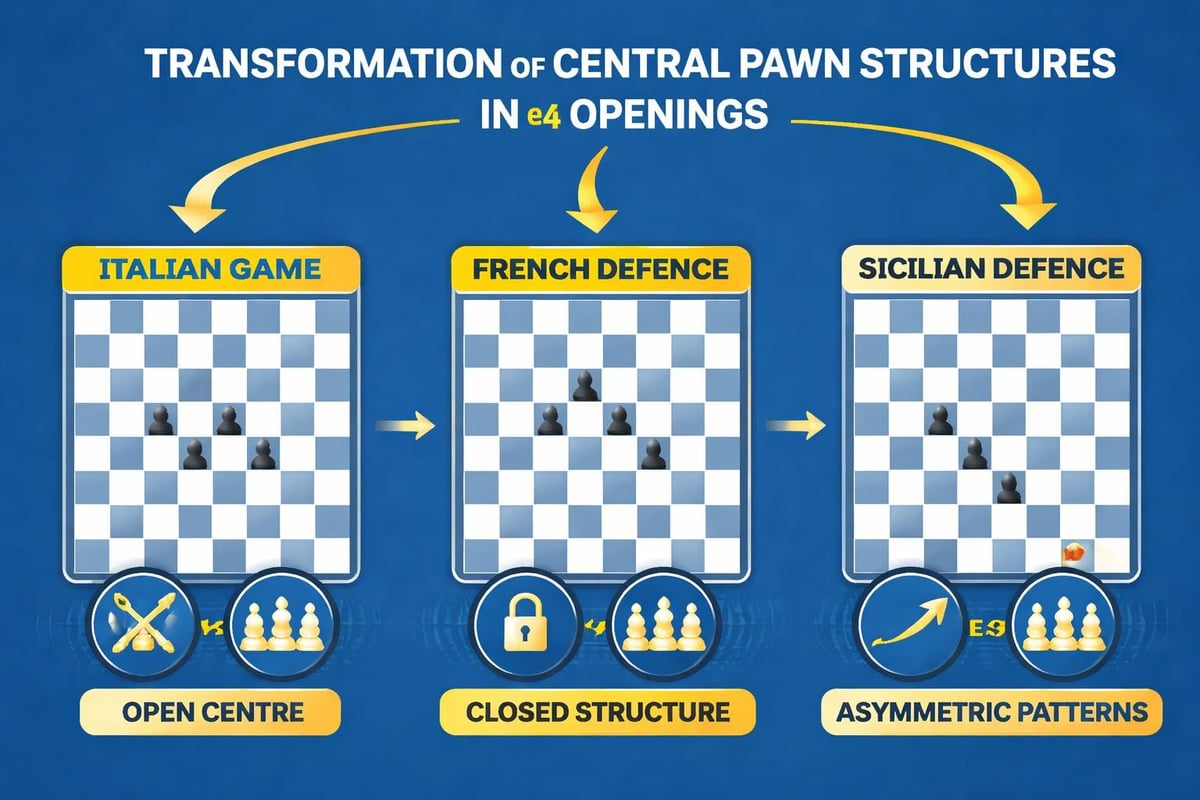
The pawn structure tells you where to attack and defend. In e4 openings, you'll frequently encounter these formations:
Open Centre: Typical after exchanges in the Italian or Scotch Game. Both sides develop freely and tactics dominate.
Closed Centre: Common in the French Defence after 1.e4 e6 2.d4 d5 3.e5. Play shifts to the wings with slower, more strategic plans.
Asymmetric Centre: The hallmark of Sicilian structures where White has a central majority whilst Black enjoys queenside expansion.
Transitioning to the Middlegame
Your opening preparation doesn't end when you complete development. The real test comes in converting your opening advantage into middlegame pressure. How do you make this transition smoothly?
Identifying Your Strategic Goals
Around move 10-15, stop and assess the position. What did your opening achieve? Where are the weaknesses in Black's position? What's your natural plan based on the pawn structure?
In Ruy López positions, you might aim for a queenside expansion with a4-a5. In the Italian Game, you could prepare a central break with d4. Against the Sicilian, you're often launching a kingside attack whilst Black counters on the opposite wing.
Converting Advantages
The advantage you gain from e4 openings usually takes one of these forms:
- Development advantage: More active pieces ready to create threats
- Space advantage: Control of key squares restricting opponent's options
- Tactical advantage: Concrete threats against weaknesses
- Structural advantage: Better pawn formation for the endgame
Each type of advantage requires different conversion techniques. Development and tactical advantages must be exploited quickly before they evaporate. Space and structural advantages can be nursed throughout the game.
Practical Training Methods
Knowing theory is one thing; applying it successfully in your games requires deliberate practice. What training methods actually improve your e4 opening play?
Study Master Games
Watch how strong players handle the opening systems you're learning. Focus on games from the past five years to ensure the theory remains current. Notice not just the moves, but the plans and ideas behind them.
You can explore various chess resources to find annotated games that explain the strategic ideas clearly rather than just listing moves.
Solve Opening Puzzles
Tactical puzzles from your chosen e4 openings reinforce pattern recognition. When you solve a pin tactic from the Italian Game position, you'll spot similar opportunities in your games.
Play Training Games
Nothing beats over-the-board experience. Play rapid or classical games specifically to practice your e4 openings, even if you occasionally lose. Each game teaches you something theory books cannot.
Effective practice routine:
- Choose one e4 opening to focus on this week
- Study 2-3 master games in that opening
- Solve 10-15 tactics from typical positions
- Play 3-5 games using that opening
- Analyse your games, especially deviations from theory
Advanced Concepts in E4 Theory
Once you've mastered the fundamentals, you can explore deeper strategic concepts that separate club players from experts. These ideas appear across multiple e4 openings and represent sophisticated understanding.
The Concept of Prophylaxis
Sometimes the strongest move prevents your opponent's plans rather than executing your own. In the Ruy López, White often plays h3 not to attack anything, but to prevent ...Bg4 pinning the knight.
This prophylactic thinking transforms your e4 openings from mechanical move-making into strategic chess. You anticipate threats and neutralise them before they materialise.
Dynamic vs Static Advantages
Understanding when to maintain tension versus when to release it through exchanges requires deep positional sense. In many e4 openings, you face the choice between maintaining your central pawn or exchanging it for rapid development.
The King's Gambit exemplifies this choice-sacrificing the f-pawn for dynamic piece play. The Ruy López shows the opposite approach, maintaining central tension for dozens of moves whilst manoeuvring for optimal piece placement.
Modern Preparation Techniques
In 2026, opening preparation has evolved beyond memorising lines. Top players use computer analysis to understand positions deeply, focusing on typical plans rather than specific move orders.
This approach works brilliantly for club players too. Instead of memorising 20 moves of the Najdorf Sicilian, understand the strategic ideas behind White's typical plans. When your opponent deviates from your preparation, you'll still know what to do.
Choosing Between E4 and Other First Moves
Should you commit exclusively to e4 openings, or maintain flexibility with other first moves like 1.d4 or 1.Nf3? This question depends entirely on your chess goals and personality.
E4 openings reward tactical awareness, calculation ability, and comfort in sharp positions. If you enjoy attacking chess and thrive in complex tactical situations, building a comprehensive e4 repertoire makes sense.
However, having 1.d4 as a backup provides useful flexibility. When you need a solid point against a strong opponent, switching to queen's pawn openings can reduce the opponent's preparation advantage.
For most improving players, specialising in e4 openings whilst understanding basic d4 systems provides the optimal balance. You develop expertise in one opening move whilst maintaining enough versatility to adjust when needed.
You'll find that exploring various approaches to chess improvement, including working with the best online chess coaches, can help you determine which opening systems suit your style best.
Keeping Your E4 Repertoire Fresh
Opening theory never stands still. New ideas emerge constantly, and lines you studied last year might be refuted today. How do you keep your repertoire current without spending excessive time on theory?
Follow Recent High-Level Games
Major tournaments produce innovative ideas weekly. Set aside 30 minutes each week to review recent games in your openings. Websites like Lichess provide free databases where you can explore the latest trends in e4 opening theory.
Identify Theoretical Hotspots
Some positions in your e4 openings receive constant theoretical attention whilst others remain stable for decades. Focus your updating efforts on the critical, evolving positions rather than trying to stay current across every variation.
Test New Ideas in Your Games
When you discover an interesting novelty or improvement, test it in your games rather than just admiring it. Practical testing reveals whether you actually understand the idea and can execute it under game conditions.
Mastering e4 openings takes time, but the journey itself makes you a stronger chess player. You'll develop tactical vision, positional understanding, and the confidence to handle sharp positions. Whether you're just starting to learn to play chess or refining your existing skills, having reliable opening knowledge gives you a foundation for every game. Chess Cheat Sheets provides streamlined guides and comprehensive resources that help you master these openings without drowning in endless variations, giving you the confidence to play your best chess from move one.


