

You've got a tournament coming up, and that familiar mix of excitement and nerves is starting to build. Whether you're facing your first competitive match or you're a seasoned club player looking to level up, how you prepare can make the difference between brilliant victories and frustrating blunders. Chess prep isn't just about memorising opening lines until your eyes glaze over. It's about building a complete system that gets you mentally sharp, tactically ready, and confident when you sit down at the board.

Understanding What Chess Prep Actually Means
Let's clear something up straight away: effective chess prep looks different for everyone. A beginner preparing for their first club tournament will have vastly different needs compared to an intermediate player gunning for a rating breakthrough.
At its core, chess prep encompasses everything you do to improve your readiness before a game or tournament. This includes studying openings, solving tactical puzzles, analysing your previous games, and even managing your mental state. The key is finding what works for you without burning out.
The Three Pillars of Effective Preparation
Think of your chess prep as resting on three essential supports:
- Technical preparation: Your opening repertoire, tactical skills, and endgame knowledge
- Mental preparation: Your ability to stay calm, focused, and resilient under pressure
- Physical preparation: Sleep, nutrition, and overall wellbeing that affects board performance
Many players obsess over the technical side whilst completely ignoring the mental and physical aspects. That's like training for a marathon by only reading about running. You need balance across all three areas to perform at your best.
Building Your Opening Repertoire Efficiently
Here's where many chess players go wrong: they try to learn every opening variation under the sun. You don't need to know twenty different systems. You need a solid, reliable repertoire that you understand deeply.
Start with one or two openings for White and two or three defences for Black. That's it. Master those before expanding. If you're playing 1.e4 as White, you might focus on the Italian Game against 1...e5 and prepare specific responses against the French, Caro-Kann, and Sicilian.
For those wondering about specific opening difficulties, remember that simpler doesn't mean worse. The London System has helped countless players reach 2000+ ratings precisely because it's straightforward and reliable.
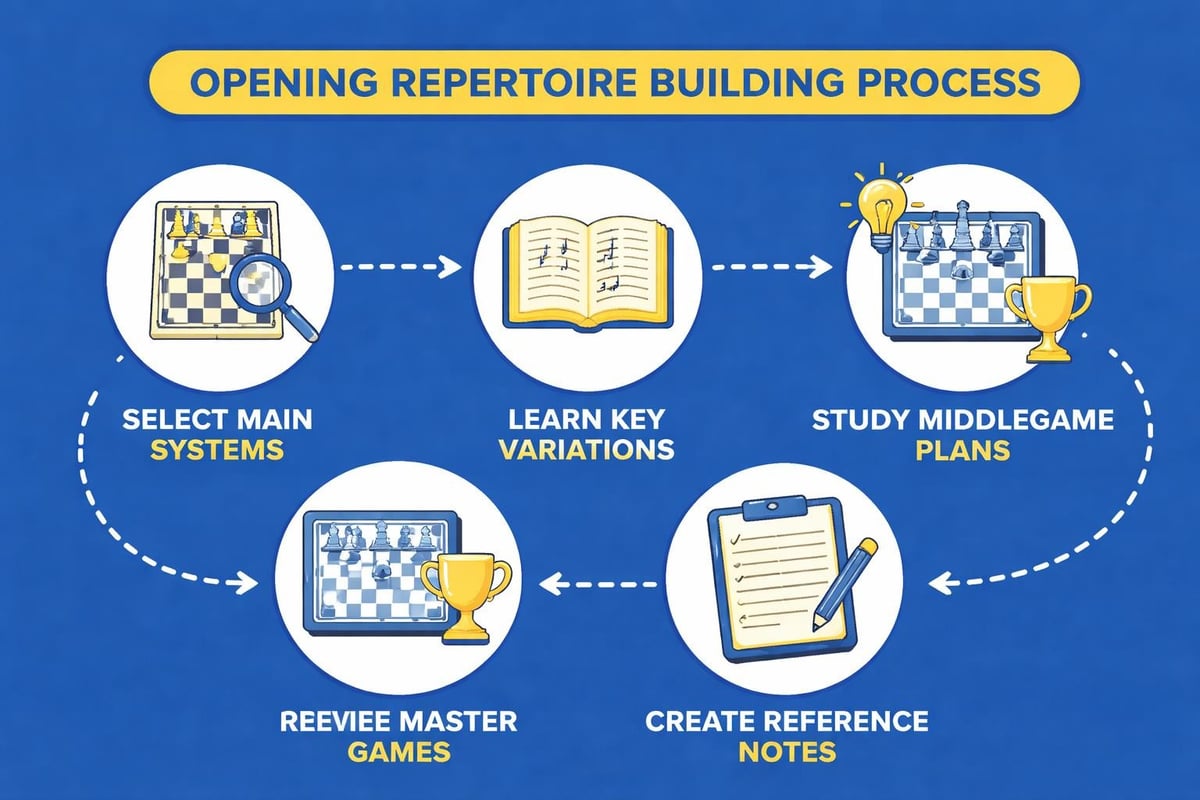
Creating Your Personal Opening Guide
Rather than drowning in theory, create streamlined reference materials. This is where comprehensive opening toolkits become invaluable. Having quick-reference guides means you can review your lines efficiently without wading through dense chess books.
| Preparation Stage | Time Investment | Focus Areas |
|---|---|---|
| Initial Learning | 2-3 weeks | Main ideas, key moves, typical pawn structures |
| Deepening Knowledge | 4-6 weeks | Critical variations, common traps, opponent errors |
| Maintenance | 15-30 min weekly | Review, update with new ideas, patch weaknesses |
Your opening prep should answer three questions: What am I trying to achieve? What are my opponent's main plans? How do I respond to common deviations?
Tactical Training: The Non-Negotiable Element
If there's one aspect of chess prep you absolutely cannot skip, it's tactics. Openings might get you a good position, but tactics win games. Even grandmasters lose games to simple tactical oversights when they're not sharp.
The seven skills training model emphasises pattern recognition as fundamental to chess improvement. Your brain needs to recognise tactical motifs instantly, without conscious calculation. This comes from repetition and active problem-solving.
Set aside time daily for tactical puzzles. Twenty minutes of focused puzzle-solving beats two hours of mindless clicking. When you solve puzzles, don't just find the answer. Understand why it works and what pattern you're exploiting.
Active vs Passive Study
There's a massive difference between passively watching chess videos and actively engaging with positions. Passive consumption feels productive but rarely translates to board improvement. Active study requires effort.
- Work through puzzles without hints
- Analyse your own games critically
- Set up positions and try to find plans
- Practice time management with timed exercises
This aligns with what effective chess training methods recommend: solving positions improves problem-solving skills far more than simply reading about concepts.
The Pre-Tournament Preparation Routine
You've spent months building your skills. Now you've got a tournament in two weeks. How do you prepare specifically for this event? This is where chess prep becomes tactical in a different sense.
First, research your likely opponents if possible. Check their recent games, note their opening preferences, and identify patterns in their play. You're not trying to prepare twenty lines deep. You're looking for tendencies you can exploit.
Your Week-Before Checklist
7 Days Before:
- Review your main opening lines
- Solve 15-20 tactical puzzles daily
- Play 2-3 practice games at tournament time controls
- Analyse one recent game deeply
3 Days Before:
- Light tactical work only
- Quick opening review (no new theory!)
- Visualisation exercises
- Ensure logistics are sorted (travel, accommodation, materials)
Day Before:
- Minimal chess work
- One quick puzzle session to stay sharp
- Early night with quality sleep
- Prepare everything you need (clock, scorebook, water)
The chess tournament preparation guide emphasises consistent training routines and time management, which are crucial for maintaining performance throughout multi-round events.
Game-Day Preparation: Your Secret Weapon
Here's something most players overlook: what you do on game day matters enormously. You can have perfect preparation behind you, but if you show up frazzled, hungry, and mentally scattered, you're fighting with one hand behind your back.
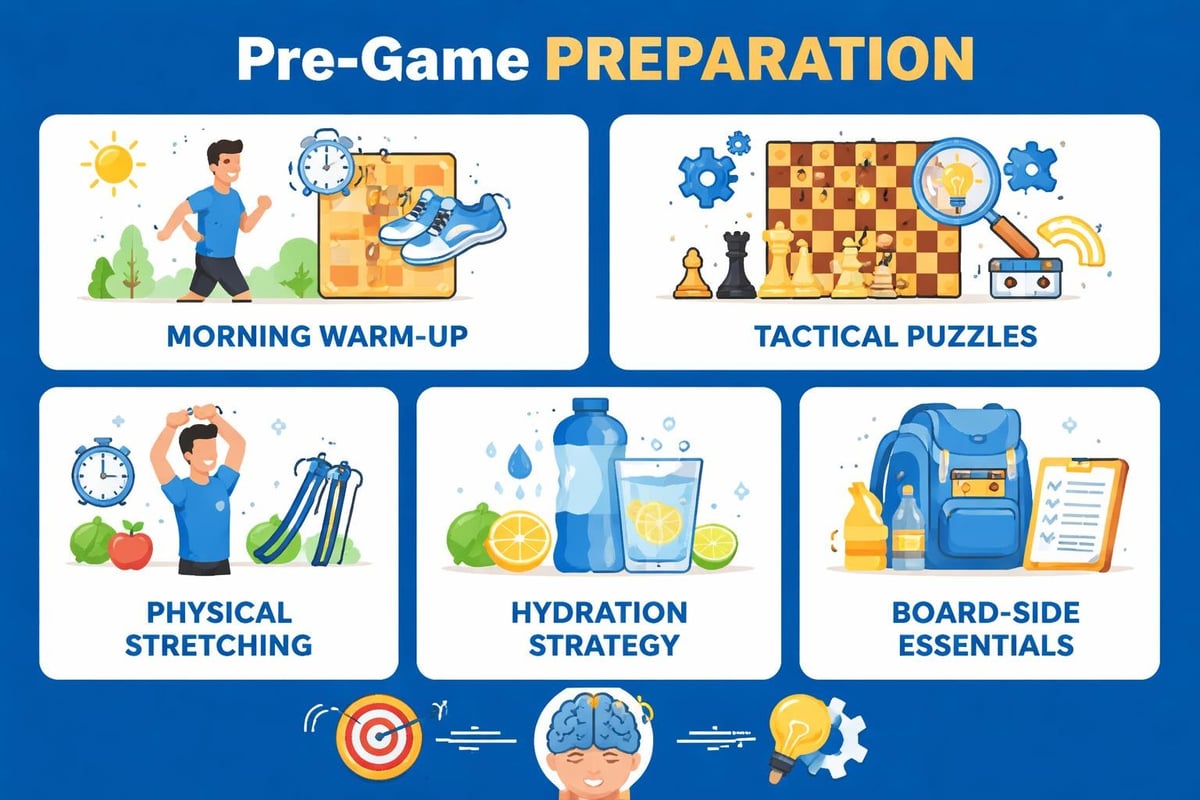
Start with a simple routine you can repeat before every game. Maybe it's fifteen minutes of easy tactics, a short walk, or some breathing exercises. Whatever works for you, make it consistent. Your brain loves routines because they reduce decision fatigue.
The First-Move Ritual
When you sit down at the board, don't rush. Take these steps:
- Get comfortable and breathe deeply
- Check the position setup (yes, even in tournament play)
- Remind yourself of your opening plan
- Start your clock with confidence
This simple pre-game routine helps you start calm and oriented, with a basic plan and warm board vision that minimises early mistakes.
Managing Your Chess Prep Schedule
You're busy. Between work, family, and life's demands, finding time for serious chess prep seems impossible. The good news? Quality trumps quantity every single time.
A focused thirty-minute session beats three hours of distracted study. Block out specific times for specific tasks. Monday might be opening review, Tuesday and Thursday for tactics, Wednesday for game analysis, and weekend for longer practice games.
| Day | Duration | Activity | Goal |
|---|---|---|---|
| Monday | 30 min | Opening review | Reinforce main lines |
| Tuesday | 30 min | Tactical puzzles | Pattern recognition |
| Wednesday | 45 min | Game analysis | Learn from mistakes |
| Thursday | 30 min | Tactical puzzles | Maintain sharpness |
| Friday | Rest | Light reading | Mental recovery |
| Saturday | 60-90 min | Practice games | Apply knowledge |
| Sunday | 45 min | Study weak areas | Address gaps |
This schedule is flexible. Missing a day won't derail your progress. Consistency over weeks and months matters far more than perfection over days.
Tools and Resources for Efficient Prep
The chess world in 2026 offers incredible resources, but you can easily drown in options. You don't need subscriptions to five different platforms. Pick a few quality resources and use them thoroughly.
For tactical training, dedicated puzzle collections provide structured practice without distractions. Physical puzzle books have the advantage of forcing you to calculate without the temptation to click for hints immediately.
Building Your Chess Library
You don't need fifty chess books gathering dust. Start with essentials:
- One comprehensive opening guide for your chosen systems
- One tactics book with progressive difficulty
- One endgame manual covering basic positions
- One game collection from a player whose style you admire
The best chess books for your level provide structured learning paths rather than encyclopaedic coverage. Quality reference materials save hours of searching through databases.
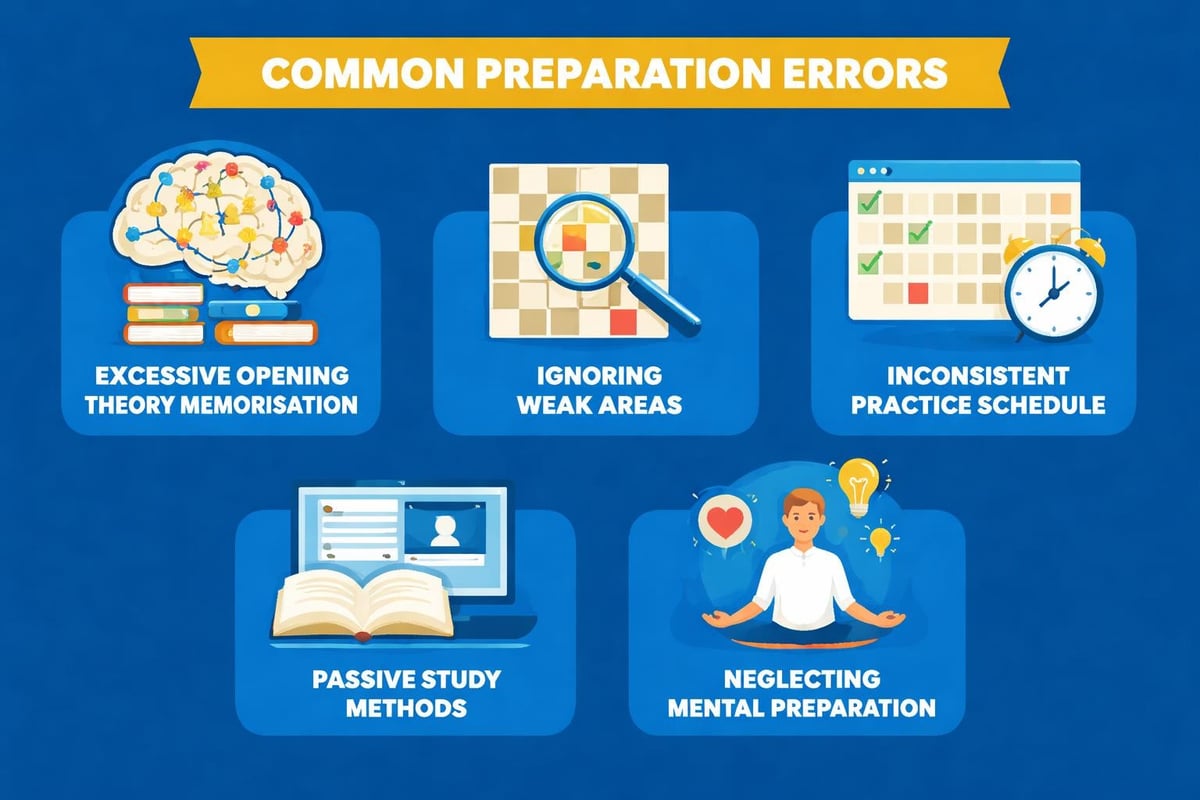
Addressing Common Chess Prep Mistakes
Let's talk about what doesn't work. These mistakes plague players at every level, wasting time and creating frustration.
Mistake #1: Studying too much theory too deeply. You're not preparing for the World Championship. Learn the principles and typical plans rather than memorising move 23 in an obscure variation.
Mistake #2: Neglecting your weaknesses. Everyone loves working on their strengths. It feels good to practise what you're already decent at. But your rating breakthrough comes from shoring up weaknesses, not polishing strengths.
Mistake #3: No consistent review schedule. You can't cram for chess like you might cram for an exam. The knowledge needs time to settle and integrate. Regular, spaced review beats marathon sessions.
The Forgetting Curve and Spaced Repetition
Your brain naturally forgets information unless you review it. This is why cramming the night before doesn't work for chess prep. You need spaced repetition: reviewing material at increasing intervals.
Review new opening lines after one day, then three days, then a week, then a month. This cements the knowledge far more effectively than studying the same line ten times in one sitting.
Mental Preparation: The Overlooked Advantage
You've done the work. You know your openings, you've solved thousands of tactics, and your endgame technique is solid. But when you're in a must-win situation with time ticking down, can you access that knowledge?
Mental preparation separates good players from great ones at the amateur level. The ability to stay calm under pressure, bounce back from mistakes, and maintain focus through a long tournament day is trainable.
Try these mental prep techniques:
- Visualisation: Spend five minutes imagining yourself playing confidently and handling pressure well
- Breathing exercises: Learn basic techniques to calm nerves before and during games
- Positive self-talk: Replace "I hope I don't blunder" with "I trust my preparation"
- Mistake recovery: Practice moving on quickly after errors in training games
The practical guide to chess preparation emphasises maintaining a calm mindset and reducing avoidable mistakes through mental readiness.

Analysing Your Games: The Feedback Loop
Here's the harsh truth: you're making the same mistakes repeatedly, and you don't even realise it. Without proper game analysis, you're destined to repeat patterns that hold you back.
After every serious game, win or lose, analyse it thoroughly. Not immediately (emotions cloud judgement), but within a day or two. Look for critical moments where the evaluation shifted significantly.
The Analysis Process
Use this framework:
- Initial review: Go through the game without an engine, noting where you felt uncertain
- Engine check: Identify actual mistakes versus perceived mistakes
- Pattern identification: What types of positions gave you trouble?
- Action items: What specific skills need work based on this game?
Don't just glance at computer evaluations. Understand why a move was wrong and what you should have considered. This is active learning that transforms your game.
Adapting Your Chess Prep as You Improve
What works at 1200 won't work at 1600. As you improve, your chess prep needs to evolve. Beginners benefit most from tactical training and basic opening principles. Intermediate players need deeper opening understanding and improved calculation ability.
Pay attention to what's actually holding you back. If you're consistently getting worse positions from the opening, invest more time in understanding common chess openings and their typical plans. If you're winning from the opening but losing won endgames, shift your focus accordingly.
The beauty of structured prep is that it scales. The same principles apply whether you're rated 1000 or 2000. The depth and complexity increase, but the foundation remains consistent.
Creating Your Personal Prep System
Cookie-cutter approaches rarely work long-term. You need a chess prep system tailored to your schedule, learning style, and goals. Some players thrive with detailed written notes. Others prefer minimal reference materials and more board time.
Experiment for a month with different approaches:
- Try morning prep versus evening sessions
- Compare physical books versus digital resources
- Test longer weekly sessions versus daily short bursts
- Assess different opening styles to find your comfort zone
Track what actually improves your play versus what just feels productive. Your results will guide your system refinement.
Maintaining Long-Term Motivation
Chess prep can feel like a grind sometimes. The progress isn't linear. You'll plateau, you'll have frustrating tournaments, and you'll wonder if all this effort is worth it.
Set process goals rather than outcome goals. Instead of "I want to reach 1800 by June," try "I'll complete thirty minutes of quality prep five days per week." You control the process. You can't control whether your tournament opponents play well or poorly.
Celebrate small victories. Solved a difficult tactic? Successfully played a complex endgame? Found a nice move in analysis? These incremental improvements compound over time into significant rating gains.
Consider joining a chess community or finding a study partner. Shared preparation keeps motivation high and provides accountability. When you know someone's expecting your game analysis tomorrow, you're more likely to do it.
Effective chess prep combines smart study habits, mental readiness, and consistent effort over time. Rather than overwhelming yourself with endless theory and scattered practice, focus on building a streamlined system that fits your life and addresses your actual weaknesses. Chess Cheat Sheets provides exactly this kind of focused, efficient approach through comprehensive guides and resources that help you master openings and improve your game without drowning in excessive study. Whether you're preparing for your next tournament or building long-term chess strength, having the right tools makes preparation both effective and enjoyable.


