

Learning chess can feel overwhelming at first, but understanding how each piece moves is the foundation of everything you'll do on the board. Whether you're just starting out or looking to solidify your knowledge, grasping the fundamentals of chess pieces and moves will transform your game from confusing to confident. The beautiful thing about chess is that once you know how each piece travels across the board, you can start seeing patterns, planning strategies, and enjoying the game's infinite possibilities. Let's explore everything you need to know about how these six unique pieces work together to create the most captivating game ever invented.
Understanding the Chess Board Setup
Before diving into individual pieces, you need to understand the battlefield itself. The chessboard consists of 64 squares arranged in an 8×8 grid, alternating between light and dark colours. Each player begins with 16 pieces arranged on the two rows closest to them.
The board orientation is crucial for proper play. Always ensure that each player has a light square in the bottom-right corner. This simple rule prevents confusion and ensures you're playing according to standard conventions.
Initial Piece Placement
Your back row (first rank) contains your most powerful pieces: rooks in the corners, knights beside them, bishops next, and your queen and king in the centre. The queen always starts on her own colour (white queen on light square, black queen on dark square), whilst the king takes the remaining centre square.
Your entire second row is filled with pawns, creating a protective wall in front of your major pieces. This setup has remained unchanged for centuries, reflecting the game's strategic balance.
The King: The Most Important Piece
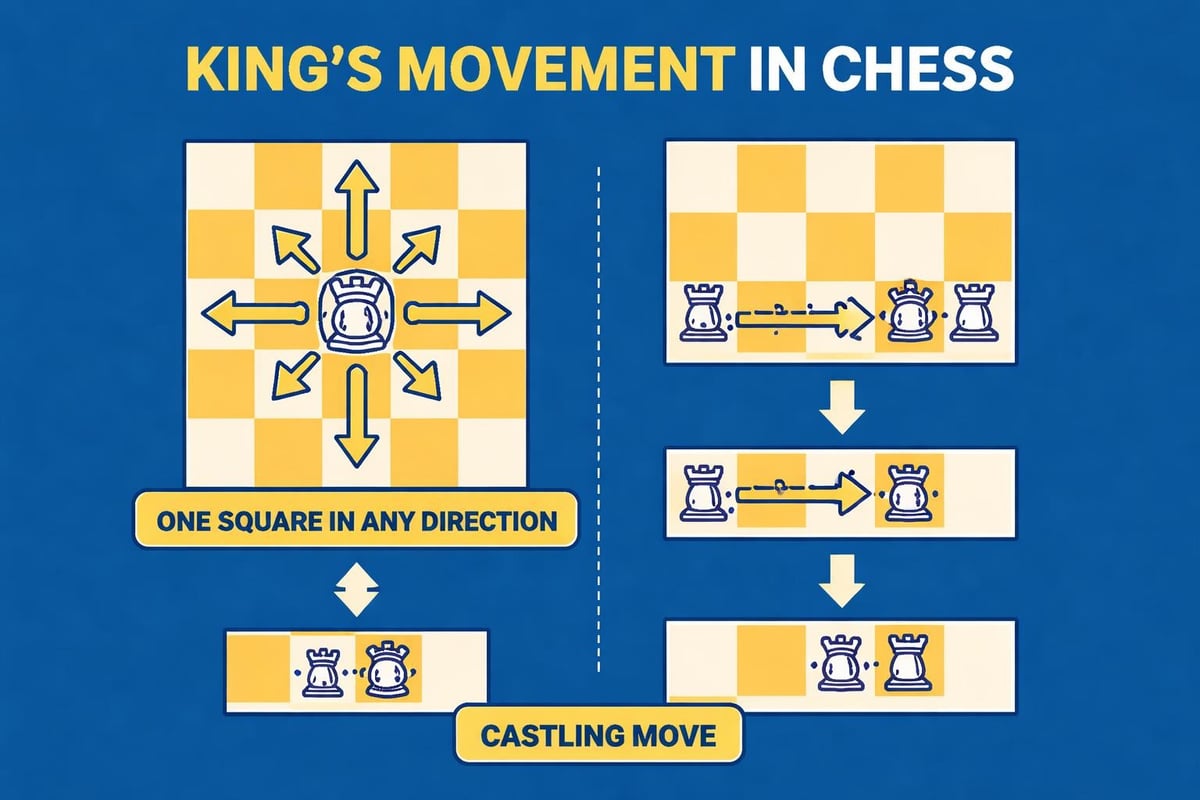
The king is simultaneously the most important and least powerful piece in chess. You can move your king one square in any direction: forward, backward, sideways, or diagonally. That's it. No jumping, no racing across the board.
Why the king matters:
- Losing your king means losing the game
- Protecting your king is your primary objective
- The king becomes more active in endgames
The concept of "check" occurs when your opponent attacks your king. You must immediately address this threat by moving your king, blocking the attack, or capturing the attacking piece. When no legal move can save your king from capture, that's checkmate, and the game ends.
Castling: The King's Special Move
Castling represents the only time you move two pieces simultaneously. This defensive manoeuvre involves moving your king two squares toward a rook, whilst the rook jumps over to the square beside the king.
| Castling Type | King Movement | Rook Movement | Purpose |
|---|---|---|---|
| Kingside | Two squares right | Jumps left of king | Quick development |
| Queenside | Two squares left | Jumps right of king | King safety |
You can only castle if neither piece has moved, no pieces stand between them, the king isn't in check, and the king doesn't move through or land on an attacked square. These restrictions make castling a privilege that must be earned through careful play.
The Queen: Maximum Mobility
Your queen is your most powerful attacking piece, combining the movement of both rooks and bishops. She can travel any number of squares vertically, horizontally, or diagonally, limited only by the board's edge or other pieces blocking her path.
This incredible mobility makes the queen worth approximately nine pawns in material value. Losing your queen early typically puts you at a severe disadvantage, though skilled players can sometimes compensate through superior position or tactical tricks.
Queen movement characteristics:
- Moves unlimited squares in eight directions
- Cannot jump over pieces
- Can capture on any square she can reach
- Most versatile piece for attacks and defence
Many beginners make the mistake of bringing their queen out too early, only to have her chased around the board by less valuable pieces. Developing your minor pieces and castling before activating your queen is generally wiser strategy, as demonstrated in most common chess openings.

The Rook: Commanding Files and Ranks
Rooks move any number of squares vertically or horizontally, but never diagonally. These powerful pieces excel at controlling entire rows (ranks) or columns (files) of the board, making them particularly valuable in open positions.
Starting the game tucked in the corners, your rooks often enter play later than other pieces. Connecting your rooks (positioning them so they protect each other along a rank) marks an important milestone in your development.
Rook Strategy and Value
Worth approximately five pawns each, rooks become increasingly powerful as the game progresses and pieces are exchanged. In endgames, rooks can dominate, cutting off the enemy king and supporting your passed pawns toward promotion.
Open files (vertical columns without pawns) serve as highways for rook activity. Controlling these files, especially the central ones, gives you significant advantages in the middlegame. Understanding the rules of chess regarding rook movement helps you exploit these strategic elements.
The Bishop: Diagonal Dominance
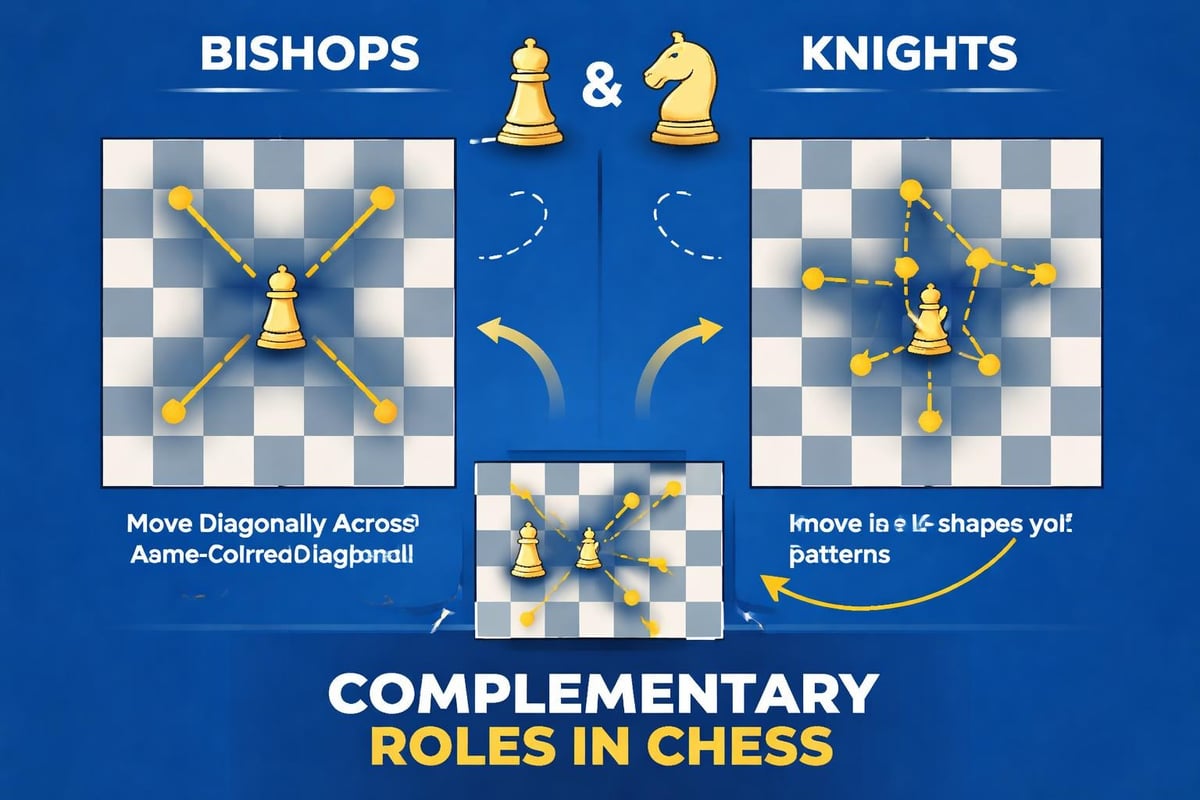
Bishops travel diagonally any number of squares, but here's the catch: each bishop remains on its starting colour forever. Your light-squared bishop never touches dark squares, and vice versa. This limitation means bishops work best as a pair, covering all squares between them.
Worth roughly three pawns, bishops gain strength in open positions where long diagonals stretch across the board. They can control squares far from their current position, making them excellent for long-range attacks and defence.
Bishop Pair Advantage
Having both bishops whilst your opponent has lost one (or has a bishop and knight) creates what players call the "bishop pair advantage." In open positions, this advantage can be worth half a pawn or more in practical play.
Long diagonal control allows bishops to influence both sides of the board simultaneously. A bishop on a2 can affect squares near h8, creating threats your opponent must respect even from a distance.
The Knight: The Jumping Trickster
Knights move in an L-shape: two squares in one direction, then one square perpendicular. This unique movement pattern makes knights the only pieces that can jump over others, ignoring any pieces in their path.
Knight movement pattern:
- Move two squares horizontally or vertically
- Then one square at a 90-degree angle
- Can jump over any pieces blocking the path
- Always lands on opposite colour from starting square
Worth approximately three pawns like bishops, knights excel in closed positions where pawns block bishops' diagonals. The knight's unique characteristics make it particularly effective in cramped positions and complex tactical situations.
Knight Positioning Matters
A knight on the board's edge controls fewer squares than a centralized knight. The old chess saying "a knight on the rim is dim" reminds players to keep knights toward the centre where they maximize their influence.
Knights require several moves to cross the board, making them slower than bishops in open positions. However, their ability to attack pieces without being attacked back (since no other piece moves like them) creates unique tactical opportunities.
The Pawn: Small But Strategic
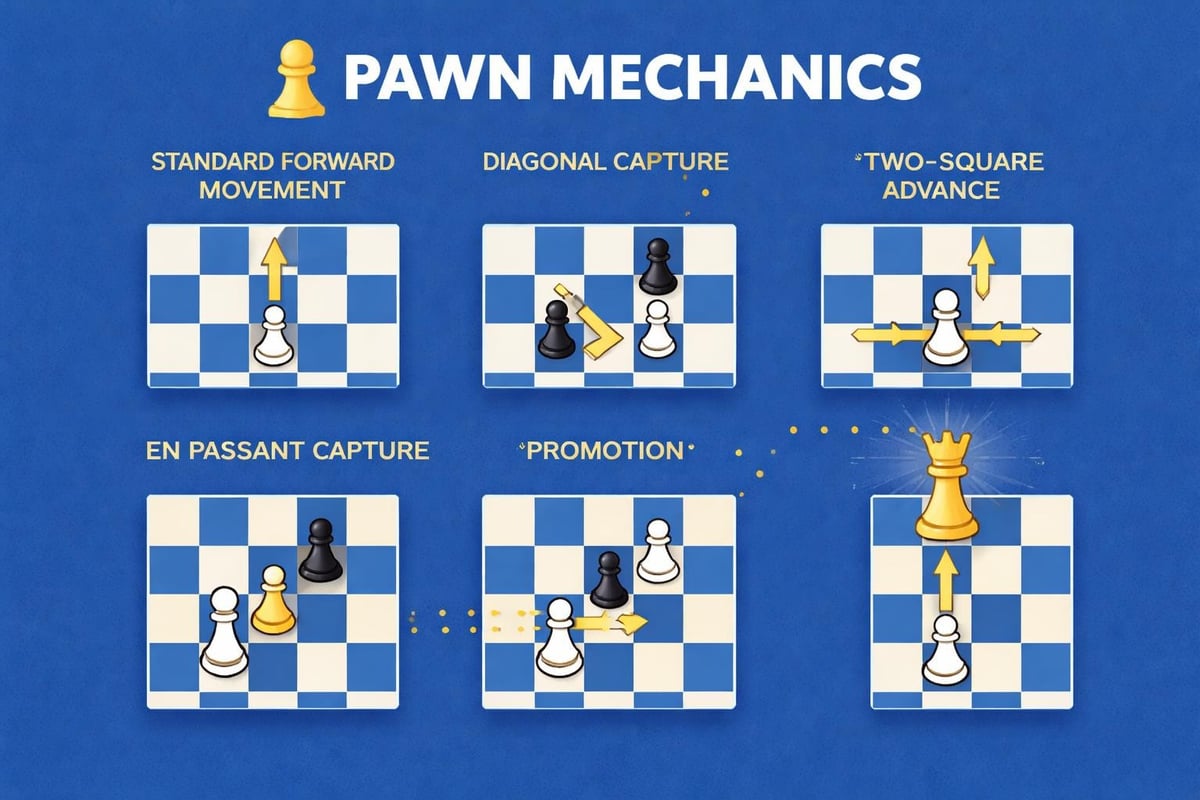
Pawns move forward one square but capture diagonally. On their first move, they can advance two squares instead of one. Despite being worth only one point, pawns create your position's structure and determine much of the game's character.
Unlike other pieces, pawns never move backward. Each forward step represents a permanent commitment, making pawn moves particularly important to consider carefully. You'll find detailed pawn structure principles in resources about chess resources.
Pawn Special Moves and Promotion
| Special Move | Description | When It Applies |
|---|---|---|
| En Passant | Capture passing pawn | Immediately after opponent's two-square pawn advance |
| Promotion | Transform to any piece | Upon reaching opposite end of board |
| Two-square advance | Initial double move | First move only for each pawn |
En passant is chess's most misunderstood rule. When your opponent moves a pawn two squares forward to avoid your pawn's capture, you can capture it "in passing" as if it had only moved one square. This special capture must happen immediately or the opportunity disappears.
Pawn promotion allows any pawn reaching the opposite end to transform into a queen, rook, bishop, or knight. Players almost always choose a queen, creating a second (or third!) queen on the board. Understanding these chess pieces and moves helps you plan long-term strategies around pawn advancement.
Combining Pieces for Tactical Success
Knowing how individual pieces move is just the beginning. Real chess mastery comes from understanding how pieces work together. Bishops and rooks can create deadly batteries along diagonals and files. Knights and bishops complement each other's weaknesses. Queens and rooks combine for devastating attacks.
Effective piece combinations:
- Rook and queen on seventh rank (opponent's second row)
- Two bishops controlling different coloured diagonals
- Knight and bishop working together in attacks
- Connected rooks protecting each other
Forks occur when one piece attacks two or more enemy pieces simultaneously. Knights excel at forks because of their unique movement pattern. Pins happen when attacking through one piece to a more valuable piece behind it, making the front piece unable to move without exposing the back piece.
Understanding Piece Value
While exact values vary by position, the standard point system helps you evaluate exchanges:
- Pawn: 1 point
- Knight: 3 points
- Bishop: 3 points (slightly more in open positions)
- Rook: 5 points
- Queen: 9 points
- King: Priceless (losing it loses the game)
These values guide decisions about trading pieces. Exchanging your bishop for an opponent's rook gains you approximately two points of material, usually a favourable trade. However, positional considerations sometimes outweigh pure material calculations.
Special Rules That Define Chess Pieces and Moves
Beyond basic movement, special rules shape gameplay in important ways. The fifty-move rule declares a draw if fifty moves pass without a pawn move or capture. The threefold repetition rule allows players to claim draws when the same position occurs three times with the same player to move.
Stalemate occurs when a player has no legal moves but isn't in check. Unlike checkmate, stalemate results in a draw, not a loss. This rule creates fascinating endgame situations where the stronger side must avoid accidentally stalemating their opponent.
Touch-Move and Other Tournament Rules
In formal play, if you touch a piece, you must move it if a legal move exists. This "touch-move" rule prevents players from testing moves physically before committing. Similarly, once you release a piece on a square, that move is complete and cannot be changed.
Recording moves using chess notation becomes mandatory in serious tournament play. Understanding algebraic notation helps you study games, follow along with instruction, and track your own progress.
Developing Your Understanding Further
Mastering chess pieces and moves takes practice, but you don't need to figure everything out alone. Studying annotated games shows you how strong players utilize each piece's unique characteristics. Working through tactical puzzles trains your brain to spot piece coordination patterns instantly.
The best openings for black and white all stem from fundamental principles about piece development and control. Understanding how pieces move naturally leads to understanding why certain opening moves make sense whilst others don't.
Playing regularly against varied opponents exposes you to different styles and piece coordination ideas. Each game teaches new lessons about how pieces interact, which combinations work well, and which piece trades favour your position.
Common Mistakes with Piece Movement
New players frequently move pieces without considering all their options. Before moving, ask yourself: "Can this piece move anywhere better? What is my opponent threatening? Does this move help my position?"
Typical beginner errors:
- Moving the same piece multiple times in the opening
- Bringing the queen out too early
- Neglecting to develop minor pieces (bishops and knights)
- Forgetting about pawn promotion possibilities
- Missing opponent's attacking possibilities
Understanding piece value prevents trading your rook for a bishop without compensation. Recognizing when to trade pieces and when to avoid exchanges separates improving players from perpetual beginners. Resources like good beginner chess books can help you avoid these common pitfalls.
Activity Versus Material
Sometimes the most valuable aspect of chess pieces and moves isn't about points but about activity. An active rook controlling an open file might be worth more than a passive queen stuck behind its own pawns. A well-placed knight on an outpost square can dominate a bishop with no good squares.
Piece activity measures how many squares a piece controls and influences. Active pieces create threats, tie down opponent's pieces to defence, and contribute to attacks. Passive pieces sit on squares where they accomplish little, waiting for better opportunities that may never come.
Sacrificing material for activity represents one of chess's most beautiful concepts. Giving up a pawn or even a piece to activate your remaining forces and create overwhelming pressure demonstrates deep understanding beyond simple point-counting.
Understanding how chess pieces move forms the essential foundation for every tactic, strategy, and brilliant combination you'll ever play. With these fundamentals firmly in place, you're ready to explore deeper aspects of chess strategy and start winning more games. Whether you're working on opening repertoires or endgame technique, having instant recall of piece movements allows your mind to focus on higher-level planning rather than basic mechanics. Chess Cheat Sheets provides streamlined guides, puzzles, and opening toolkits that build on your foundational knowledge, helping you master chess efficiently without spending years on extensive study, so you can rapidly improve your practical results at the board.


