

Learning chess can feel overwhelming when you're staring at the board for the first time, wondering which piece goes where and what it's allowed to do. You've got six different pieces, each with its own movement pattern, and trying to remember them all whilst planning your strategy can seem like an impossible task. That's exactly where a chess piece moves cheat sheet becomes your best friend. Whether you're teaching yourself chess or helping a child learn the game, having a quick reference guide transforms confusion into confidence. In this comprehensive guide, we'll break down every piece movement, special rules, and practical tips to help you master the fundamentals without spending months on theory.

Understanding the Basics: Why You Need a Chess Piece Moves Cheat Sheet
Before you can execute brilliant tactics or study complex openings, you need to master the fundamentals. Think of it like learning to drive - you wouldn't attempt a motorway journey before understanding how the pedals work, would you?
A chess piece moves cheat sheet serves as your reliable companion during those early games when you're still building muscle memory. Rather than interrupting your game to search online or flip through a hefty book, you can glance at your sheet and continue playing. This keeps the momentum going and helps you learn faster through repetition.
The Learning Curve Challenge
Most beginners struggle with the same hurdles:
- Remembering which piece is which - especially distinguishing bishops from pawns at first glance
- Understanding movement limitations - why can't my bishop reach that square?
- Grasping special moves - castling, en passant, and promotion confuse even dedicated learners
- Applying knowledge under pressure - knowing the rules in theory versus using them in practice
Having a comprehensive guide to chess basics eliminates these roadblocks. You'll spend less time second-guessing yourself and more time actually playing chess, which is how improvement happens.
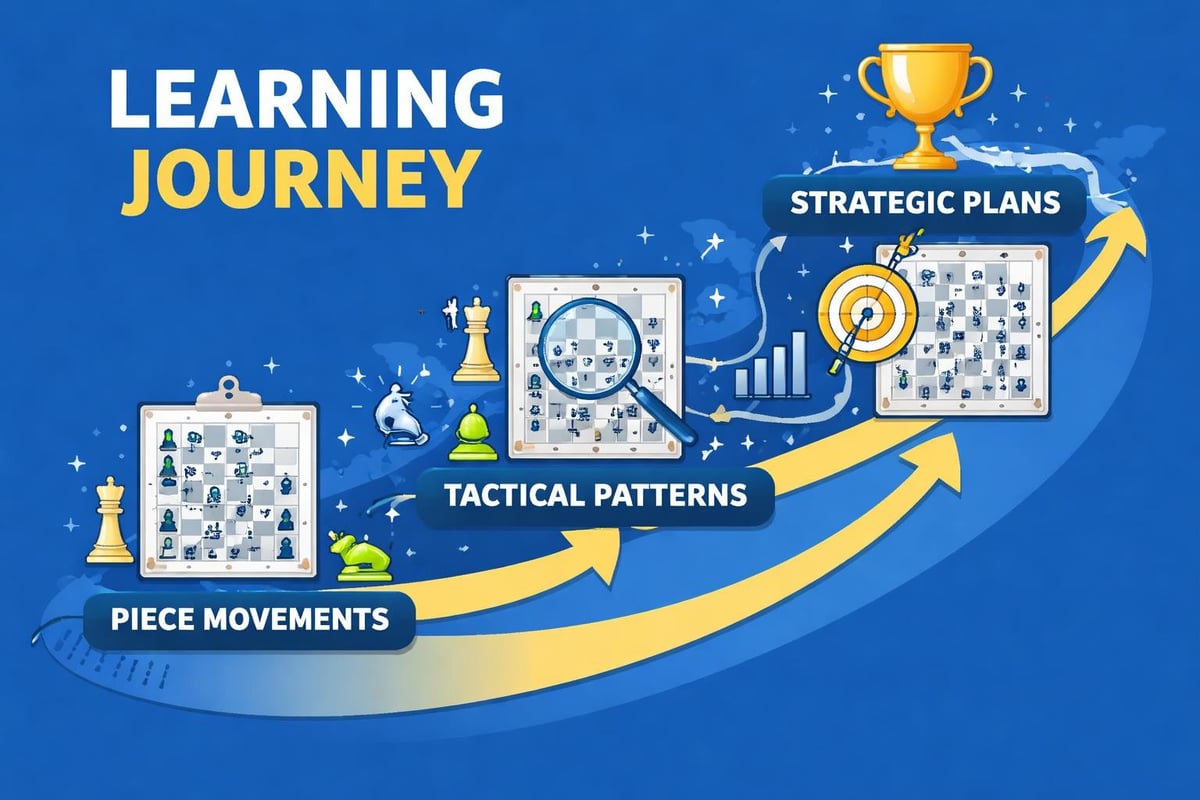
The King: Your Most Important Piece
Let's start with the piece that defines the entire game. Your king can move exactly one square in any direction - forward, backward, sideways, or diagonally. Sounds simple, right? But here's the crucial bit: you can never move your king into check (a position where it could be captured on the next move).
The king's limited mobility makes it vulnerable, which is why protecting it becomes your primary concern throughout the game. Unlike other pieces, the king never leaves the board - when it's checkmated, the game ends.
Special Move: Castling
Castling is the only move in chess that lets you move two pieces simultaneously. Here's how it works:
- Your king and rook must both be in their starting positions
- Neither piece can have moved previously in the game
- No pieces can occupy the squares between them
- The king cannot be in check, move through check, or end up in check
Kingside castling: Move your king two squares toward the rook on the h-file, then place the rook on the square the king crossed.
Queenside castling: Move your king two squares toward the rook on the a-file, then place the rook on the square the king crossed.
This defensive manoeuvre protects your king and activates your rook - two benefits in one move.
The Queen: Maximum Power and Flexibility
Your queen is the most powerful piece on the board, combining the movement patterns of both the rook and bishop. She can move any number of squares in straight lines - horizontally, vertically, or diagonally - as long as her path isn't blocked.
With this incredible range, your queen can control up to 27 squares from the centre of an empty board. That's nearly half the board! However, this power comes with responsibility.
Queen Usage Tips
- Don't develop her too early - she becomes a target for opponent's minor pieces
- Avoid trading her for lesser pieces - generally, queen for queen is fair, but queen for rook and bishop might not be
- Use her to support attacks - but keep her protected with other pieces
- Remember her defensive value - she's excellent at stopping enemy threats
Many beginners make the mistake of bringing their queen out aggressively in the opening, only to spend the next several moves retreating from attacks. Patience pays off when using this powerful piece.
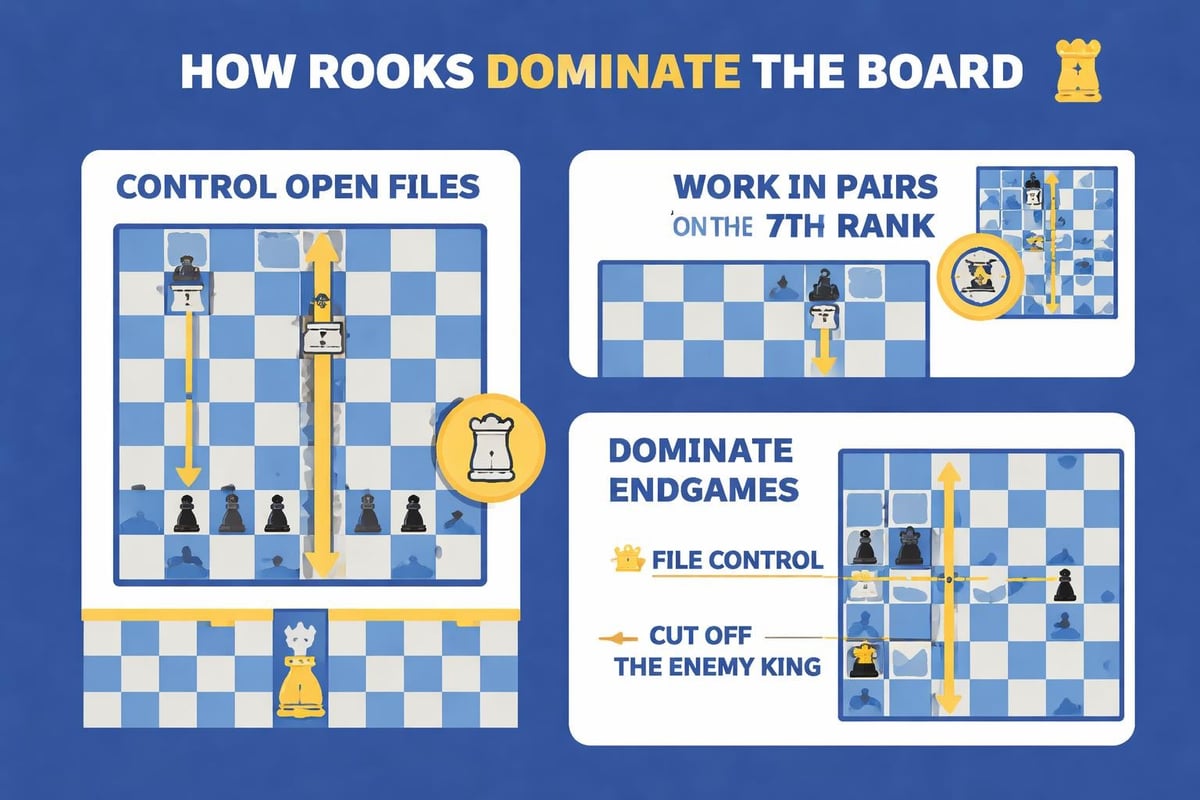
The Rook: Straight-Line Domination
Rooks move any number of squares horizontally or vertically - never diagonally. They're particularly powerful on open files (columns with no pawns) where they can penetrate deep into enemy territory.
Each player starts with two rooks, positioned in the corners. They're worth roughly five pawns in material value, making them more valuable than bishops or knights but less than the queen.
| Rook Strengths | Rook Weaknesses |
|---|---|
| Powerful in endgames | Slow to develop in openings |
| Control open files | Vulnerable to pins and skewers |
| Work well in pairs (doubled rooks) | Less mobile in closed positions |
| Excellent at cutting off enemy king | Can be trapped behind own pawns |
Getting your rooks working together is a common strategic goal. When you've got both rooks on the same file or rank, they support each other and control significant territory.
The Bishop: Diagonal Specialist
Bishops move diagonally any number of squares, but here's the catch - each bishop is forever confined to either light squares or dark squares. You start with one of each colour, and this creates an interesting dynamic.
Because bishops travel diagonally, they can quickly cross the board from corner to corner. A bishop on a1 can reach h8 in just one move if the path is clear. This long-range capability makes bishops particularly effective in open positions.
Bishop Pair Advantage
Having both your bishops whilst your opponent has lost one (or has bishop and knight) is called the "bishop pair advantage." Why does this matter?
- Your bishops cover all squares (both colours)
- They work well together in open positions
- In endgames, two bishops can dominate knight and bishop combinations
However, bishops can become "bad bishops" if trapped behind their own pawns on the same colour. This is why pawn structure matters tremendously when you've got bishops on the board.

The Knight: The Unconventional Warrior
Knights move in an L-shape: two squares in one direction (horizontal or vertical) and then one square perpendicular to that. It's the only piece that can jump over other pieces, making it uniquely valuable in crowded positions.
Understanding knight movement is often the trickiest part of a chess piece moves cheat sheet because it's so different from other pieces. From the centre of the board, a knight can reach eight different squares. From a corner, only two.
Knight Characteristics
Strengths:
- Jumps over pieces (only piece with this ability)
- Excellent in closed positions
- Can't be pinned (its movement pattern prevents this)
- Alternates square colours (light to dark, dark to light)
Weaknesses:
- Slow to cross the board
- Less effective in open positions
- Requires several moves to relocate
- Limited range compared to bishops or rooks
A well-placed knight on an outpost (a square defended by your pawn that can't be attacked by enemy pawns) becomes incredibly strong. Knights on the rim are dim, as the old saying goes - they control fewer squares from the edges.
The Pawn: Small But Strategic
Pawns are the foot soldiers of chess, and whilst they're the least valuable pieces, they shape every game you'll ever play. Normal pawn movement is simple: one square forward. However, from their starting position, pawns have the option to move two squares forward.
Here's where it gets interesting - pawns are the only pieces that capture differently from how they move. They capture diagonally, one square forward to either side.
Pawn Special Rules
En Passant: When an opponent's pawn moves two squares forward from its starting position and lands beside your pawn, you can capture it "in passing" as if it had only moved one square. You must execute this capture immediately on your next turn or lose the opportunity forever.
Promotion: When your pawn reaches the opposite end of the board (the eighth rank), it must be promoted to a queen, rook, bishop, or knight. Most players choose a queen, but sometimes tactical situations require an "underpromotion" to a different piece.
| Pawn Formation | Strategic Purpose |
|---|---|
| Pawn Chain | Connected pawns supporting each other diagonally |
| Passed Pawn | No enemy pawns can stop its march to promotion |
| Doubled Pawns | Two pawns on the same file (usually a weakness) |
| Isolated Pawn | No friendly pawns on adjacent files |
Understanding pawn structure is essential for long-term planning. Once you've mastered piece movements, studying different pawn formations becomes your next step toward improvement.
Putting It All Together: From Moves to Strategy
Now that you understand how each piece moves individually, the real chess begins when you start combining their powers. A chess piece moves cheat sheet gives you the foundation, but applying this knowledge creates winning positions.
Think about piece coordination. Your knight and bishop work together to control different coloured squares. Your rooks double on an open file to pressure your opponent's position. Your queen supports an attack whilst your pawns advance to restrict enemy pieces.
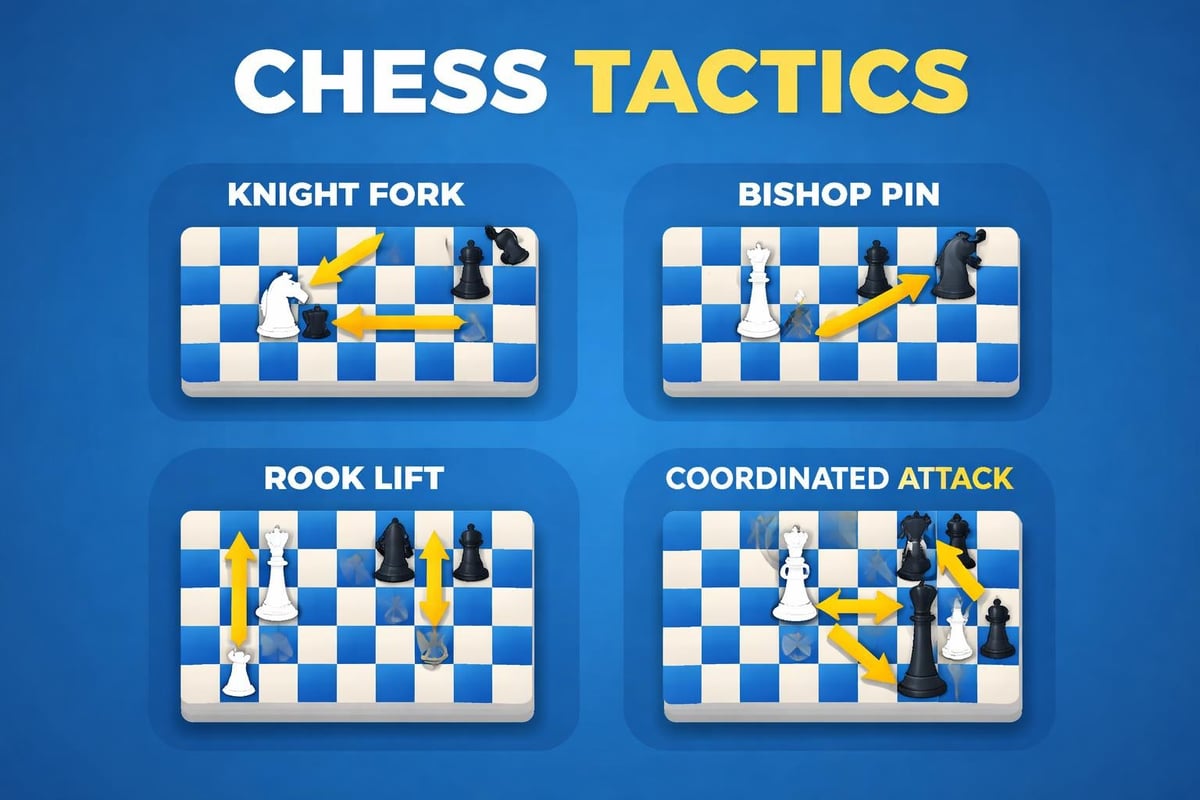
Common Movement Patterns to Practice
- Knight forks - using the knight's unique movement to attack two pieces simultaneously
- Bishop pins - using diagonal movement to trap a piece against a more valuable one
- Rook lifts - moving a rook to the third or fourth rank to swing across the board
- Queen infiltration - using the queen's flexibility to invade the enemy position
Resources like Chess.com's comprehensive cheat sheet can help reinforce these patterns alongside basic piece movements. The more you practice, the more these combinations become second nature.
Special Situations Every Player Encounters
Beyond basic movements, certain situations arise in every chess game that you need to understand. These aren't just academic rules - they directly impact your games.
Check, Checkmate, and Stalemate
Check occurs when your king is under direct attack. You must immediately:
- Move the king to safety
- Block the attack with another piece
- Capture the attacking piece
Checkmate means your king is in check and you have no legal moves to escape. Game over - you lose.
Stalemate happens when you're not in check but have no legal moves available. This results in a draw, which can be frustrating if you're winning or a lifeline if you're losing.
Touch-Move Rule
In tournament chess, if you touch a piece, you must move it if a legal move exists. This isn't just etiquette - it's an official rule. Before touching anything, make sure you've considered your move thoroughly. Many games have been lost because someone grabbed a piece impulsively.
Building Muscle Memory with Your Cheat Sheet
Simply reading about piece movements won't make you a strong player. You need to actively engage with the material. Here's how to use a chess piece moves cheat sheet effectively:
Week 1 Strategy:
- Keep the cheat sheet beside your board
- Play slow games against computer or friends
- Reference it freely without shame
- Focus on one piece type per day
Week 2 Strategy:
- Try to recall movements before checking
- Practice piece movement puzzles
- Watch tutorial videos like this instructional guide on piece movements
- Start combining pieces in simple tactics
Week 3-4 Strategy:
- Gradually reduce cheat sheet reliance
- Join online platforms to learn chess
- Begin studying basic openings
- Challenge yourself with timed games
The goal isn't to memorise the cheat sheet word-for-word. Rather, you want the movement patterns to become instinctive, freeing your mind to focus on strategy and tactics.
Beyond Basic Moves: Next Steps in Your Chess Journey
Once piece movements become automatic, you'll naturally wonder what comes next. This is where chess gets truly exciting. You'll start noticing patterns, understanding positional concepts, and developing your own style.
Consider exploring popular chess openings to give your games structure from move one. Learning basic opening principles helps you develop pieces efficiently and control the centre.
Recommended Learning Path
After mastering your chess piece moves cheat sheet:
- Study basic tactics - forks, pins, skewers, discovered attacks
- Learn fundamental endgames - king and pawn versus king, basic rook endings
- Understand opening principles - control centre, develop pieces, castle early
- Practice regularly - consistent play beats occasional long sessions
- Review your games - learn more from losses than wins
Resources for continued improvement include quality chess books for beginners and various free chess learning materials. The chess community offers incredible support for players at every level.
Practical Tips for Faster Learning
Everyone learns differently, but certain approaches consistently help beginners master piece movements more quickly. You might think daily practice means hours at the board, but even 15-20 minutes of focused study makes a difference.
Effective Practice Methods
- Visualisation exercises - close your eyes and imagine piece movements
- Online puzzles - platforms offer thousands of tactical problems
- Play both colours - understanding both sides improves overall comprehension
- Teach someone else - explaining movements solidifies your own understanding
- Use physical boards - tactile learning reinforces digital study
Understanding algebraic chess notation helps you read chess books and analyse games. Each square has a unique name (a1, h8, etc.), and pieces are denoted by letters (N for knight, B for bishop, R for rook, Q for queen, K for king). Pawns have no letter designation.
Common Mistakes When Learning Piece Movements
We all make mistakes when learning chess - it's part of the process. However, recognising common errors helps you avoid them or correct them quickly.
Moving the knight incorrectly is probably the most frequent beginner mistake. Remember: two squares in one direction, then one square perpendicular. Not one-and-one, not three squares total. The L-shape must be exact.
Forgetting pawns can't move backward catches many newcomers. Once a pawn advances, it's committed to that direction. This makes pawn moves particularly strategic since they're irreversible.
Castling illegally happens when players forget the requirements. Both pieces must be unmoved, squares between must be empty, and the king cannot castle out of, through, or into check.
Overlooking en passant opportunities is understandable since this rule seems odd initially. However, it can provide crucial tactical opportunities in pawn endgames.
Making Your Cheat Sheet Work for You
Not all chess piece moves cheat sheets are created equal. Some provide detailed diagrams, others offer concise text descriptions. Find the format that matches your learning style.
Consider creating your own personalised version. The act of writing out movements and rules reinforces learning. Include troublesome rules you frequently forget or add notes about patterns you've discovered.
| Visual Learners | Verbal Learners | Kinesthetic Learners |
|---|---|---|
| Diagram-heavy sheets | Text-based descriptions | Physical board practice |
| Colour-coded movements | Written explanations | Movement repetition drills |
| Video tutorials | Audiobooks/podcasts | Teaching others |
| Pattern recognition | Mnemonic devices | Tactile piece handling |
Resources like DaveChild's general chess cheat sheet offer different presentation styles you can adapt to your preferences. Don't be afraid to mix formats until you find what clicks.
Converting Knowledge Into Playing Strength
There's a crucial difference between knowing how pieces move and using that knowledge effectively. Your chess piece moves cheat sheet gets you started, but developing board vision and tactical awareness requires active play.
Start with longer time controls - perhaps 15 or 30 minutes per player. This gives you time to think without the pressure of rapid chess. As movements become automatic, gradually decrease thinking time.
Join a chess club or online community. Playing against varied opponents exposes you to different styles and strategies. You'll see piece movements used in ways you hadn't imagined, expanding your understanding naturally.
Consider working through chess resources specifically designed for improving players. Structured learning accelerates improvement compared to random practice alone.
The Role of Piece Values in Decision-Making
Understanding relative piece values helps you make smart trading decisions. The traditional point system approximates piece worth:
- Pawn: 1 point
- Knight: 3 points
- Bishop: 3 points (slightly more valuable than knight in open positions)
- Rook: 5 points
- Queen: 9 points
- King: Priceless (you lose if checkmated)
These values aren't absolute. A well-placed knight might be worth more than a passive rook. A bishop pair might outweigh a queen in certain endgames. Context matters enormously.
When considering captures or trades, calculate the material exchange. Trading your rook for your opponent's bishop and knight (5 points for 6 points) generally favours your opponent. However, if that trade gives you a winning position, material values become secondary to practical considerations.
Mastering piece movements is your first real achievement in chess, transforming you from someone who knows the rules into someone who can actually play the game. With consistent practice using your chess piece moves cheat sheet, these patterns will become second nature within weeks. When you're ready to deepen your understanding and accelerate your improvement with structured learning materials, Chess Cheat Sheets offers comprehensive guides, opening resources, and tactical training designed specifically for players building their skills efficiently without overwhelming theory.


