

Setting up a chessboard might seem straightforward, but understanding the chess order pieces follow can make the difference between starting strong and stumbling right out of the gate. Whether you're teaching your children the game or you're an adult learner picking up chess for the first time in 2026, knowing both the initial placement and the strategic development order of your pieces is fundamental to improving your game. Let's walk through everything you need to know about arranging your chess pieces correctly and using them effectively from the very first move.
Understanding the Initial Chess Order Pieces Follow
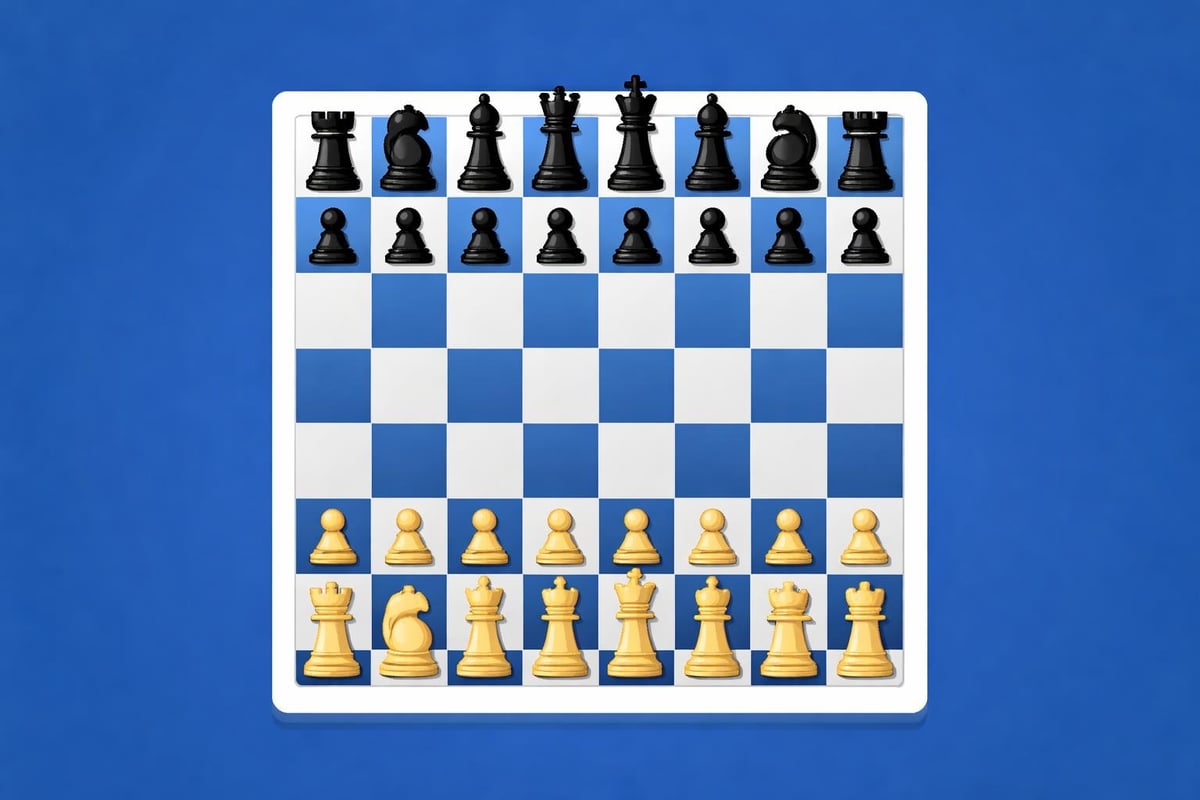
Before you can develop a brilliant opening strategy, you need to know where everything goes. The correct setup of a chessboard follows a specific pattern that's remained consistent throughout chess history.
Here's what you need to remember about the initial chess order pieces arrangement:
- Bottom right square must be light-colored (often white or cream)
- Queens start on their own color (white queen on white square, black queen on black square)
- Kings occupy the remaining center square next to their queens
- Symmetrical piece placement mirrors across both sides of the board
The back rank (first row for each player) follows this order from left to right: rook, knight, bishop, queen, king, bishop, knight, rook. All eight pawns line up directly in front of these pieces on the second rank.
Common Setup Mistakes to Avoid
You'd be surprised how often even experienced players make errors when setting up their boards quickly. I've seen tournament games delayed because someone placed their king and queen incorrectly!
The most frequent mistakes include:
- Reversing king and queen positions (remember "queen on her color")
- Flipping the board orientation (light square on the right)
- Mixing up bishop placement (they start on opposite colors)
- Starting without checking both sides match each other
Taking an extra thirty seconds to verify your proper chess piece placement ensures you're not learning bad habits or playing invalid games.
Development Order: Strategic Chess Order Pieces Philosophy
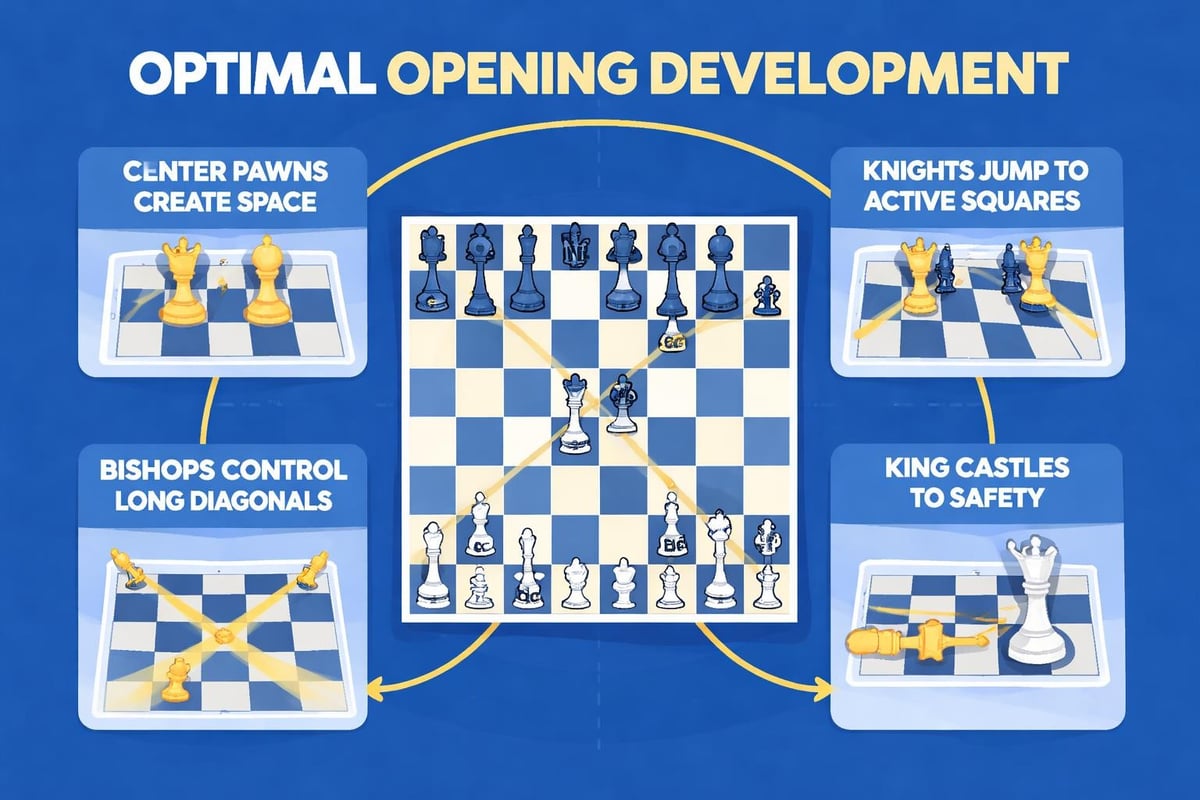
Once your board is set up correctly, understanding which pieces to develop first becomes crucial. This is where the concept of chess order pieces extends beyond physical placement into strategic thinking.
The general development principles that strong players follow include:
- Control the center with pawns (e4, d4, e5, d5)
- Develop knights before bishops (they have fewer good squares)
- Don't move the same piece twice in the opening
- Castle early to protect your king
- Connect your rooks by completing development
Why Knights Usually Come Out First
Knights are typically the first pieces you'll develop after your initial pawn moves. Why? They need to reach their ideal squares (f3, c3 for White; f6, c6 for Black) and have only one or two optimal development squares, unlike bishops which can often go to multiple useful diagonals.
When you study resources about developing pieces in the opening phase, you'll notice this knight-first principle appears repeatedly across different opening systems.
| Development Priority | Piece Type | Typical Timing | Purpose |
|---|---|---|---|
| First moves | Center pawns | Moves 1-2 | Control center, open lines |
| Early development | Knights | Moves 2-4 | Occupy strong central squares |
| Middle development | Bishops | Moves 3-6 | Control diagonals, prepare castling |
| Safety move | Castling | Moves 6-10 | King safety, rook activation |
| Later development | Queen | After move 8 | Avoid early attacks, coordinate pieces |
Piece Values and Hierarchical Order
Understanding the relative value of pieces helps you make better decisions about which chess order pieces to exchange and which to preserve. This hierarchy affects everything from opening development to endgame transitions.
Standard piece values:
- Pawn: 1 point (baseline)
- Knight: 3 points
- Bishop: 3 points (slightly more than knight in open positions)
- Rook: 5 points
- Queen: 9 points
- King: Infinite (losing it means losing the game)
These values inform trading decisions throughout your game. Exchanging a knight (3 points) for three pawns (3 points) might seem equal, but the practical strength often differs based on position.
How Value Affects Development Order
You'll notice that the chess order pieces follow in development roughly corresponds to their value in reverse. Your least valuable pieces (pawns) move first, then knights and bishops, while your most valuable piece (the queen) typically develops later.
Why develop lower-value pieces first? Because they're less vulnerable to attacks and help control key squares for your more valuable pieces. Bringing your queen out too early often results in your opponent developing with tempo by attacking her, forcing you to move the same piece repeatedly.
The fundamental rules of chess explain how each piece moves, which directly impacts when you should develop them.
Opening-Specific Development Orders
Different chess openings prescribe different development sequences. The chess order pieces follow varies based on whether you're playing the Italian Game, the Sicilian Defense, or something more unconventional like the Grob Opening.
Classical Development: Italian Game Example
In the Italian Game, White follows this development pattern:
- e4 (center pawn)
- Nf3 (king's knight develops, controls center)
- Bc4 (bishop develops, eyes f7)
- d3 or c3 (supporting pawns)
- Nc3 (queen's knight develops)
- O-O (castling kingside)
This represents a textbook chess order pieces sequence that beginners should study. You can explore this further through our Italian Game guide.
Defensive Systems: Caro-Kann Approach
The Caro-Kann Defense demonstrates how Black can vary piece development order based on White's choices:
- Move 1: ...c6 (supporting pawn, preparing ...d5)
- Move 2: ...d5 (challenging White's center)
- Move 3: ...dxe4 or ...Bf5 (bishop develops early, unusually)
- Move 4-6: ...Nd7, ...Ngf6, ...e6 (knights and pawns coordinate)
Notice how in the Caro-Kann, Black sometimes develops the light-squared bishop before the knights. This shows that while principles guide piece development, specific positions may require flexible thinking.

Coordinating Piece Development
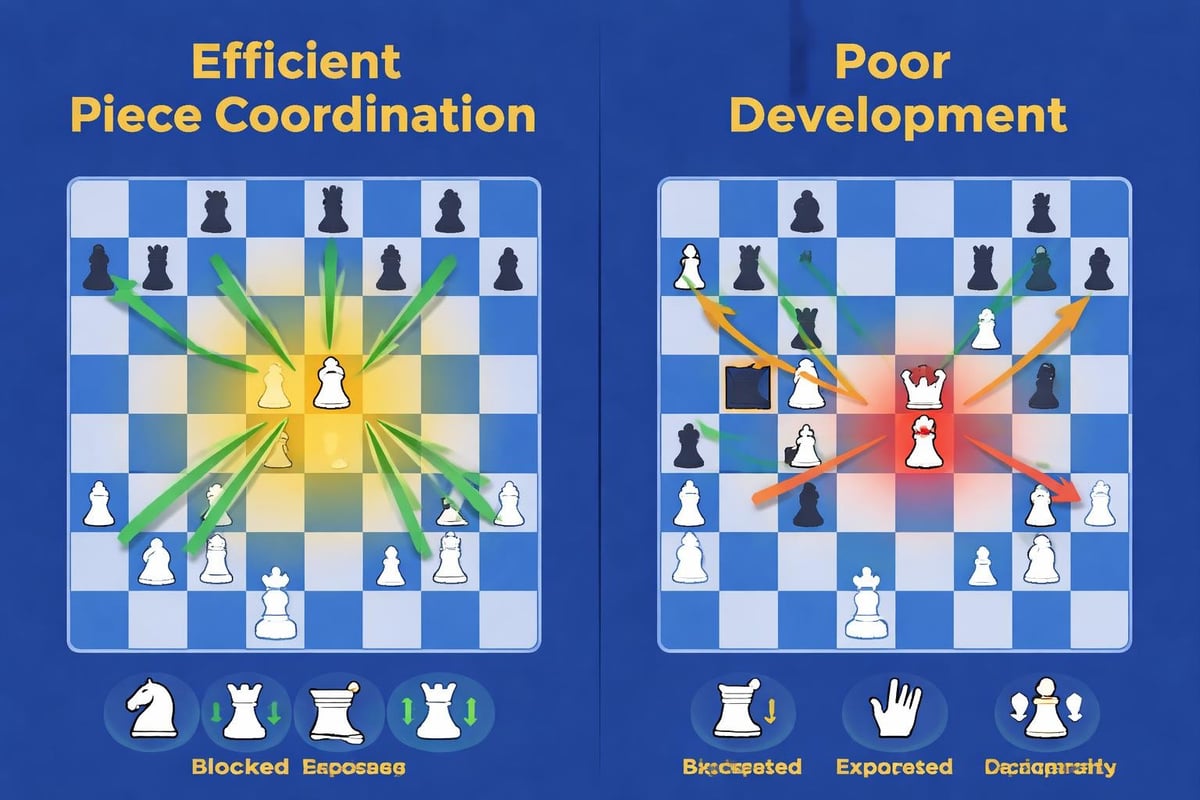
Understanding individual piece development is important, but knowing how they work together transforms your chess. The chess order pieces follow should create harmony, not just random development.
Creating Piece Coordination
Think of your pieces as an orchestra. Each instrument (piece) has its role, but they need to play together:
Coordination checklist:
- Do my pieces support each other?
- Can my opponent attack one piece without facing threats from others?
- Are my pieces aimed at important squares or targets?
- Have I created any weaknesses by developing pieces?
When you're learning to play chess effectively, understanding coordination separates beginners from intermediate players.
| Coordination Type | Example | Benefit |
|---|---|---|
| Knight + Bishop | Nf3 + Bc4 (Italian) | Both attack f7 square |
| Rook + Queen | Connected rooks + centralized queen | Control open files together |
| Pawns + Pieces | Pawn chain + bishop behind it | Pawns control squares, bishop adds pressure |
| Double Attack | Queen + knight fork | Multiple threats simultaneously |
Avoiding Piece Conflicts
Sometimes pieces get in each other's way. Your knight might block your bishop's diagonal, or developing your queen early might occupy a square your knight needs. Recognizing these conflicts helps you choose better development sequences.
Common conflicts to watch for:
- Blocked diagonals: Developing bishops before moving pawns that block them
- Crowded squares: Multiple pieces competing for the same good square
- Premature queen moves: Queen occupying squares needed for minor pieces
- Undeveloped rooks: Pieces blocking rook files and preventing their activation
Special Situations and Exceptions
While general principles guide the chess order pieces typically follow, chess is a game of exceptions. Recognizing when to break the rules defines strong players.
When to Develop Your Queen Early
Most guides tell you to develop your queen late, but certain openings require early queen development:
- Scandinavian Defense: Black plays ...Qa5 or ...Qd8-d6 very early
- Attacking systems: Sometimes White plays Qd1-d3 or Qd1-f3 to create immediate threats
- Gambit positions: Queen can join attacks when opponent's king remains central
The key is whether your early queen move creates concrete threats or simply exposes her to attacks.
Delaying Castling
Castling typically happens between moves 6-10, but sometimes you'll delay it:
Reasons to wait:
- Your opponent might attack the castled position immediately
- You need to keep central tension
- Opposite-side castling plans (where you castle queenside instead)
- Your king is relatively safe in the center temporarily
Working with a chess coach can help you understand these nuanced decisions.
Practical Exercises for Mastering Piece Development
Understanding theory is one thing, but applying it requires practice. Here's how to internalize proper chess order pieces principles.
Exercise 1: Development Counting
After each game, count how many pieces each side developed by move 10. Developed pieces are those off their starting squares and doing something useful (not moved randomly back and forth).
Target numbers:
- Excellent: 5-6 pieces developed
- Good: 4-5 pieces developed
- Needs improvement: 3 or fewer pieces developed
Exercise 2: Position Evaluation
Look at positions from your games after move 8-10 and ask:
- Which pieces are developed?
- Which pieces are still on their starting squares?
- Are my developed pieces coordinated?
- Is my king safe?
- Did I follow development principles?
Exercise 3: Opening Repertoire Building
Choose two openings (one for White, one for Black) and study their development patterns thoroughly. Understanding common chess openings helps you recognize familiar patterns and apply proper piece development automatically.
Practicing with specialized opening puzzles reinforces these patterns through repetition and tactical awareness.
Resource Management and Piece Activity
Beyond the basic chess order pieces arrangement, managing your pieces throughout the game involves maximizing their activity and scope.
Active vs. Passive Pieces
An active piece controls important squares and creates threats. A passive piece sits on less useful squares or is blocked by your own pawns.
Characteristics of active pieces:
- Control central squares
- Aim at opponent's position
- Have multiple squares they can move to
- Support your strategic plans
Signs of passive pieces:
- Blocked by your own pawns
- Stuck on the back rank
- No clear purpose or targets
- Limited mobility
Improving Piece Activity
When you notice passive pieces, create plans to activate them:
- Open files for rooks: Trade or push pawns to create open files
- Find diagonals for bishops: Ensure your pawn structure doesn't trap bishops
- Centralize knights: Bring knights toward the center rather than the edges
- Activate your queen: Once minor pieces are developed, find active queen posts
The better you understand chess resources and study materials, the more quickly you'll recognize when your pieces need repositioning.
Learning From Your Setup Mistakes
Every player makes mistakes with chess order pieces when they're learning. I certainly positioned my king and queen incorrectly dozens of times as a beginner! The important thing is learning from these errors.
Common Development Errors
Beyond setup mistakes, watch for these development errors:
- Moving the same piece multiple times in the opening
- Bringing your queen out too early without purpose
- Neglecting king safety and delaying castling
- Developing pieces to passive squares
- Ignoring your opponent's threats while developing
Building Better Habits
Create a pre-game checklist that ensures you're thinking about proper development:
Your development checklist:
- Did I set up the board correctly?
- Am I controlling the center?
- Have I developed knights before bishops?
- Is my king getting toward safety (castling)?
- Are my pieces coordinated?
- Am I creating threats or just moving randomly?
Reviewing your games regularly helps identify patterns in your mistakes. Many players find that studying opening guides and principles accelerates their improvement by showing them correct patterns to follow.
Advanced Concepts: Piece Development in Different Game Phases
While we've focused primarily on opening development, understanding how the chess order pieces evolved from their starting positions affects middlegame and endgame play too.
Middlegame Repositioning
In the middlegame, you'll often redeploy pieces to better squares. A knight on c3 might belong on e4 or d5. A bishop on e2 might need to swing to c4 or b5. This repositioning maintains the spirit of proper development even though the opening has ended.
Endgame Activation
As pieces trade off, your remaining pieces need maximum activity. King activity becomes especially important in endgames, where your king transforms from a piece needing protection to an active fighting unit.
Endgame development priorities:
- Activate your king (bring it toward the center)
- Centralize remaining pieces
- Coordinate pieces for maximum effect
- Create passed pawns and support their advancement
Understanding these transitions helps you see chess development as a continuous process, not just an opening concern.
Mastering the chess order pieces follow, both in initial setup and strategic development, provides the foundation for all your chess improvement. Whether you're verifying that your board is arranged correctly or planning which piece to develop next, these principles guide better decision-making at every level. If you're ready to accelerate your learning with structured guides that break down opening principles, piece development patterns, and tactical themes, explore the comprehensive resources at Chess Cheat Sheets, where you'll find everything from detailed opening guides to specialized puzzle collections designed to reinforce proper development habits and sharpen your tactical vision.


