

If you've spent any time trying to improve your chess, you've probably encountered the challenge of mastering openings. Where do you even start? What resources actually work? In 2026, the chess openings book pdf has become an essential tool for players who want to study efficiently without lugging around heavy tomes or spending hours flipping through pages. Digital formats offer searchable content, easy navigation, and the ability to study anywhere on your laptop, tablet, or phone. But with countless options available, how do you know which approach works best for your needs?
Why Chess Players Choose PDF Opening Books
The shift towards digital chess resources isn't just about convenience. It's about accessibility and practicality in our modern lives.
The Practical Advantages of Digital Format
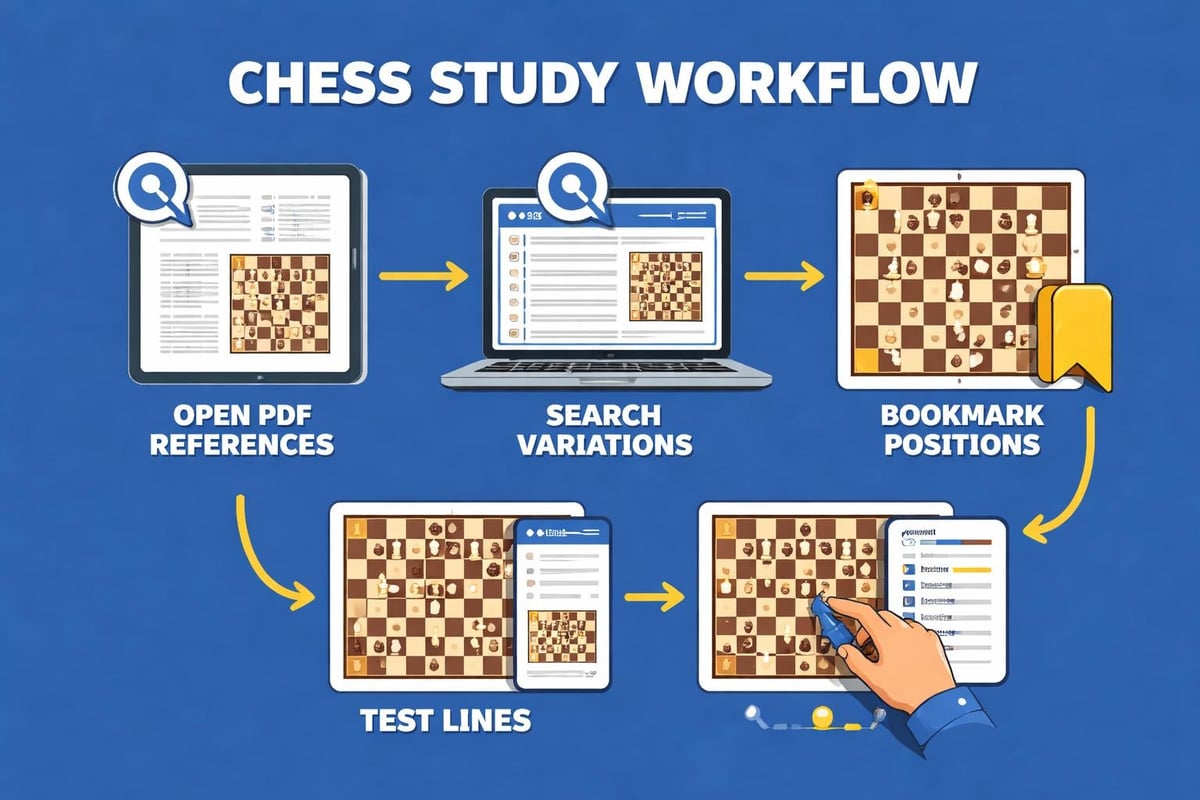
Think about your typical study session. You're probably sitting with a device already, whether analysing games online or working through puzzles. Having your opening repertoire in PDF format means everything's in one place. You can search for specific positions instantly, bookmark critical lines, and even annotate directly on the document.
Key benefits include:
- Instant searchability across hundreds of pages
- No physical storage space required
- Easy to update and organise
- Perfect for travel and on-the-go study
- Often more affordable than printed versions
- Simple to share variations with training partners
Many players find that chess opening books in PDF format integrate seamlessly with their existing study tools. You can have your opening guide open alongside your chess software, making it easy to test variations on a board whilst reading theoretical explanations.
What Makes a Quality Chess Openings Book PDF
Not all PDFs are created equal, though. The best chess openings book pdf resources share certain characteristics that make them genuinely useful rather than just digital clutter.
First, navigation matters enormously. A well-structured PDF includes clickable table of contents, internal hyperlinks between related sections, and clear chapter divisions. You shouldn't have to scroll endlessly to find the Sicilian Dragon variation you need.
Second, diagram quality can make or break your understanding. Crisp, clear board positions with proper algebraic notation help you grasp positions at a glance. Some PDFs even include colour-coded arrows showing key piece movements.
| Feature | Why It Matters | What to Look For |
|---|---|---|
| Hyperlinks | Quick navigation | Clickable contents, cross-references |
| Diagrams | Visual clarity | High-resolution boards, frequent positions |
| Annotations | Deeper understanding | Explanatory text, move evaluations |
| Organisation | Efficient study | Logical structure, clear sections |
Third, the depth of coverage should match your level. Beginners benefit from explanations of key ideas and typical plans, whilst intermediate players need concrete variations and move-by-move analysis.
Finding and Evaluating Chess Opening PDFs
Where should you actually look for quality resources? And once you've found them, how do you separate the wheat from the chaff?
Reputable Sources for Opening Materials
The internet is awash with chess PDFs, but quality varies wildly. Some fantastic resources exist alongside poorly scanned, outdated materials that might actually harm your understanding.
Trusted sources typically include:
- Official publisher digital editions from established chess publishers
- Educational platforms offering structured courses with accompanying PDFs
- Chess master compilations created by titled players with teaching experience
- Historical classics now in public domain, like Lasker's Manual of Chess
- Specialised chess education sites like Chess Cheat Sheets that focus on digestible, practical formats
Historical references such as Modern Chess Openings have been digitised and remain valuable for understanding opening evolution, even if specific variations have been updated by modern theory.
How to Assess Content Quality
You've downloaded a chess openings book pdf. Now what? How do you know if it's worth your study time?
Start by checking the publication or creation date. Opening theory evolves, and whilst fundamental principles remain constant, specific lines can be refuted. A PDF from 2010 might miss crucial developments in popular openings.
Next, examine the move annotations. Quality resources explain why moves are played, not just what moves to make. Look for explanations of positional themes, pawn structures, and typical plans for both sides.
Test a section you already know something about. If you've played the Italian Game, read that section. Does it match your understanding? Does it offer new insights? This gives you a benchmark for the rest of the content.

Structuring Your Opening Study with PDFs
Having a chess openings book pdf is one thing. Actually using it effectively? That's where most players struggle.
Creating a Personal Opening Repertoire
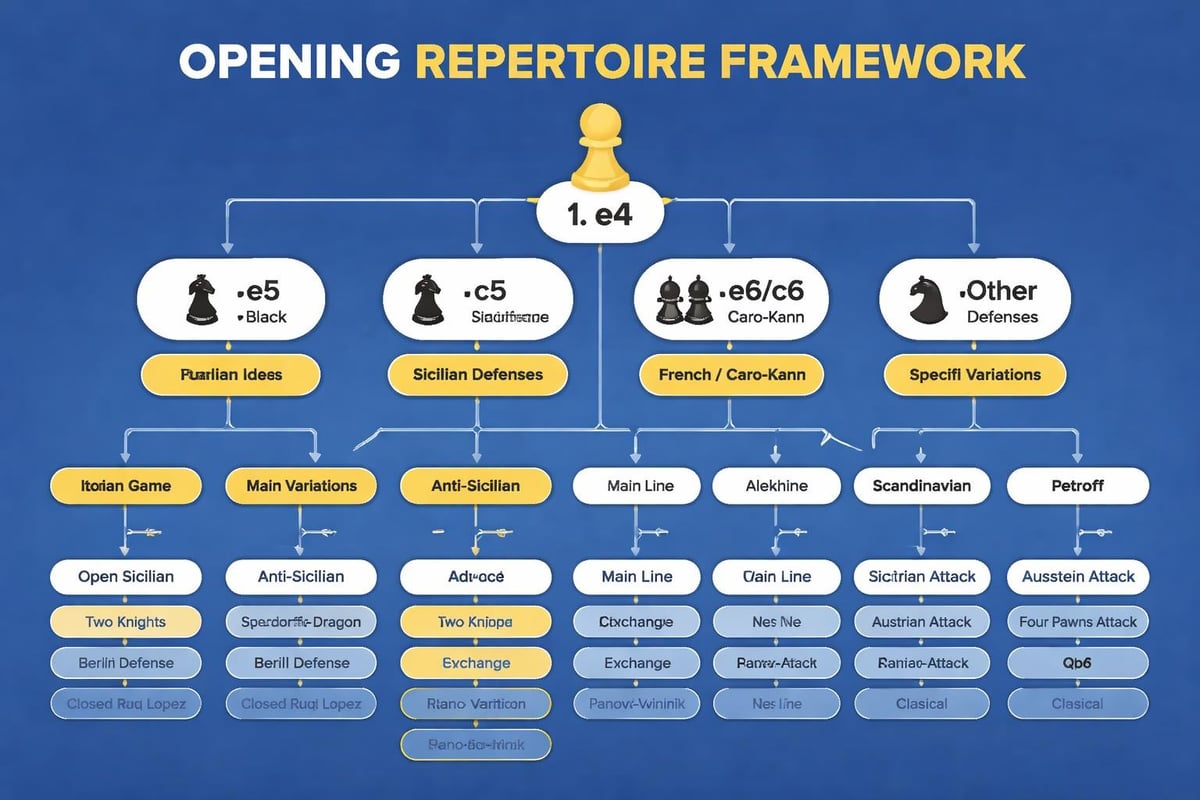
You can't learn every opening. Even grandmasters specialise in specific systems that suit their style. Your PDF library should reflect your repertoire choices.
Start with this approach:
- Choose one opening as White (e.g., 1.e4 or 1.d4)
- Select two defences against 1.e4 (perhaps Sicilian and French)
- Pick two defences against 1.d4 (like Queen's Gambit Declined and Nimzo-Indian)
Once you've made these choices, focus your PDF study on these systems. Many players collect dozens of opening books but never master any single opening because they spread their attention too thin.
If you're deciding between defences, resources comparing options like Caro-Kann vs French Defense can help guide your repertoire decisions.
Active Study Techniques with Digital Resources
Reading isn't enough. You need to engage actively with the material to retain it.
Try this three-phase approach:
- Read and understand the opening ideas and typical plans
- Play through variations on a physical or digital board
- Test yourself by trying to recall key lines without looking
Many players keep a separate document or notebook where they summarise each opening in their own words. This active processing helps cement the information far better than passive reading.
Organising Your Chess PDF Library
As you accumulate resources, organisation becomes crucial. Nothing's more frustrating than knowing you have the perfect reference for a position but being unable to find it.
File Naming and Folder Systems
Create a logical folder structure on your device:
Chess Opening PDFs/
├── White Repertoire/
│   ├── 1.e4/
│   ├── 1.d4/
│   └── Alternative First Moves/
├── Black Against 1.e4/
├── Black Against 1.d4/
├── General Opening Theory/
└── Historical References/
Name files descriptively: "Sicilian_Najdorf_Comprehensive_2025.pdf" beats "chess_book_3.pdf" every time.
Annotation Tools and Software
Modern PDF readers offer powerful annotation features. Use them strategically:
- Highlighters for critical variations you need to memorise
- Comments for your own analysis and questions
- Bookmarks for positions you want to review regularly
Some players even create custom tags or categories within their PDF software, making it easy to filter by theme (tactical openings, positional systems, gambit lines, etc.).
Comparing PDF Formats to Other Learning Methods
Let's be honest about where chess openings book pdf resources excel and where they fall short.
PDFs vs Physical Books
| Aspect | PDF Format | Physical Book |
|---|---|---|
| Portability | Excellent | Limited |
| Searchability | Instant | Manual only |
| Note-taking | Digital annotations | Margins and highlights |
| Reading comfort | Screen fatigue possible | Easier on eyes |
| Durability | Permanent (with backups) | Can wear or damage |
| Cost | Often lower | Usually higher |
Physical books still have devoted fans, especially for deep study sessions. There's something about sitting with a board and a proper book that feels more focused for some players. But for quick reference and regular consultation, PDFs win hands down.
PDFs vs Video Courses
Video courses have exploded in popularity, and they offer unique advantages like seeing positions explained dynamically. However, they're harder to reference quickly. If you need to check a specific variation, scrolling through a 45-minute video is frustrating.
The ideal approach? Use both together. Watch video courses for the initial learning and conceptual understanding, then keep PDF references for quick review and specific position lookup. Understanding the most common chess openings helps you prioritise which systems deserve video course investment versus PDF study.
Specialised Opening PDF Resources
Not every chess openings book pdf tries to cover everything. Some of the most valuable resources focus on specific niches.
Opening-Specific Deep Dives
Single-opening monographs go incredibly deep. If you've committed to the Najdorf Sicilian as your main weapon against 1.e4, a 300-page PDF devoted solely to that opening provides far more value than a general opening encyclopaedia.
These specialist resources typically include:
- Move-by-move analysis of critical lines
- Game collections featuring the opening
- Strategic themes specific to resulting positions
- Preparation against different opponent responses
- Recent theoretical developments
Resources exploring less common but effective systems, like the Ponziani Opening, can give you surprise weapons that opponents haven't prepared for.
Beginner-Friendly vs Advanced Materials
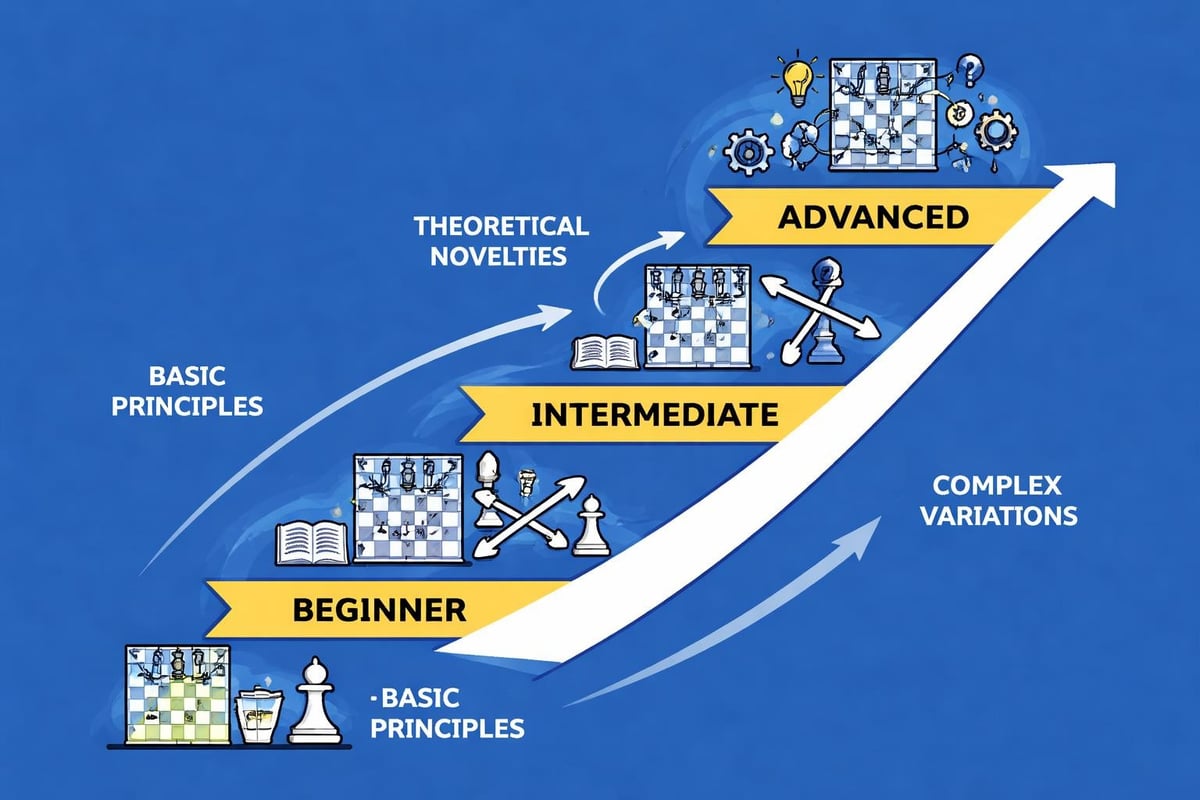
Your rating and experience should guide your PDF selection. Advanced theoretical tomes assume significant chess knowledge and can overwhelm developing players.
Beginners benefit from PDFs that:
- Explain fundamental opening principles
- Focus on ideas rather than memorisation
- Include common opponent mistakes
- Offer clear move explanations
Intermediate and advanced players need:
- Concrete variations and critical positions
- Recent high-level games
- Strategic nuances and positional understanding
- Coverage of sideline responses
If you're just starting your opening education, exploring good beginner chess books can point you towards resources matched to your level.
Integrating PDFs with Your Training Routine
Having resources is pointless without a system for using them consistently.
Daily and Weekly Study Plans
Consistency trumps intensity. Twenty minutes daily beats a five-hour Sunday marathon every time.
Sample weekly schedule:
- Monday: Review one opening variation (15 minutes)
- Tuesday: Play through master games in your repertoire (20 minutes)
- Wednesday: Test yourself on key positions (15 minutes)
- Thursday: Learn a new sideline or response (20 minutes)
- Friday: Quick review of the week's material (15 minutes)
- Weekend: Play games online, applying what you've learned
Keep your current focus PDF readily accessible. Many players keep it open on a second screen or tablet whilst playing online games, allowing quick reference when needed.
Connecting Theory to Practice
Theory without practice is wasted effort. After studying a variation from your chess openings book pdf, you need to play it in real games.
Online chess platforms let you filter opponents by rating and preferred openings. Some players even seek out opponents who play specific defences they're studying, turning each game into practical testing of their preparation.
After each game, return to your PDF. Did the opening unfold as expected? Where did you deviate from theory? Was it an improvement or a mistake? This feedback loop transforms passive reading into active learning.
Historical and Classical Opening Literature
Some of the most valuable chess PDFs are digitised versions of classical texts that have shaped opening theory for decades or even centuries.
Accessing Chess Heritage
Works like the Handbuch des Schachspiels, first published in 1843, influenced opening theory for generations. While specific variations have evolved, the strategic principles these masters identified remain relevant.
The Oxford Companion to Chess provides encyclopaedic coverage that contextualises modern opening theory within chess's broader history.
These historical PDFs offer perspective. When you understand how an opening evolved, you grasp the underlying ideas more deeply than by memorising contemporary computer-approved variations.
Balancing Classical Wisdom with Modern Theory
Should you study opening books from the 1920s? Yes, but with context.
Classical authors excelled at explaining strategic concepts. Modern engines find tactical improvements, but they don't explain why certain pawn structures favour particular piece placements. Combine historical insight with current theory for the deepest understanding.
Building Your PDF Collection Strategically
You don't need dozens of opening books. You need the right ones for your repertoire and level.
Quality Over Quantity
Three well-chosen PDFs that you study thoroughly beat thirty that you skim once and forget.
Prioritise resources that:
- Cover your specific repertoire choices
- Match your current playing strength
- Explain ideas, not just moves
- Include practice exercises or tests
- Receive positive reviews from players at your level
Consider starting with broader chess resources that compile various materials in one place. Checking out comprehensive chess resources can help you identify which specific openings deserve dedicated study before investing in specialised PDFs.
Updating Your Library
Opening theory evolves. Strong novelties emerge, computers refute old lines, and new ideas gain popularity.
Schedule annual reviews of your PDF collection. Are your main resources still current? Have any critical lines been updated? Many publishers release revised editions of popular opening books, and updating your digital library is often simpler and cheaper than replacing physical books.
Making the Most of Free vs Paid Resources
Budget constraints are real. Can you build a solid opening foundation without spending money?
Free Quality Resources
Legitimate free chess openings book pdf options exist, particularly:
- Public domain classics (pre-1924 works)
- Educational materials from non-profit chess organisations
- Sample chapters from commercial books
- Community-created compilations (verify quality carefully)
Free doesn't always mean inferior, but it often means less comprehensive or outdated. Still, classics like Lasker's writings provide tremendous value at zero cost.
When to Invest in Premium Materials
Paid resources typically offer:
- Up-to-date theoretical coverage
- Professional editing and diagram quality
- Comprehensive variation analysis
- Author support and corrections
For openings central to your repertoire, investing in quality paid PDFs makes sense. For secondary or exploratory systems, free materials often suffice.
Many chess education platforms offer bundled resources that provide better value than purchasing individual PDFs. Exploring options like opening toolkits can give you comprehensive coverage at reasonable prices.
Common Pitfalls in PDF Opening Study
Even with excellent resources, players make predictable mistakes that undermine their progress.
The Collector's Trap
Downloading resources feels productive. It isn't. Only studying them creates improvement.
Many players accumulate vast PDF libraries they've barely opened. This creates decision paralysis where you spend more time choosing what to study than actually studying.
Solution: Limit yourself to one or two opening PDFs at a time. Finish working through them before acquiring more.
Memorisation Without Understanding
The worst approach to opening study is treating variations like shopping lists to memorise without understanding the underlying ideas.
When you encounter a recommended move, ask yourself:
- What strategic goal does this move serve?
- What happens if my opponent deviates?
- How does this fit the opening's overall plan?
Understanding lets you handle positions when opponents leave known theory. Pure memorisation leaves you lost after move eight.
Neglecting Black Repertoire
White players often study their first-move choices extensively whilst giving minimal attention to their defences as Black. This creates a lopsided repertoire where you're well-prepared half the time.
Give equal focus to both colours. If anything, studying the best openings for Black deserves extra attention since you must respond to White's choice rather than dictating the opening yourself.
Mastering chess openings doesn't require memorising every variation in existence, but it does demand strategic study of the systems that suit your style and level. Whether you're exploring classical texts or modern theoretical works, a well-chosen chess openings book pdf provides the foundation for confident, principled play from move one. If you're ready to streamline your opening preparation without drowning in overwhelming theory, Chess Cheat Sheets offers precisely organised guides and resources that help you master essential opening ideas efficiently, giving you more time to actually play and enjoy chess rather than getting lost in endless study.


