

Chess opening books have been the cornerstone of serious chess study for decades, but let's be honest – not all of us have time to wade through 400-page tomes dissecting every variation of the Ruy Lopez. Whether you're just starting out or you've been playing for years, finding the right resources to improve your opening repertoire can feel overwhelming. The good news? The landscape of chess education has evolved dramatically, and in 2026, you have more options than ever to learn openings efficiently without getting lost in endless theory.
Why Chess Opening Books Still Matter in 2026
You might be wondering if traditional chess opening books are still relevant when we've got engines analysing millions of positions and AI churning out novelties daily. The answer is a resounding yes, though perhaps not in the way you'd expect.
The value of quality opening literature lies in the explanation, not just the moves. While you can memorise lines from a database, understanding opening theory helps you grasp the underlying ideas that guide your decisions when opponents deviate from known paths.
Modern chess opening books excel at:
- Breaking down complex ideas into digestible concepts
- Explaining typical middlegame plans arising from specific openings
- Highlighting common tactical patterns and pawn structures
- Providing annotated model games that illustrate key themes
- Offering structured learning paths rather than random variation soup
The real question isn't whether you need opening resources – it's which ones will give you the best return on your study time.
Different Types of Chess Opening Books and Resources
Not all opening materials are created equal, and understanding the different formats available can save you countless hours of frustration. Let's break down what's out there and who each type serves best.
Comprehensive Opening Encyclopedias
These massive reference works attempt to cover every reasonable variation of an opening system. They're brilliant if you're a titled player preparing for specific opponents, but for most club players, they're overkill. You'll find hundreds of variations you'll never encounter in practice.
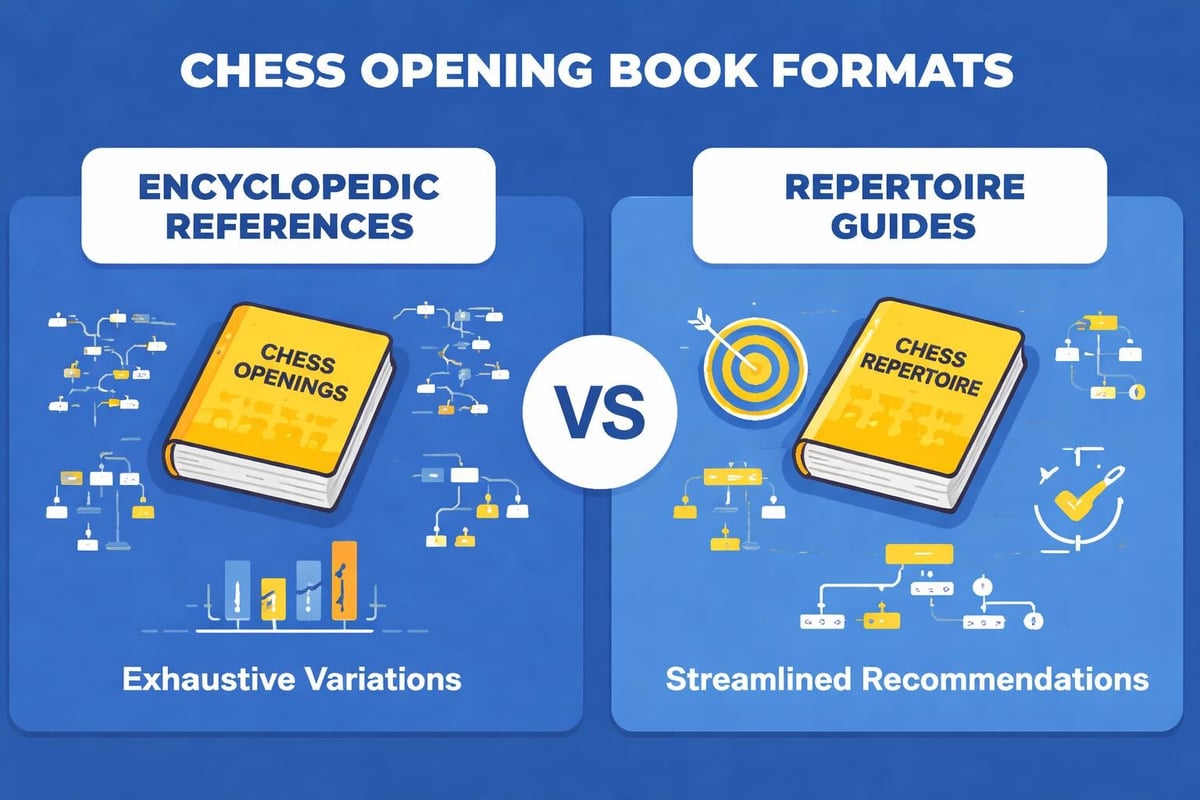
Repertoire Books
This category focuses on giving you a complete arsenal for either White or Black. Rather than showing every possible response, the author recommends specific lines and explains why. These work brilliantly for building a coherent opening system, and they're what most improving players actually need.
What to look for in repertoire books:
- Clear explanations of main plans and ideas
- Coverage of critical sidelines without drowning in minutiae
- Recent examples from high-level games
- Practical advice for handling transpositional options
Opening Primers and Introductions
These lighter resources introduce opening concepts without overwhelming detail. They're perfect for beginners who need to understand fundamental principles before diving into specific variations. Resources like the guides available at Chess Cheat Sheets fall into this category – designed to get you playing confidently without months of memorisation.
| Book Type | Best For | Depth Level | Time Investment |
|---|---|---|---|
| Encyclopedia | Advanced players, specific prep | Exhaustive | Very high |
| Repertoire Guide | Building complete system | Moderate to deep | High |
| Primer/Quick Guide | Learning fundamentals fast | Introductory | Low to moderate |
| Video Course | Visual learners | Varies | Moderate |
Choosing the Right Chess Opening Books for Your Level
Here's where many players go wrong – they buy books that are either too advanced or too basic for their current understanding. I've seen club players purchase dense theoretical manuals meant for masters, only to abandon them after two chapters because they couldn't follow the analysis.
For Beginners (Under 1200 Rating)
At this stage, you don't need deep theory. You need to understand opening principles and have a simple, reliable system. Look for resources that emphasise:
- Controlling the centre
- Developing pieces efficiently
- King safety fundamentals
- Avoiding early tactical disasters
Starting with focused guides like the Italian Game or Caro-Kann Defense helps you build confidence with solid, proven systems before branching out.

For Intermediate Players (1200-1800)
You've got the basics down, now it's time to deepen your understanding. At this level, you benefit from:
- Choosing 1-2 main openings as White and 1-2 defences as Black
- Learning typical middlegame structures that arise from your chosen systems
- Understanding key strategic ideas rather than memorising 20 moves deep
- Studying complete games to see how openings transition into the middlegame
Resources that explain the "why" behind moves become invaluable here. You'll also start appreciating materials that cover how to handle common mistakes – like these common Caro-Kann mistakes many players make.
The development of chess theory shows us that even masters continue refining their opening understanding throughout their careers, so don't feel pressured to know everything at once.
Building an Efficient Opening Repertoire
Let's talk strategy. You could spend years trying to master every opening under the sun, or you can build a focused repertoire that serves you well in 95% of your games. Which sounds more appealing?
The Core Principle: Quality Over Quantity
Pick openings that suit your playing style and stick with them long enough to actually understand them. Constantly switching systems means you never develop the pattern recognition that makes openings feel natural.
Here's a practical framework:
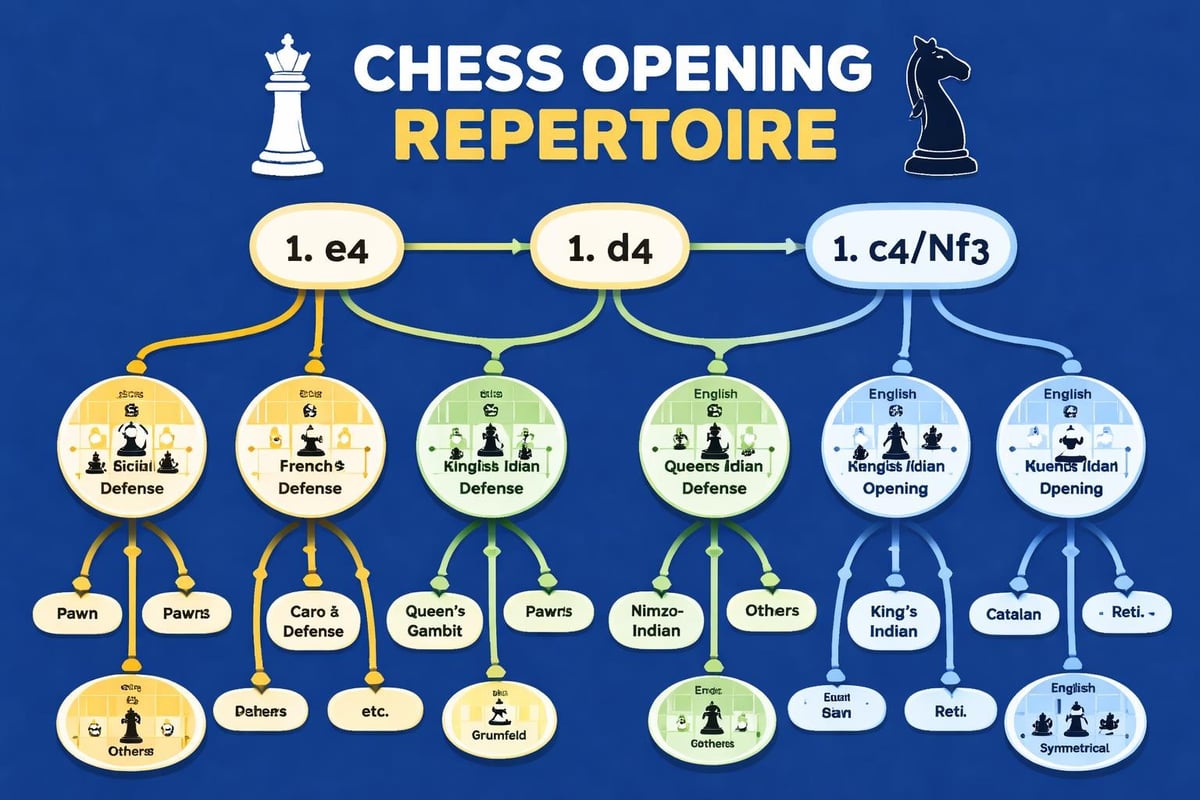
- As White: Choose one main opening (1.e4, 1.d4, or 1.c4) and learn solid responses to Black's main defences
- As Black vs 1.e4: Master one main defence (Caro-Kann, French, or Sicilian)
- As Black vs 1.d4: Pick one response and understand it thoroughly
Balancing Theory with Understanding
This is crucial: don't just memorise moves. After studying a line, ask yourself:
- What's the main plan for both sides?
- Which pieces belong on which squares?
- What pawn structure are we heading towards?
- How does this typically transition to the middlegame?
When you can answer these questions, you're actually learning chess rather than just memorising sequences.
Digital Resources vs Traditional Books
In 2026, the debate between physical books and digital resources has largely been settled: you probably need both, but in different contexts. Each format offers distinct advantages depending on how you learn best.
Why Physical Books Still Work
There's something about sitting down with a physical book and a chessboard that enhances retention. You're not clicking through variations mindlessly – you're actively setting up positions, which reinforces learning. Plus, no screen distractions when you're deep in study mode.
Digital Advantages You Can't Ignore
Modern platforms offer interactive features that traditional books simply can't match. You can play through variations instantly, get immediate feedback from engines, and access databases with millions of games. Many platforms even adapt to your skill level and track your progress.
The sweet spot? Use streamlined digital resources for quick reference during games and focused study sessions with physical materials when you're building foundational knowledge. Quick-reference guides and cheat sheets work perfectly as digital companions to your more thorough study.
| Format | Pros | Cons | Best Use Case |
|---|---|---|---|
| Physical Books | Deep focus, better retention, no distractions | Can't search, no engine analysis | Structured study sessions |
| Digital Platforms | Interactive, searchable, constantly updated | Screen fatigue, distraction risk | Quick lookups, tactical training |
| PDF Resources | Portable, searchable, affordable | Requires discipline to study properly | Travel, reference material |
| Cheat Sheets | Ultra-quick reference, distilled information | Less depth than full books | Tournament prep, rapid review |
Common Mistakes When Using Chess Opening Books
Let me share something I see constantly: players buying excellent opening books and then using them completely wrong. It's like having a gym membership and only using the car park.
Mistake #1: Memorising Without Understanding
You've probably encountered this player – they rattle off 15 moves of theory perfectly, then collapse immediately when you play move 16 that's not in their book. They've memorised lines without understanding the ideas behind them.
The fix? For every line you study, write down (yes, actually write) the main ideas in your own words. What's the plan? What are you trying to achieve? This forces actual understanding.
Mistake #2: Studying Too Many Openings Simultaneously
Jack of all trades, master of none. When you're trying to learn the Sicilian, King's Indian, and Grünfeld all at once, you end up confused and unable to play any of them well.
Focus. Pick one opening, study it for at least three months, play 50+ games with it, then consider adding another to your repertoire.
Mistake #3: Ignoring Move Orders
Opening books often show the "ideal" move order, but real games involve transpositional possibilities. Understanding how different move orders can reach the same position – or lead to completely different games – is crucial for practical play.
Research on chess opening complexity demonstrates how interconnected opening systems really are, making flexible understanding more valuable than rigid memorisation.
Mistake #4: Not Playing Your Openings
This seems obvious, but you'd be surprised how many players study openings extensively without actually playing them in games. Reading about the London System is one thing; dealing with the King's Indian when you're on the clock is entirely different.
After studying a new line, play at least 5-10 games with it quickly. You'll discover which positions feel natural and which need more work.
Maximising Your Study Time with Opening Resources
Time is precious, and most of us can't dedicate hours daily to chess study. Here's how to get maximum benefit from minimal time investment.
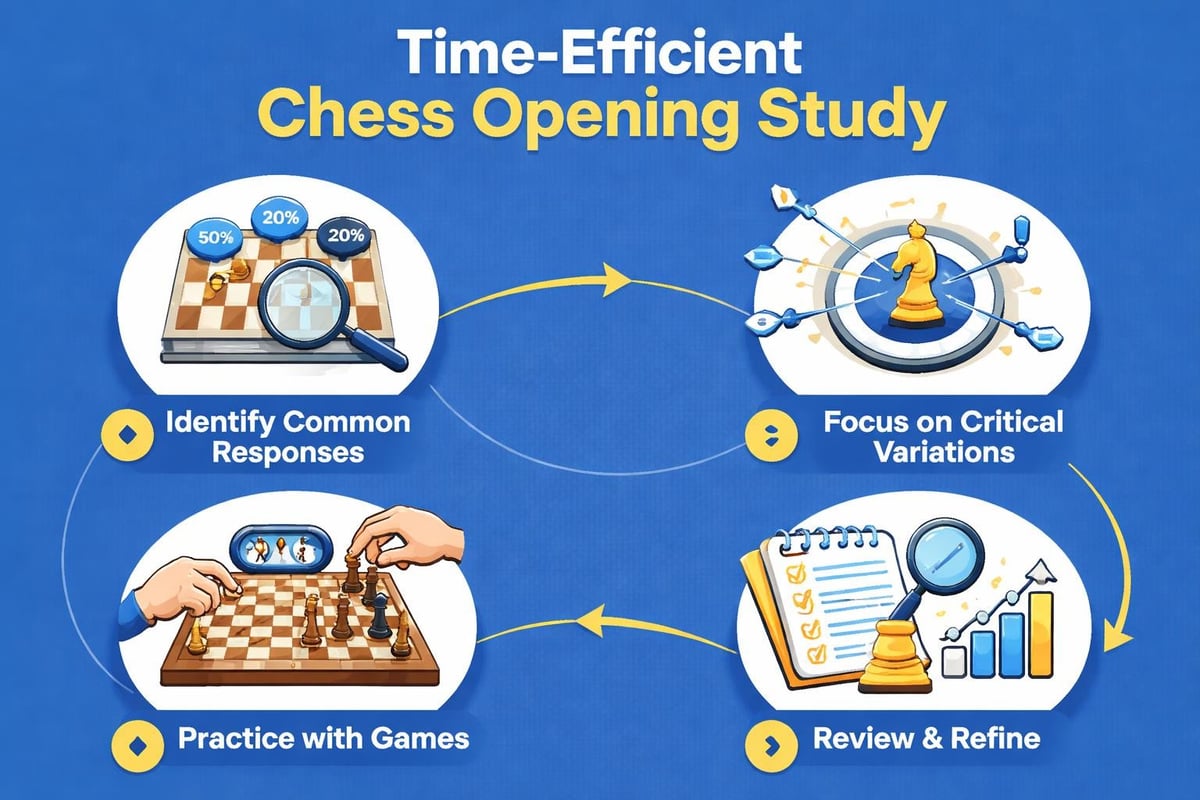
The 80/20 Approach to Opening Study
Focus on the 20% of variations that occur in 80% of your games. For most club players, this means:
- Main line responses to your chosen openings
- Two or three critical sidelines your opponents actually play
- General principles for handling unusual moves
Skip the obscure variations that appear once in a hundred games. When you encounter them, learn from that specific game rather than trying to prepare for every possibility in advance.
Creating Effective Study Sessions
Here's a proven 30-minute study session structure:
- 5 minutes: Review main ideas of your chosen opening
- 15 minutes: Work through 2-3 annotated games showing key themes
- 10 minutes: Set up critical positions and practice finding the right plans
Short, focused sessions beat marathon study binges where you're mentally checked out after the first hour. Your brain needs time to consolidate learning between sessions.
Leveraging Spaced Repetition
Don't study an opening once and assume you've got it. Return to your opening materials regularly:
- Day 1: Initial study
- Day 3: Quick review
- Week 1: Practice games
- Week 2: Review problematic positions
- Month 1: Comprehensive revision
This approach, backed by learning science, ensures information moves from short-term to long-term memory.
Specific Recommendations for Popular Openings
Let's get practical. Here are targeted suggestions for building your repertoire based on common opening choices, along with the types of resources that work best for each.
For 1.e4 Players
If you play 1.e4, you need solid responses to the Sicilian, French, and Caro-Kann as a minimum. Rather than learning every anti-Sicilian system, pick one approach and master it. The same principles apply to handling the French and other defences.
For 1.d4 Enthusiasts
The Queen's pawn opening leads to rich strategic battles. You'll face the King's Indian, Nimzo-Indian, and various Slav setups regularly. Resources explaining pawn structures and piece placement tend to be more valuable than those focusing purely on move-order minutiae.
Systems like the London System offer a relatively straightforward entry point while still providing plenty of strategic depth.
Building a Black Repertoire
As Black, you need answers to both 1.e4 and 1.d4, plus something against the occasional 1.c4 or 1.Nf3. The Caro-Kann provides a solid, reliable defence against 1.e4 without requiring encyclopaedic knowledge.
Against 1.d4, consider what style suits you:
- Solid and strategic? Look at the Queen's Gambit Declined
- Dynamic and complex? The King's Indian or Grünfeld
- Practical and flexible? The Nimzo-Indian or Queen's Indian
Whatever you choose, commit to it for at least several months of serious play before judging its effectiveness.
Integrating Opening Study with Overall Improvement
Here's a truth many chess opening books won't tell you: improving your opening play alone won't dramatically boost your rating if your tactics are weak or your endgame technique is poor. Opening study must fit into a balanced improvement plan.
The Recommended Time Allocation
For players under 1500:
- 30% Opening principles and systems
- 50% Tactical training
- 20% Basic endgames
For players 1500-1800:
- 35% Opening repertoire
- 40% Tactics and calculation
- 25% Endgames and strategy
Notice that even for intermediate players, openings shouldn't dominate your study time. When you've got a solid repertoire that gets you reasonable positions, diminishing returns set in quickly.
Connecting Openings to Middlegame Plans
The best chess opening books seamlessly transition from the opening phase to middlegame strategy. When studying any opening, identify:
- Typical pawn structures: What formations arise and how do you play them?
- Piece activity: Which pieces become strong or weak in resulting positions?
- Key strategic themes: Are you playing for a kingside attack, queenside expansion, or central control?
This holistic approach, rather than move memorisation, transforms opening knowledge into actual playing strength. Understanding how the Italian Game transitions to the middlegame exemplifies this connected thinking.
Staying Current Without Drowning in Theory
Chess theory evolves constantly. New ideas emerge at the elite level, filters down through databases, and eventually impact club play. How do you keep your openings fresh without spending hours tracking theoretical developments?
Practical Approaches for Club Players
Be selective about updates. Unless you're playing in strong tournaments regularly, most theoretical novelties won't affect your games. Focus on understanding core ideas rather than chasing the latest grandmaster preparation.
Review your own games. When you lose from the opening or struggle in familiar positions, that's when to consult current resources. Problem-driven learning is far more effective than trying to stay current with everything.
Use filtered information sources. Rather than following every game played at the elite level, find curated sources that highlight genuinely important developments in your openings. Platforms like ChessPublishing.com offer monthly updates organised by opening, making it easier to track what actually matters.
When to Update Your Repertoire
Your opening repertoire needs an overhaul when:
- You're consistently getting poor positions from your current systems
- Opponents are repeatedly exploiting a specific weakness in your setup
- Your playing style has evolved and your current openings no longer suit you
- Major theoretical developments have significantly changed the evaluation of your main lines
Otherwise, stick with what you know and deepen your understanding rather than constantly switching systems.
Supplementing Books with Other Resources
Chess opening books work best as part of a broader learning ecosystem. Here's how to create a complete opening study environment without breaking the bank or overwhelming yourself.
Video Content and Courses
Many players find video instruction more engaging than reading. Watching a strong player explain opening ideas while demonstrating on the board brings concepts to life in ways text sometimes can't. Just remember: passive watching doesn't equal learning. Take notes and practice what you've learned.
Working with Databases
Game databases let you see how strong players actually handle your chosen openings in practice. After studying a variation in a book, search the database for recent high-level games featuring that line. You'll often discover practical insights that books omit.
Quick Reference Materials
During tournaments or online games, you don't have time to consult detailed books. That's where streamlined opening guides prove invaluable. Having the key ideas and critical variations distilled to a single page means you can refresh your memory in minutes rather than hours.
Essential supplement toolkit:
- Main repertoire book for thorough study
- Quick-reference cheat sheets for rapid review
- Database access for practical examples
- Tactical trainer focused on your opening's typical patterns
- Occasional video courses for alternative perspectives
Making Opening Knowledge Stick
You've invested time studying chess opening books, but how do you ensure that knowledge stays accessible when you need it? Here are proven techniques for retention and recall.
Active Learning Techniques
Quiz yourself regularly. After studying a line, close the book and try to recall the moves and ideas. This retrieval practice strengthens memory far more effectively than passive re-reading.
Teach the opening to someone else (or pretend to). Explaining concepts forces you to organise your knowledge and identify gaps in your understanding.
Create your own notes. Don't just highlight someone else's book. Write summaries in your own words, create diagrams of critical positions, and maintain a personalised opening notebook.
Practice with Purpose
Playing blitz games isn't enough to consolidate opening knowledge. Try these focused approaches:
- Play slower games (15+10 or longer) where you have time to recall your preparation
- Analyse your games specifically for opening-related questions
- Set up positions from your opening and practice finding the right plans
- Play training games where you deliberately reach specific variations you're studying
Regular Maintenance
Schedule monthly "opening reviews" where you revisit your main systems. This doesn't mean studying new variations – simply refreshing the core ideas keeps them accessible. Think of it like maintaining software rather than constantly installing new programmes.
Chess opening books remain powerful tools for improvement when used wisely – focusing on understanding over memorisation, selecting appropriate materials for your level, and integrating opening study into a balanced improvement plan. Rather than drowning in encyclopaedic theory, today's improving players benefit most from streamlined, practical resources that get them playing confidently without months of preparation. Chess Cheat Sheets provides exactly this approach, offering focused guides, quick-reference materials, and practical resources designed to help you build a solid opening repertoire efficiently, so you can spend less time studying and more time enjoying the game you love.


