

You've decided to improve your chess game, and that's brilliant. But walking into a bookshop (or browsing online) and seeing hundreds of chess titles can feel overwhelming. Which chess books for beginners actually help you improve? And more importantly, which ones will you actually finish reading instead of letting them gather dust on your shelf? Let's explore the books that genuinely make a difference to your chess development, without drowning you in theoretical positions you'll never encounter in your games.
Why Physical Books Still Matter in 2026
You might wonder whether you need books when there are countless free online chess courses available. Here's the thing: books offer something unique. They provide structured learning without the distraction of notifications, video suggestions, or the temptation to jump between topics.
Physical books force you to slow down and absorb concepts properly. When you're working through a chess position on the page, you're engaging with the material differently than when you're clicking through an app. Your brain actually retains more.
That said, books work best as part of a broader learning approach. Combine them with practical resources like chess opening guides and regular play, and you'll see faster improvement.
What Makes a Great Beginner Chess Book
Not all chess books for beginners are created equal. Some brilliant books for intermediate players are absolutely terrible for newcomers. So what should you look for?
Clear Explanations Without Jargon
The best beginner books explain concepts in plain English. If you're constantly stopping to decode notation or terminology, you're not learning chess. You're learning a new language, which is a different skill entirely.
Key features of beginner-friendly books:
- Diagrams on nearly every page
- Step-by-step explanations of why moves work
- Real-game examples, not just abstract positions
- Exercises that reinforce each concept immediately
- Progressive difficulty that builds confidence
Balance Between Theory and Practice
You need both understanding and application. A book that's all theory becomes boring quickly. One that's all puzzles without context won't help you understand the deeper patterns.
The sweet spot? Books that introduce a concept, show you why it matters, then give you positions to solve that reinforce that specific idea.
Essential Chess Books for Beginners in 2026
Let's look at specific titles that have stood the test of time and continue helping beginners improve. These aren't just popular books. They're books that actually work.
Bobby Fischer Teaches Chess
This programmed learning book remains extraordinary. Fischer's approach uses small, incremental steps that build your pattern recognition naturally. You're not memorizing. You're developing instincts.
| Strengths | Considerations |
|---|---|
| Focuses purely on checkmate patterns | Limited coverage of opening principles |
| Immediate feedback on every question | Can feel repetitive for some learners |
| Builds confidence through small wins | Dated notation style |
| Affordable and widely available | Focuses mainly on tactics, not strategy |
The genius of this book lies in its structure. Each page asks a question, and you discover the answer by turning the page. This active learning approach works brilliantly for beginners who find traditional chess books intimidating.
Play Winning Chess by Yasser Seirawan
Seirawan's series stands out for its conversational approach. He writes like he's sitting across from you, explaining concepts as a friendly coach would. Chess.com's recommendations for beginners frequently feature this title for good reason.
What you'll learn:
- The fundamental principles of force, time, and space
- How pieces work together rather than in isolation
- Basic tactical patterns that appear in every game
- When to break the "rules" you've learned
- How to think about planning in chess
This book doesn't overwhelm you with variations. Instead, it builds your chess understanding from the ground up, which matters more than memorizing specific moves.
Logical Chess: Move by Move by Irving Chernev
Every single move in every game gets an explanation. That's the promise and the power of this book. You're not left wondering why a master played a particular move. Chernev tells you explicitly.
For beginners struggling to understand the "why" behind good moves, this book is transformative. You start seeing chess as a series of logical decisions rather than mysterious genius. Chess World's categorized recommendations highlight how this approach suits different learning styles.
The Complete Idiot's Guide to Chess
Don't let the title fool you. This comprehensive introduction covers everything from basic piece movement through opening principles to endgame fundamentals. The writing style keeps things light without sacrificing depth.
What makes this particularly valuable? It acknowledges that beginners have questions they might feel embarrassed asking. The book answers them all without judgment.
Building Your Chess Foundation
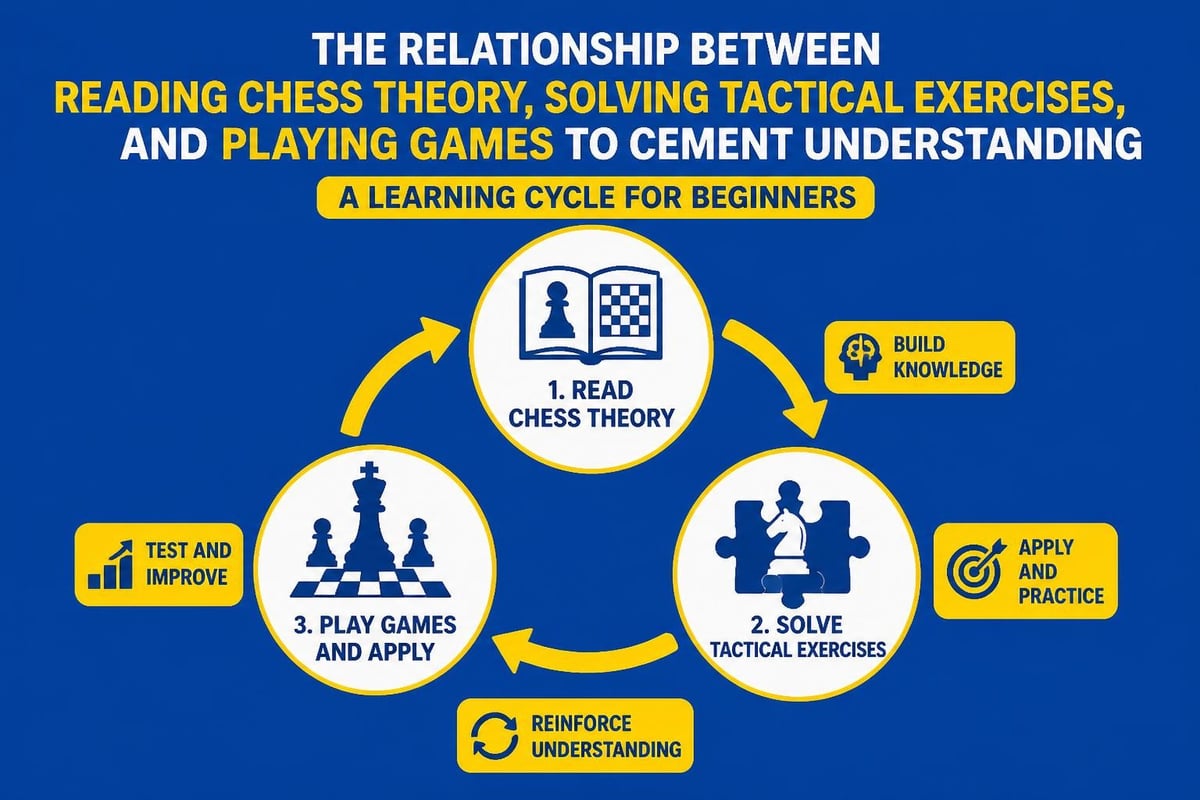
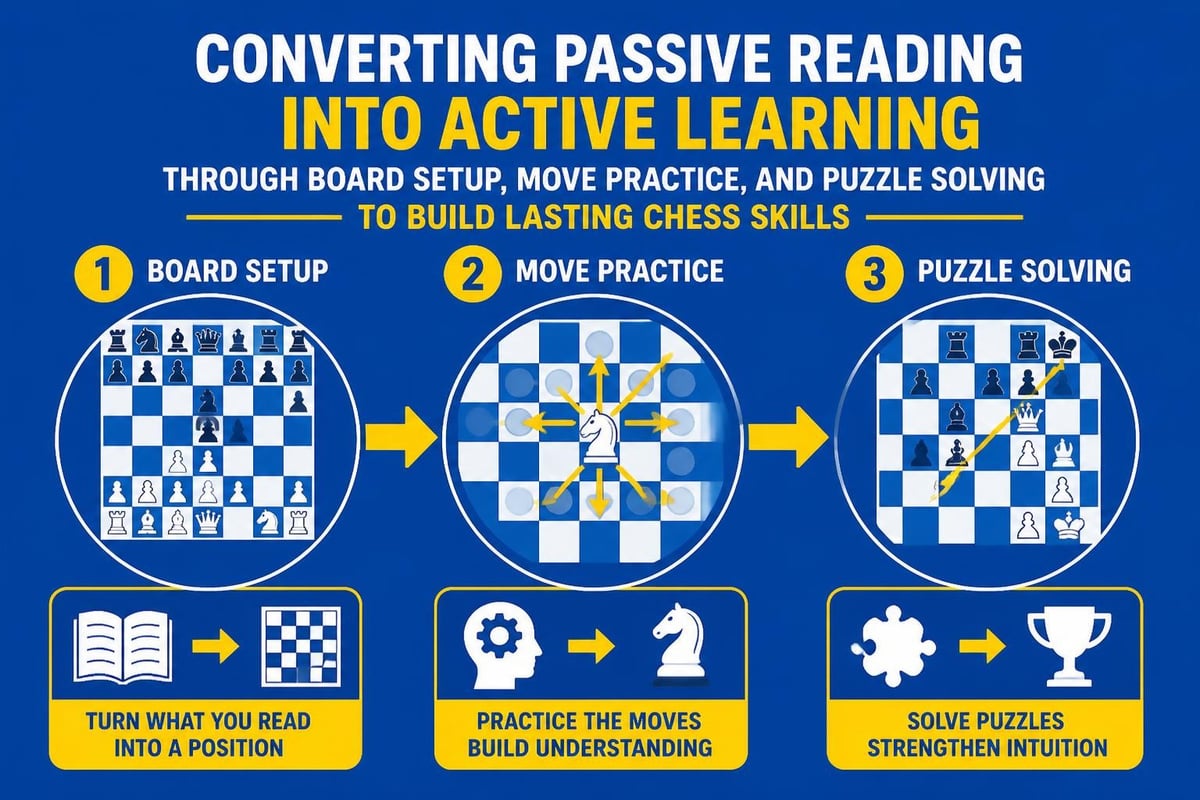
Reading chess books for beginners effectively requires more than passive absorption. You need a system for turning information into improvement.
Set Up a Board While Reading
This isn't optional. Having a physical board (or a digital one on a second screen) transforms your learning. When you physically move pieces through the positions shown in the book, you're encoding the information kinesthetically as well as visually.
Your reading setup should include:
- The book open to the current position
- A chess board matching the diagram
- A notebook for recording insights
- Minimal distractions (yes, put your phone away)
Work Through Every Exercise
Skipping exercises because they look easy is tempting. Don't do it. Even simple puzzles reinforce pattern recognition. And sometimes those "easy" positions contain subtleties you'll miss if you rush through.
Think of exercises like chess puzzles designed specifically to reinforce what you've just learned. They're not tests. They're practice opportunities.
Complementing Books With Modern Resources
Chess books for beginners work best when combined with contemporary tools. You don't need to choose between old and new learning methods. You can use both strategically.
When to Use Books vs Digital Resources
Books excel at providing structured, distraction-free learning. They're perfect for understanding concepts and building your theoretical foundation. Digital resources shine for immediate feedback, spaced repetition, and tracking your progress over time.
| Learning Goal | Best Resource Type | Why It Works |
|---|---|---|
| Understanding principles | Books | Deep focus without distractions |
| Tactical pattern training | Online puzzle tools | Immediate feedback, spaced repetition |
| Opening repertoire | Cheat sheets | Quick reference, easy to review |
| Endgame technique | Books + online databases | Theory plus practical testing |
| Game analysis | Digital tools with engines | Objective feedback on mistakes |
Creating Your Personal Study Plan
Read one chapter or section at a time. Rushing through an entire book in a weekend won't help you improve. Chess understanding develops through reflection and application, not speed-reading.
After each study session, play a few games focusing on the concept you've just learned. If you've read about controlling the center, make that your focus in your next three games. This targeted practice accelerates improvement far more than random play.
Common Mistakes When Choosing Chess Books
Many beginners waste money on books that aren't appropriate for their level. Understanding these pitfalls saves you both money and frustration.
Buying Too Advanced Material
That 800-page opening encyclopedia might look impressive on your shelf, but it won't help you if you're still figuring out basic tactics. Chess Doctrine's tested recommendations emphasize matching books to your actual playing strength, not your aspirations.
Warning signs a book is too advanced:
- Assumes you know algebraic notation fluently
- Discusses subtle positional nuances without tactical context
- Covers opening variations 15 moves deep
- Contains minimal explanatory text between diagrams
- References games and players you've never heard of
Collecting Instead of Studying
Buying five chess books doesn't make you five times better than buying one. Actually working through a single quality book teaches you more than skimming five. Resist the urge to build a chess library before you've mastered the fundamentals.
Focus on completing one book before purchasing another. You'll know you've truly absorbed the material when you can explain the concepts to someone else.

Specialized Topics for Beginners
Once you've built a basic foundation, you might want books covering specific aspects of the game. But timing matters here.
Tactics Books
Tactical pattern recognition forms the foundation of chess improvement. Books dedicated to tactics help you spot these patterns faster. However, pure puzzle books work better after you understand basic principles.
Consider starting with books that explain why tactical patterns work, not just collections of positions to solve. Understanding the geometry behind pins, forks, and skewers helps you spot them in your own games.
Opening Guides for Beginners
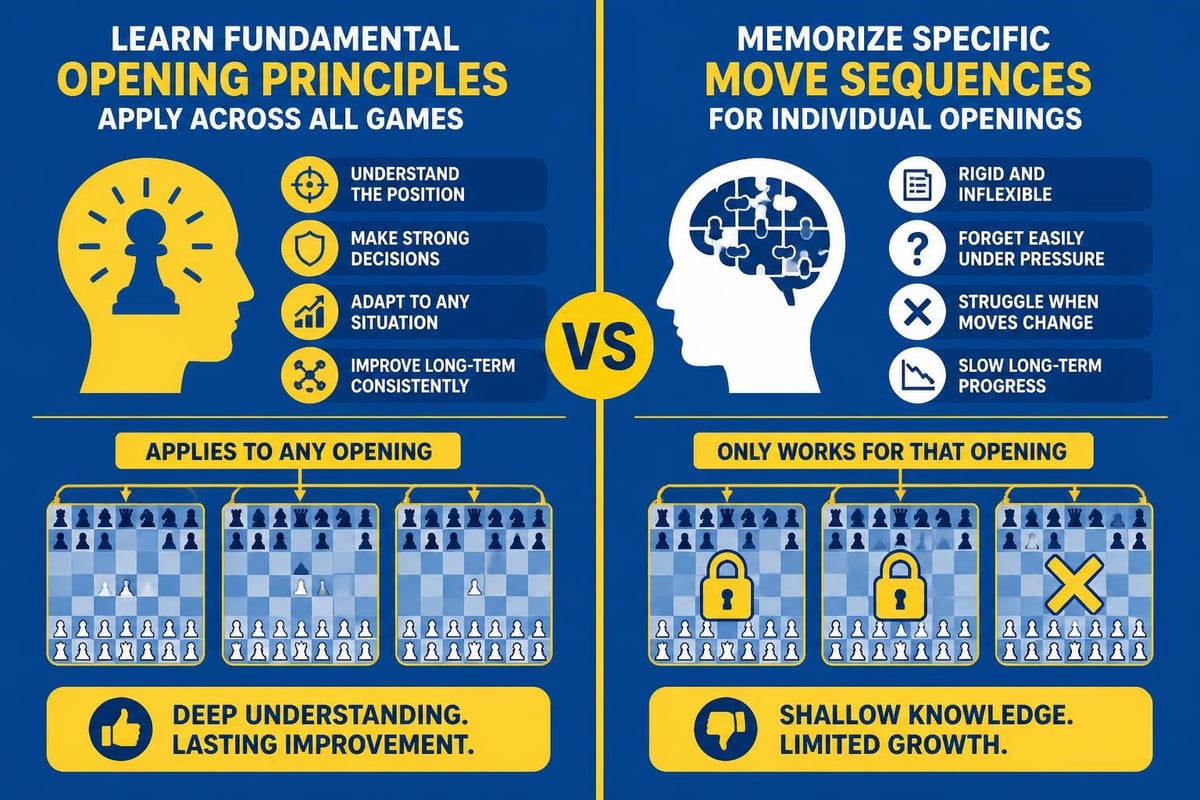
Here's where many beginners go wrong. They buy detailed opening books when they'd benefit more from understanding opening principles. Chess.com's analysis of which books actually help beginners consistently shows that principle-based learning beats memorization.
Learn the concepts first:
- Control the center with pawns and pieces
- Develop your pieces efficiently
- Castle your king to safety
- Connect your rooks
- Avoid moving the same piece twice in the opening
After you understand these principles, simplified resources like opening cheat sheets help you build a basic repertoire without overwhelming detail.
Making Books Work for Your Schedule
You don't need hours of daily study to benefit from chess books for beginners. Consistency matters more than volume.
The 20-Minute Daily Approach
Twenty focused minutes beats an unfocused hour every time. Set a timer, eliminate distractions, and engage deeply with the material. This sustainable approach builds genuine understanding without burning you out.
Sample 20-minute session:
- 5 minutes reviewing yesterday's concepts
- 10 minutes learning new material
- 5 minutes solving related exercises
This structure ensures you're not just consuming information. You're processing and applying it, which is where real improvement happens.
Tracking Your Progress
Keep notes about what you've learned and how it's appearing in your games. When you successfully apply a concept from your reading in an actual game, that reinforcement makes the lesson stick.
Your notes don't need to be elaborate. Simple observations like "Used the fork pattern from Chapter 3 to win a knight" create powerful connections between study and practice. Understanding your chess Elo progression helps you measure whether your reading is translating to practical improvement.
Beyond Your First Chess Book
After you've worked through a foundational book, you'll have better judgment about what to study next. Your games will reveal your weaknesses, and you can choose books addressing those specific gaps.
Maybe you're losing won endgames, which suggests you need endgame training. Or perhaps you're getting crushed in the opening, which points toward studying opening principles more deeply. Let your actual playing experience guide your reading choices.
The best recommendations from experienced players all emphasize this point: study what you need, not what seems impressive. Chess improvement is personal, and your book selection should reflect your specific challenges.
Building a Personal Reference Library
Eventually, you'll develop a small collection of books you return to repeatedly. These become your reference library, trusted sources you consult when you need clarity on specific topics.
This library develops organically. You'll discover which authors' teaching styles resonate with you. Some players love detailed explanations. Others prefer concise, diagram-heavy approaches. Neither is better. They're just different.
Signs a book deserves a permanent spot on your shelf:
- You find yourself recommending it to other beginners
- You've returned to it multiple times for reference
- The concepts have directly improved your practical play
- The writing style makes difficult concepts accessible
- You discover new insights even on rereading
Quality matters more than quantity. Three well-chosen, thoroughly studied books teach you more than twenty partially-read ones.
Alternative Learning Formats
While we're focusing on chess books for beginners, it's worth acknowledging that some people learn better through other formats. Videos, courses, and interactive tools all have their place.
The key is honest self-assessment. If you've bought three chess books and haven't finished any of them, perhaps books aren't your optimal learning format. That's fine. Resources like beginner PDFs might suit your learning style better.
However, before abandoning books entirely, consider whether the issue is the book or your approach. Are you trying to read too much at once? Are you reading without a board? Are you skipping the exercises? Sometimes tweaking your method makes all the difference.
Investment Considerations
Chess books for beginners typically cost between £10 and £25. That's remarkably inexpensive compared to lessons or courses. But even modest investments deserve careful consideration.
| Purchase Strategy | Pros | Cons | Best For |
|---|---|---|---|
| Buy new physical books | Support authors, pristine condition | Higher cost | Learners who value new materials |
| Buy used copies | Significant savings | May have markings, wear | Budget-conscious students |
| Library borrowing | Free, try before buying | Limited availability, return deadlines | Sampling different styles |
| Digital editions | Portable, searchable | Harder to use with physical board | Readers with tablets/e-readers |
Whatever you choose, make sure you actually use what you buy. The best chess book is the one you'll actually read and work through completely.
Finding the right chess books for beginners accelerates your improvement by providing structured, focused learning that builds genuine understanding rather than just memorized patterns. Whether you choose classic titles or modern approaches, the key is matching the book to your current level and committing to working through it completely. Ready to complement your reading with practical tools? Chess Cheat Sheets offers streamlined guides, puzzles, and opening resources that turn the principles you're learning into practical skills you can use in every game, helping you improve efficiently without endless study sessions.


