

You've got your chess set in front of you, pieces scattered across the board, and you're ready to play your first game. But wait-how exactly should everything be arranged? Getting the chess board set up correctly is the essential first step in your chess journey, and whilst it might seem straightforward, there are specific rules and conventions that every player needs to know. Whether you're teaching a child, preparing for your first tournament, or simply want to avoid that awkward moment when someone points out your board's facing the wrong way, this guide will walk you through everything you need to know about setting up your chess board properly.
Understanding Board Orientation: Light Square on Your Right
Before you place a single piece, you need to get the board itself positioned correctly. This is perhaps the most common mistake beginners make, and it's an easy one to avoid.
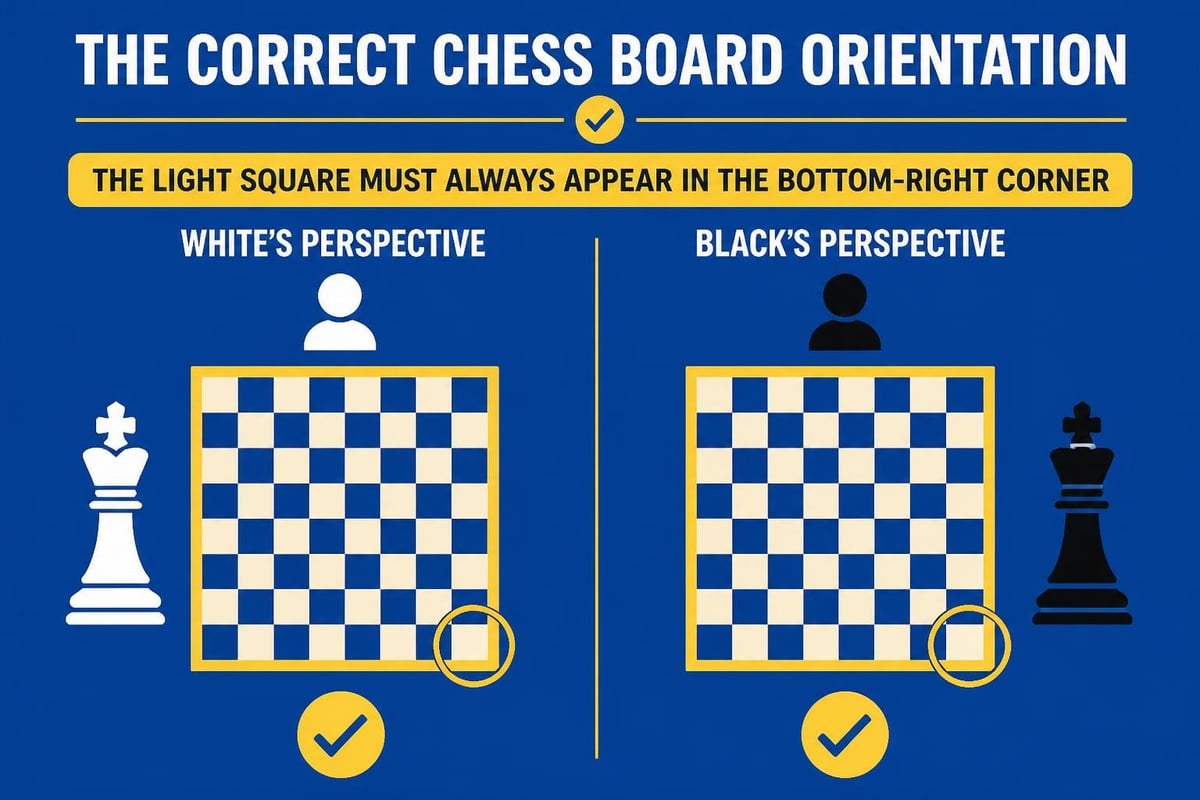
The golden rule? The light square must always be in your bottom-right corner. It doesn't matter if you're playing with white or black pieces-this rule applies to both players. When you sit down at the board, glance at that corner nearest your right hand. If it's a dark square, rotate the board 90 degrees.
Why does this matter? Well, proper board orientation ensures that all chess notation, recorded games, and instructional materials align with your physical setup. When you're studying chess openings or following along with master games, having your board oriented correctly makes everything infinitely easier.
The "White on Right" Memory Trick
Here's a simple mnemonic that's helped thousands of players remember the correct orientation: "White on right" or "light on right". Both phrases work beautifully and stick in your memory.
Think of it this way: every time you sit down to play, you're performing a small ritual. Check that bottom-right corner. Light square? You're good to go. Dark square? Give it a quarter turn.
Setting Up the Pieces: A Step-by-Step Approach
Now that your board is oriented correctly, it's time to place your pieces. The chess board set up follows a logical pattern that's easier to remember than you might think.
Rank One: The Back Row
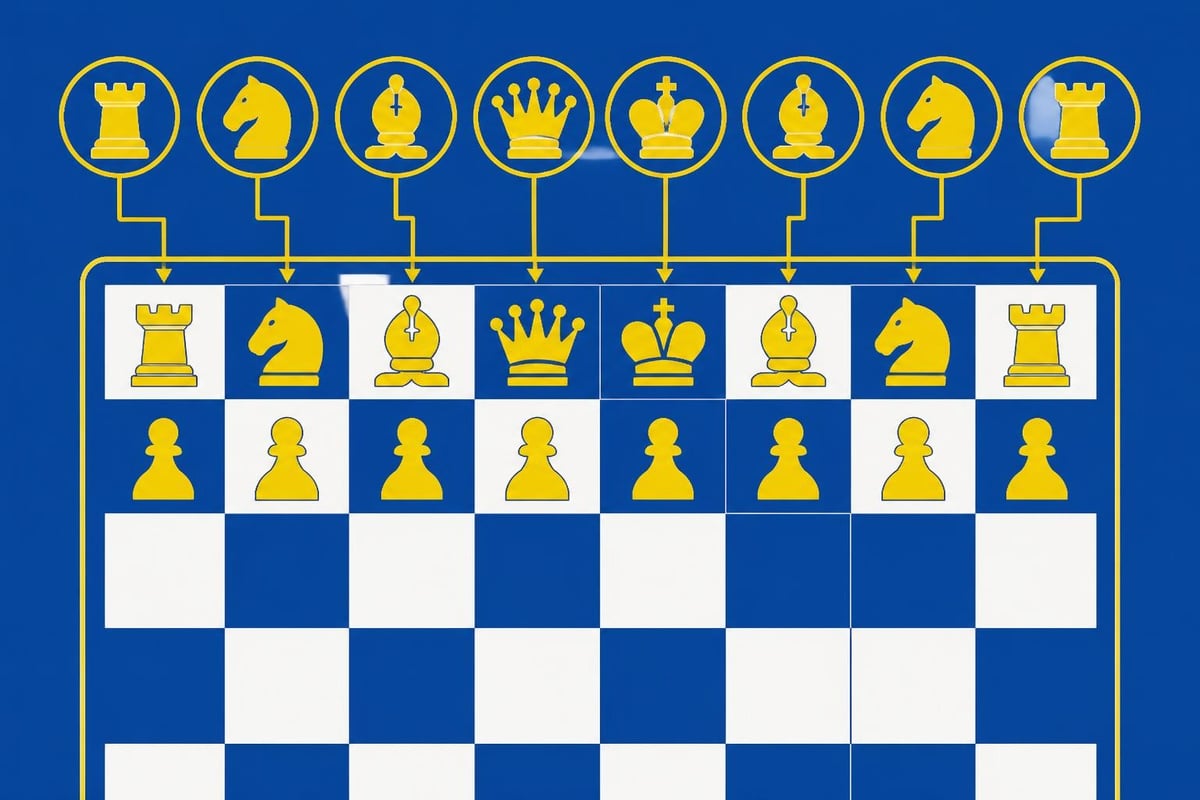
Your first rank (the row closest to you) holds your most powerful pieces. Let's build this from the outside in:
- Rooks in the corners - Place both rooks on the corner squares (a1 and h1 for white, a8 and h8 for black)
- Knights next to rooks - The knights go on b1 and g1 (or b8 and g8 for black)
- Bishops beside knights - Bishops occupy c1 and f1 (c8 and f8 for black)
- Queen on her colour - This is crucial: the white queen goes on d1 (a light square), and the black queen goes on d8 (a dark square)
- King takes the remaining square - Your king fills the last spot on the back rank
The phrase "queen on her own colour" is your best friend here. White queen on light square, black queen on dark square. Get this right, and you've avoided another classic beginner mistake.
Rank Two: The Pawn Wall
This bit's refreshingly simple. All eight pawns line up on your second rank (rank 2 for white, rank 7 for black). Every square on that rank gets a pawn. No gaps, no exceptions.
Your pawns form a protective wall in front of your more valuable pieces, and as you'll discover when you start exploring chess openings, how you move these pawns in the opening stages shapes your entire game.
Common Setup Mistakes and How to Avoid Them
Even experienced players occasionally make setup errors when they're distracted or playing casually. Let's look at the mistakes that crop up most frequently.
The Switched Royals Problem
Swapping the king and queen positions is incredibly common. You'll see this happen at club level, in parks, and even occasionally in casual online play where physical boards are involved.
How to catch it: Remember that the queens should be "facing each other" across the centre of the board. If your white queen is on d1 and the black queen is on d8, you're golden. If they're on e-file, something's gone wrong.
| Common Mistake | Correct Setup | Quick Check |
|---|---|---|
| Queen and king swapped | Queen on her colour | Queens face each other on d-file |
| Board rotated 90° | Light square bottom-right | Check your right corner |
| Knights and bishops reversed | Knights on b/g files | Knights closer to rooks |
Mirror Image Confusion
Sometimes players set up their pieces as a mirror image of their opponent's, which sounds logical but creates chaos. Your pieces should match your opponent's setup, not mirror it.
Think about it: both white queens sit on light squares (d1 and d8 are both light). Both black kings sit on light squares (e1 and e8 are both light). The pieces occupy the same files, just different ranks.
Why Correct Setup Matters for Your Chess Development
You might wonder whether a small setup mistake really matters, especially in casual games. Actually, starting with the correct chess board set up builds crucial habits that support your entire chess education.
When you're studying tactics and strategies, the positions you see in books, videos, and apps all assume standard setup. If your board's oriented differently, translating these lessons becomes unnecessarily difficult.
Notation and Record-Keeping
Chess notation relies on the board being set up in the standard way. The square a1 is always the bottom-left corner from white's perspective-a light square where white's queenside rook begins the game.
If you want to record your games, analyse them later, or share them with coaches and friends, you need that consistency. Learning how to play chess with proper notation from day one accelerates your improvement dramatically.
Double-Checking Your Setup: A Quick Verification Method
Before you start your game, run through this rapid checklist. It takes about five seconds and prevents embarrassing mid-game discoveries.
The Five-Second Setup Check
- Corner check: Is there a light square in your bottom-right corner?
- Queen check: Is your queen on her own colour (white on light, black on dark)?
- Pawn count: Do you have exactly eight pawns forming an unbroken line?
- Symmetry check: Do both sides of the board mirror each other?
- File check: Are your rooks on the a and h files?
This systematic approach becomes second nature after a few games. You'll find yourself automatically verifying the setup without conscious thought.
Teaching Others the Proper Chess Board Set Up
If you're introducing chess to children, friends, or students, teaching the correct setup is your first lesson. Make it engaging rather than overwhelming.
Breaking It Down for Beginners
Start with the board orientation-that light square on the right. Once that's locked in, build the pieces in stages:
- Place all the pawns first (many beginners find this least intimidating)
- Add the rooks in the corners
- Work inward with knights and bishops
- Finish with the royal couple in the centre
Expert chess educators often recommend letting beginners set up the board multiple times in one session. Repetition builds muscle memory and confidence.
Fun Memory Games
Try this: set up the board correctly, then scramble all the pieces. Time yourself reassembling everything properly. Can you beat your previous time? This transforms a potentially tedious task into an engaging challenge.
For younger players, creating a story around the setup helps tremendously. The rooks are castles in the corners, knights are horses that protect them, bishops stand beside knights, and the royal family occupies the centre of the back rank.

Special Considerations for Different Chess Variants
Whilst standard chess has one universal setup, you might encounter situations where the arrangement differs slightly. Understanding these variations prevents confusion.
Chess960 (Fischer Random Chess)
In this variant, the back-rank pieces are randomised whilst following specific rules. However, the pawns always stay on the second rank, and the board orientation remains identical-light square on your right.
Training Positions
When you're working on specific chess opening strategies, you'll often start from positions several moves into the game. These aren't "wrong" setups-they're deliberate training positions designed to focus on particular patterns and ideas.
Converting Setup Knowledge into Opening Preparation
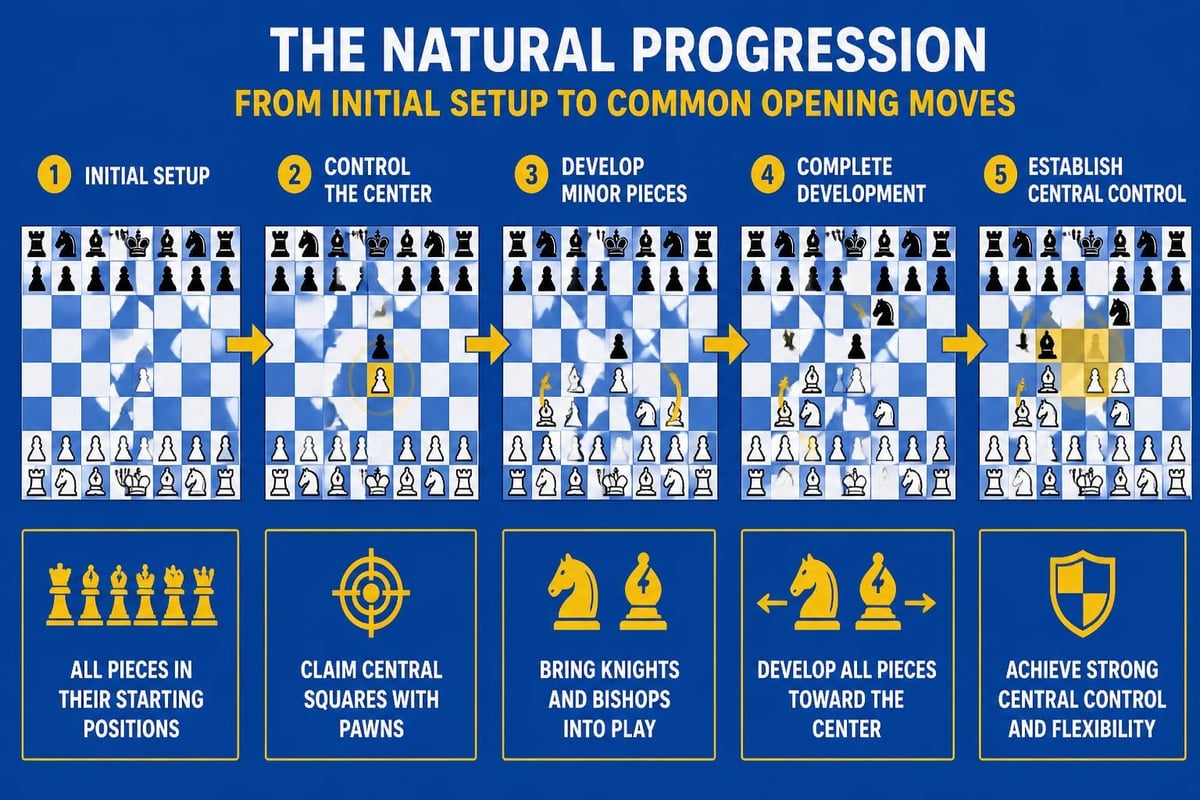
Once you've mastered the chess board set up, you're ready to explore how games actually begin. The opening phase-typically the first 10-15 moves-determines the character of the middlegame to come.
Understanding where each piece starts helps you appreciate why certain openings work. For instance, when you're studying the Ruy Lopez, you'll notice how white's light-squared bishop naturally develops to attack the knight on c6 after it moves from its starting square.
The Setup-to-Opening Connection
| Piece | Starting Square (White) | Common First Moves | Strategic Purpose |
|---|---|---|---|
| King | e1 | Usually castles later | Early safety crucial |
| Queen | d1 | Often d1-d2 or stays put | Develops after minor pieces |
| Rooks | a1, h1 | Activated via castling | Control open files |
| Knights | b1, g1 | Nf3, Nc3 most common | Control centre early |
| Bishops | c1, f1 | Multiple diagonals available | Long-range piece activity |
| Pawns | Second rank | e4, d4 most popular | Fight for centre control |
Practical Setup Tips for Different Playing Situations
The context of your game might affect how you approach the chess board set up. Let's look at various scenarios you'll encounter.
Tournament Play
In formal competition, both players typically share responsibility for setting up. Arrive at the board early, verify the setup together, and start your clocks only when you're both satisfied everything's correct. Tournament-level chess demands precision from the very first moment.
Online vs Physical Chess
When playing online, the platform handles setup automatically. However, if you're following along on a physical board whilst playing digitally, you'll need to set up manually. This practice actually reinforces your understanding and helps you visualise positions more clearly.
Teaching Settings
In coaching situations, you might set up and break down the board dozens of times in a session. Keep your pieces organised-many sets come with compartmentalised boxes that speed up the process considerably.
Advanced Setup Considerations
As you progress in chess, you'll discover that even the setup phase can reveal interesting strategic insights.
Psychological Aspects
Some players deliberately slow down their setup routine to establish a calm, focused mindset before the game begins. This ritual preparation helps them transition from everyday life into competitive mode.
Others verify their opponent's setup carefully, not out of distrust, but as part of their pre-game routine. It's a final mental check before the battle commences.
Historical Context
The current chess board set up has remained virtually unchanged for centuries. Understanding that you're arranging pieces in the same configuration used by legendary players like Fischer, Kasparov, and Carlsen connects you to chess history.
When you're exploring different opening systems and their evolution, remember that they all spring from this identical starting position. The creativity of chess emerges from how we navigate from this fixed beginning.
Troubleshooting Setup Questions
Let's address some questions that frequently puzzle newcomers to chess.
What if my set has extra pieces? Many sets include extra queens (for pawn promotion) and sometimes extra pawns. These don't go on the board initially-keep them aside for when you need them.
Does it matter which specific piece goes where within piece types? Not functionally. Your kingside knight can go on either kingside or queenside if you prefer-though most players keep pieces consistent with their starting positions throughout the game.
Should I set up my opponent's side or my own first? Personal preference. Some players set up their own pieces first to ensure they're comfortable with the arrangement. Others set up their opponent's side as a courtesy. Both approaches work fine.
What if we discover a setup error mid-game? In casual play, simply correct it and continue. In tournament play, call an arbiter immediately-there are specific rules governing these situations.
Building Setup into Your Chess Routine
Make the chess board set up part of your deliberate practice routine. Each time you sit down to study or play, take that extra moment to ensure everything's perfect.
This attention to detail extends beyond the board. When you're studying chess move by move, that same precision helps you spot tactical opportunities and avoid blunders.
Creating Positive Habits
- Set up without looking at references (test yourself)
- Verify orientation before placing any pieces
- Double-check queen placement every single time
- Make setup part of your pre-game ritual
- Use setup time to mentally prepare for the game ahead
The chess board set up might seem like a trivial preliminary, but it's the foundation upon which everything else rests. Get it right, and you're ready to explore the infinite possibilities that chess offers.
Getting your chess board set up correctly is the essential first step that enables everything else in your chess journey-from tactics to strategy to opening preparation. Once you've mastered this fundamental skill, you're ready to dive deeper into the game's rich complexity. Chess Cheat Sheets provides comprehensive guides, streamlined opening cheat sheets, and practical resources designed to accelerate your improvement without overwhelming you with theory. Whether you're memorising your first opening or refining your middlegame understanding, our tools help you build confidence and skill efficiently-starting from that perfectly arranged board in front of you.


