

Understanding chess board positions is fundamental to improving your game, whether you're just learning how pieces move or working towards intermediate mastery. Every position on the board tells a story, revealing tactical opportunities, strategic weaknesses, and potential winning combinations. The ability to quickly assess and understand different positions separates casual players from those who consistently win games. This comprehensive guide will help you develop the skills to read, record, and evaluate chess board positions like a seasoned player.
What Are Chess Board Positions and Why Do They Matter?
Chess board positions refer to the specific arrangement of all pieces on the board at any given moment during a game. Think of each position as a snapshot, capturing not just where the pieces sit but also the potential energy and possibilities embedded in that arrangement. When you understand positions deeply, you're not just seeing pieces on squares, you're seeing patterns, threats, and opportunities.
The initial position of a chessboard establishes the foundation for everything that follows. White pieces occupy ranks 1 and 2, whilst Black pieces occupy ranks 7 and 8. This symmetrical setup might seem simple, but it contains profound strategic implications that grandmasters still explore today.
Why should you care about positions? Because chess isn't just about knowing how pieces move. It's about recognising when your knight is perfectly placed on c5, or spotting that your opponent's king is vulnerable on g8. Every decision you make creates a new position, and each position presents unique challenges and opportunities.
The Language of Position: Algebraic Notation
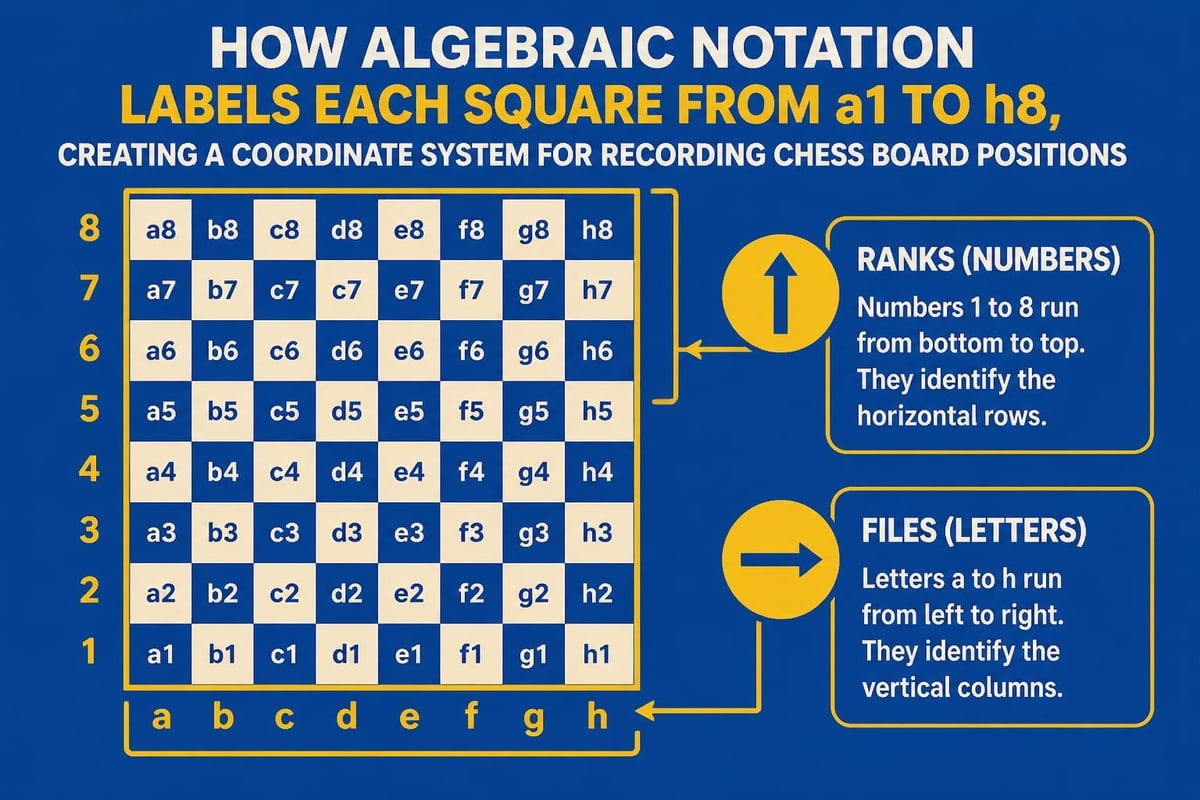
Before we dive deeper, you'll need to speak the language. Algebraic notation is the universal system for recording chess board positions. Files (columns) are labelled a-h from left to right, whilst ranks (rows) are numbered 1-8 from bottom to top. This creates 64 unique squares, each with its own address like e4 or d7.
When you're studying chess openings, you'll constantly encounter notation like "1.e4 e5 2.Nf3 Nc6". This tells you exactly which pieces moved to which squares, allowing you to recreate any position on your board.
Recording and Sharing Positions with FEN Notation
Have you ever wanted to share a specific position from your game without replaying all the moves? That's where Forsyth-Edwards Notation (FEN) becomes invaluable. FEN is a compact text format that describes any chess position in a single line.
A typical FEN string looks like this: rnbqkbnr/pppppppp/8/8/8/8/PPPPPPPP/RNBQKBNR w KQkq - 0 1
Let's break down what this means:
- Piece placement: Lowercase letters represent Black pieces, uppercase represent White pieces (r=rook, n=knight, b=bishop, q=queen, k=king, p=pawn)
- Active colour: 'w' for White to move, 'b' for Black to move
- Castling availability: Letters indicating which castling options remain
- En passant: The square where en passant capture is possible
- Halfmove clock: Moves since last pawn advance or capture
- Fullmove number: The current move number
Understanding FEN notation allows you to quickly input any position into chess engines, share positions with other players, or bookmark interesting positions from your games for later study.
Key Elements That Define Chess Board Positions
Every position consists of several critical elements. Recognising these components helps you evaluate what's happening on the board and determine your best plan forward.
Material Count
The most basic aspect of any position is material. Each piece has a relative value:
| Piece | Point Value |
|---|---|
| Pawn | 1 |
| Knight | 3 |
| Bishop | 3 |
| Rook | 5 |
| Queen | 9 |
| King | Invaluable |
However, material alone doesn't determine position quality. A position where you're down a pawn but have active pieces and attacking chances might be superior to one where you're up material but passive and cramped.
Piece Activity and Placement
Where your pieces stand matters enormously. A knight on the rim truly is dim, whilst a knight anchored on e5 or d5 can dominate the entire board. Similarly, bishops that control long diagonals exert far more influence than those blocked by their own pawns.
When analysing chess board positions, ask yourself:
- Are my pieces coordinating or working independently?
- Do I control key central squares like e4, d4, e5, and d5?
- Are my rooks on open or semi-open files?
- Is my queen safely placed yet still active?
King Safety
The position of your king often determines whether a position is playable or desperate. In the middlegame, your king typically wants to be safely castled behind pawns. In the endgame, the king transforms into an active piece that should centralise and support pawn advancement.
Look at positions from games like the Caro-Kann Defense, where Black often maintains a solid pawn structure precisely to ensure long-term king safety whilst developing pieces.
Common Position Types You'll Encounter
Different chess board positions require different approaches. Recognising position types helps you select appropriate strategies and plans.
Open Positions
Open positions feature few pawns in the centre and open files. These positions favour pieces with long-range mobility: bishops, rooks, and the queen. Tactical opportunities abound because pieces can rapidly shift from one side of the board to another.
In open positions, you should:
- Activate your pieces quickly
- Control open files with your rooks
- Look for tactical combinations
- Castle early to safeguard your king
Closed Positions
Closed positions have locked pawn chains in the centre, restricting piece mobility. Knights often outperform bishops here because they can hop over pawns. Strategy trumps tactics, and plans unfold slowly over many moves.
The London System often leads to semi-closed positions where White builds a solid structure and aims for a methodical kingside attack.
Tactical Positions
Some positions are sharp, unstable, and rich with tactical possibilities. These positions often arise from aggressive openings where both players have attacked quickly rather than consolidated. One wrong move can lose instantly.
Studying tactical puzzles from specific positions helps you recognise patterns like pins, forks, skewers, and discovered attacks when they appear in your games.

Evaluating Chess Board Positions Effectively
How do you know if a position is good or bad? Evaluation is both an art and a science. Here's a systematic approach to position assessment.
The Three-Question Method
When faced with any position, ask yourself:
- Who is better and why? Consider material, piece activity, king safety, and pawn structure.
- What are the critical features? Identify weaknesses, strong pieces, tactical themes, and strategic imbalances.
- What should I do about it? Formulate a concrete plan based on your assessment.
This framework prevents you from moving randomly and encourages purposeful play based on position requirements.
Identifying Weaknesses
Weaknesses in chess board positions come in many forms:
- Weak squares: Squares that can't be defended by pawns and become outposts for enemy pieces
- Backward pawns: Pawns stuck behind their neighbours on half-open files
- Isolated pawns: Pawns with no friendly pawns on adjacent files
- Exposed king: A king vulnerable to checks and attacks
- Inactive pieces: Pieces with limited scope or no useful squares
Spotting your opponent's weaknesses gives you targets to attack. Recognising your own weaknesses helps you defend or compensate for them.
Position-Based Pattern Recognition
The most powerful skill in chess is pattern recognition. Experienced players don't calculate every position from scratch; they recognise familiar patterns and apply known principles.
Common Tactical Patterns
Certain position types trigger specific tactical patterns. When you see a king and queen on the same diagonal with only one piece between them, you should immediately consider bishop sacrifices. When an enemy piece is pinned to its king or queen, look for ways to attack it again.
The more positions you study, the larger your pattern library becomes. This is why working through opening puzzles proves so valuable: you build familiarity with position types that arise from your preferred openings.
Strategic Patterns
Strategic patterns are subtler than tactical ones but equally important. Recognising that doubled rooks on an open file often lead to penetration on the seventh rank, or that knight versus bad bishop endgames favour the knight, helps you make sound strategic decisions.
Consider the Ruy Lopez, which creates characteristic pawn structures and piece configurations. Once you've studied these positions, you'll recognise them instantly and know the typical plans for both sides.
Advanced Concepts in Position Analysis
As you progress beyond beginner level, you'll want to understand more sophisticated aspects of chess board positions.
Dynamic Versus Static Factors
Chess positions contain both static and dynamic elements:
| Static Factors | Dynamic Factors |
|---|---|
| Pawn structure | Piece activity |
| Material balance | Initiative |
| Weak squares | Attacking chances |
| King safety (long-term) | Tactical opportunities |
Static factors don't change quickly. If you have a backward pawn, it'll probably stay weak for many moves. Dynamic factors are temporary: you have the initiative now, but one inaccurate move loses it.
Understanding this distinction helps you decide whether to act immediately or prepare slowly. When you have dynamic compensation for static weaknesses, you often need to strike quickly before your activity dissipates.
Space and Mobility
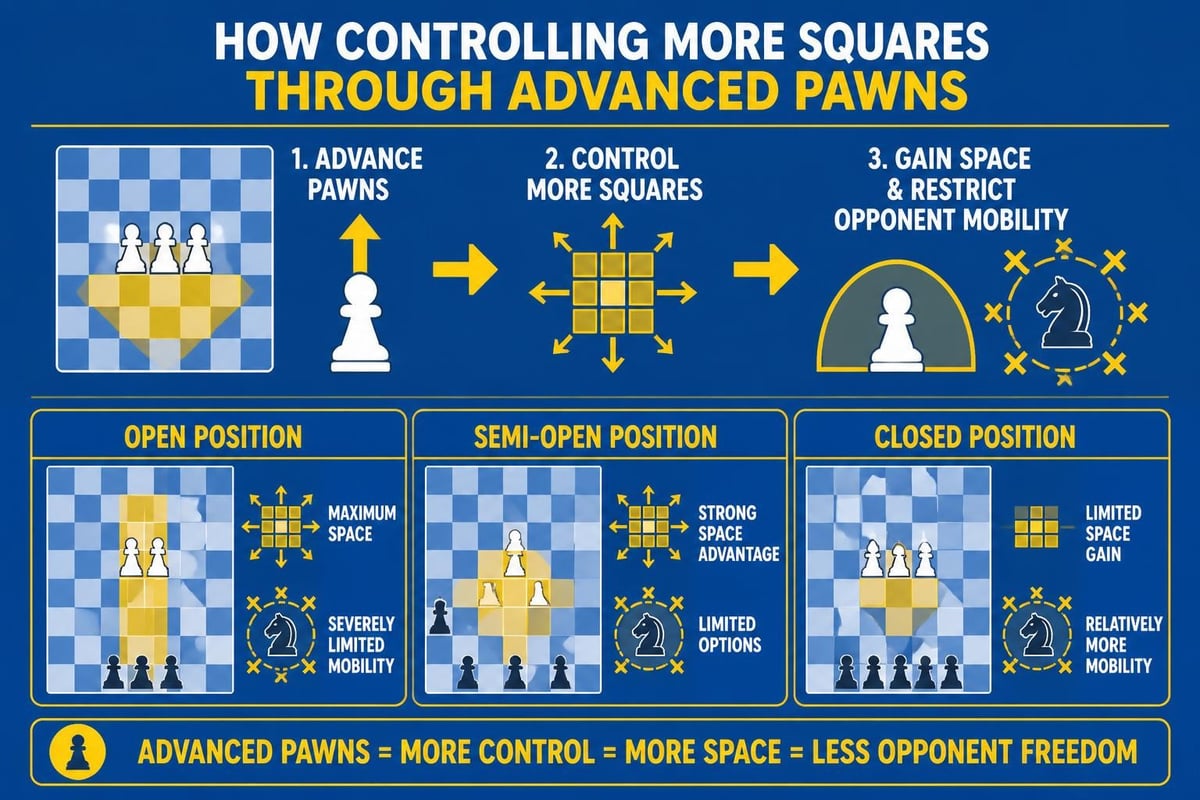
Space refers to the squares you control, particularly in your half of the board. More space usually means more options for piece manoeuvres. However, extended pawns can also become weaknesses if you can't defend them adequately.
Mobility is related but distinct: it's about how freely your pieces can move. Even with less space, if your pieces coordinate well, you might have adequate mobility. Conversely, you can control lots of squares but have passive, poorly-placed pieces.
Practical Position Training Methods
Theory is useful, but practical training cements your understanding. Here are effective methods for improving your positional understanding.
Position Reconstruction
Take a master game and play through it until move 15 or 20. Now, without looking at the board, try to reconstruct the position from memory. This exercise strengthens your ability to visualise positions and remember typical patterns.
Start with games from familiar openings where you already know the early moves. Gradually increase the number of moves before attempting reconstruction.
Guess the Move
Study a high-quality game and, at each critical position, cover the moves and try to find the best continuation yourself. Compare your choice with what the master played. This trains both position evaluation and move selection.
When your choice differs, don't just move on. Spend time understanding why the master's move was superior. What did you miss about the position?
Position Comparison
Take two similar positions and analyse the differences. Perhaps one has an extra tempo, or the pawn structure varies slightly. Understanding how small differences affect evaluation sharpens your positional judgement.
For example, compare positions from the Caro-Kann Classical Variation with those from other Caro-Kann lines. The subtle differences teach you what matters most in this opening structure.
Technology and Chess Board Positions
Modern technology has revolutionised how we study and understand chess board positions. Chess engines provide objective evaluations, whilst databases contain millions of positions to study.
Using Chess Engines Effectively
Engines like Stockfish evaluate positions with superhuman accuracy. However, simply checking the engine evaluation doesn't improve your chess. Instead, use engines to:
- Verify your analysis after you've done your own thinking
- Find tactical resources you missed
- Test whether your strategic assessment aligns with computer evaluation
- Explore alternative moves in critical positions
Recent research into position evaluation attribution helps break down engine evaluations piece by piece, making computer analysis more interpretable for human players.
Position Databases
Enormous databases allow you to search for specific position types. Want to see how grandmasters handled positions with isolated queen's pawns? Search the database and study dozens of examples.
This position-based learning is often more efficient than studying complete games because it focuses on the specific patterns you want to understand.
The Psychology of Position Assessment
Your psychological state affects how you evaluate positions. Optimists tend to overestimate their position's strength, whilst pessimists see problems everywhere. Developing objective position evaluation requires self-awareness.
Avoiding Confirmation Bias
When you want a position to be good (perhaps because you've invested significant time reaching it), you might overlook its weaknesses. Similarly, when facing a strong opponent, you might see your position as worse than it truly is.
Combat this by asking: "If I were advising a friend in this position, what would I objectively say?" This mental distance often reveals a more accurate assessment.
Time Management Based on Position
Not all positions deserve equal thinking time. In clearly advantageous positions with no tactics, playing quickly often works best. Save your time for critical moments when the position is unclear or multiple reasonable moves exist.
Recognising position complexity helps you allocate your clock wisely during games.
Building Your Position Evaluation Checklist
Create a mental checklist for evaluating any chess board position. Here's a framework to start with:
Material and Development
- Who has more material and by how much?
- Are all pieces developed and coordinating?
- Which side controls more space?
King Safety and Structure
- How safe is each king?
- What's the pawn structure like?
- Are there weak pawns or squares?
Activity and Initiative
- Which pieces are active or passive?
- Who has the initiative?
- Are there immediate tactical threats?
Long-term Factors
- What are the natural plans for each side?
- Which side has the better endgame?
- How does the position likely evolve?
Run through this checklist habitually and it'll become second nature. Eventually, you'll assess positions almost instantly without conscious effort.
From Position to Plan
Understanding a position is only useful if you translate that understanding into a concrete plan. Every position suggests certain plans whilst ruling out others.
Matching Plans to Positions
In positions where you have space advantage, expansion often makes sense. With weak enemy squares, aim to occupy them with pieces. When ahead in development, seek to open the position and attack before your opponent catches up.
The London System opening guide demonstrates how specific position types in this opening dictate clear plans: White typically aims for e4, develops pieces to natural squares, and launches a kingside attack.
Flexibility in Planning
Whilst having a plan is crucial, rigid adherence to one plan regardless of changing circumstances is a mistake. As the position evolves, your plan should adapt. Reassess after your opponent's moves, especially surprising or strong ones.
Good chess thinking involves maintaining strategic continuity whilst remaining tactically flexible. You keep your overall objective but adjust your method based on what the position offers.
Mastering the evaluation and understanding of chess board positions transforms your entire approach to the game, turning confusion into clarity and random moves into purposeful plans. Whether you're studying classical positions or exploring new territory, the principles outlined here will guide your development. Ready to accelerate your improvement? Chess Cheat Sheets provides streamlined guides, comprehensive puzzles, and practical resources that help you recognise patterns and master positions without endless hours of study, giving you the tools to confidently handle any position you encounter.


