

So you've decided to learn chess? Brilliant choice! Whether you're inspired by a friend's invitation to play, a tournament you watched online, or simply the desire to exercise your mind, you're about to embark on one of the most rewarding intellectual journeys available. This beginners guide to chess will walk you through everything you need to know to start playing confidently. We'll cover the board setup, how each piece moves, basic rules, and essential strategies that'll have you winning games sooner than you might think. Let's get stuck in.
Understanding the Chessboard and Setup
The chessboard is your battlefield, and getting familiar with it is your first step. It's an 8x8 grid containing 64 squares that alternate between light and dark colours. Here's something many newcomers miss: the board must be positioned so that each player has a light square in the bottom right corner. That simple detail matters more than you'd think.
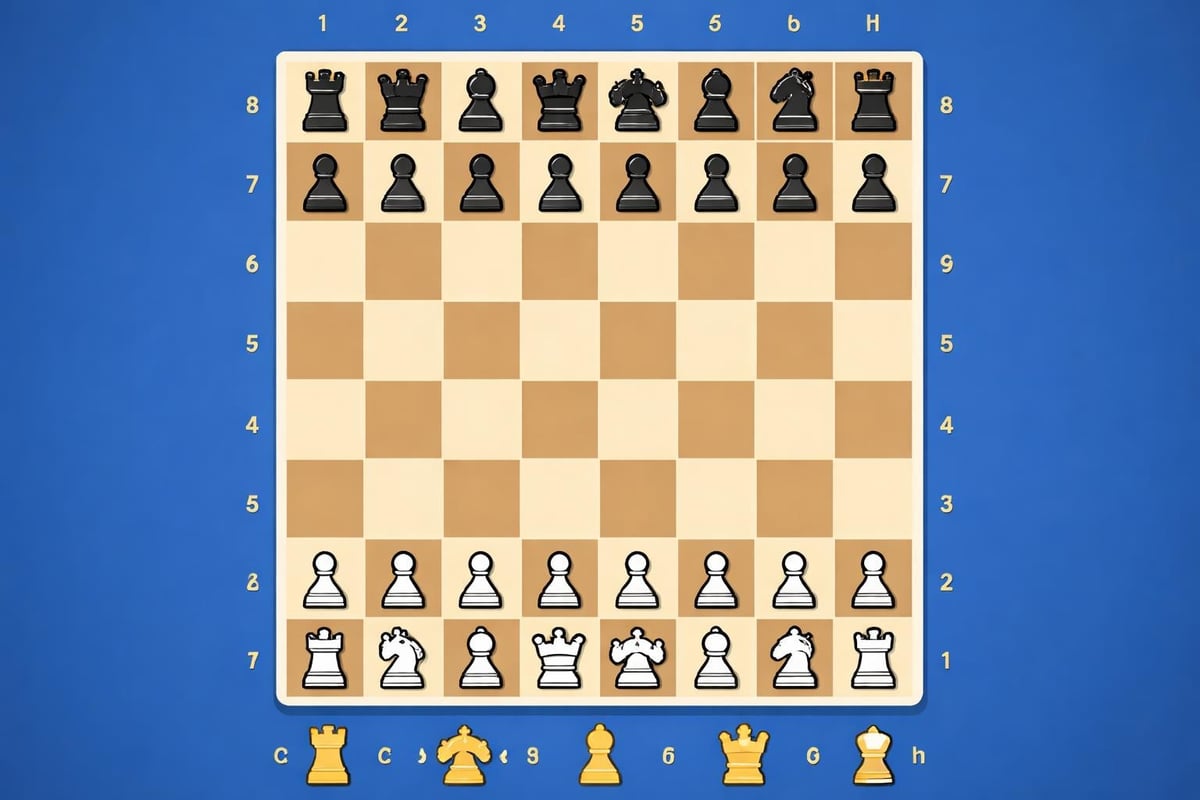
Each player starts with 16 pieces arranged on the two rows closest to them. The back row contains your major and minor pieces, whilst the second row houses your eight pawns. Getting this setup right is crucial, and there's a helpful phrase to remember: "queen on her colour." This means the white queen starts on a light square, and the black queen starts on a dark square.
The Complete Starting Position
Let me break down exactly where each piece goes:
- Rooks occupy the corners (a1, h1 for White; a8, h8 for Black)
- Knights sit next to the rooks (b1, g1 for White; b8, g8 for Black)
- Bishops are positioned beside the knights (c1, f1 for White; c8, f8 for Black)
- Queen takes the remaining square of her own colour (d1 for White, d8 for Black)
- King stands on the final square (e1 for White, e8 for Black)
- Pawns fill the entire second rank (row 2 for White, row 7 for Black)
The rules of chess are standardised worldwide, so once you learn them, you can play anywhere.
How Each Chess Piece Moves
Now we're getting to the heart of this beginners guide to chess. Each piece has its own unique movement pattern, and understanding these is absolutely fundamental. Let's explore each one.
The Pawn: Your Front-Line Soldiers
Pawns are peculiar little pieces. They move forward one square at a time, but on their very first move, they have the option to advance two squares. Here's where it gets interesting: pawns capture differently than they move. They take opponent pieces diagonally, one square forward to the left or right.
When a pawn reaches the opposite end of the board (the eighth rank), it promotes. You can transform it into a queen, rook, bishop, or knight. Most players choose a queen, making pawn promotion incredibly powerful.
The Rook: Straight-Line Power
Rooks are straightforward. They move any number of squares horizontally or vertically, as long as their path isn't blocked. They're particularly strong in the endgame when the board opens up. Think of them as your long-range artillery.
The Knight: The Tricky Jumper
Knights move in an L-shape: two squares in one direction and then one square perpendicular to that. They're the only pieces that can jump over other pieces, making them fantastic for complex positions. The chess piece article explains how knights are valued at roughly three pawns.
The Bishop: Diagonal Dominance
Bishops move diagonally any number of squares. Each bishop is confined to either light or dark squares for the entire game. You start with one of each, so they complement each other nicely. They're particularly effective when they control long diagonals.
The Queen: Supreme Flexibility
The queen combines the powers of both the rook and bishop. She can move any number of squares horizontally, vertically, or diagonally. She's your most powerful piece, which means losing her early is usually devastating. Protect her, but don't be afraid to use her actively.
The King: Protect at All Costs
The king moves one square in any direction. He's the most important piece because losing him means losing the game. You can never move your king into check (under attack), and the entire game revolves around protecting your king whilst attacking your opponent's.
| Piece | Movement Type | Approximate Value | Special Abilities |
|---|---|---|---|
| Pawn | Forward 1 (or 2 on first move) | 1 point | Promotion, en passant |
| Knight | L-shape jump | 3 points | Can jump pieces |
| Bishop | Diagonal | 3 points | Confined to one colour |
| Rook | Horizontal/vertical | 5 points | Castling partner |
| Queen | All directions | 9 points | Most versatile |
| King | One square any direction | Invaluable | Castling |
Special Moves Every Beginner Should Know
Beyond basic movements, chess has several special moves that often catch beginners off guard. Understanding these will immediately elevate your game.
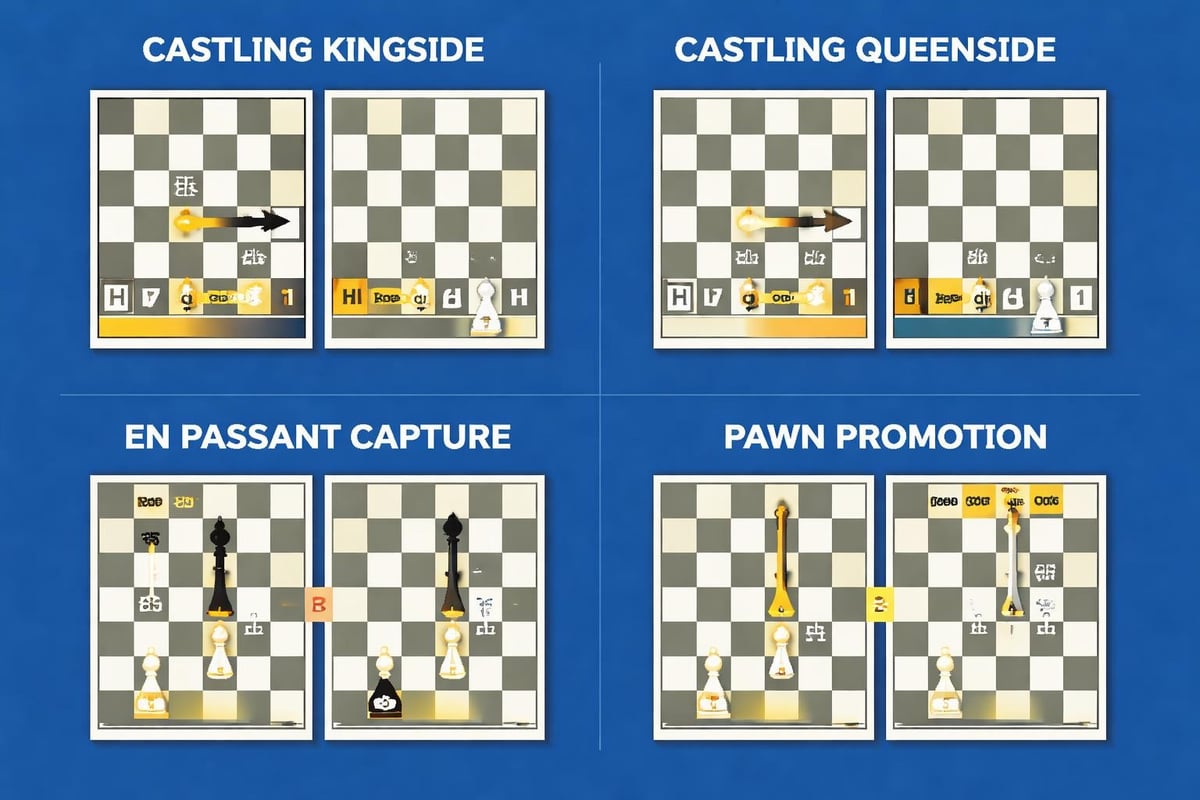
Castling is a defensive manoeuvre involving your king and one rook. The king moves two squares towards the rook, and the rook jumps over to the square the king crossed. You can only castle if neither piece has moved before, there are no pieces between them, and the king isn't in check or moving through check. It's brilliant for king safety.
En passant is a special pawn capture. If your opponent moves a pawn two squares forward from its starting position, landing beside your pawn, you can capture it as if it had only moved one square. This must be done immediately on the next move, or the opportunity vanishes.
Promotion transforms a pawn that reaches the eighth rank into any other piece (except a king). Most players choose a queen, but sometimes a knight is tactically superior to avoid stalemate.
The Basic Rules and Objective
What's the point of chess? The objective is to checkmate your opponent's king. This means placing their king under attack (check) in such a way that they cannot escape on their next move. It's not enough to simply capture pieces; you need to trap the king.
Check, Checkmate, and Stalemate
When your king is under attack, you're in check. You must immediately respond by either moving the king to safety, blocking the attack with another piece, or capturing the attacking piece. You can't ignore check.
Checkmate happens when your king is in check and you have absolutely no legal moves to escape. Game over. You've lost.
Stalemate occurs when it's your turn but you're not in check and you have no legal moves. This results in a draw, not a loss. I've seen countless beginners accidentally stalemate their opponents when they were completely winning. Watch out for this.
Other Ways Games End
- Resignation: A player can resign at any time if they feel their position is hopeless
- Draw by agreement: Both players can mutually agree to a draw
- Threefold repetition: If the same position occurs three times, either player can claim a draw
- Fifty-move rule: If fifty moves pass without a pawn move or capture, either player can claim a draw
- Insufficient material: If neither player has enough pieces to deliver checkmate (like king versus king), it's a draw

Your First Opening Moves Matter
Many beginners randomly push pawns without much thought, but your opening moves establish your entire game. You don't need to memorise extensive theory, but understanding basic opening principles will give you a significant advantage.
Opening Principles for Beginners
Start by controlling the centre of the board. The four central squares (e4, e5, d4, d5) are the most important real estate in chess. Pieces placed centrally have maximum influence over the board.
Develop your pieces efficiently. Get your knights and bishops into the game before moving the same piece twice. A good rule of thumb: develop a new piece with each move during the opening.
Castle early to protect your king. Generally, you want to castle within the first ten moves. King safety is paramount, especially for newcomers who might not spot incoming threats.
If you're looking for structured guidance on openings, our most common chess openings guide breaks down the tried-and-tested systems that millions of players rely on.
Simple Opening Recommendations
For White, starting with 1.e4 (moving your king's pawn two squares forward) is classical and opens lines for your pieces. Alternatively, 1.d4 leads to more strategic positions. Both are excellent for learning.
For Black, responding to 1.e4 with 1...e5 creates symmetrical positions that are easy to understand. This beginners guide to chess recommends learning solid, straightforward responses before exploring more complex defences. Once you're comfortable, you might explore our guides on the best openings for Black.
Basic Tactical Patterns to Recognise
Tactics are short-term sequences that win material or deliver checkmate. Even at beginner level, recognising a few basic patterns will dramatically improve your results.
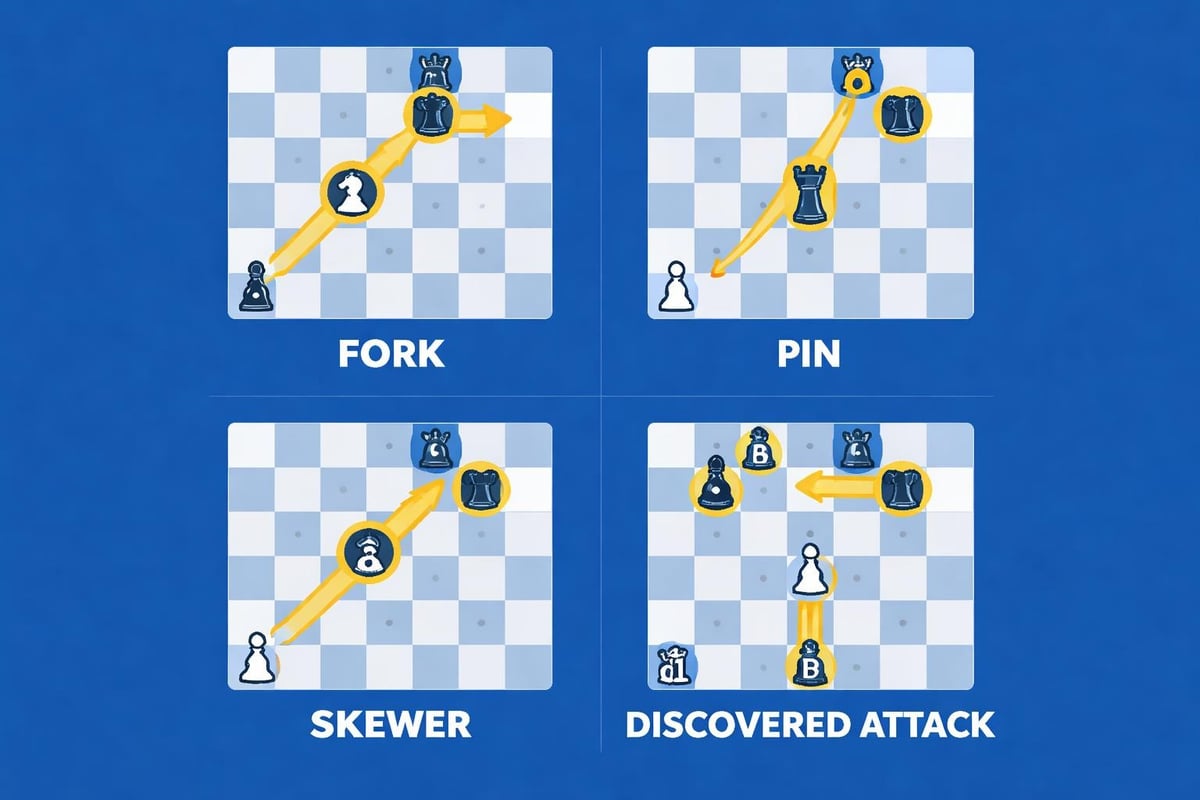
Forks happen when one piece attacks two or more enemy pieces simultaneously. Knights are particularly effective at this. For instance, a knight on e5 might attack both a queen on c6 and a rook on g6. Your opponent can only save one.
Pins occur when a piece can't move without exposing a more valuable piece behind it. Imagine a bishop attacking a knight, with the enemy king behind that knight. The knight is pinned because moving it would expose the king to check.
Skewers are the reverse of pins. You attack a valuable piece, and when it moves, you capture a less valuable piece behind it. Rooks and bishops execute skewers brilliantly along open files and diagonals.
Discovered attacks happen when moving one piece uncovers an attack from another piece behind it. These can be devastating because you're essentially making two threats in one move.
Fundamental Strategic Concepts
Once you've grasped the rules and basic tactics, it's time to think strategically. Strategy is your long-term plan, whilst tactics are the immediate sequences that execute that plan.
Material Count and Piece Value
Generally, the player with more pieces (or higher total value) has the advantage. The rough point system helps you evaluate trades:
- Pawn = 1 point
- Knight = 3 points
- Bishop = 3 points (slightly more valuable than knights in open positions)
- Rook = 5 points
- Queen = 9 points
Would you trade your queen for two pawns? Absolutely not. But trading your queen for two rooks and a pawn? That's roughly equal and might be good depending on the position.
Controlling Key Squares
Chess isn't just about pieces; it's about controlling important squares. The centre is crucial, but so are other strategic squares near your opponent's king or on important files (vertical columns).
Your pieces work better when they control lots of squares. A knight on the edge of the board controls only 2-3 squares, but a centralised knight can control up to 8 squares. That's why we say "a knight on the rim is dim."
Pawn Structure Fundamentals
Pawns create your position's skeleton. They're slow-moving and can't retreat, so pawn moves are commitments. Avoid creating isolated pawns (pawns with no friendly pawns on adjacent files) or doubled pawns (two pawns on the same file) unless there's a good reason.
Connected pawns that protect each other are strong. A pawn chain (pawns on the same diagonal protecting each other) can be very solid. Understanding pawn structures is advanced, but being aware of these patterns helps even beginners.
Developing Your Skills Beyond the Basics
You've absorbed the core information from this beginners guide to chess. What's next? Improvement comes from consistent practice and study, but you don't need to spend hours analysing grandmaster games just yet.
Play Regularly
The absolute best way to improve is to play. Online platforms make finding opponents at your level incredibly easy. Don't be discouraged by losses; each game teaches you something. Try to play longer time controls when starting out. Games with at least 15 minutes per side give you time to think through moves.
Analyse Your Games
After each game, spend a few minutes reviewing what happened. Where did you lose material? What did you miss? Many online platforms offer computer analysis that highlights mistakes. This feedback loop accelerates learning dramatically.
Solve Puzzles Daily
Chess puzzles train your tactical vision. Spending just 10-15 minutes daily solving puzzles will make you spot tactical opportunities during games. Our puzzle collection provides targeted practice that builds pattern recognition.
Study Endgames
Many beginners ignore endgames, but they're where games are won or lost. Learning how to checkmate with king and queen versus king, or understanding basic king and pawn endgames, will save you from throwing away winning positions.
Common Beginner Mistakes to Avoid
Every chess player makes mistakes, but being aware of common pitfalls helps you avoid them. Let me share the errors I see most frequently from newcomers.
Moving too quickly is perhaps the most common issue. Take your time. Before each move, ask yourself: "What is my opponent threatening?" This simple question prevents countless blunders.
Neglecting king safety often leads to quick defeats. Don't leave your king in the centre too long. Castle early and keep pawns in front of your castled king unless there's a compelling reason to advance them.
Making aimless moves without a plan is another frequent problem. Each move should have a purpose: developing a piece, controlling key squares, improving your position, or creating threats. Random pawn pushes rarely help.
Bringing the queen out too early exposes her to attacks. Your opponent can develop pieces whilst simultaneously threatening your queen, forcing her to move repeatedly. This gives them a development advantage.
Ignoring development to grab pawns or launch premature attacks usually backfires. Getting your pieces into the game before starting tactical operations is fundamental.
| Common Mistake | Why It's Bad | How to Fix It |
|---|---|---|
| Moving too fast | Overlook opponent's threats | Use your time; check threats first |
| Exposing the king | Leads to quick checkmates | Castle early, keep king safe |
| Aimless moves | No progress towards winning | Have a purpose for each move |
| Queen out early | She becomes a target | Develop minor pieces first |
| Pawn grabbing | Fall behind in development | Prioritise piece activity |
Resources for Continued Learning
This beginners guide to chess has given you the foundation, but chess mastery is a lifelong journey. Fortunately, you're living in an era with unprecedented access to learning resources.
Books remain one of the best learning tools. Structured lessons from experienced authors provide systematic instruction that random online articles can't match. Our selection of good beginner chess books includes titles specifically designed for players at your level.
Video content helps you see ideas in action. Watching skilled players explain their thought processes during games builds your understanding of how to think about positions. Many educational YouTube channels cater specifically to beginners.
The outline of chess provides a comprehensive overview of the game's various aspects, from history to strategy, giving you a roadmap for areas to explore as you progress.
Cheat sheets and quick reference guides are invaluable during your learning phase. Having a concise summary of opening principles, piece values, or tactical patterns saves time and reinforces key concepts. Our cheat sheets collection condenses essential information into easily digestible formats.
Building a Practice Routine
Consistency beats intensity when learning chess. Playing one game daily with reflection is more valuable than playing twenty games in one frenzied session without thought.
Here's a simple routine that works brilliantly for beginners:
- Warm up with 3-5 puzzles (10 minutes)
- Play one longer game with at least 15 minutes per side (30-40 minutes)
- Review your game immediately afterwards (10 minutes)
- Study one chess concept from a book or video (15 minutes)
- Practice that concept with a few quick games or exercises (15 minutes)
That's roughly 80 minutes of focused chess study, which is plenty for steady improvement. You don't need to do this daily; even three times weekly will yield significant progress.
Tracking Your Progress
Keep a simple chess journal. Note down new concepts you've learnt, tactical patterns you've spotted (or missed), and positions you found particularly challenging. Reviewing this periodically shows how far you've come and identifies areas needing more work.
Your rating will fluctuate, especially early on. Don't obsess over the number. Focus instead on understanding concepts and making fewer mistakes. The rating will naturally follow your improving understanding.
Joining the Chess Community
Chess is fundamentally social. While you can certainly improve through solitary study, connecting with other players enhances the experience enormously.
Local chess clubs welcome beginners and provide face-to-face play that online games can't replicate. The social aspect, combined with the ability to discuss positions afterwards, accelerates learning. Many clubs run beginner sessions or host simuls where a strong player takes on multiple opponents simultaneously.
Online communities offer discussion forums where you can ask questions, share interesting games, and learn from players worldwide. The chess community is generally welcoming and helpful to genuine learners.
Playing against friends and family makes learning more enjoyable. Teaching others what you've learnt reinforces your own understanding. Start a chess tradition with regular games and watch everyone improve together.
You've now got everything you need to start your chess journey with confidence. From understanding how pieces move to recognising basic tactics and avoiding common mistakes, this foundation will serve you well in countless games to come. The key is consistent practice combined with targeted learning, and that's exactly where Chess Cheat Sheets comes in. Our comprehensive guides, streamlined cheat sheets, and carefully designed puzzles help you master openings and improve your game without getting overwhelmed by extensive theory. Start playing today, and let our resources support your development from beginner to confident chess player.


