

Learning chess can feel overwhelming at first, but understanding basic chess moves is your foundation for everything that follows. Whether you're completely new to the game or looking to solidify your fundamentals, mastering how each piece moves is the essential first step. Think of it like learning the alphabet before writing your first novel. Once you've got these movements down, you'll be ready to explore strategies, tactics, and the fascinating world of chess openings. Let's break down everything you need to know to get your pieces moving confidently across the board.

Understanding the Chess Board Setup
Before we dive into basic chess moves, you need to understand the battlefield itself. The chessboard consists of 64 squares arranged in an 8x8 grid, alternating between light and dark colours. Each player begins with 16 pieces: one king, one queen, two rooks, two bishops, two knights, and eight pawns.
Here's something many beginners miss: the board should always be positioned so that each player has a light-coloured square in the bottom right corner. This simple setup rule ensures you're playing on a properly oriented board.
The vertical columns are called files (labelled a-h), and the horizontal rows are called ranks (numbered 1-8). This coordinate system helps you record moves and follow along with chess resources when you're studying.
How the King Moves
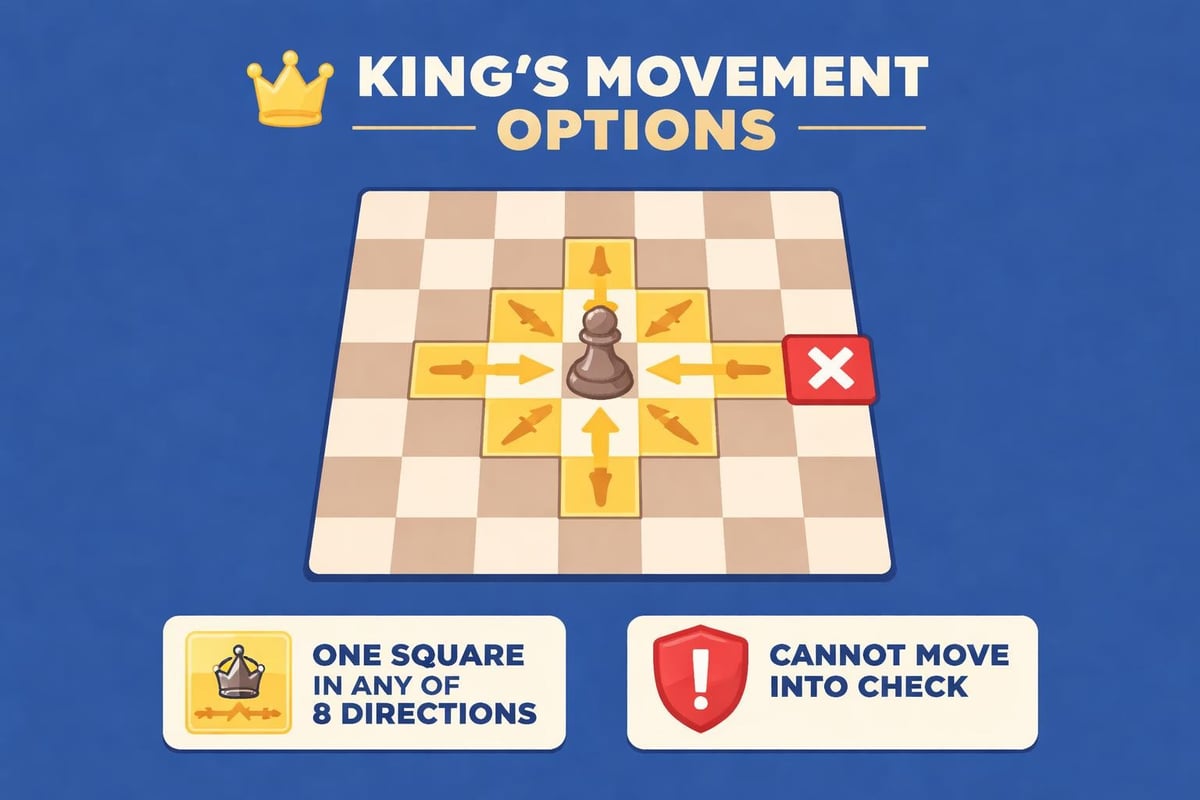
The king is your most important piece, even though it's not the most powerful. The king's movement is straightforward: it can move exactly one square in any direction-forwards, backwards, sideways, or diagonally.
King Movement Characteristics
Your king can never move into check, which means you can't place it on a square where an opponent's piece could capture it on their next turn. This restriction shapes everything about chess strategy.
Key points about king movement:
- Moves one square at a time
- Can move in all eight directions
- Cannot move into threatened squares
- Participates in the special move called castling
The king might seem weak, but protecting it is your primary objective throughout the game. Lose your king, and the game is over.
The Queen: Your Most Powerful Piece
The queen's movement capabilities make it the most versatile piece on the board. She combines the power of both the rook and bishop, moving any number of squares along ranks, files, or diagonals.
Think of the queen as your tactical weapon. She can control vast portions of the board from a central position, making her invaluable for both attack and defense. However, with great power comes great responsibility-losing your queen early in the game often puts you at a significant disadvantage.
| Direction | Distance | Restrictions |
|---|---|---|
| Horizontal | Unlimited | Cannot jump over pieces |
| Vertical | Unlimited | Cannot jump over pieces |
| Diagonal | Unlimited | Cannot jump over pieces |
The queen captures by moving to the square occupied by an opponent's piece, removing that piece from the board. Many beginners make the mistake of moving their queen out too early, only to find it gets chased around by less valuable pieces.
Rook Movement and Strategy
Rooks move in straight lines, travelling any number of squares horizontally or vertically. These powerful pieces excel in open positions where files and ranks aren't cluttered with pawns.
Using Your Rooks Effectively
Each player starts with two rooks positioned in the corners of the board. Understanding basic chess moves for rooks includes recognizing when to activate them, which typically happens in the middle game once some pawns have been exchanged.
Rook movement essentials:
- Moves along files (vertically) and ranks (horizontally)
- Cannot move diagonally
- Travels any distance until blocked
- Captures by landing on opponent's piece
Rooks work beautifully on open files-that's why controlling central files is such an important strategic goal. When you're exploring good beginner chess books, you'll find countless examples of effective rook placement.
Bishop Movement Patterns
The bishop moves exclusively along diagonals, sliding any number of squares until it reaches the edge of the board or encounters another piece. Each bishop is confined to squares of one colour throughout the entire game. Bishops control long diagonals effectively, making them particularly strong in open positions.
You start with two bishops-one on light squares and one on dark squares. This means they complement each other perfectly, controlling different coloured squares. Losing both bishops early can leave gaps in your position that are difficult to defend.
The bishop captures the same way it moves, by landing on a square occupied by an opponent's piece. Many players underestimate bishops, but they can be devastatingly effective when positioned on long, open diagonals.
The Knight's Unique Movement
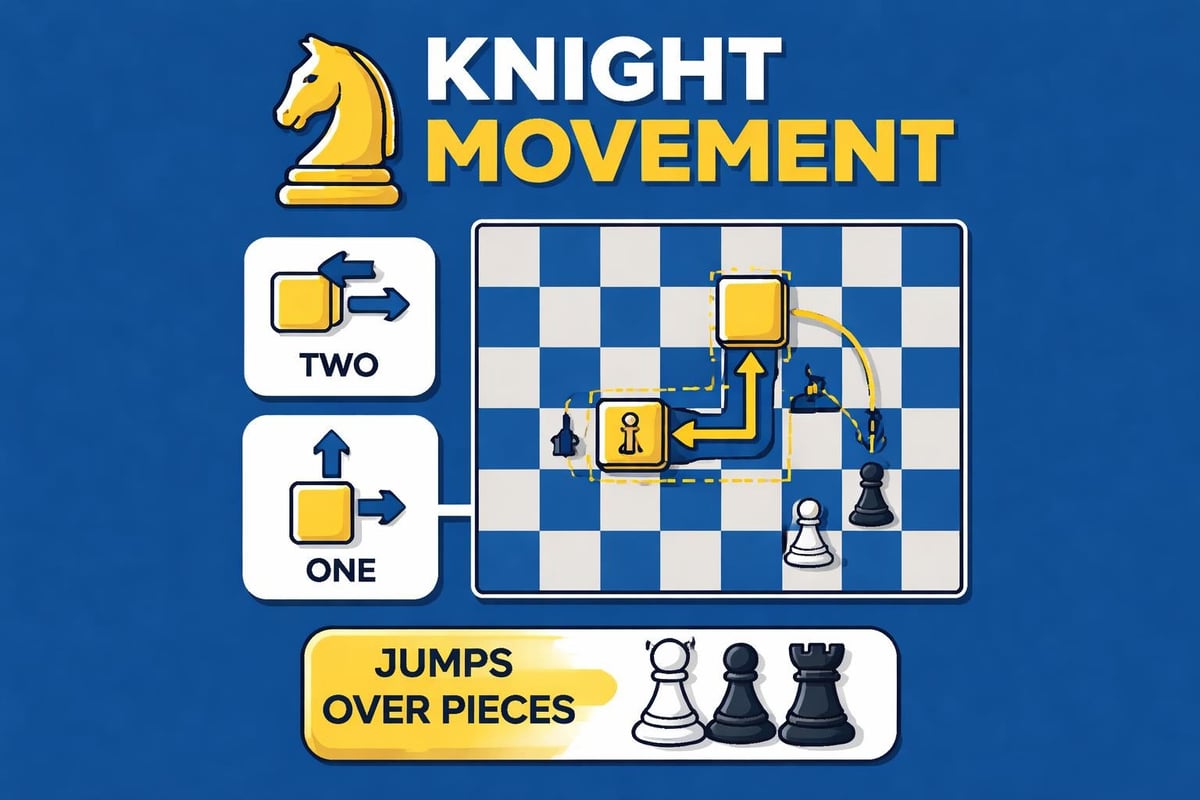
Here's where basic chess moves get interesting. The knight moves in an L-shape: two squares in one direction, then one square perpendicular to that. What makes the knight truly special is its ability to jump over other pieces-it's the only piece with this power.
Knight Movement Details
From any position, a knight can potentially move to eight different squares (assuming it's not near the edge of the board). This L-shaped movement pattern takes practice to visualize, especially for beginners.
Knight characteristics:
- Moves in an L-shape (2+1 squares)
- Jumps over pieces
- Always lands on opposite colour square
- Controls up to eight squares
Knights are particularly effective in closed positions where pawns block diagonals and files. They can hop over these obstacles whilst bishops and rooks become restricted. When you're studying most common chess openings, you'll notice knights often develop early for this reason.
Pawn Movement and Special Rules
Pawns have unique movement rules that distinguish them from all other pieces. They move forward one square but capture diagonally. From their starting position, pawns have the option to advance two squares on their first move.
Pawn Advancement and Captures
Understanding pawn movement is crucial because these pieces form the structure of your position. They create chains, control squares, and determine which pieces can become active.
| Situation | Movement |
|---|---|
| First move | One or two squares forward |
| Subsequent moves | One square forward |
| Capturing | One square diagonally forward |
| Blocked | Cannot move |
Special pawn moves include:
- En passant: A special pawn capture that can occur when an opponent's pawn moves two squares forward from its starting position, landing beside your pawn
- Promotion: When a pawn reaches the opposite end of the board, it transforms into any piece (except a king)
Pawns are the only pieces that cannot move backwards, making every pawn move a permanent decision. This is why pawn structure becomes so important as you improve your game.
Castling: A Special King and Rook Move
Castling is the only move in chess where you move two pieces simultaneously. It involves moving your king two squares towards a rook, whilst the rook moves to the square the king crossed over.
When Can You Castle?
You can castle kingside (short castle) or queenside (long castle), depending on which rook you use. This move serves two crucial purposes: it tucks your king into safety behind pawns and activates your rook.
Castling requirements:
- Neither the king nor the rook involved has moved previously
- No pieces stand between the king and rook
- The king isn't currently in check
- The king doesn't pass through a square under attack
- The king doesn't land on a square under attack
Most strong players castle early in the game to secure their king's safety. When you're learning how to play chess, mastering castling should be a priority.
Capturing Pieces
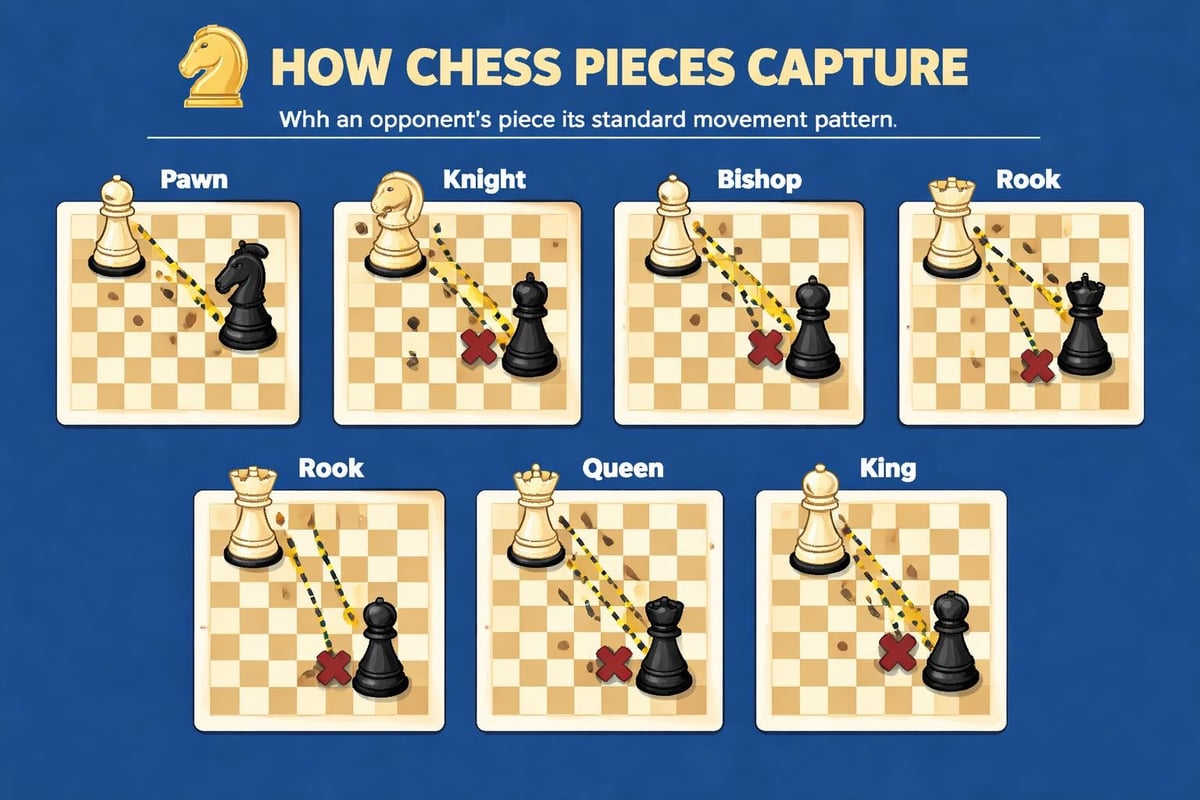
Capturing in chess follows a simple principle: you move your piece to a square occupied by an opponent's piece, removing their piece from the board. The captured piece is out of the game permanently.
Each piece captures using its normal movement pattern. Your rook captures along ranks and files, your bishop captures diagonally, and so forth. The only exception is the pawn, which captures differently than it moves-one square diagonally forward rather than straight ahead.
Capturing principles:
- You can only capture opponent's pieces (not your own)
- Capturing is optional, not mandatory
- The capturing piece occupies the captured piece's square
- Only the king cannot capture a defended piece (it would be moving into check)
Understanding when to trade pieces and when to avoid captures is a skill that develops with experience. Sometimes the best move isn't to capture at all, even when you have the opportunity.
Check and Checkmate
When your opponent's king is under immediate threat of capture, it's in "check." The player in check must immediately respond by moving the king, blocking the attack, or capturing the attacking piece.
Checkmate occurs when a king is in check and has no legal move to escape. This ends the game immediately. Understanding basic chess moves means recognizing how to deliver check and, ultimately, checkmate.
Responding to Check
You have three options when your king is checked:
- Move the king to a safe square
- Block the attack by placing a piece between the attacker and your king
- Capture the attacking piece
If none of these options exist, you're in checkmate and the game is over. This is why king safety is paramount throughout every phase of the game.

Special Situations and Stalemate
Stalemate is a drawing condition that occurs when a player has no legal moves but isn't in check. This is different from checkmate-the king isn't under threat, but the player simply cannot make any legal move.
Stalemates often happen in endgames when one player has a significant material advantage but accidentally leaves their opponent with no legal moves. It's a frustrating way to draw a game you should win, so staying aware of your opponent's options is crucial.
Piece Values and Trading
Whilst not strictly about basic chess moves, understanding relative piece values helps you make informed decisions about captures and trades. Here's the traditional point system:
| Piece | Point Value |
|---|---|
| Pawn | 1 point |
| Knight | 3 points |
| Bishop | 3 points |
| Rook | 5 points |
| Queen | 9 points |
| King | Invaluable |
These values are guidelines, not absolute rules. Position matters enormously-a well-placed knight can be worth more than a poorly positioned rook. As you study resources from Chess Cheat Sheets, you'll develop a better feel for contextual piece value.
Developing Your Pieces Efficiently
Now that you understand how each piece moves, let's talk about developing them effectively. Development means moving your pieces from their starting squares to more active positions where they control important squares and coordinate with other pieces.
Efficient development principles:
- Move each piece once in the opening
- Develop knights before bishops
- Castle early to secure your king
- Don't move the same piece repeatedly unless necessary
- Control the center with pawns and pieces
These guidelines appear in virtually every discussion of best openings for black and white. Good development creates a harmonious position where your pieces work together.
Common Beginner Mistakes
Even when you understand basic chess moves perfectly, certain mistakes are common among new players. Being aware of these pitfalls helps you avoid them.
Moving your queen out too early often backfires. Opponents can develop pieces whilst attacking your queen, forcing it to retreat repeatedly. This wastes valuable time whilst they build a better position.
Neglecting king safety is another frequent error. It's tempting to focus on attack, but leaving your king exposed in the center can lead to devastating tactical blows. The chess rules and regulations emphasize king safety for good reason.
Avoid these mistakes:
- Moving the same piece multiple times in the opening
- Ignoring opponent's threats
- Making pawn moves that weaken your king's position
- Trading pieces without purpose
- Forgetting to develop all your pieces
Practicing Your Moves
Understanding basic chess moves intellectually is different from executing them naturally during a game. Practice is essential. Start by setting up positions and moving pieces according to the rules until the patterns become second nature.
Many players benefit from solving puzzles that focus on piece movement and basic tactics. When you're comfortable with how pieces move, you can progress to studying more complex positions and strategic concepts.
Online platforms provide excellent opportunities to practice, but don't underestimate the value of physical boards. Moving actual pieces helps build muscle memory and spatial awareness. The basic rules of chess become intuitive through repetition.
Moving Forward from the Basics
Once you've mastered basic chess moves, a whole world of chess study opens up. You'll be ready to explore opening theory, tactical patterns, endgame techniques, and positional concepts. Each of these areas builds upon your fundamental understanding of piece movement.
The beauty of chess is that you can enjoy playing at any skill level. Even with just basic move knowledge, you can have engaging games. As your understanding deepens, you'll appreciate the game's complexity and elegance more fully.
Consider keeping a notebook where you record positions that confused you or moves you didn't understand. Reviewing these later with fresh eyes often provides insights. This reflective practice accelerates improvement more than simply playing game after game.
Mastering basic chess moves gives you the foundation to explore everything chess has to offer, from tactical puzzles to sophisticated opening systems. Whether you're looking to understand piece coordination, study specific openings, or develop a complete repertoire, having these fundamentals locked in makes everything else easier. Chess Cheat Sheets provides streamlined guides and resources that help you build on these basics without getting overwhelmed, offering clear cheat sheets and opening guides that transform complex concepts into accessible, practical knowledge you can apply immediately in your games.


