

Ever wondered what would happen if you took the traditional chessboard and added another dimension? A 3d chess game does exactly that, transforming the classic 64-square battlefield into a multi-layered strategic playground. Whether you're fascinated by science fiction's portrayal of futuristic chess or simply looking for a fresh challenge to sharpen your tactical skills, three-dimensional chess offers an exciting evolution of the game we all know and love. In 2026, these games have become increasingly sophisticated, combining stunning graphics with challenging AI opponents and innovative rule variations that push even experienced players to think differently.
Understanding the Appeal of Three-Dimensional Chess
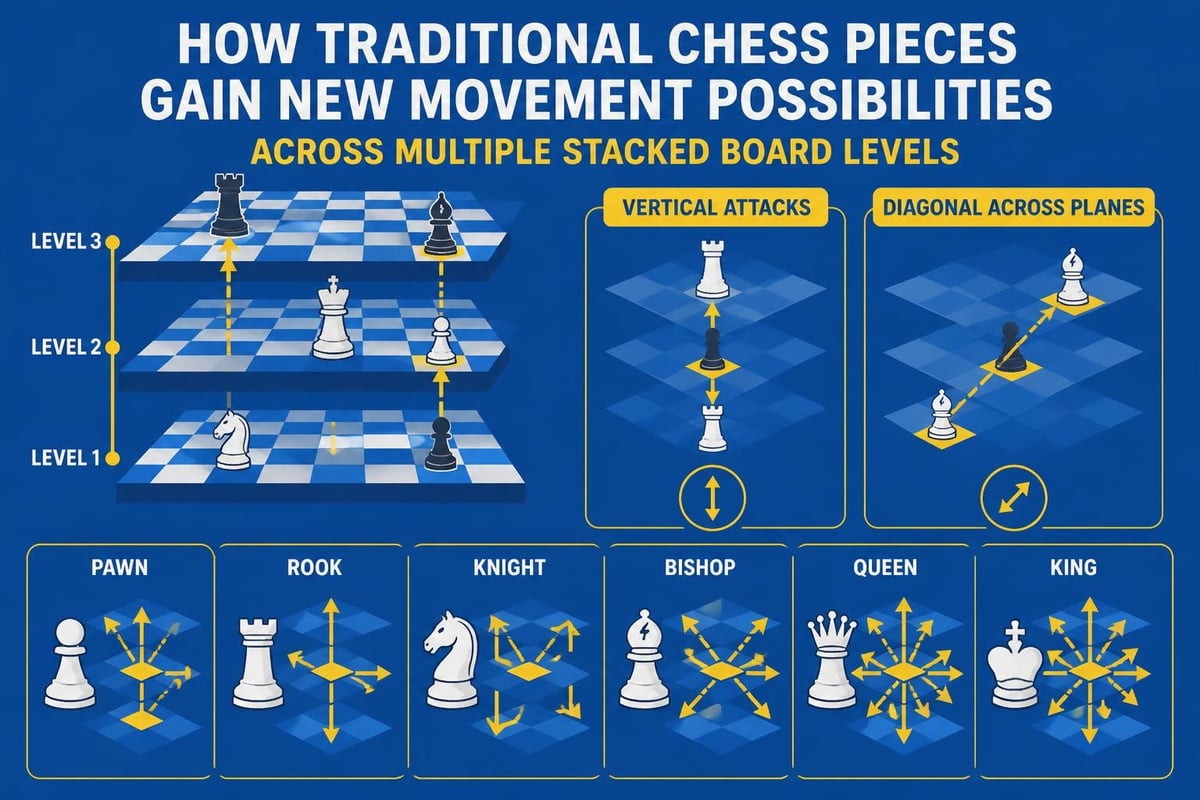
Traditional chess has captivated minds for centuries, but what happens when you introduce vertical movement into the equation? A 3d chess game fundamentally changes how you approach spatial awareness and piece coordination.
The concept isn't entirely new. Star Trek popularised the idea decades ago, but modern technology has finally made it accessible to everyone. Now, you can experience these mind-bending variations through various platforms, from mobile apps to desktop applications.
Why Players Are Embracing 3D Variations
The appeal goes beyond novelty. Here's what draws chess enthusiasts to three-dimensional variants:
- Enhanced spatial reasoning: Training your brain to think in multiple dimensions simultaneously
- Fresh strategic challenges: Classic opening theory becomes less relevant, forcing creative thinking
- Visual engagement: Modern 3D graphics make the experience more immersive than traditional boards
- Skill transfer: The fundamentals you've learned still apply, but in exciting new ways
When you've spent years mastering chess openings, a 3d chess game provides a refreshing change of pace whilst still rewarding your existing knowledge.
Popular 3D Chess Platforms and Variations
Not all three-dimensional chess games are created equal. Some stay close to traditional rules whilst others completely reimagine the game.
Standard 3D Chess Implementations
DreamChess offers an open-source option that's perfect for beginners. It features beautiful OpenGL graphics and runs on multiple platforms, making it accessible whether you're on Windows, Mac, or Linux. The game maintains standard chess rules but presents them in a visually stunning three-dimensional environment.
For those seeking something more ambitious, QuadLevel 3D Chess extends traditional chess across four stacked boards. This variation adds genuine strategic depth, as pieces can move between levels, creating attack patterns impossible on a flat board.
Modern Commercial Options
The Steam platform hosts several impressive offerings. Wozitdev's 3D Chess provides full 3D gameplay with support for both standard rules and custom variants. The developers have planned a campaign mode, adding structure for those who prefer guided progression.
Mobile players aren't left out either. Champion Chess brings three-dimensional chess to iOS and Android devices with multiple AI difficulty levels and tournament features.
| Platform | Key Features | Best For |
|---|---|---|
| DreamChess | Open-source, multiple board sets, cross-platform | Budget-conscious players, Linux users |
| QuadLevel 3D | Four stacked boards, unique vertical movement | Experienced players seeking new challenges |
| Wozitdev's 3D Chess | Custom variants, campaign mode planned | Players wanting variety and structure |
| Champion Chess | Mobile-friendly, tournament mode, multiple AI levels | On-the-go gaming |
Learning Strategies for 3D Chess Success
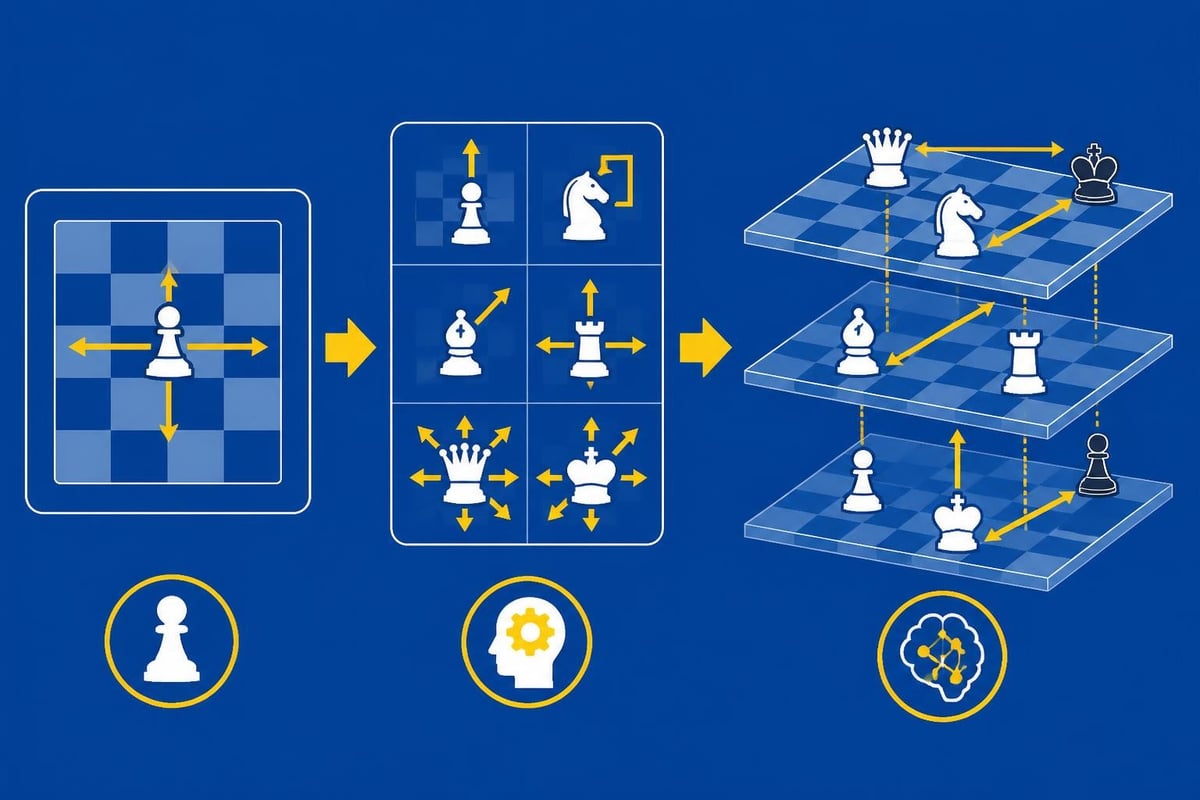
Transitioning from traditional chess to a 3d chess game requires adjusting your thought patterns. Your existing skills provide a foundation, but you'll need to develop new visualisation abilities.
Building Your Three-Dimensional Vision
Start by playing against easier AI opponents. Just as you wouldn't jump straight into complex variations when learning chess videos for beginners, you shouldn't rush into the highest difficulty levels in 3D chess.
Practice visualising the entire board structure before making moves. In traditional chess, you scan horizontally and along diagonals. In three dimensions, you must add vertical awareness to your scanning pattern.
Key skills to develop:
- Vertical threat recognition: Identifying attacks from pieces on different levels
- Multi-level tactics: Setting up combinations that span multiple boards or layers
- Spatial memory: Tracking piece positions across all dimensions simultaneously
- Modified opening principles: Adapting control-the-centre concepts to three-dimensional space
The educational platform TACTIX takes this learning seriously, offering AI-powered coaching specifically designed for three-dimensional chess. It combines visual excellence with educational depth, making the learning curve less steep.
Transferring Traditional Chess Knowledge
You might wonder whether your hours spent studying the Sicilian Defense or the Italian Game still matter in a 3d chess game. The answer is both yes and no.
What Still Applies
Your fundamental understanding of chess principles remains valuable. Piece values, tactical motifs like pins and forks, and endgame concepts all transfer, albeit in modified forms.
Control of central squares still matters, but now you're controlling multiple centres simultaneously. The concept of piece activity becomes even more crucial when pieces can move between levels.
What Changes Dramatically
Opening theory becomes less prescriptive. Whilst you can't directly apply the Ruy Lopez move-by-move, the underlying principles of rapid development and king safety remain relevant.
Traditional concepts that evolve in 3D:
- Centre control: Extends vertically, creating multiple control zones
- King safety: Threats can come from above or below, not just horizontal planes
- Pawn structure: Chain formations become three-dimensional
- Piece coordination: Pieces must work together across different levels

Technical Aspects and Game Engines
Behind every impressive 3d chess game lies sophisticated programming. Understanding how these games work can deepen your appreciation for both the chess and the technology.
Rule Variations and Implementations
Some games stick closely to traditional rules, simply presenting them in 3D graphics. Others, like Ziggurat 3D Chess, introduce genuinely new movement patterns that take advantage of the three-dimensional space.
The challenge for developers is balancing innovation with playability. Add too many new rules, and you alienate traditional chess players. Change too little, and the 3D aspect becomes merely cosmetic.
AI Challenges in Three Dimensions
Programming strong AI for 3D chess presents unique challenges. Traditional chess engines have decades of optimization behind them. Three-dimensional variants require different evaluation functions and search algorithms.
The computational complexity increases dramatically. A traditional chess position might have 20-40 legal moves. A 3D variant could have significantly more, especially when vertical movement is possible from most squares.
| Aspect | Traditional Chess | 3D Chess |
|---|---|---|
| Average legal moves per position | 30-35 | 50-80+ (depending on variant) |
| Computational complexity | High | Very high |
| Opening theory depth | Extensive | Limited but growing |
| Learning curve | Steep | Steeper |
Practical Applications for Skill Development
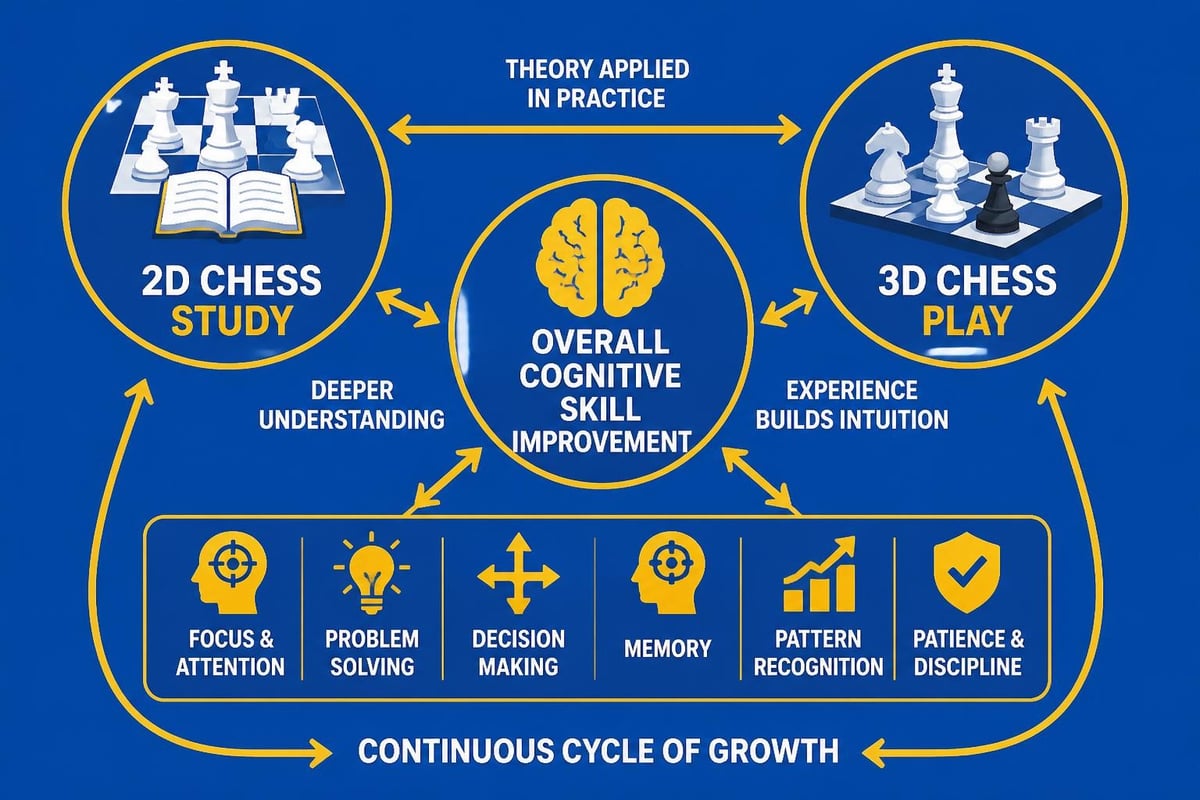
Can playing a 3d chess game actually improve your traditional chess? The research suggests yes, but perhaps not in the ways you'd expect.
Cognitive Benefits
Three-dimensional chess exercises different mental muscles. You're developing enhanced spatial reasoning, which translates to better board visualisation in standard chess. When you return to a flat board, identifying diagonal attacks and knight forks becomes easier.
The novelty factor also matters. When you've analysed thousands of traditional positions, your brain can slip into autopilot. A 3d chess game forces active engagement, keeping your mind sharp and receptive.
Specific skills that transfer back to 2D chess:
- Improved visualisation of complex positions
- Better recognition of geometric patterns
- Enhanced ability to calculate multiple variations simultaneously
- Stronger spatial awareness during tactical sequences
Balancing Traditional and 3D Practice
Should you abandon your chess opening cheat sheets in favour of three-dimensional play? Absolutely not. Think of 3D chess as a supplement, not a replacement.
Many strong players use 3D variants as a break from serious study. After spending hours working through the Queen's Gambit or practising common chess openings, a few games of 3D chess provides mental refreshment whilst maintaining chess-related brain activity.
Getting Started with Your First 3D Game
Ready to take the plunge? Here's how to approach your first foray into three-dimensional chess without feeling overwhelmed.
Choosing Your First Platform
Start with a free option like DreamChess to test your interest. The beautiful graphics provide immediate appeal, whilst the standard rules mean you're not learning an entirely new game from scratch.
If you're serious about exploring this variant long-term, consider investing in a platform with good AI and tutorial features. The mobile option Champion Chess works brilliantly if you want to practise during your commute.
Your First Games: Expectations vs Reality
Don't expect to play well immediately. Even if you're rated 1500 Elo in traditional chess, you'll likely struggle initially with the three-dimensional aspect.
Realistic progression timeline:
- Games 1-5: Confusion and frequent blunders
- Games 6-15: Basic pattern recognition developing
- Games 16-30: Comfortable with piece movements
- Games 31+: Genuine strategic planning emerging
This learning curve mirrors your initial chess journey. Remember how challenging it felt when you first started? The same patience applies here.
Advanced Concepts for Experienced Players
Once you've mastered basic 3D movement, deeper strategic concepts emerge that have no parallel in traditional chess.
Level Control and Vertical Strategy
In games like QuadLevel 3D Chess, controlling specific levels becomes strategically crucial. Think of it as controlling ranks and files, but with an added dimension.
Establishing a piece on a central level gives it influence upward and downward. This creates a three-dimensional version of the "outpost" concept familiar from traditional chess.
Multi-Dimensional Combinations
The most beautiful moments in a 3d chess game come from tactics that exploit all three dimensions. A bishop might attack a piece on one level whilst simultaneously defending a square on another, creating combinations impossible on a flat board.
Common tactical themes in 3D chess:
- Vertical pins (pinning through multiple levels)
- Cross-level forks (a piece attacking targets on different boards simultaneously)
- Skewers through dimensional space
- Discovered attacks created by moving between levels
These patterns take time to recognise intuitively, but they follow logical extensions of 2D tactical principles.
The Community and Competitive Scene
Whilst a 3d chess game hasn't reached the competitive heights of traditional chess, a dedicated community has formed around various platforms.
Online Communities and Resources
Forums and Discord servers dedicated to 3D chess variants provide spaces for discussion, game analysis, and finding opponents. The communities tend to be welcoming to newcomers, recognising that growing the player base benefits everyone.
Some platforms host regular tournaments, though prizes and prestige remain modest compared to traditional chess events. Still, the competitive aspect adds motivation for serious study.
Future Developments
The technology continues to evolve. Virtual reality implementations are emerging, potentially offering even more immersive three-dimensional chess experiences. Imagine physically reaching out to move pieces floating in space around you.
AI development will likely continue improving, perhaps eventually matching the strength of traditional chess engines. As more players engage with these variants, opening theory will develop, and we'll see deeper strategic understanding emerge.
| Year | Development Milestone |
|---|---|
| 2020 | First mainstream mobile 3D chess apps |
| 2023 | VR implementations gain traction |
| 2026 | AI coaching platforms emerge (like TACTIX) |
| 2027+ | Predicted: standardised competitive formats and rating systems |
Integrating 3D Chess into Your Chess Improvement Routine
How does a 3d chess game fit into a serious chess improvement programme? More comfortably than you might think.
Complementary Training Method
Consider 3D chess as you would chess puzzles or blindfold practice - a supplementary activity that develops specific skills. Whilst it shouldn't replace core study of openings, middlegames, and endgames, it offers unique benefits.
Schedule it strategically. Perhaps play a few 3D games after intensive opening study, when your brain needs something different but chess-related. The mental shift can actually help consolidate your traditional learning.
Creating a Balanced Study Plan
A well-rounded chess improvement programme in 2026 might look like this:
- Opening preparation (30% of study time): Using resources from Chess Cheat Sheets to master your repertoire
- Tactical training (30%): Solving puzzles and studying combinations
- Game analysis (20%): Reviewing your games and master games
- 3D chess and other variants (10%): Maintaining freshness and developing spatial awareness
- Physical chess (10%): Over-the-board play for tournament preparation
This balanced approach ensures you're developing comprehensively whilst keeping training engaging. The variety prevents burnout, a common problem amongst dedicated chess students.
A 3d chess game offers far more than novelty. It provides genuine cognitive benefits, refreshes your perspective on traditional chess, and delivers entertainment whilst developing skills. Whether you're exploring DreamChess's beautiful graphics, challenging yourself with QuadLevel's complexity, or using TACTIX's AI coaching, three-dimensional chess represents an exciting frontier in chess development. When you're ready to strengthen your traditional chess alongside these modern variants, Chess Cheat Sheets provides the guides, resources, and opening repertoires you need to excel on the classic 64-square battlefield. Our comprehensive cheat sheets and puzzles help you master fundamental concepts that transfer across all chess variants, building confidence without overwhelming study demands.


