

If you're looking to shake up your opening repertoire and catch your opponents off guard, the kings gambit might be exactly what you need. This aggressive opening has been turning heads for centuries, and there's a reason why it continues to fascinate players from club level all the way up to grandmasters. By sacrificing a pawn on move two, White immediately signals their intentions: this is going to be a fight.
The opening starts with 1.e4 e5 2.f4, and just like that, you've offered your f-pawn in exchange for rapid development and attacking chances. It's bold, it's risky, and when it works, it's absolutely thrilling. But is it right for you? Let's dive deep into what makes this opening tick and how you can add it to your chess arsenal.
What Makes the King's Gambit So Special?
The kings gambit stands out from most modern openings because it completely disregards conventional wisdom about pawn structure and safety. Whilst contemporary theory often emphasizes solid development and maintaining material balance, this opening throws caution to the wind.
Here's what you're really getting when you play the King's Gambit:
- Immediate central pressure and space advantage
- Rapid piece development, especially for your bishops and knights
- Open lines that can lead to devastating attacks
- Psychological pressure on opponents unfamiliar with the theory
- Practical winning chances even in slightly worse positions
The strategic ideas behind the King's Gambit revolve around controlling the center with pieces rather than pawns, opening the f-file for potential rook attacks, and creating immediate threats against Black's kingside. When your opponent accepts the gambit with 2...exf4, you're not mourning the loss of that pawn. Instead, you're celebrating the open lines you've just created.
Historical Context and Modern Relevance
This opening has serious pedigree. It was enormously popular during the Romantic Era of chess in the 19th century, when players like Adolf Anderssen and Paul Morphy used it to create masterpieces of attacking chess. The famous "Immortal Game" from 1851 featured the King's Gambit and remains one of the most celebrated games in chess history.
But does it still work today? Absolutely. Whilst it's not seen as frequently at the super-GM level, the kings gambit remains a potent weapon for club players and even appears occasionally in top-level games. Modern defensive techniques have made it harder to justify the pawn sacrifice theoretically, but practical results tell a different story.
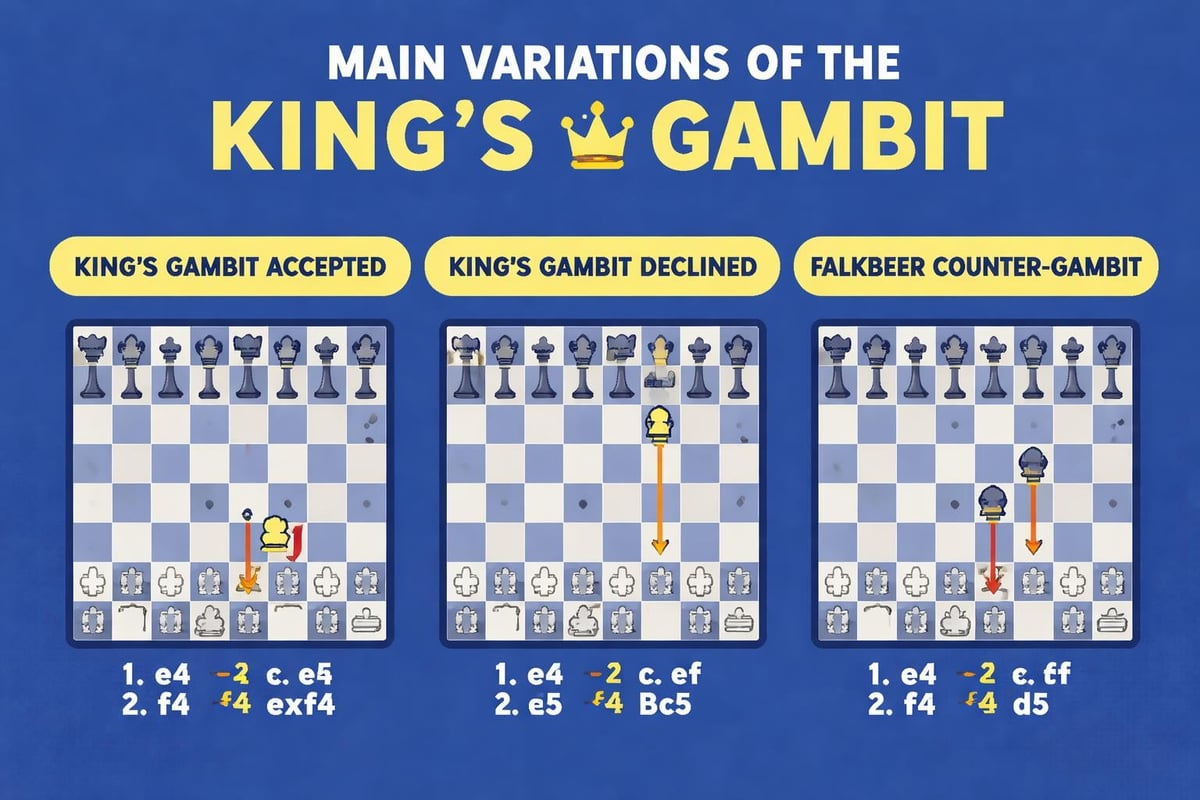
The King's Gambit Accepted: Main Lines
When Black takes the pawn with 2...exf4, you're entering the King's Gambit Accepted territory. This is where the real fun begins. Your next move, 3.Nf3, develops a piece whilst eyeing the weak d4 and e5 squares.
The Classical Variation
After 2...exf4 3.Nf3, Black's most popular response is 3...g5, defending the gambit pawn and creating counterplay. This leads to the Classical Variation, and whilst it looks incredibly aggressive from both sides, there's a method to the madness.
Your plan typically involves:
- Playing d4 to control the center
- Developing your bishop to c4 or d3
- Castling kingside (yes, even with those pawns advanced!)
- Launching an attack down the f-file or through the center
The resulting positions are sharp, tactical, and absolutely critical to calculate accurately. One wrong move can leave your king exposed or your attack sputtering out. But when you get it right? Your opponent won't know what hit them.
Modern Defense and the Fischer Variation
Bobby Fischer famously published an article titled "A Bust to the King's Gambit" in 1961, proposing 3...d6 as a solid defense. The variations and strategic considerations around this line have evolved significantly since then.
| Variation | Black's Approach | White's Strategy | Difficulty Level |
|---|---|---|---|
| Classical (3...g5) | Hold the pawn, counterattack | Central breakthrough, f-file pressure | Advanced |
| Fischer Defense (3...d6) | Solid development | Slow buildup, positional play | Intermediate |
| Modern Defense (3...d5) | Counter-sacrifice | Accept material, attack Black's center | Intermediate |
| Cunningham Defense (3...Be7) | Quick development | Rapid attack on f7 | Beginner-friendly |
The King's Gambit Declined: When Black Says No
Not every opponent will accept your generous pawn offer. When Black plays 2...Bc5, you're facing the King's Gambit Declined, Classical Variation. This is actually one of the most solid defenses against the opening.
Black's logic is simple: develop pieces, keep the center solid, and don't give White the open lines they're craving. Your response needs to be equally principled. The main continuation is 3.Nf3, and you'll typically follow up with d3, Nc3, and Be2, building a solid position whilst maintaining your extra space.
Key ideas in the King's Gambit Declined:
- Don't overextend trying to prove your advantage
- Focus on piece coordination and central control
- Be prepared for a slower, more strategic battle
- Look for opportunities to advance d4 under favorable circumstances
The openings for White require understanding when to push for an advantage and when to consolidate your position. Against the declined variation, patience becomes a virtue.
The Falkbeer Counter-Gambit
One of the sharpest responses to the kings gambit is the Falkbeer Counter-Gambit: 2...d5. Black immediately strikes back at your center, offering their own pawn sacrifice. This counter-gambit completely changes the character of the game.
After 3.exd5 e4, Black gains space and pushes your knight around. The critical position arises, and you need to know your theory here. The main line continues 4.d3 Nf6 5.dxe4 Nxe4, and suddenly both sides have sacrificed material for activity.

Practical Tips for Playing the King's Gambit
Theory is one thing, but making this opening work in your actual games requires understanding some practical considerations. Let's talk about what really matters when you sit down to play.
Understanding Piece Placement
Your bishops are absolutely crucial in the kings gambit. The light-squared bishop typically belongs on c4, eyeing f7 and controlling key central squares. Your dark-squared bishop might go to c4 (after d4), to e2 (in quieter lines), or sometimes even to d3 to support central play.
Knights need to be active. Your kingside knight almost always develops to f3, controlling central squares and supporting potential pawn breaks. The queenside knight usually heads to c3, though sometimes b1-d2-f3 maneuvers make sense.
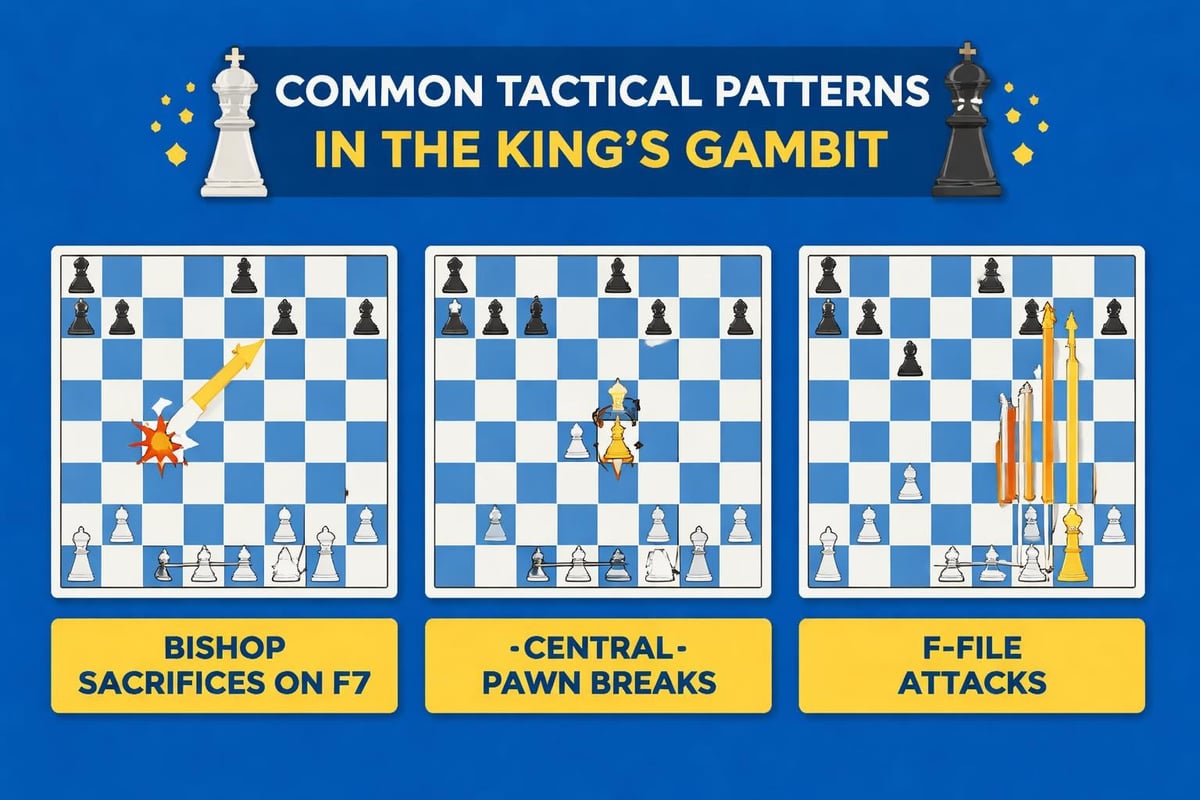
Common Tactical Themes
The beauty of the kings gambit lies in its recurring tactical motifs. Once you recognize these patterns, you'll spot winning combinations much more easily.
- The Bc4 and Qf3 battery: Aiming at f7 creates constant threats
- Central pawn breaks: d4 and e5 advances often crack Black's position open
- Knight sacrifices on e5 or f7: Destroying Black's king safety
- Discovered attacks: Your pieces coordinate beautifully for these
- Back rank tactics: Open files often lead to this
When to Avoid the King's Gambit
Honesty is important here. The kings gambit isn't suitable for every situation or every player. If you're facing a well-prepared opponent who knows the theory inside out, you might struggle to achieve more than equality. Against strong defensive players who excel at simplifying positions, your attacking chances might evaporate.
Similarly, if you're uncomfortable with sharp tactical positions or get nervous when your king looks exposed, this opening might cause you more stress than your opponents. There's no shame in choosing more solid openings for White that better suit your style.
Building Your King's Gambit Repertoire
You can't possibly learn every variation of this opening immediately, and you shouldn't try. Instead, build your repertoire systematically, starting with the most common responses you'll face.
Essential Lines to Study First
Begin with the King's Gambit Accepted, Classical Variation (2...exf4 3.Nf3 g5). This is what you'll face most often, and understanding the resulting positions will teach you the opening's key ideas. The comprehensive overview from Chess.com provides excellent starting points for your study.
Next, learn the Fischer Defense (3...d6) and at least one line against the King's Gambit Declined. These cover probably 80% of what you'll encounter in practice. Once you're comfortable with these, you can expand into the more exotic variations.
Study plan for mastering the King's Gambit:
- Learn main line KGA Classical Variation (Week 1-2)
- Study Fischer Defense and Modern Defense responses (Week 3)
- Add King's Gambit Declined repertoire (Week 4)
- Study Falkbeer Counter-Gambit basics (Week 5)
- Play practice games and review with an engine (Ongoing)
Using Resources Effectively
The historical and analytical resources available for this opening are extensive, which can feel overwhelming. Focus on understanding ideas rather than memorizing moves. When you study a variation, ask yourself: "What is White trying to achieve? What's Black's defensive idea? What are the critical moments?"
Working through chess resources specifically designed for improvement helps tremendously. Annotated games showing typical middlegame plans are more valuable than pure theory dumps.
Transitioning to the Middlegame
The opening phase in the kings gambit often leads to unique middlegame structures that require specific understanding. Your pawn structure will rarely be perfect, but your piece activity should compensate.
Typical Pawn Structures
After the dust settles from the opening complications, you might find yourself with pawns on e4 and d4, controlling the center beautifully. Alternatively, you might have a pawn majority on the kingside whilst Black controls the queenside. Understanding how to play these structures separates those who dabble in the King's Gambit from those who truly master it.
In positions where you've maintained your f-pawn (against the declined variations), you can sometimes advance f4-f5, creating immediate kingside threats. When you've sacrificed the f-pawn but control the f-file, your rooks can become devastating attacking pieces.
Attacking Principles
The kings gambit teaches you aggressive chess, but aggression without purpose leads to disaster. Your attacks need concrete threats, not just vague pressure. Calculate forcing sequences, look for ways to involve all your pieces, and don't forget about king safety.
Sometimes the best continuation isn't a direct attack but improving your worst-placed piece. That queenside knight on c3 might need to reroute to f5 or d5. Your bishops might need to reposition to create maximum pressure.
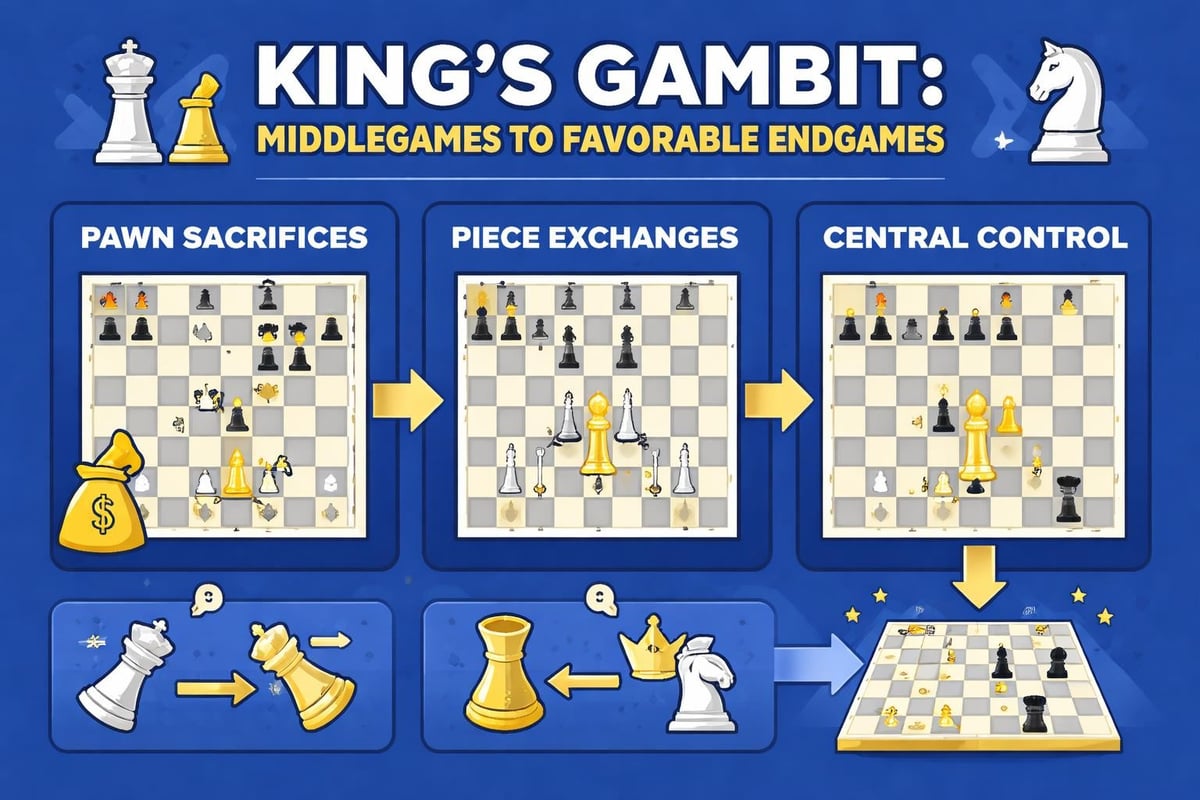
Advanced Concepts and Ideas
Once you're comfortable with basic the kings gambit positions, these advanced concepts will elevate your play to the next level.
Positional Sacrifices
Beyond the initial pawn sacrifice, the King's Gambit often involves additional material investments for long-term compensation. You might sacrifice the exchange (rook for knight or bishop) to destroy Black's pawn structure or to open lines toward their king. These decisions require accurate evaluation, but they're often the difference between a good King's Gambit player and a great one.
Dynamic Play vs. Static Advantages
Traditional chess evaluation focuses on static factors: material count, pawn structure, king safety. The kings gambit teaches you to value dynamic factors: piece activity, initiative, attacking potential. Sometimes being down a pawn with active pieces is better than being up material with passive pieces.
This mindset shift benefits your entire chess game. You'll start recognizing when to sacrifice material for initiative in other openings, and you'll develop better intuition for dynamic positions. The principles that guide engine choices often value these dynamic factors quite differently than human players.
Common Mistakes to Avoid
Learning from others' errors saves you painful lessons at the board. Here are the most frequent mistakes players make when first trying the King's Gambit.
Classic blunders in the King's Gambit:
- Castling too early without sufficient development
- Neglecting Black's counterplay against your center
- Pushing pawns without concrete tactical justification
- Forgetting about your own king safety
- Playing on autopilot instead of calculating critical lines
- Overestimating your compensation after losing the gambit pawn
The biggest mistake? Not playing the opening enough. You'll lose games as you learn, and that's perfectly normal. Each loss teaches you something about the positions, and gradually, you'll develop the pattern recognition that makes the kings gambit work.
Comparing with Other Aggressive Openings
You might wonder how the King's Gambit stacks up against other attacking openings. The Italian Game offers White excellent attacking chances with less theoretical risk. The Scotch Game provides central control with immediate piece activity.
What the kings gambit offers that these don't is immediate imbalance and sharp play from move two. There's no slow maneuvering, no gradual buildup. You're in the thick of it immediately, and that psychological impact shouldn't be underestimated.
Is It Worth Learning in 2026?
Absolutely, though perhaps not as your only opening. The King's Gambit works brilliantly as a surprise weapon, as a learning tool for attacking chess, and as an opening that keeps chess fun and exciting. Will it make you a grandmaster? Probably not by itself. Will it improve your tactical vision, attacking skills, and overall chess understanding? Definitely.
Modern chess engines can refute some lines with perfect play, but you're not playing against perfect opponents. You're playing against humans who make mistakes, who get uncomfortable in sharp positions, and who might not know the theory as well as you do. The strategic applications discussed in various chess forums show this opening remains viable for practical play.
Integrating the King's Gambit into Your Overall Repertoire
The kings gambit shouldn't exist in isolation. It needs to fit within your broader approach to chess. If you play solid, positional chess with Black, this opening provides the aggressive outlet you need with White. If you prefer tactical chaos in all your games, it pairs perfectly with sharp defenses.
Think about which move orders lead to your preferred variations. Against 1...e5, you have the King's Gambit. But what about 1...c5, 1...e6, or 1...c6? You need complete preparation for those responses too. The comprehensive opening guides help you build a cohesive repertoire.
Practice and Improvement Strategies
Studying games by King's Gambit specialists helps enormously. Look at games by modern players who still employ this opening at high levels. Analyze both their wins and losses, understanding what worked and what didn't.
Play blitz and rapid games to gain experience with typical positions. The time pressure makes you rely on pattern recognition rather than deep calculation, and that's exactly the skill you need to develop. Later, play classical games where you can calculate more deeply and explore the positions thoroughly.
Regular review sessions with an engine show you where your understanding falls short. Don't just check for mistakes; ask the engine to show you alternative plans and ideas you might have missed. This deepens your understanding of the opening's strategic foundations.
Training Tools and Resources
Beyond theoretical study, specific training methods accelerate your mastery of the kings gambit. Tactics puzzles from King's Gambit positions sharpen your calculation skills. Endgame practice from typical structures ensures you can convert your advantages.
Creating a personal database of your King's Gambit games helps track your progress and identify recurring problems. When you lose a game, add it to your database with notes about what went wrong and how to improve. When you win brilliantly, save those games too and review the key moments that decided the game.
The opening guides and cheat sheets provide quick reference materials for those moments when you need to refresh your memory before a game. Having condensed, organized information at your fingertips makes pre-game preparation much more efficient.
The King's Gambit offers an exciting journey into aggressive, tactical chess that will sharpen your attacking skills and deepen your understanding of dynamic play. Whether you adopt it as a main weapon or occasional surprise, the principles you learn will enhance your entire chess game. Ready to master this classic opening and add it to your arsenal? Chess Cheat Sheets provides comprehensive guides, quick-reference materials, and structured resources that make learning the King's Gambit and other openings straightforward and effective, helping you improve your chess without endless hours of study.


