

Have you ever wondered why simple chess puzzles grab the attention of both beginners and grandmasters? Every day, millions of players challenge themselves with these brain teasers to test their skills and push their limits.
Solving simple chess puzzles is one of the most effective ways to boost tactical awareness, sharpen calculation, and prepare for competitive play in 2026. In this post, you’ll discover nine must-try puzzles that can make a real difference in your game. Ready to see measurable progress and enjoy the thrill of improvement? Dive in, and unlock your chess potential today.

The Power of Chess Puzzles in Skill Development
Simple chess puzzles might look unassuming, but they pack a powerful punch when it comes to improving your chess game. Whether you are just starting or looking to sharpen your tactics, these puzzles offer a focused, practical way to boost your skills every day.

Why Chess Puzzles Matter
Have you ever wondered why so many players, from beginners to grandmasters, spend hours solving simple chess puzzles? These puzzles are more than just fun brain teasers. They help you spot patterns, improve memory, and sharpen your problem-solving skills.
A recent study showed that regular chess puzzle practice can actually improve calculation speed and tactical vision. Even world champions like Magnus Carlsen and Judit Polgar have credited puzzle training for their success. The best part is, simple chess puzzles adapt to your level, so everyone benefits.
With over 1 million puzzles solved each day on major platforms, it is clear that puzzle-solving is a growing trend. If you want more strategies to make the most of your practice, Improve with Chess Puzzles has some valuable tips.
How to Approach Simple Chess Puzzles Effectively
Tackling simple chess puzzles is not just about finding the right move. Start by observing the position carefully. List out all the threats and potential captures. Next, calculate each candidate move and visualize possible responses.
The key is understanding the ideas behind the solution, not simply memorizing moves. Set a timer to mimic real game pressure and keep a puzzle journal to track your progress. When you make a mistake, review the solution and see if there was an alternative path.
Consistent practice with simple chess puzzles will help you build a strong tactical foundation and boost your confidence at the board.
Common Mistakes to Avoid When Solving Chess Puzzles
Everyone makes mistakes when learning, but being aware of common pitfalls can save you time. Many players rush through simple chess puzzles without fully analyzing the position. Others ignore their opponent's defensive resources, missing key tactics.
Some forget to look for basic themes like forks or pins, while a few get distracted by flashy moves and overlook practical solutions. Not reviewing incorrect answers is also a trap, as you miss the chance to learn from your errors.
Relying only on intuition instead of careful calculation is another common misstep. Remember, reflection and analysis are just as important as solving the puzzle itself.
Benefits of Incorporating Puzzles into Daily Training
Adding simple chess puzzles to your daily routine pays off in surprising ways. You will notice your tactical sharpness increase, and your board vision becomes clearer with each session. Calculation speed and decision-making improve, building confidence for real games.
It is rewarding to see your progress, especially when your rating climbs after consistent practice. Many players use puzzles as a warm-up before tournaments, finding they help reduce nerves and sharpen focus.
Most importantly, simple chess puzzles make learning chess more enjoyable and keep your motivation high, no matter your level.
9 Must-Try Simple Chess Puzzles to Sharpen Your Skills in 2026
Ready to transform your chess game in 2026? Dive into these nine simple chess puzzles that pack a powerful punch for players of every level. Each puzzle here targets a vital skill, making your practice both fun and practical. Whether you want to outsmart your friends or climb the online rating ladder, these challenges will keep you sharp and motivated.
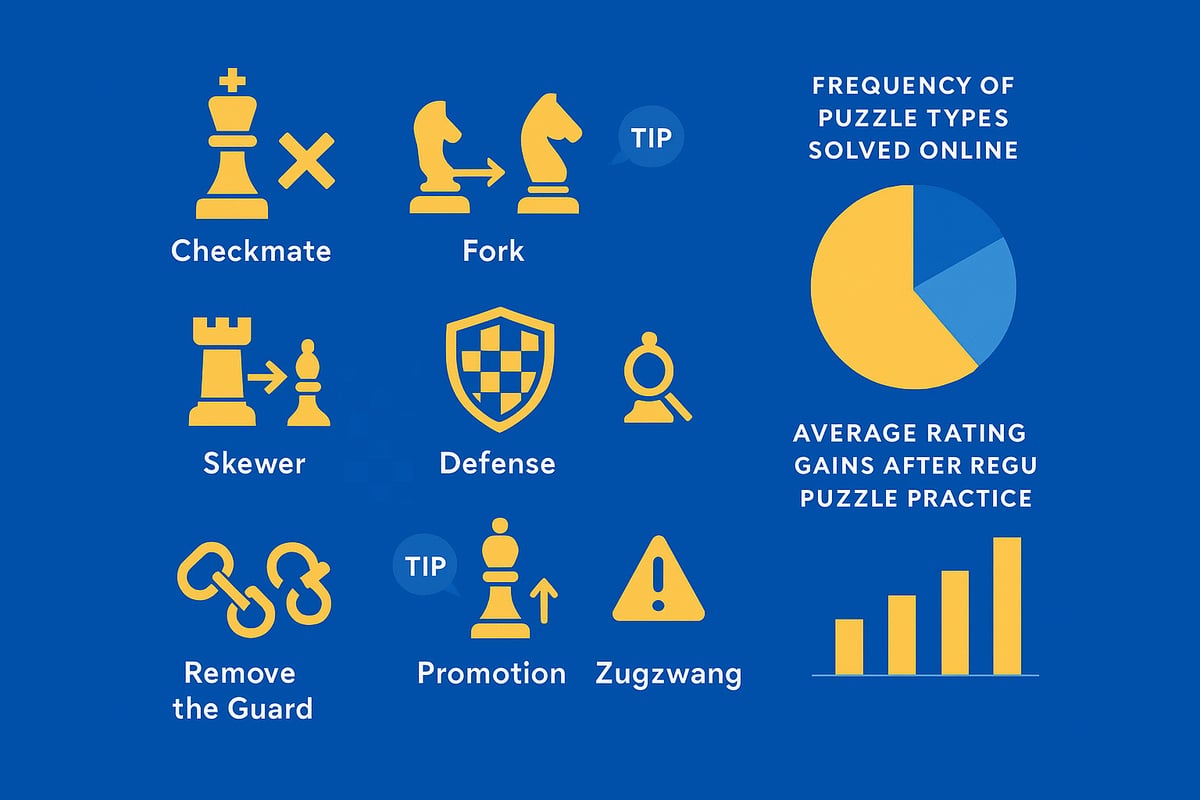
1. The Classic Mate in One
Let’s start simple, but don’t underestimate this one. Mate in one puzzles are the bread and butter of simple chess puzzles for every beginner. Mastering them helps you spot checkmating patterns instantly, which is crucial in real games.
Consider this scenario:
8 . . . . . . . .
7 . . . . . . . .
6 . . . . . . . .
5 . . . . . . . .
4 . . . . . . . .
3 . . . . . . . .
2 . . . . . K . .
1 . . . . . . Q k
  a b c d e f g h
White to move, mate in one.
The answer: Qg1#—the queen delivers checkmate, supported by the king. This pattern is a classic example of how simple chess puzzles develop your tactical vision.
Common themes in mate in one:
- Back rank mate
- Smothered mate
- Support mates
Tips for practicing:
- Always check for all checks on each move.
- Practice at the start of every chess session.
- Use mate in one puzzles as a warm-up.
Did you know that mate in one is the most-solved puzzle type on platforms like Chess.com? That proves how foundational it is. If you’re just starting, consider exploring a How to Play Chess Cheat Sheet to build your basics while you tackle simple chess puzzles.
2. Find the Fork
Fork puzzles are the heart of tactical play in chess. The fork is when one piece attacks two or more enemy pieces at the same time, usually leading to a material win. Among simple chess puzzles, fork tactics are the most satisfying to spot.
Let’s look at a quick example:
8 . . . . . . . .
7 . . . . . . . .
6 . . . . . . . .
5 . . . . . . . .
4 . . . . . . . .
3 . . . . . . . .
2 . . . . . N . .
1 . . . . . k Q .
  a b c d e f g h
White to move: Nf6+ attacks the king and the queen.
Common fork types:
- Knight forks (most common)
- Queen forks
- Pawn forks
How to spot forks in simple chess puzzles:
- Look for loose pieces.
- Find squares where your piece can attack two targets.
- Practice visualizing the fork before moving.
Regular fork practice improves your calculation speed and sharpens your tactical awareness. If you want to read more about how puzzle-solving boosts your chess thinking, check out this article on how chess training boosts problem-solving abilities.
3. Pin and Win
Pins are sneaky and powerful. In simple chess puzzles, pin tactics teach you how to immobilize your opponent’s pieces and win material. A pin happens when a piece cannot move without exposing a more valuable piece behind it.
For instance:
8 . . . . . . . .
7 . . . . . . . .
6 . . . . . . . .
5 . . . . . . . .
4 . . . . . . . .
3 . . . . . . . .
2 . . . . . R . .
1 . . . . . k K .
  a b c d e f g h
White to move: Re8+ pins the black king to the back rank.
Types of pins:
- Absolute pin (piece cannot move at all)
- Relative pin (piece can move, but it’s risky)
Tips for pinning in simple chess puzzles:
- Target pieces in a line with the king or queen.
- Use long-range pieces like bishops and rooks.
- Set up pins by luring enemy pieces onto the same file, rank, or diagonal.
Many grandmasters credit their early puzzle training with pins for their tactical growth. Practicing pins regularly will make these patterns second nature in your games.
4. Skewer the King
A skewer is like a reverse pin. In simple chess puzzles, skewers teach you how to attack a valuable piece, forcing it to move and exposing a weaker piece behind it.
Example position:
8 . . . . . . . .
7 . . . . . . . .
6 . . . . . . . .
5 . . . . . . . .
4 . . . . . . . .
3 . . . . . . . .
2 . . . . . Q . .
1 . . . . . k . K
  a b c d e f g h
White to move: Qe8+ forces the king to move, and then you win the rook behind it.
Key points about skewers in simple chess puzzles:
- Usually done with queen or rook.
- Most effective on open files and diagonals.
- Look for lined-up pieces, with the more valuable one in front.
Tips for setting up skewers:
- Control open lines.
- Force the opponent’s pieces onto the same rank or file.
- Practice endgame skewers, where they’re even more common.
Famous games have been decided by a single skewer. The more you practice, the easier it becomes to spot these winning chances.

5. Defensive Resource: Save the Game
Simple chess puzzles aren’t only about attacking. Defense is equally important, and puzzles focused on saving the game teach you resilience.
Imagine you’re facing mate or about to lose material. Your job is to find the only move that keeps you alive. For example:
8 . . . . . . . .
7 . . . . . . . .
6 . . . . . . . .
5 . . . . . . . .
4 . . . . . . . .
3 . . . . . . . .
2 . . . . . k . .
1 . . . . . . K .
  a b c d e f g h
Black to move: Ke2 avoids mate and keeps fighting.
How to use defensive simple chess puzzles:
- Practice finding stalemates or perpetual checks.
- Learn to interpose pieces to block threats.
- Switch your mindset to defense when under pressure.
Case studies show that world champions often escape with clever defensive resources. Practicing these puzzles boosts your confidence and gives you tools for tournament time scrambles.
6. Discovered Attack Surprise
Discovered attacks are tactical goldmines in simple chess puzzles. The idea is to move one piece, uncovering a hidden threat from another piece.
Try this:
8 . . . . . . . .
7 . . . . . . . .
6 . . . . . . . .
5 . . . . . . . .
4 . . . . . . . .
3 . . . . . . . .
2 . . . . . B . .
1 . . . . . k R K
  a b c d e f g h
White to move: Bg2+ reveals a rook attack, and the king has nowhere to go.
Tips for mastering discovered attacks in simple chess puzzles:
- Line up your pieces for maximum effect.
- Practice with bishops and rooks for longer-range threats.
- Always check what threats are revealed after you move a piece.
Notable games are filled with discovered attacks that changed the course of battle. Practice these puzzles to become a tactical wizard and catch your opponents off guard.
7. Remove the Guard
Removing the defender is a classic tactic in simple chess puzzles. It’s all about capturing or deflecting the piece that’s protecting something critical.
Example:
8 . . . . . . . .
7 . . . . . . . .
6 . . . . . . . .
5 . . . . . . . .
4 . . . . . . . .
3 . . . . . . . .
2 . . . . . Q . .
1 . . . . . k . K
  a b c d e f g h
White to move: Qxe7 removes the guard of the back rank, leading to mate.
Tactics for practicing in simple chess puzzles:
- Look for overworked defenders.
- Try exchange sacrifices to pull away defenders.
- Check for deflection and attraction themes.
Tournament games often hinge on spotting and exploiting these moments. The more you practice, the quicker you’ll recognize when a defender is vulnerable.
8. Promotion Tactics
Pawn promotion can flip a game on its head. In simple chess puzzles, promotion tactics teach you how to shepherd your pawns to the finish line, often under pressure.
Example puzzle:
8 . . . . . . . .
7 . . . . . . . .
6 . . . . . . . .
5 . . . . . . . .
4 . . . . . . . .
3 . . . . . . . .
2 . . . . . P . .
1 . . . . . k . K
  a b c d e f g h
White to move: e2-e4 and prepare for promotion.
Key tactics for promotion in simple chess puzzles:
- Underpromotion to knight or rook for a tactical edge.
- Promote with check to gain time.
- Calculate pawn races accurately.
Did you know that online platforms feature thousands of promotion puzzles? Regular practice here will give you an edge in endgames and time scrambles.
9. Zugzwang in Action
Zugzwang is a fancy word, but in simple chess puzzles, it means forcing your opponent into a move that hurts their position.
Classic example:
8 . . . . . . . .
7 . . . . . . . .
6 . . . . . . . .
5 . . . . . . . .
4 . . . . . . . .
3 . . . . . . . .
2 . . . . . K . .
1 . . . . . . k .
  a b c d e f g h
White to move: If black moves, any move loses. Forcing black to move creates a win.
Why practice zugzwang in simple chess puzzles?
- It’s common in king and pawn endings.
- Teaches you how to create and exploit critical moments.
- Builds your strategic awareness for real games.
Famous endgames often hinge on zugzwang. Practice these puzzles to develop patience and master the endgame squeeze.
Maximizing Your Chess Puzzle Practice in 2026
Are you ready to make the most out of your simple chess puzzles routine? Whether you're aiming for a rapid rating climb or just want to enjoy steady progress, maximizing your practice is all about strategy and consistency. Let’s break down how you can choose, track, integrate, and maintain your puzzle journey for the best results.
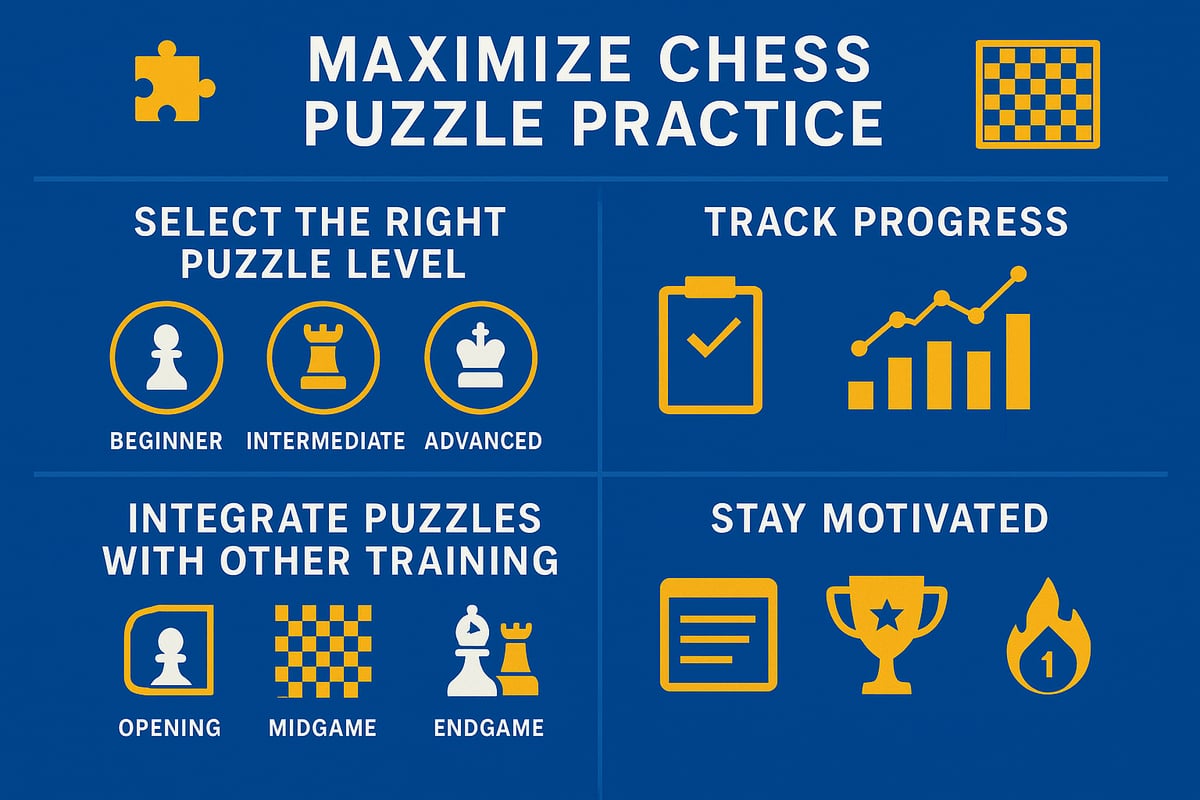
Choosing the Right Puzzles for Your Level
Selecting the right simple chess puzzles is the first step to boosting your chess skills. Start with puzzles that match your current rating and experience. If you’re new, focus on basic tactics like mate-in-ones or simple forks. As you improve, gradually increase difficulty to keep things challenging but not overwhelming.
It’s a smart move to use resources that break down moves and solutions. For practical guidance, check out Help with Chess Moves to better understand puzzle-solving techniques. Try thematic training too—choose puzzles based on tactical themes like pins or endgames. This approach helps you avoid frustration and burnout, making your practice both effective and enjoyable.
Tracking Progress and Measuring Improvement
Tracking your progress with simple chess puzzles helps you see real improvement. Use a puzzle journal, spreadsheet, or built-in analytics from online platforms to record solved puzzles and accuracy rates. Set realistic goals, like solving five puzzles a day or hitting a target accuracy percentage.
Many sites offer puzzle ratings, so you can watch your skill level grow over time. Celebrate milestones—maybe a new high score or a streak of correct solutions. Regular tracking keeps you motivated and shows just how far you’ve come since you started practicing simple chess puzzles.
Integrating Puzzle Solving with Other Chess Training
For the best results, blend your simple chess puzzles practice with other chess study areas. Mix puzzles into your opening prep, middlegame tactics, and endgame studies. This holistic approach ensures you’re training all aspects of your game, not just tactics in isolation.
Try scheduling puzzle sessions as a warm-up before games or as a cool-down after study. Group solving or discussing solutions with friends can offer new perspectives and reinforce learning. By weaving simple chess puzzles into your overall routine, you’ll build a more robust chess foundation.
Staying Motivated and Consistent with Puzzle Practice
Consistency is key when it comes to mastering simple chess puzzles. Set a daily or weekly routine—just ten minutes a day can make a big difference over time. Gamify your experience using leaderboards, streaks, or personal rewards to keep things fun and engaging.
Join online puzzle communities to share tips, celebrate successes, and overcome plateaus together. Remember, everyone hits rough patches, but sticking with your simple chess puzzles practice will pay off. Real-life examples show that regular solvers often see steady rating gains and greater confidence at the board.
So, now that you’ve explored these nine must try chess puzzles, are you feeling that spark to take your skills even further? I totally get the excitement—chess puzzles are one of the best ways to build confidence and sharpen your tactical eye, especially if you’re aiming to level up in 2026. But here’s the thing: real progress comes from putting it all together—openings, tactics, endgames, the whole package. If you’re ready for that next step, why not check out Get The FULL Chess Mastery Bundle? It’s a game changer if you want to keep improving without the overwhelm.


