

Have you ever wondered how chess players around the world are reaching grandmaster-level understanding without stepping foot in a traditional classroom? The landscape of chess education has shifted dramatically, and a remote chess academy has become the go-to solution for ambitious players seeking structured, professional instruction. Whether you're juggling work commitments, living in an area without local chess clubs, or simply prefer the flexibility of learning at your own pace, online chess training offers unprecedented access to world-class instruction. The beauty of remote learning is that you're no longer limited by geography-the best coaches and resources are just a click away, ready to help you transform your game from beginner blunders to confident, calculated moves.
Why Remote Chess Learning Has Revolutionised the Game
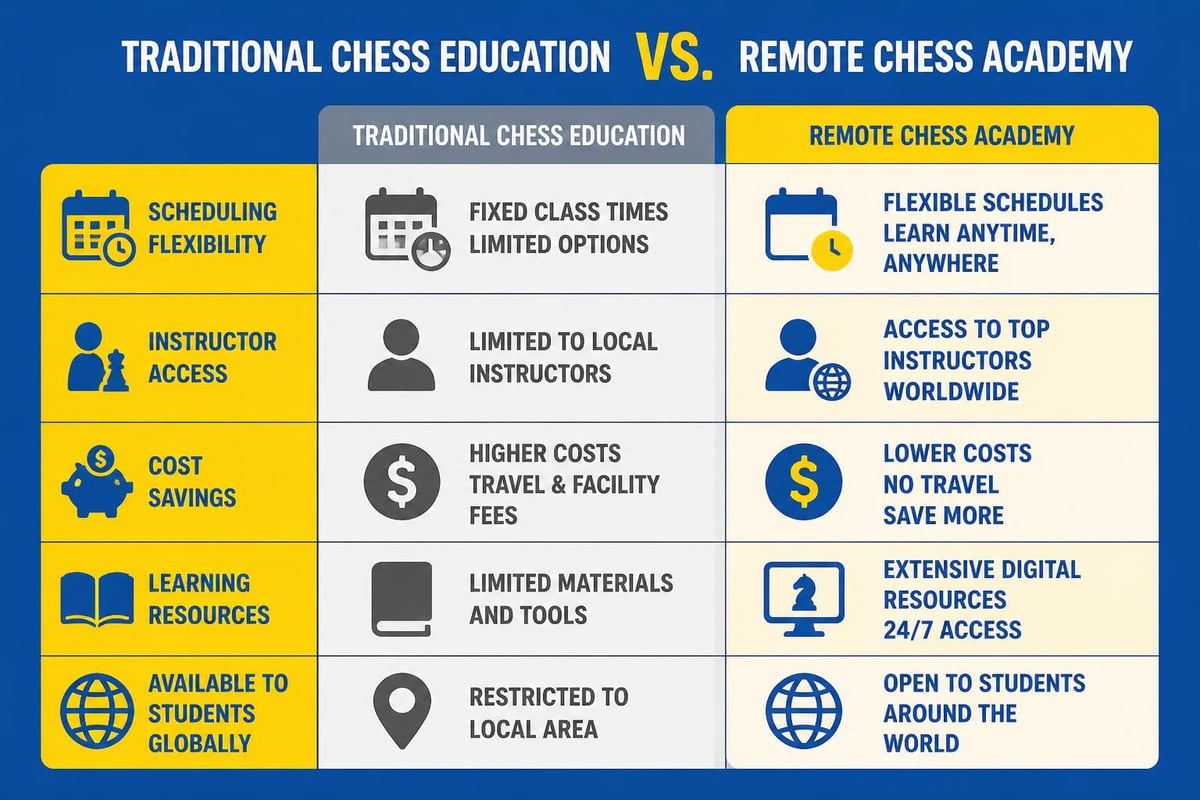
The traditional model of chess education-dusty clubrooms, fixed lesson times, limited access to expert coaches-has given way to something far more dynamic. A remote chess academy breaks down barriers that once held players back.
Think about it: where else can you receive personalised feedback from a grandmaster while sitting in your pyjamas at midnight? The flexibility alone makes online chess training invaluable for busy professionals, students, and parents. But there's more to it than convenience.
Key advantages of remote chess academies include:
- Access to world-class instructors regardless of location
- Flexible scheduling that fits your lifestyle
- Lower costs compared to in-person coaching
- Recorded lessons you can review repeatedly
- Interactive platforms with instant feedback
- Global community of fellow learners
Research into experiential effects in online chess has shown that players can achieve significant performance improvements through remote learning environments. The data suggests that the psychological barriers some players fear-lack of personal connection, reduced engagement-simply don't materialise when the platform is well-designed.
The Structure Behind Effective Online Chess Training
Not all remote chess academies are created equal. The most effective programmes share common structural elements that facilitate genuine improvement rather than passive content consumption.
ABCHESS and similar platforms demonstrate how structured approaches combine live instruction with self-paced learning. They typically organise content into progressive modules, ensuring students build foundational skills before tackling advanced concepts.
Here's what a well-structured remote chess academy curriculum looks like:
- Initial assessment to determine current skill level
- Personalised learning path based on strengths and weaknesses
- Core curriculum modules covering openings, middlegame, endgame
- Tactical training with daily puzzles and exercises
- Live coaching sessions for real-time feedback
- Tournament preparation and game analysis
- Progress tracking with measurable milestones
The London System middlegame plans offer a perfect example of how targeted learning resources can complement broader academy instruction. When you understand the specific strategies behind your chosen openings, you're not just memorising moves-you're building chess intuition.
Choosing the Right Remote Chess Academy for Your Level
Here's the challenge: with dozens of online chess platforms available, how do you select one that matches your needs? The answer depends on your current rating, learning style, and specific goals.
Beginner-Friendly Platforms
If you're relatively new to chess or rated below 1200, you need foundations, not advanced theory. Chessity provides over 200 interactive lessons designed specifically for players building their fundamental understanding. The gamified approach keeps beginners engaged while systematically improving pattern recognition.
Beginners benefit most from:
- Clear explanations of basic tactics (forks, pins, skewers)
- Simple opening principles rather than deep theory
- Frequent reinforcement through puzzles
- Patient instruction that doesn't assume prior knowledge
The Chess Learning Academy specialises in teaching younger players, emphasising critical thinking development alongside chess skills. This holistic approach helps beginners understand why moves work, not just what moves to make.
Intermediate Player Resources
Once you've crossed the 1200-1600 rating threshold, your needs shift. You've mastered basic tactics; now you need positional understanding, opening repertoire development, and endgame technique. A remote chess academy catering to intermediate players should offer deeper analysis and more sophisticated training methods.
| Learning Need | Resource Type | Expected Outcome |
|---|---|---|
| Opening repertoire | Video courses + databases | Consistent first 15 moves |
| Tactical vision | Puzzle sets (rated 1400-1800) | Pattern recognition speed |
| Endgame technique | Systematic study + practice | Converting winning positions |
| Positional play | Annotated master games | Strategic understanding |
Research on chess opening complexity reveals that intermediate players often struggle not because openings are inherently difficult, but because they lack systematic frameworks for understanding them. This is precisely where resources like the Caro-Kann Classical Variation strategy guide become invaluable-they provide the structural understanding that transforms memorisation into comprehension.
The Technology Powering Modern Chess Education
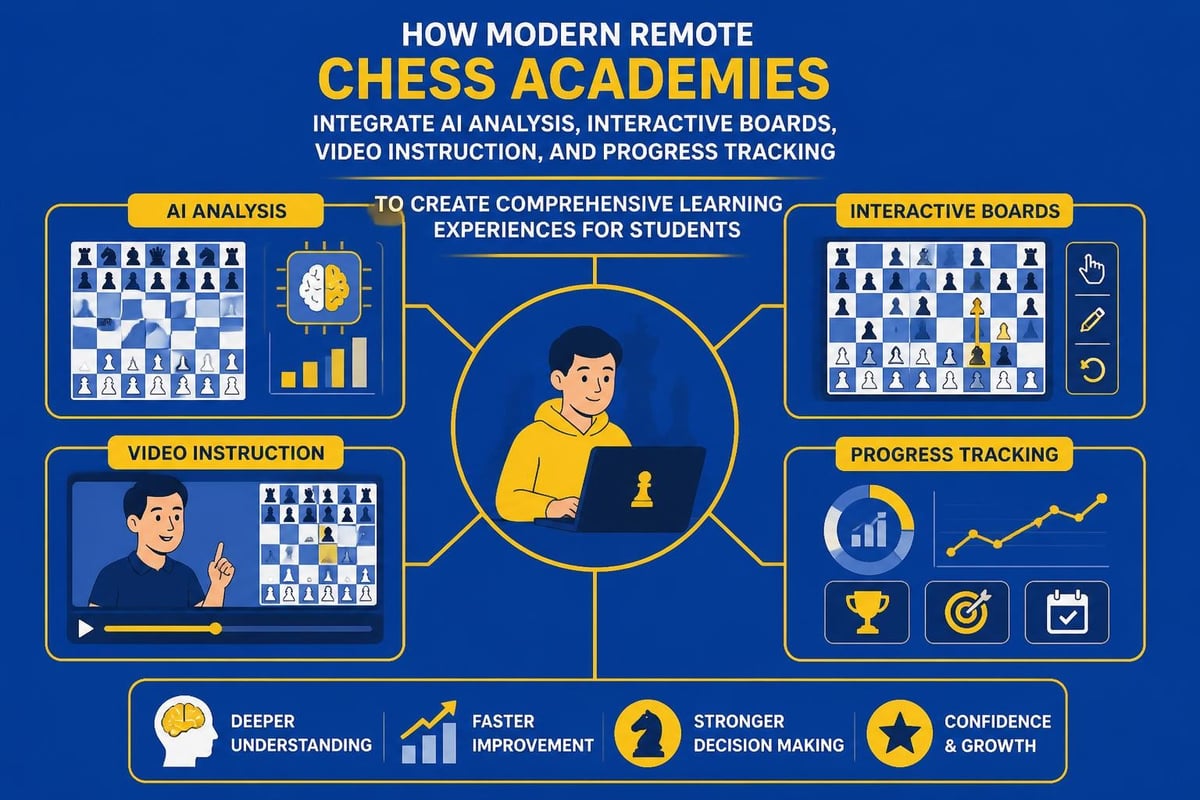
Behind every effective remote chess academy lies sophisticated technology that makes learning seamless and engaging. We're not just talking about video hosting-the platforms that truly enhance learning integrate multiple technologies.
Interactive chessboards allow real-time move input during lessons. Instead of passively watching, you're actively solving problems. When you make a move, the system provides immediate feedback, reinforcing correct thinking or explaining errors.
Studies on deep neural networks in chess learning demonstrate how artificial intelligence can personalise instruction. Modern platforms analyse your games, identify recurring weaknesses, and automatically generate practice positions targeting those specific gaps.
Live Versus Pre-Recorded Content
This debate divides chess educators. Some swear by live interaction; others champion the efficiency of recorded courses. The truth? You need both.
Live sessions offer:
- Real-time question answering
- Personalised feedback on your specific games
- Accountability and scheduled commitment
- Community interaction with fellow students
Recorded content provides:
- Learn at your own pace
- Replay complex concepts multiple times
- Access to expert instruction beyond your budget for private coaching
- Flexibility for irregular schedules
Chess4Life cleverly combines both approaches, offering instructional videos you can review anytime alongside opportunities for live play and coaching. This hybrid model suits the widest range of learning preferences.
Building Your Opening Repertoire Remotely
One area where remote chess academies particularly excel is opening preparation. Traditional coaching might give you a repertoire based on your coach's preferences; online learning lets you explore diverse systems and choose what genuinely fits your style.
The most common chess openings provide a starting point, but you'll want to specialise. As white, you might choose between aggressive systems like the King's Gambit or solid positional approaches like the London System. As black, will you meet 1.e4 with the Sicilian, French, or Caro-Kann?
A remote chess academy gives you the resources to explore each option thoroughly before committing. You can:
- Watch introductory videos explaining the opening's philosophy
- Study model games by strong players
- Practice the opening against computer opponents
- Analyse your results and refine your understanding
- Receive coaching feedback on your games in that opening
The Ruy Lopez opening guide demonstrates the depth required for true mastery-it's not enough to know the first ten moves; you must understand the resulting positions and typical plans.

Game Analysis and Improvement Cycles
Here's where remote chess academies provide something traditional coaching often lacks: consistent, detailed game analysis. Every game you play contains lessons, but extracting them requires systematic review.
The Professional Analysis Process
Top coaches follow a structured approach when analysing student games:
- Identify critical moments (turning points)
- Examine alternative moves at these junctures
- Classify errors (tactical oversights, strategic misunderstandings, time management)
- Suggest specific training to address weaknesses
- Highlight successful decisions to reinforce good habits
Remote Chess Academy, founded by GM Igor Smirnov, has perfected this process through its online courses. Students submit games, receive detailed video analysis, and get customised training recommendations. This creates a feedback loop that accelerates improvement far beyond simply playing more games.
The sentiment analysis research on chess move evaluation offers fascinating insights into how we can better communicate the quality of chess decisions. Modern remote chess academies increasingly incorporate these findings, helping students understand not just what went wrong, but why certain moves create problems.
Time Management and Consistency in Remote Learning
The flexibility of a remote chess academy is both its greatest strength and a potential weakness. Without fixed class times and physical attendance requirements, maintaining consistency requires self-discipline.
Successful online learners typically:
- Set specific study times in their calendar
- Treat these appointments as seriously as in-person commitments
- Create a dedicated study space free from distractions
- Track progress through a chess journal or app
- Join study groups or accountability partnerships
Think of your chess improvement as a marathon, not a sprint. Thirty minutes of focused study daily outperforms sporadic three-hour cramming sessions. Your brain needs time to consolidate patterns and concepts.
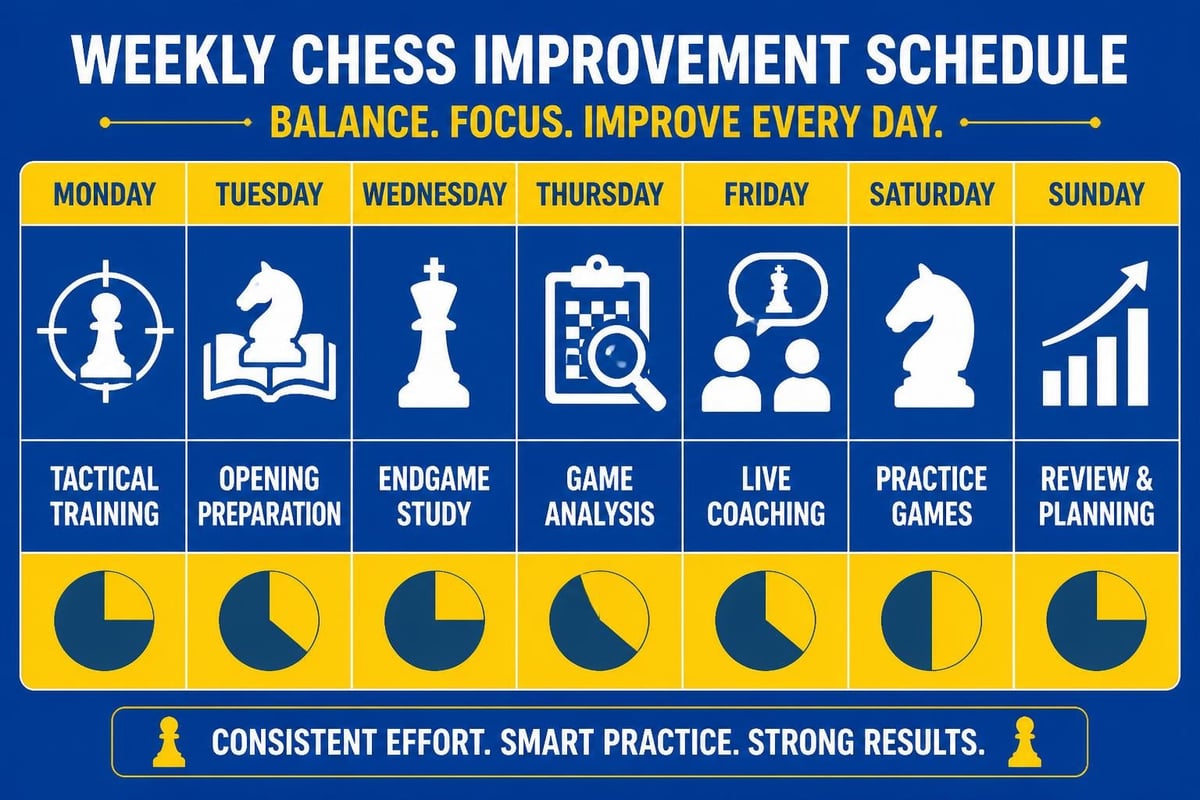
Creating Your Personal Study Schedule
| Day | Activity | Duration | Focus |
|---|---|---|---|
| Monday | Tactics training | 30 mins | Pattern recognition |
| Tuesday | Opening study | 45 mins | Repertoire deepening |
| Wednesday | Endgame practice | 30 mins | Technical positions |
| Thursday | Game analysis | 60 mins | Learning from mistakes |
| Friday | Live lesson | 90 mins | Coaching feedback |
| Weekend | Tournament play | Variable | Practical application |
This structure ensures balanced development across all game phases. Notice how it incorporates the complete learning cycle: study, practice, application, and review.
The Social Element of Remote Chess Communities
You might assume that learning chess online means learning alone. Actually, the best remote chess academies cultivate vibrant communities that rival in-person clubs for camaraderie and support.
Online forums, Discord servers, and study group features connect you with players worldwide who share your passion. These communities offer:
- Training partners matched to your rating and schedule
- Opening discussions where players share discoveries and innovations
- Tournament opportunities against fellow academy members
- Mentorship relationships with more experienced students
- Motivation and accountability during challenging plateaus
The GM Igor Smirnov YouTube lessons demonstrate how even one-way video content can foster community through comments, where students share insights and discuss concepts together. This transforms passive consumption into active learning.
Cost-Effectiveness Compared to Traditional Coaching
Let's address the practical concern: does a remote chess academy represent good value? Compare the costs carefully.
Traditional in-person coaching:
- Private lessons: £40-100 per hour
- Group classes: £15-30 per session
- Travel time and costs
- Limited scheduling flexibility
- Geographic constraints on instructor quality
Remote chess academy:
- Monthly membership: £10-50 for unlimited access
- Live coaching sessions: £20-60 per hour
- No travel costs
- Learn from world-class instructors regardless of location
- Extensive recorded content included
For the price of two private lessons, you could access an entire month of academy content, live group sessions, and community resources. The economics heavily favour online learning, especially for intermediate players who can benefit from group instruction rather than requiring exclusively private attention.
The chess openings section at Chess Cheat Sheets complements academy membership perfectly-instead of paying for custom opening preparation, you access comprehensive guides covering every major system, letting you focus coaching sessions on nuanced questions and game analysis.
Measuring Progress and Setting Goals
How do you know if your remote chess academy is actually improving your play? Subjective feelings aren't reliable-you need objective metrics and clear goals.
Effective progress indicators include:
- Rating changes over 3-month periods (short-term fluctuations mean little)
- Tactical puzzle accuracy at progressively higher difficulty levels
- Time spent calculating before finding the best move decreases
- Opening preparation depth measured by moves played confidently
- Endgame conversion rate in winning positions
Set SMART goals: Specific, Measurable, Achievable, Relevant, Time-bound. "Get better at chess" fails this test. "Increase my rating from 1400 to 1550 within six months by completing 50 endgame lessons and playing 100 rated games" succeeds brilliantly.
Your remote chess academy should provide tools for tracking these metrics. Many platforms generate progress reports showing how your tactical rating, opening knowledge, and other parameters evolve over time. These visualisations help maintain motivation during inevitable plateaus.
Supplementing Academy Learning with Targeted Resources
Even the most comprehensive remote chess academy can't cover everything in perfect detail. Smart students supplement academy instruction with specialised resources addressing their specific weaknesses or interests.
This is where curated guides become invaluable. When your academy introduces an opening system, you might want deeper analysis than the introductory lesson provides. The Caro-Kann Defense guide offers exactly this depth, explaining not just moves but the strategic ideas and typical pawn structures arising from this solid defence.
Effective supplementary resources:
- Opening databases for exploring specific variations deeply
- Puzzle books targeting your tactical blind spots
- Master game collections in your preferred openings
- Endgame manuals for systematic technique improvement
- Chess software for independent analysis
The key is integration. Don't randomly consume chess content-select resources that directly address gaps identified through your academy learning. If your coach notices you struggle with knight endgames, prioritise that topic in your supplementary study.
Adapting Your Learning Style to Online Formats
Not everyone learns identically. Some players absorb concepts quickly through video demonstrations; others need hands-on practice before understanding clicks. A quality remote chess academy accommodates different learning preferences.
Visual learners thrive on diagram-heavy explanations and video demonstrations. Watching pieces move while hearing strategic commentary reinforces concepts through multiple sensory channels.
Kinesthetic learners need to physically (or virtually) move pieces. Interactive platforms where you input moves, rather than just watching, suit this learning style perfectly.
Analytical learners prefer written explanations they can study at their own pace, referring back to specific points. Detailed PDF course materials complement video content for these students.
Identify your learning style and ensure your chosen remote chess academy provides resources matching your preferences. Most platforms now offer multi-modal content-videos with transcripts, interactive boards alongside written explanations-recognising that effective learning often combines multiple approaches.
Remote chess education has democratised access to world-class instruction, offering flexibility and affordability that traditional coaching can't match. By choosing the right academy, maintaining consistent study habits, and supplementing structured lessons with targeted resources, you'll accelerate your improvement beyond what seemed possible just years ago. Whether you're building your opening repertoire or refining endgame technique, Chess Cheat Sheets provides the streamlined guides and practical resources that transform theoretical knowledge into confident over-the-board performance, helping you master chess openings and sharpen your skills without overwhelming study requirements.


