

When you think about iconic chess openings, few have captured the imagination quite like the Queen's Gambit. Whether you're setting up your queens gambit chess board for the first time or you've played this opening dozens of times, there's always something new to discover. The Netflix series may have brought the name into popular culture, but this opening has been dominating chess boards for over 500 years. Let me walk you through everything you need to know about setting up and playing this brilliant opening, from the initial board position to the strategic ideas that make it so powerful.
Understanding the Queens Gambit Chess Board Setup
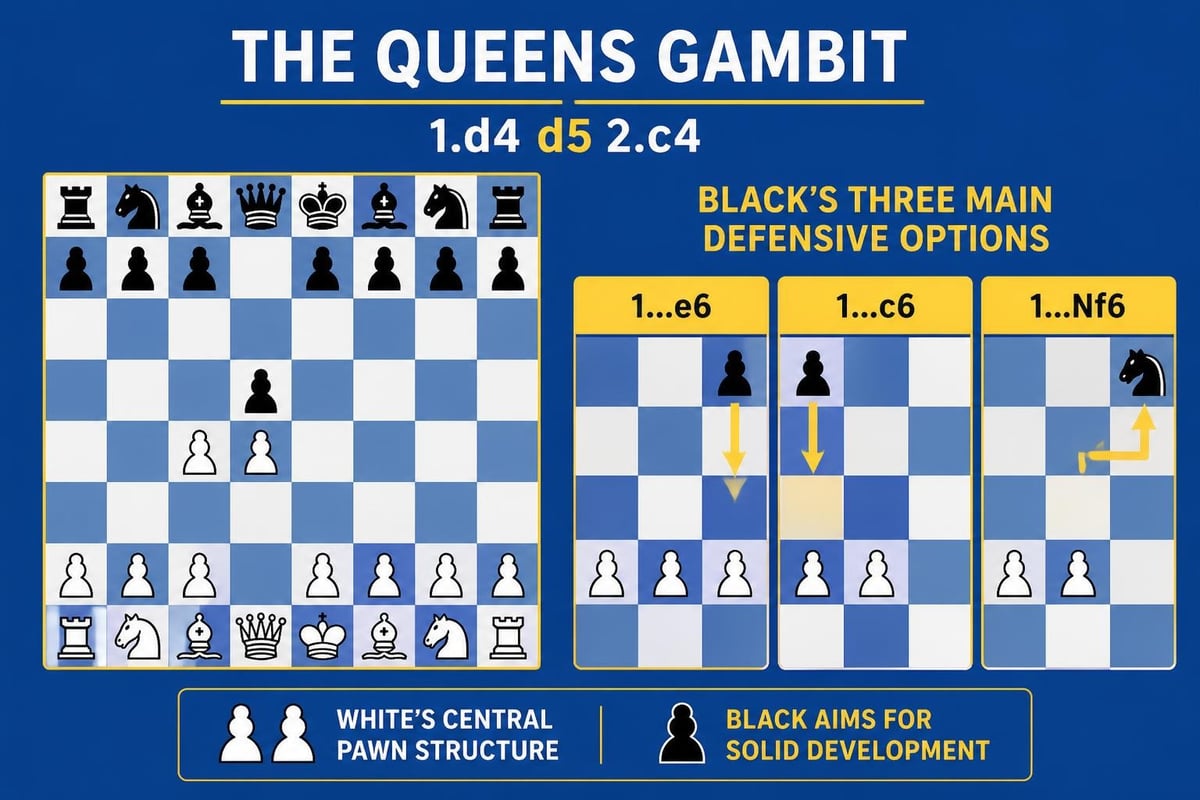
The queens gambit chess board begins with a simple yet powerful sequence of moves. You'll start with 1.d4, placing your queen's pawn two squares forward. Black typically responds with 1...d5, establishing control in the centre. Then comes the defining moment: 2.c4.
This is where the "gambit" part comes into play. White offers a pawn sacrifice, but here's the fascinating bit: it's not really a true gambit at all. Unlike other gambits where you're genuinely sacrificing material for rapid development, the Queen's Gambit is what chess players call a "pseudo-gambit." White can almost always regain the pawn if Black accepts the offer.
The Initial Position
After these opening moves, your queens gambit chess board shows a characteristic pawn structure. White has pawns on d4 and c4, whilst Black has a pawn on d5. The tension is palpable, and Black faces a critical decision.
Black has three main responses:
- Accept the gambit with 2...dxc4 (Queen's Gambit Accepted)
- Decline with 2...e6 (Queen's Gambit Declined)
- Counter-attack with 2...c6 (Slav Defence)
Each choice leads to completely different middle-game positions, which is why the Queen's Gambit has such rich theoretical depth.
Why the Queens Gambit Chess Board Position Is So Powerful
You might wonder why this particular setup has stood the test of time. The answer lies in the strategic advantages White gains from the very first moves. When you establish your pawns on d4 and c4, you're not just controlling the centre-you're actively fighting for it in a way that gives you long-term benefits.
The queens gambit chess board position offers White several key advantages. First, you're developing your queenside whilst maintaining central pressure. Second, you're preparing to develop your pieces to their most active squares. Third, you're creating potential weaknesses in Black's position that you can exploit later in the game.
Strategic Goals for White
| Strategic Element | How It Benefits White | Typical Plan |
|---|---|---|
| Central control | Dominates d4 and e4 squares | Build a strong pawn centre |
| Piece development | Natural squares for pieces | Nf3, Nc3, Bg5, e3 |
| Queenside pressure | Creates long-term attacking chances | Minority attack on queenside |
| Flexibility | Multiple pawn structures available | Adapt to Black's setup |
The beauty of studying positions like these is that they teach you fundamental chess principles. If you're looking to expand your opening repertoire beyond the Queen's Gambit, you might enjoy exploring chess openings for white that share similar strategic themes.
Main Variations on the Queens Gambit Chess Board
Let's dive deeper into what happens after those initial moves. The queens gambit chess board can transform into wildly different positions depending on Black's choice, and understanding these variations is crucial for your chess development.
Queen's Gambit Declined
This is the classical response, and it's been played at the highest levels for generations. After 2...e6, Black supports the d5 pawn and prepares to develop the kingside pieces. The resulting positions are solid, strategic, and require careful planning from both sides.
Key characteristics of the QGD:
- Black maintains a strong point on d5
- White often plays for a minority attack
- Both sides have good piece placement options
- The struggle centres around the d5 pawn
A typical continuation might be 3.Nc3 Nf6 4.Bg5 Be7 5.e3 O-O 6.Nf3 h6 7.Bh4. You can see how both sides develop logically whilst maintaining the central tension. This variation appears frequently in master games because it offers both sides reasonable chances for a complex middle-game.

Queen's Gambit Accepted
When Black plays 2...dxc4, accepting the pawn, the queens gambit chess board takes on a different character entirely. Black gives up the centre temporarily to grab material, but White has excellent compensation.
After 3.Nf3, White doesn't rush to recapture the pawn. Instead, you continue developing and building central pressure. The strategic concept here revolves around White's superior centre versus Black's extra pawn (which is only temporary anyway).
The history and evolution of the Queen's Gambit shows how top players have refined both sides of this variation over centuries.
Setting Up Your Queens Gambit Chess Board for Practice
If you're serious about mastering this opening, you need to practise the positions repeatedly. Setting up your queens gambit chess board correctly is the first step, but deliberate practice makes all the difference.
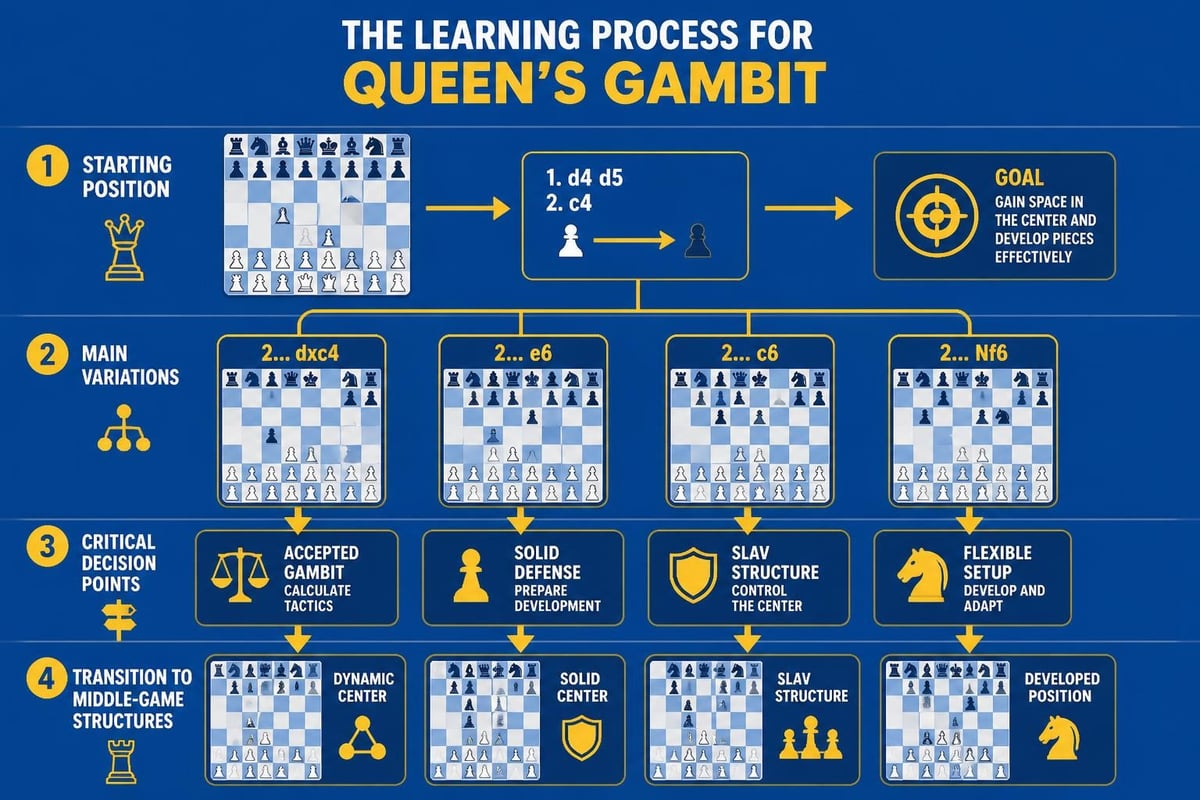
- Start with the basic position after 1.d4 d5 2.c4
- Choose a variation to study (QGD, QGA, or Slav)
- Play through master games in that variation
- Identify critical positions where understanding matters most
- Practise transitions to the middle-game
Common Mistakes to Avoid
Even experienced players make errors when handling the queens gambit chess board positions. Here are the most frequent pitfalls I've observed:
White's common mistakes:
- Developing the queenside knight before the kingside
- Playing e3 too early and blocking the bishop
- Forgetting about the minority attack plan
- Neglecting king safety in pursuit of queenside attacks
Black's common mistakes:
- Accepting the gambit without a plan to hold the pawn
- Developing pieces passively in the QGD
- Allowing White's central pawns too much freedom
- Missing tactical opportunities in sharp lines
The Slav Defence deserves special mention because it's become incredibly popular at all levels. With 2...c6, Black supports d5 without blocking the light-squared bishop. This flexibility makes it a favourite amongst players who want solid positions with counterattacking potential. Understanding various defensive structures helps you appreciate why the Slav has such a strong reputation.
Advanced Concepts for the Queens Gambit Chess Board
Once you've grasped the basics, it's time to explore the deeper strategic themes that make the queens gambit chess board positions so rich and complex. These concepts separate casual players from those who truly understand the opening.
Pawn Structures and Their Plans
The pawn structure determines your entire middle-game plan. In Queen's Gambit positions, you'll encounter several characteristic structures:
| Pawn Structure | Key Features | Winning Plan |
|---|---|---|
| Hanging pawns (c4/d4) | Dynamic but vulnerable | Create attacking chances before they become weak |
| Isolated queen's pawn | Central control vs weakness | Attack or defend based on whose IQP it is |
| Carlsbad structure | White c4/d4 vs Black e6/d5 | Minority attack for White, kingside play for Black |
| Exchange variation | Symmetrical centre | Manoeuvring game, slight edge for White |
Understanding these structures helps you make better decisions throughout the game. For instance, if you reach a Carlsbad structure, you know White should be pushing b4-b5 on the queenside whilst Black should be launching a kingside attack with moves like f5 and possibly g5.
Piece Placement Principles
On the queens gambit chess board, certain squares become critical for piece placement. White's light-squared bishop often belongs on g5, pinning Black's knight and creating pressure. The queen's knight typically develops to c3, supporting the d4 pawn and preparing for potential pawn breaks.
Black's pieces have their own preferred squares. The kingside knight usually goes to f6, whilst the queenside knight might head to d7 or c6 depending on the variation. The dark-squared bishop faces a strategic dilemma in the QGD-it's blocked by the e6 pawn, which is why many lines involve either ...b6 and ...Bb7 or ...Nbd7 followed by ...b6.
Practical Tips for Improving Your Queens Gambit Play
Theory is valuable, but practical play is where you truly learn. Here's how to accelerate your improvement with the queens gambit chess board positions.
Study methods that work:
- Analyse complete master games, not just opening moves
- Use tactics puzzles from Queen's Gambit positions
- Play the same variation repeatedly to build pattern recognition
- Review your games to spot recurring mistakes
- Work with a coach or study partner when possible
The strategic foundations you build studying the Queen's Gambit transfer to other openings as well. Similar central pawn structures appear in the Catalan Opening, which combines Queen's Gambit ideas with a kingside fianchetto.
Building Your Opening Repertoire
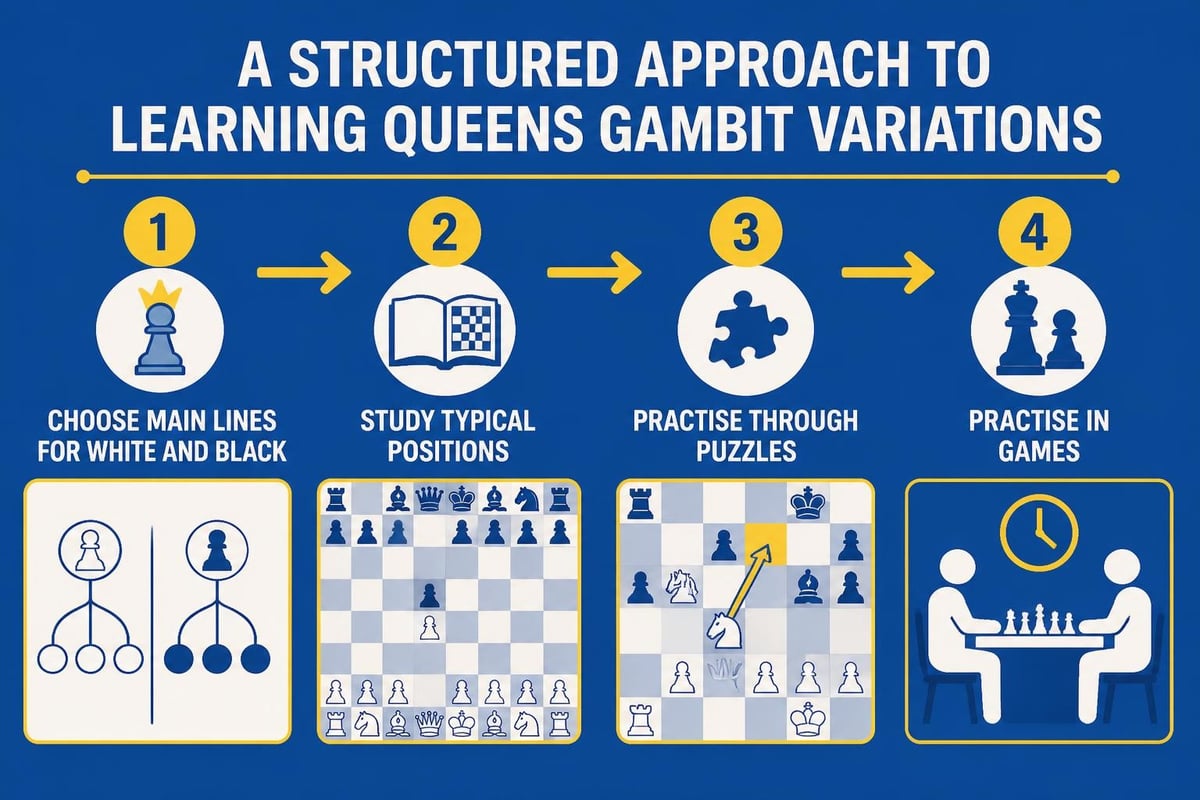
You don't need to learn every variation of the queens gambit chess board positions. Instead, focus on one main line as White and one or two defences as Black. This focused approach builds deep understanding rather than superficial knowledge.
For White, I recommend starting with the main lines of either the QGD or QGA. Learn the key ideas, the typical plans, and a few critical variations. As Black, choose either the Classical QGD or the Slav Defence based on your playing style. Do you prefer solid, strategic positions? Go for the QGD. Want more flexibility and counterplay? The Slav might suit you better.
Resources for Mastering the Queens Gambit Chess Board
You've got plenty of excellent resources available for improving your understanding of these positions. The comprehensive overview of strategic concepts provides a solid foundation for players at any level.
Training Materials You Should Use
Essential study resources:
- Opening databases with annotated games
- Video courses focusing on plans and ideas
- Puzzle collections from Queen's Gambit positions
- Interactive training tools for memorisation
- Cheat sheets for quick reference during games
If you're just starting your chess journey, chess videos for beginners can help you understand the fundamental concepts before diving deep into specific openings.
Practice Positions to Master
Set up these critical positions on your queens gambit chess board and play them out multiple times:
- The Exchange Variation position after 1.d4 d5 2.c4 e6 3.Nc3 Nf6 4.cxd5 exd5
- The Tartakower Variation after 1.d4 d5 2.c4 e6 3.Nc3 Nf6 4.Bg5 Be7 5.e3 O-O 6.Nf3 h6 7.Bh4 b6
- The Semi-Slav after 1.d4 d5 2.c4 e6 3.Nc3 Nf6 4.Nf3 c6
- The QGA mainline after 1.d4 d5 2.c4 dxc4 3.Nf3 Nf6 4.e3 e6 5.Bxc4 c5
Each position teaches different strategic themes and tactical patterns. Regular practice with these setups improves your intuition for similar positions that arise in your games.
Common Questions About the Queens Gambit Chess Board
Players often have specific questions about handling these positions. Let me address the most frequent ones I encounter.
Is the Queen's Gambit suitable for beginners?
Absolutely! The queens gambit chess board positions teach fundamental chess principles: central control, piece development, and strategic planning. While some variations get complex, the basic ideas are accessible to players of all levels. You don't need to memorise 20 moves deep-understanding the key concepts matters more.
How do I know which variation to play?
Your choice depends on your playing style and what you enjoy. Aggressive players might prefer the sharper lines of the QGA or certain Slav variations. If you favour strategic, positional chess, the Classical QGD offers rich middle-games with clear plans for both sides. Experiment with different lines to discover what suits you best.
Should I study the Queen's Gambit as both White and Black?
Yes! Understanding both sides of the queens gambit chess board deepens your comprehension dramatically. When you know White's plans, you defend better as Black. When you understand Black's counterplay, you anticipate it better as White. This dual perspective is invaluable.
The detailed analysis of Queen's Gambit fundamentals explains the core strategic objectives that apply regardless of which specific variation you're playing.
Transitioning from Opening to Middle-Game
One aspect that often gets overlooked is how to transition smoothly from your queens gambit chess board setup into a favourable middle-game. Many players know the opening moves but struggle once the "book" ends.
Key Transition Moments
Critical decision points include:
- When to release central tension with a pawn exchange
- Choosing between kingside castling or queenside castling
- Deciding when to start your pawn storm
- Recognising when to trade pieces vs keeping tension
Let's say you've reached a typical QGD position where both sides have developed their pieces. White has Nc3, Nf3, Bg5, and has castled kingside. Black has Nf6, Be7, O-O, and has played ...Nbd7. What's your plan now?
As White, you're looking to establish dominance on the queenside. You might play Qc2, Rad1, and prepare e4 or the minority attack with b4-b5. As Black, you need counterplay, often through ...c5 or kingside expansion with ...Ne4 and ...f5. Understanding these plans transforms you from someone who "knows the opening" to someone who truly comprehends the queens gambit chess board positions.
Connecting Queen's Gambit to Your Overall Chess Development
The strategic lessons from the queens gambit chess board extend far beyond this single opening. The central control, piece coordination, and long-term planning you develop here apply across all aspects of your chess.
Skills You Develop
Working with these positions improves several crucial chess skills:
- Pawn structure evaluation: Recognising which structures favour you
- Piece activity: Understanding which squares maximise your pieces' effectiveness
- Strategic planning: Creating and executing long-term plans
- Tactical awareness: Spotting combinations in semi-closed positions
- Endgame technique: Handling typical Queen's Gambit endgames
These transferable skills make you a stronger overall player. The positional understanding you gain studying the Ruy Lopez or other classical openings complements what you learn from the Queen's Gambit perfectly.
Practical Examples from Real Games
Let's look at how strong players handle the queens gambit chess board in actual competition. Theory is helpful, but seeing ideas in action clarifies everything.
Consider a classic game where White plays the Exchange Variation. After the opening phase, White has the typical Carlsbad structure-pawns on c4 and d4 against Black's e6 and d5. White methodically executes the minority attack: b4, a4, b5. Black tries to create kingside counterplay but White's queenside pressure proves more effective. Eventually, Black's queenside pawns become weak, and White converts this advantage into a win.
This example demonstrates patience and strategic consistency-qualities every improving player needs to develop. The queens gambit chess board teaches you to formulate plans and stick with them, even when progress seems slow.
Lessons from master games:
- Plans unfold over many moves, not just a few
- Pawn structures dictate strategic objectives
- Prophylactic thinking prevents opponent counterplay
- Technical endgame skills matter enormously
Studying annotated games helps you internalise these patterns. The comprehensive guide to Queen's Gambit strategy includes numerous instructive examples worth analysing.
The queens gambit chess board offers a lifetime of learning opportunities, from your first tentative moves to deep strategic mastery. Understanding the initial setup, key variations, and strategic themes transforms this classical opening from a series of moves into a powerful weapon in your chess arsenal. Whether you're building your opening repertoire from scratch or refining your existing knowledge, Chess Cheat Sheets provides the streamlined guides, puzzles, and resources you need to master the Queen's Gambit and other essential openings efficiently, helping you improve your game without getting lost in endless theoretical variations.


