

You've probably sat across from an opponent, staring at the board, wondering why their moves seem so effortless whilst yours feel forced. The difference isn't innate talent or years of study. It's understanding the patterns that separate casual players from those who consistently play winning chess. Whether you're just learning the ropes or looking to push past a plateau, mastering the fundamentals alongside tactical sharpness transforms your entire approach to the game.
Understanding the Foundations of Winning Chess
Before diving into complex strategies, let's address what actually makes chess "winning" in practical terms. You're not aiming to memorise every variation or study grandmaster games for hours. Instead, you need a reliable framework that works in real positions against real opponents.
Winning chess rests on three pillars: tactical awareness, positional understanding, and opening preparation. Most players skip straight to openings, but that's like building a house starting with the roof. Your tactical vision determines whether you spot opportunities or blunder pieces away.
Think about your last few games. How many times did you miss a simple fork or walk into a pin? Understanding chess tactics forms the bedrock of improvement because tactics decide the majority of amateur games. Strategy matters, but only when you're not hanging pieces.
The Tactical Foundation
Tactics are the immediate, concrete sequences that win material or deliver checkmate. They're the difference between theoretical understanding and board results.
Here's what you absolutely need to recognise instantly:
- Forks: Attacking two or more pieces simultaneously with one piece
- Pins: Restricting piece movement because moving would expose a more valuable piece
- Skewers: Forcing a valuable piece to move and capturing a less valuable piece behind it
- Discovered attacks: Moving one piece to reveal an attack from another
- Removal of defender: Eliminating the piece protecting a key square or piece
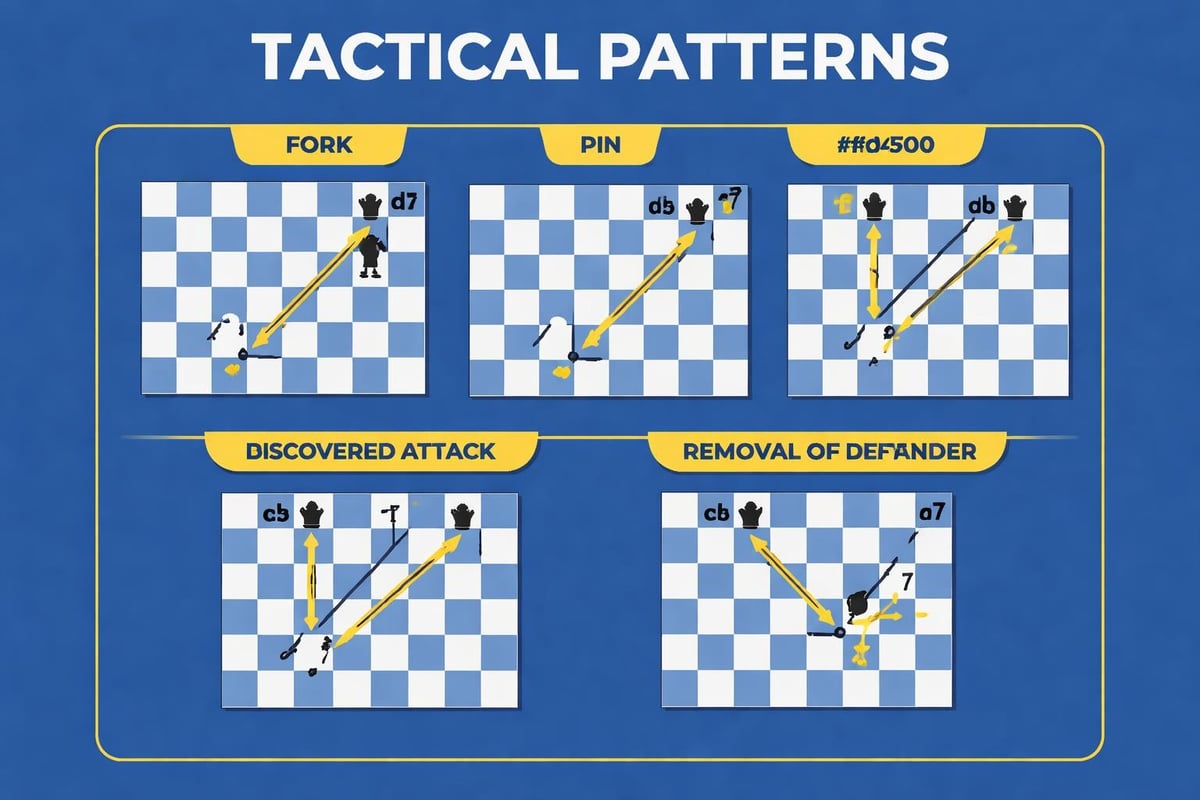
Each pattern appears dozens of times in your games, yet most players only spot them occasionally. The solution isn't talent. It's systematic pattern recognition developed through focused practice.
Building Your Opening Repertoire Efficiently
You've probably encountered players who rattle off 15 moves of theory whilst you're still trying to develop pieces sensibly. Don't let this intimidate you. They've memorised lines; you need to understand principles.
When you play winning chess, your opening accomplishes three critical goals: control the centre, develop pieces to active squares, and safeguard your king. That's it. Everything else is refinement.
| Opening Type | Key Benefit | Difficulty Level | Best For |
|---|---|---|---|
| Italian Game | Clear development plan | Beginner-friendly | Learning fundamental principles |
| London System | Flexible structure | Easy to learn | Players wanting consistency |
| Caro-Kann | Solid defensive setup | Moderate | Positional players |
| Sicilian Defense | Dynamic counterplay | Complex | Tactical players |
The Italian Game provides excellent structure for players learning to play winning chess because every move serves a clear purpose. You control the centre with pawns, develop knights before bishops, and castle early. Simple, effective, repeatable.
For Black, choosing solid openings that mirror these principles gives you fighting chances without memorising endless theory. The Caro-Kann and French Defense establish firm foundations whilst offering counterattacking opportunities.
Streamlining Your Study
Here's where most players waste enormous effort. They try learning five openings for White and six for Black, each with multiple variations. You end up knowing a little about everything and mastering nothing.
Instead, focus narrowly:
- Pick one opening for White that suits your style
- Learn two defences for Black (one against 1.e4, one against 1.d4)
- Study only the main lines initially
- Add variations as you encounter them in games
- Review your opening mistakes weekly
This focused approach lets you play winning chess because you actually understand your positions rather than vaguely remembering move 12 of a variation you studied once.

Developing Pattern Recognition
You know those moments when a strong player glances at a position and instantly finds the winning move? They're not calculating faster. They've seen that pattern dozens of times before.
Pattern recognition separates players who struggle for hours from those who play winning chess naturally. Your brain stores tactical and positional patterns, then recalls them when similar positions arise. The more patterns you've stored, the faster you find winning ideas.
Training Your Tactical Vision
Daily tactical puzzles aren't optional if you're serious about improvement. They're the equivalent of scales for musicians or drills for athletes. Fifteen minutes daily beats a three-hour session weekly because consistency builds neural pathways.
Improving your tactical skills requires structured practice:
- Solve 10-15 puzzles daily at your current level
- Don't guess; calculate variations fully before moving
- Review incorrect answers to understand what you missed
- Gradually increase difficulty as success rate improves
- Focus on pattern types you frequently miss
The beauty of systematic tactical training is that results appear quickly. Within weeks, you'll spot forks and pins you previously missed. Within months, complex combinations become visible.
Middlegame Principles That Win Games
The opening gets you to a playable position. The endgame converts advantages to victory. But the middlegame? That's where you actually create those advantages to convert.
Most games between club players are decided in the middlegame through tactical oversights or strategic misjudgements. When you play winning chess in this phase, you're following clear principles rather than hoping for the best.
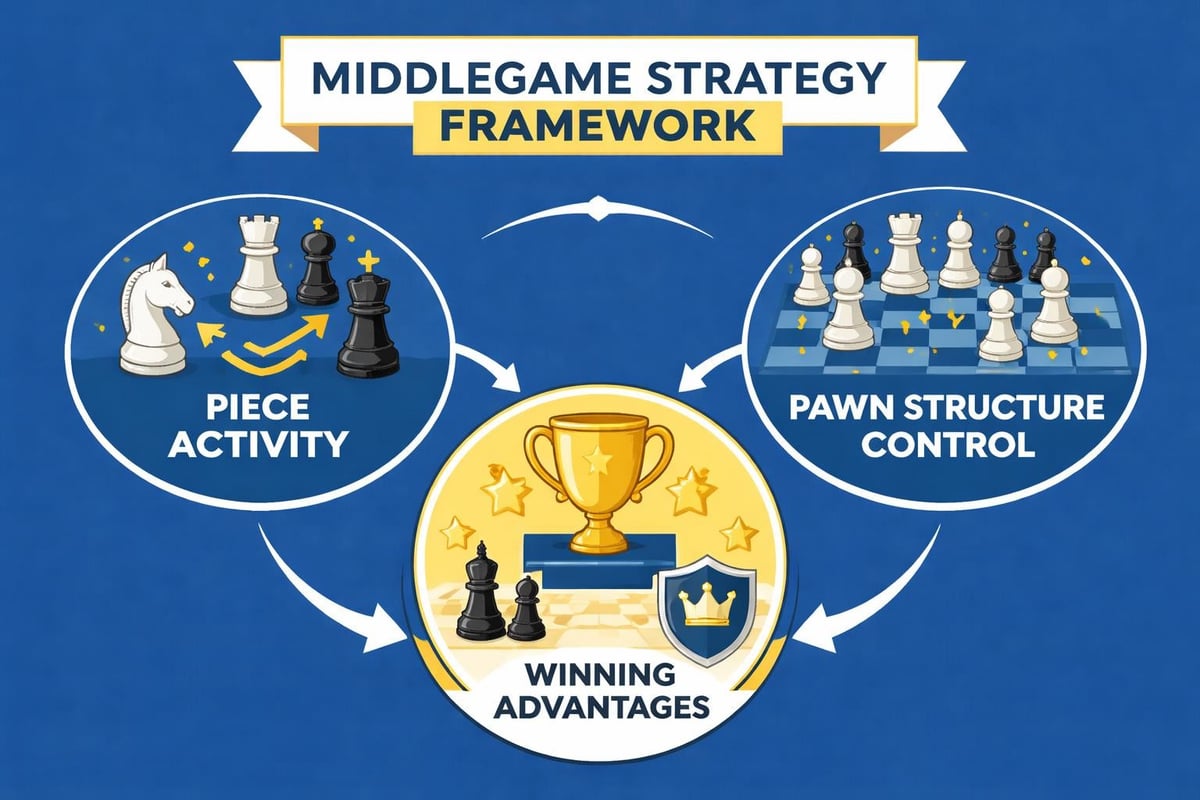
Creating Imbalances
Equal positions don't win games. You need imbalances that favour your strengths whilst exploiting opponent weaknesses. This doesn't mean sacrificing recklessly. It means understanding which types of positions suit your style.
Key imbalances to create:
- Material: Trade when ahead; avoid trades when behind
- Pawn structure: Create weaknesses in opponent's camp whilst minimising your own
- Piece activity: Active pieces beat passive pieces of equal value
- Space: More space allows easier piece manoeuvring
- Time: Development leads translate to initiative
Consider your natural playing style. Do you prefer tactical complications or slow positional squeezes? Aggressive attacks or solid defence? Understanding various strategic approaches helps you guide positions toward your strengths.
The Art of Prophylaxis
Here's an advanced concept that immediately improves your results: preventing opponent threats before they become dangerous. Instead of only pursuing your plans, ask "What is my opponent threatening?"
This simple question stops countless blunders. You're about to launch a kingside attack when your opponent has a devastating central break. You prevent their idea first, then continue your plan from a position of safety.
Practical Endgame Knowledge
You've probably heard endgames are crucial, then ignored them because they seem boring. Fair enough. But here's the reality: converting winning positions into actual victories requires basic endgame competence.
You don't need to master Rook and Bishop versus Rook endings. You need to know fundamental patterns that appear constantly.
| Endgame Type | Must-Know Concept | Frequency |
|---|---|---|
| King & Pawn | Opposition and square rule | Very High |
| Rook | Philidor and Lucena positions | High |
| Queen vs Pawn | Stopping advanced pawns | Medium |
| Minor Piece | Converting extra pawn | High |
The opposition in king and pawn endgames alone will win you dozens of half-points annually. When you understand that the king two squares directly in front of the opposing king "has the opposition" and usually wins, you'll convert positions others draw.
Converting Advantages
Playing winning chess means recognising when you're better and knowing the conversion technique. An extra pawn isn't automatically winning. You need a plan.
Standard conversion approach:
- Simplify by trading pieces (but usually not pawns)
- Activate your king in the endgame
- Create a passed pawn if possible
- Advance the passed pawn with piece support
- Force opponent into zugzwang or passive defence
Most players rush this process, allowing counterplay. Patient, systematic conversion wins far more games than brilliant attacks.
Analyzing Your Games Effectively
You finish a game, feel frustrated or relieved, then immediately queue for the next one. Stop. That's throwing away your best learning opportunity.
Every game you play contains lessons specific to your weaknesses. Miss them, and you'll repeat the same mistakes indefinitely. Recognizing tactical patterns in your own games cements learning far better than solving random puzzles.
The Review Process
Set aside 15-20 minutes after each serious game:
- Identify the turning point: Where did the game's outcome get decided?
- Find tactical oversights: What tactics did you miss for either side?
- Evaluate strategic decisions: Were your plans sound or misguided?
- Check opening preparation: Did you reach a comfortable position from the opening?
- Note patterns: What mistakes do you repeat across multiple games?
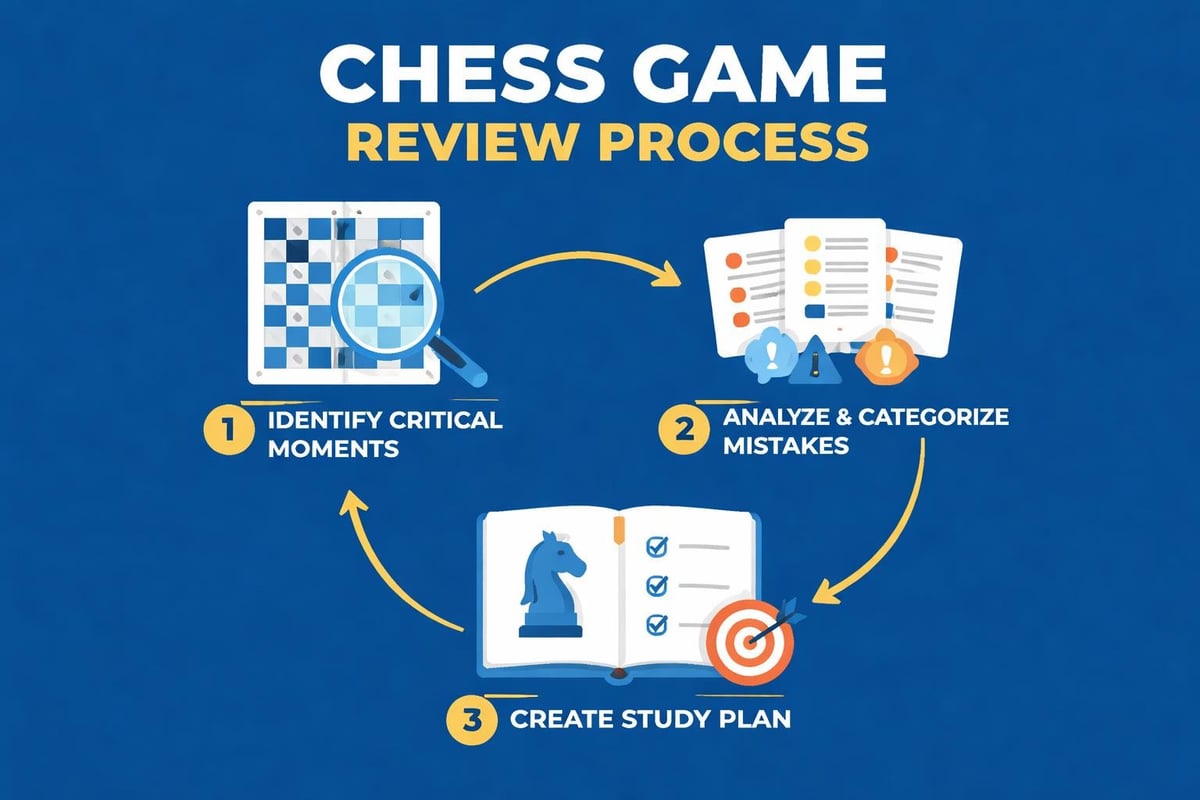
Use engine analysis sparingly at first. Try understanding positions yourself before letting the computer show optimal moves. This develops your independent thinking rather than creating engine dependency.
Time Management and Practical Play
You've probably lost games where you reached a winning position, then blundered in time pressure. Or you've spent 20 minutes on move 10, leaving insufficient time for the complex middlegame ahead.
When you play winning chess, time management matters as much as position evaluation. Brilliant moves mean nothing if you flag with a winning position.
Practical time allocation:
- Opening (moves 1-10): 5-10% of your time
- Early middlegame (moves 11-20): 30-40% of your time
- Critical middlegame (moves 21-30): 40-50% of your time
- Endgame: Remaining time with increment usage
This means in a 30-minute game, you should reach move 10 having used only 3-5 minutes maximum. Most players invert this, spending ages in comfortable opening positions and rushing critical decisions.
Practical Decision-Making
You don't need the objectively best move every turn. You need good moves played consistently. When facing a decision between a clear, safe continuation and a complex, possibly superior alternative, choose clarity unless the position demands tactics.
This especially applies to defensive positions. When you're struggling, simple moves that improve your position beat speculative complications that might backfire. Save creativity for when you're equal or better.
Training Routines for Steady Improvement
Consistency beats intensity in chess improvement. Two hours weekly for a year surpasses twenty-hour weeks followed by months of inactivity.
Here's a sustainable weekly routine:
| Day | Focus Area | Duration | Activity |
|---|---|---|---|
| Mon | Tactics | 20 min | Solve puzzles at your level |
| Tue | Opening | 20 min | Review one opening line |
| Wed | Games | 45 min | Play one serious game |
| Thu | Tactics | 20 min | Solve puzzles at your level |
| Fri | Analysis | 30 min | Review recent games |
| Sat | Study | 30 min | Watch instructional content |
| Sun | Games | 60 min | Play 1-2 serious games |
This totals roughly 3.5 hours weekly, entirely manageable alongside work and other commitments. The variety prevents burnout whilst covering all essential skills.
Accessing quality chess resources makes this training far more effective. You're not searching for materials; you're following a structured path.
Psychology and Mental Approach
Technical skills matter, but psychology determines whether you apply them effectively. You've experienced this: playing brilliantly against weaker opponents but collapsing against stronger ones. The position hasn't changed. Your mental state has.
Playing winning chess requires confidence without arrogance. You respect opponents whilst believing in your ability to outplay them through superior preparation and execution.
Handling Pressure Situations
Those critical moments where one move wins and another loses everything? They're opportunities, not disasters. Strong players thrive in sharp positions because they've trained for exactly these scenarios.
When pressure mounts:
- Breathe deeply and reset your focus
- Verify you're not missing simple tactics
- Calculate one candidate move fully before comparing alternatives
- Trust your preparation and pattern recognition
- Accept that you might be wrong but make your best attempt
The worst approach is freezing or making rushed moves to escape discomfort. Pressure positions require your best thinking, not your fastest.
Common Mistakes to Avoid
Even players who understand chess principles sabotage themselves through repeated errors. Recognising these pitfalls helps you avoid them.
Frequent improvement killers:
- Studying openings exclusively whilst ignoring tactics
- Playing blitz games instead of practicing serious time controls
- Never reviewing losses because they're "unlucky" or "frustrating"
- Blaming the opening when middlegame play was weak
- Avoiding positions outside your comfort zone
- Inconsistent practice leading to stagnation
The good news? Each mistake has a straightforward fix. Replace blitz with rapid. Analyse every loss. Deliberately play your weakest positions in training games. Improvement follows naturally.
Leveraging Study Resources Efficiently
You're drowning in available chess content. YouTube channels, courses, books, apps, websites. How do you choose without wasting time on ineffective materials?
Focus on resources that match your current level and learning style. Grandmaster analysis might be fascinating but largely irrelevant if you're hanging pieces regularly. Opening guides for intermediate players provide far more practical value.
Streamlined study materials save enormous time. Instead of searching through multiple books for opening coverage, comprehensive guides consolidate essential information. You're learning concepts, not collating data.
Practical guides and cheat sheets let you reference critical information quickly during analysis without interrupting your flow. Think of them as external memory that frees your mind for calculation and evaluation.
Playing winning chess isn't about memorising endless theory or studying eight hours daily. It's about focused practice on fundamental skills, building a practical repertoire, and developing pattern recognition through consistent training. The difference between your current level and your potential often comes down to systematic study applied regularly rather than sporadic bursts of effort. Chess Cheat Sheets provides exactly the streamlined guides and resources you need to make every study session count, helping you master essential patterns and openings without getting lost in overwhelming theory. Start building your winning foundation today with tools designed specifically for efficient improvement.


