

So you want to master chess? You're not alone. Every chess player, whether they've just learned how the pieces move or they've been playing for years, dreams of reaching that level where the game just clicks. Where you spot tactics instantly, understand positions deeply, and play with genuine confidence. The good news? Mastering chess isn't about innate genius or spending eight hours a day with a chessboard. It's about working smarter, focusing on the right areas, and building a solid foundation that supports real improvement. Let's explore exactly how you can transform your chess game without overwhelming yourself in the process.

Understanding What It Means to Master Chess
When we talk about mastering chess, what exactly are we aiming for? It's not necessarily becoming a grandmaster or achieving a 2400 rating. To master chess means developing a comprehensive understanding of the game that allows you to play confidently, spot tactical opportunities, create strategic plans, and continuously improve.
Think of it this way: a chess master doesn't need to calculate twenty moves deep in every position. Instead, they've built up a vast library of patterns, principles, and experiences that guide their decisions. They recognize when a position calls for an attack, when patient maneuvering is needed, and when tactics are lurking in the position.
The Three Pillars of Chess Mastery
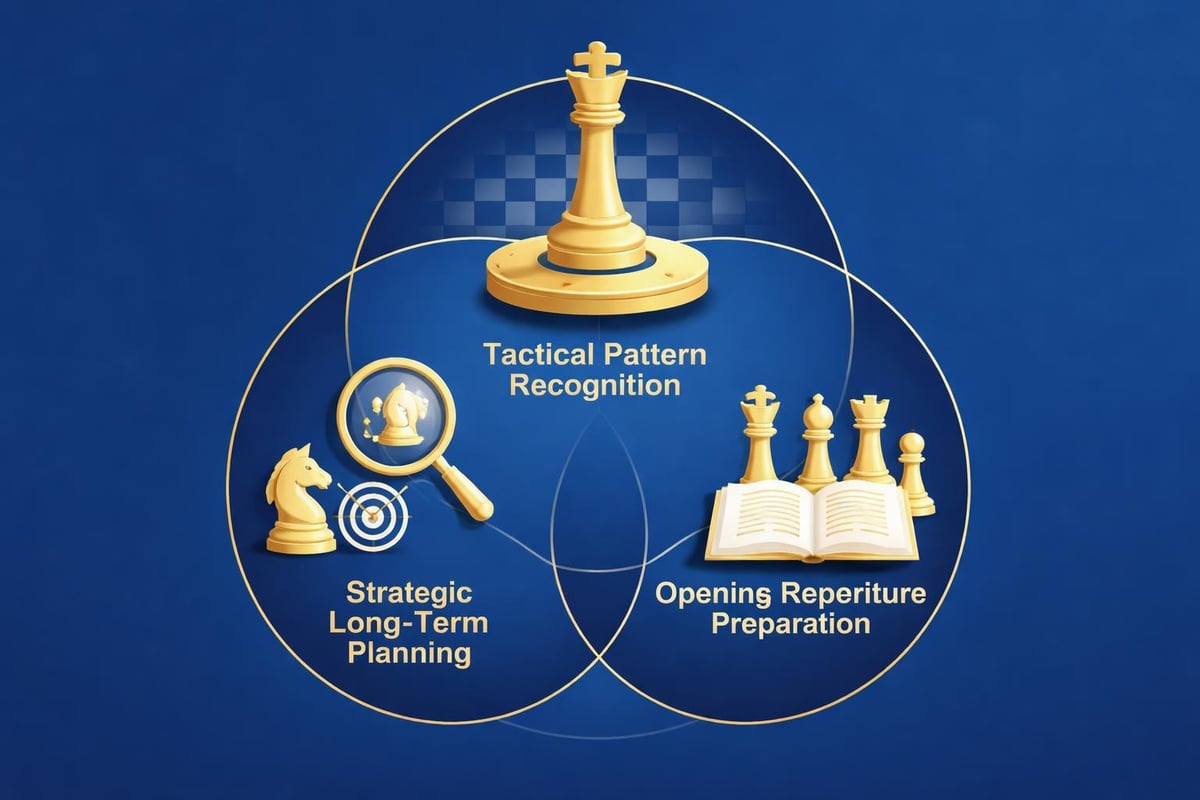
The journey to master chess rests on three fundamental pillars: tactical awareness, strategic understanding, and opening preparation. Each pillar supports the others, and neglecting any one of them will limit your progress significantly.
Tactical awareness is your ability to spot combinations, threats, and defensive resources. This is the foundation that prevents you from hanging pieces and allows you to punish your opponent's mistakes. According to research analyzing over 120 million chess games, tactical proficiency is one of the key factors distinguishing skilled players from beginners.
Strategic understanding involves the long-term planning aspects of chess. Can you evaluate which pieces are strong or weak? Do you understand pawn structures and how they dictate plans? Strategic planning separates players who simply react to threats from those who create lasting advantages.
Opening preparation gives you the confidence to navigate the first phase of the game without burning thinking time or landing in unfamiliar positions. The opening phase establishes the battlefield for everything that follows.
Building Your Tactical Foundation
Let's be honest: you can't master chess without solid tactical skills. Tactics are the building blocks of every combination, every attack, and every defensive stand you'll make over the board.
The beauty of tactical training is its measurability. You either see the tactic or you don't. You either calculate the sequence correctly or you miss something. This makes tactics the perfect area for structured practice.
Common Tactical Patterns You Must Know
Here are the essential tactical motifs that appear repeatedly in games:
- Forks: Attacking two pieces simultaneously with one piece
- Pins: Restricting a piece from moving because doing so would expose a more valuable piece
- Skewers: Forcing a valuable piece to move, exposing a less valuable piece behind it
- Discovered attacks: Moving one piece to reveal an attack from another
- Double attacks: Creating multiple threats simultaneously
- Deflection: Forcing a piece away from a critical square or defensive duty
- Removal of the defender: Capturing or driving away a piece that defends something important
The tactics training resources available today make it easier than ever to drill these patterns until they become second nature. The key is consistency. Twenty minutes of focused tactical puzzles daily will transform your game far more than an occasional marathon session.
| Training Method | Time Investment | Effectiveness | Best For |
|---|---|---|---|
| Daily puzzle sets | 20-30 min/day | Very High | Pattern recognition |
| Timed tactics tests | 15-20 min/session | High | Tournament preparation |
| Thematic tactics | 30-45 min/session | Very High | Weak pattern areas |
| Game analysis for tactics | 45-60 min/week | High | Practical application |
You might be thinking, "But I do tactics puzzles and still miss them in my games!" This frustration is common. The solution lies in practical application. After completing puzzles, review your recent games specifically looking for tactical opportunities. Did you miss any? Could your opponent have punished you tactically? This bridge between puzzle-solving and practical play is where genuine improvement happens.
Developing Strategic Vision
Tactics win games, but strategy determines which tactics become possible. To truly master chess, you need to understand the strategic principles that guide your decision-making when no immediate tactics exist.
Strategic chess is about creating weaknesses in your opponent's position while minimising your own. It's about piece coordination, pawn structure, king safety, and controlling key squares. These concepts might sound abstract, but they translate directly into concrete advantages.
Essential Strategic Concepts
Understanding middlegame planning and pawn structures provides the framework for every position you'll encounter. Let's break down the critical strategic elements:
Pawn structure dictates much of what happens in a position. Doubled pawns, isolated pawns, passed pawns, and pawn chains each create specific imbalances that favor certain plans. When you see an isolated queen's pawn, you immediately know the position revolves around blockading that pawn or using it as a battering ram.
Piece activity measures how effectively your pieces are contributing to your position. An active knight on a central outpost beats a passive knight stuck on the back rank every time. Similarly, rooks need open files and ranks to demonstrate their power.
Weak squares are squares that cannot be defended by pawns. Control these squares with your pieces, and you create lasting advantages. The famous knight on e5 or d5 in many positions exemplifies this principle perfectly.
For beginners developing their strategic foundation, positional concepts like pawn structure and piece activity provide the building blocks for sound decision-making.
Creating Strategic Plans
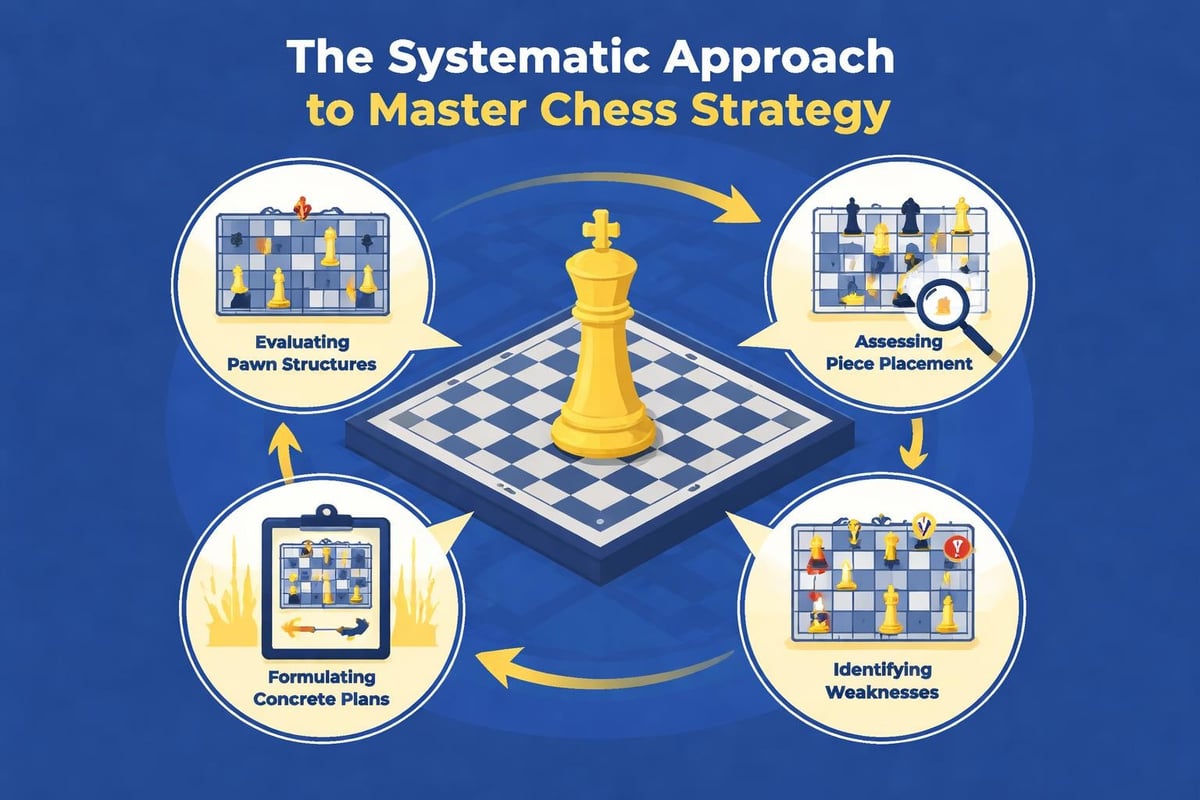
Here's a simple process for formulating strategic plans in your games:
- Assess the pawn structure and identify its characteristics
- Evaluate piece activity for both sides
- Identify weaknesses in both positions
- Determine the key battle squares where the game will be decided
- Formulate a concrete plan addressing these factors
This systematic approach replaces the common tendency to simply react to your opponent's moves. You're playing purposefully, working toward specific goals.
Mastering Your Opening Repertoire
Your opening repertoire sets the tone for every game you play. A well-chosen repertoire gives you comfortable positions where you understand the resulting middlegames. A scattered, unfocused repertoire leaves you constantly guessing.
To master chess openings, you don't need to memorize fifty moves deep in every variation. What you need is understanding. Why are we making these moves? What's the strategic point? What typical middlegame positions arise?
Building a Focused Repertoire
Rather than learning every opening under the sun, select 2-3 openings with White and 2-3 defenses against 1.e4 and 1.d4. Go deep rather than wide. The comprehensive resources available for specific openings make this approach more accessible than ever.
For example, if you play the Sicilian Defense as Black, choose one specific variation and really understand it. Study the typical pawn structures, common tactical themes, and where pieces typically belong in the middlegame. This depth beats superficial knowledge of ten different defenses.
Consider these practical opening choices:
For White:
- 1.e4 players: Learn the Italian Game or Ruy Lopez as your main weapon
- 1.d4 players: The London System or Queen's Gambit offers solid strategic foundations
- Alternative: The English Opening provides flexible systems
For Black against 1.e4:
- The Sicilian Defense (choose one variation)
- The French Defense
- The Caro-Kann Defense
For Black against 1.d4:
- The King's Indian Defense
- The Queen's Gambit Declined
- The Nimzo-Indian Defense
The key question isn't "Which opening is objectively best?" but rather "Which opening suits my playing style and helps me reach positions I understand?"
Using Cheat Sheets Effectively
Here's where streamlined study materials become invaluable. Instead of wading through 400-page opening encyclopedias, focused cheat sheets give you the essential information you need without the overwhelming detail you don't.
When you're using opening guides, focus on these elements:
- Main move order and critical deviations
- Strategic ideas behind the opening
- Common tactical patterns that arise
- Typical middlegame structures you'll reach
- Model games showing thematic plans
The collection of opening cheat sheets available today condenses months of study into digestible formats that actually help you remember what matters.

Practical Training Methods That Work
Knowledge means nothing without application. The bridge between understanding principles and executing them over the board requires deliberate practice.
Let's talk about training methods that actually deliver results. I'm not going to suggest you spend six hours analyzing grandmaster games daily. That's not realistic, and frankly, it's not the most efficient approach for most players.
The Weekly Training Schedule
Here's a realistic training framework that fits into a busy life:
| Day | Focus Area | Time | Activity |
|---|---|---|---|
| Mon | Tactics | 30 min | Puzzle sets focusing on weak patterns |
| Tue | Opening | 30 min | Review one variation, study model game |
| Wed | Strategy | 45 min | Analyze master game with strategic focus |
| Thu | Tactics | 30 min | Timed tactical tests |
| Fri | Games | 60 min | Play 2-3 longer games online |
| Sat | Analysis | 60 min | Deep analysis of your Friday games |
| Sun | Review | 30 min | Review the week's lessons, solve puzzles |
This schedule totals about 4-5 hours weekly, which is manageable for most people while still driving consistent improvement. The key is consistency over intensity. Regular practice beats sporadic marathon sessions.
Analyzing Your Own Games
Game analysis is where everything comes together. You'll spot tactical opportunities you missed, strategic errors in your planning, and opening mistakes that put you in difficult positions.
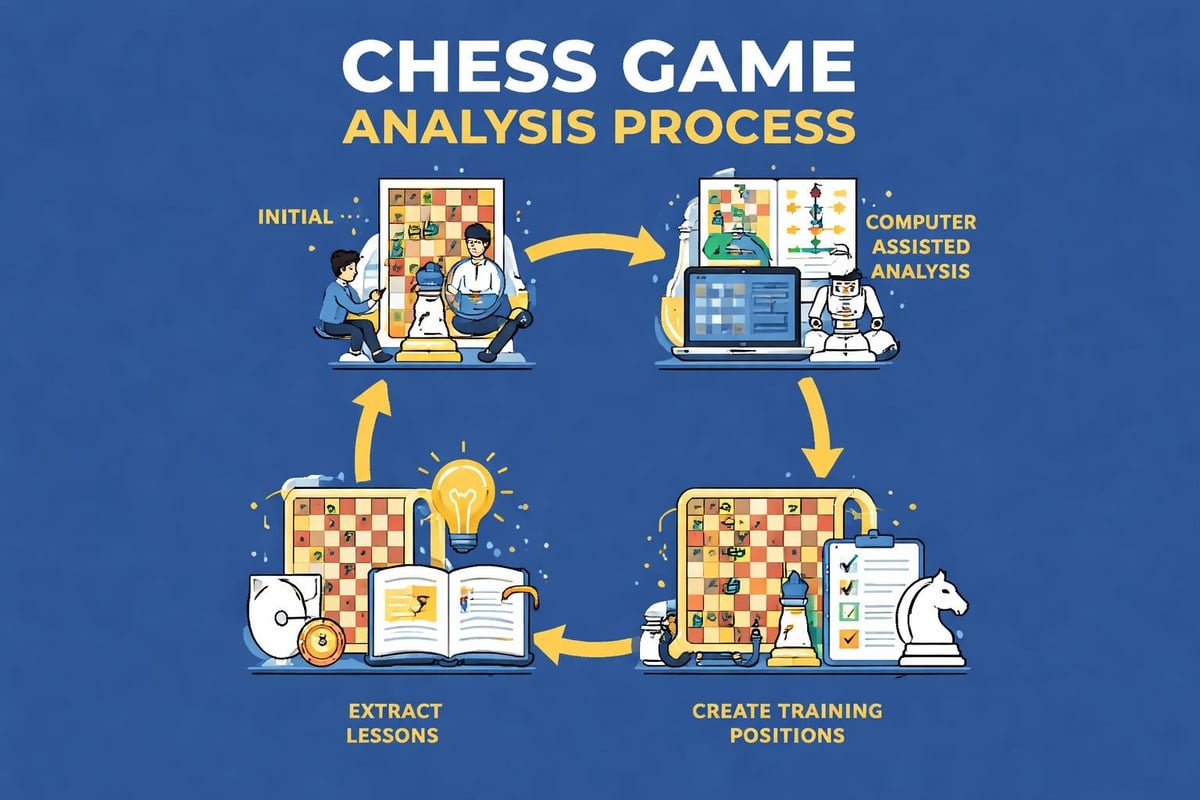
When analyzing your games:
- First pass: Go through the game without an engine, identifying critical moments
- Second pass: Use an engine to check your analysis
- Extract lessons: What specific mistakes can you avoid next time?
- Create training positions: Save positions where you went wrong for later review
Don't just check the engine's evaluation. Ask why the position changed. What strategic factors shifted? Was there a tactical blow you missed? Understanding the "why" builds intuition.
The Psychology of Improvement
Let's address something many players overlook: the mental side of chess improvement. You can study all the right material, but if your mindset undermines your progress, you'll struggle to master chess.
The cognitive functions involved in chess extend beyond simple calculation. Pattern recognition, decision-making under pressure, emotional regulation, and confidence all play crucial roles.
Overcoming Common Mental Barriers
The improvement plateau frustrates everyone eventually. You're working hard, studying regularly, but your rating stays flat. This is normal. Improvement isn't linear. Sometimes understanding needs time to consolidate before translating into results.
Time pressure anxiety causes more blunders than actual lack of knowledge. Practice playing with clocks, even in casual games. Gradually reduce time controls as you become more comfortable.
Loss aversion leads many players to play too safely, missing winning chances. Remember: improving means making mistakes at a higher level. Embrace losses as learning opportunities rather than failures.
Building a Growth Mindset
Every strong player was once a beginner. Every grandmaster has lost thousands of games. The difference between players who master chess and those who plateau isn't talent but rather persistence and smart practice.
Set process goals rather than outcome goals. Instead of "I want to gain 200 rating points," try "I'll complete 30 minutes of tactics daily and analyze all my games." You control the process; results follow naturally.
Advanced Techniques for Continued Growth
Once you've built your foundation, where do you go next? The path to master chess at higher levels requires refinement and specialization.
Deep opening preparation goes beyond learning moves to understanding the underlying plans. Study complete games in your openings, noting how strong players handle typical middlegames.
Endgame mastery separates advanced players from intermediate ones. The position might look simple, but technical precision matters enormously. King and pawn endgames, rook endgames, and minor piece endgames each require specific knowledge.
Positional sacrifices and prophylactic thinking represent advanced strategic concepts. Can you give up material for long-term positional compensation? Can you anticipate and prevent your opponent's plans before they become dangerous?
These advanced concepts build on your foundation. There's no point learning advanced prophylaxis if you're still hanging pieces to basic tactics.
Resources for Your Journey
The chess improvement landscape offers countless resources, but quality beats quantity. You don't need fifty books and ten training platforms. You need focused, high-quality materials matched to your current level.
For interactive learning, beginner-focused tutorials provide structured progression through fundamental concepts. These guided lessons ensure you're building skills in the right order.
When you're ready to explore the best websites for learning chess, prioritize platforms offering:
- Structured learning paths rather than random content
- Interactive practice with immediate feedback
- Adaptive difficulty that grows with your skills
- Comprehensive coverage of tactics, strategy, and endgames
Supplement online learning with free chess courses that provide systematic instruction without overwhelming detail.
Tools That Support Your Training
Beyond lessons and books, certain tools accelerate improvement:
- Database software for studying opening theory and master games
- Tactics trainers with spaced repetition algorithms
- Analysis engines for checking your game analysis
- Opening explorers showing current theory and statistics
The chess tools available today far exceed what previous generations had access to. Use them wisely, as supplements to understanding rather than replacements for thinking.
Balancing Study and Practice
Here's a critical question: What's the right balance between studying and playing? The answer depends on your current level and goals, but a general principle applies: you need both.
Pure study without practice leaves you with theoretical knowledge that doesn't translate over the board. Pure practice without study reinforces mistakes and limits your pattern library.
A reasonable ratio for most improving players is 60% study to 40% playing. But what counts as "study"? Not just passively reading chess books or watching videos. Active study involves:
- Solving puzzles with focused effort
- Analyzing your games in depth
- Studying master games by trying to guess moves
- Working through opening variations on a physical board
- Practicing endgame positions against a computer
When you do play, make it count. Avoid bullet chess where decisions are based purely on reflex. Play longer time controls that allow you to think, plan, and apply what you've learned.
The journey to master chess combines tactical sharpness, strategic understanding, solid opening knowledge, and consistent practice. Progress requires patience, deliberate training, and learning from every game you play. Whether you're just starting to build your foundation or looking to refine your skills at a higher level, the right approach makes all the difference. Chess Cheat Sheets provides the streamlined guides, opening resources, and tactical puzzles you need to improve efficiently without getting lost in endless theory. Start building your chess mastery today with tools designed specifically for players ready to elevate their game.


