

If you're looking to add a fighting opening to your repertoire as Black, the kings indian defence might be exactly what you need. This aggressive system has been trusted by world champions and club players alike, offering dynamic counterplay against 1.d4. Rather than challenging White's centre immediately with pawns, you'll develop your pieces in a hypermodern style, preparing a kingside attack whilst your opponent builds their central presence. It's a fascinating choice that rewards patience and tactical awareness.
Understanding the Core Ideas Behind the Kings Indian Defence
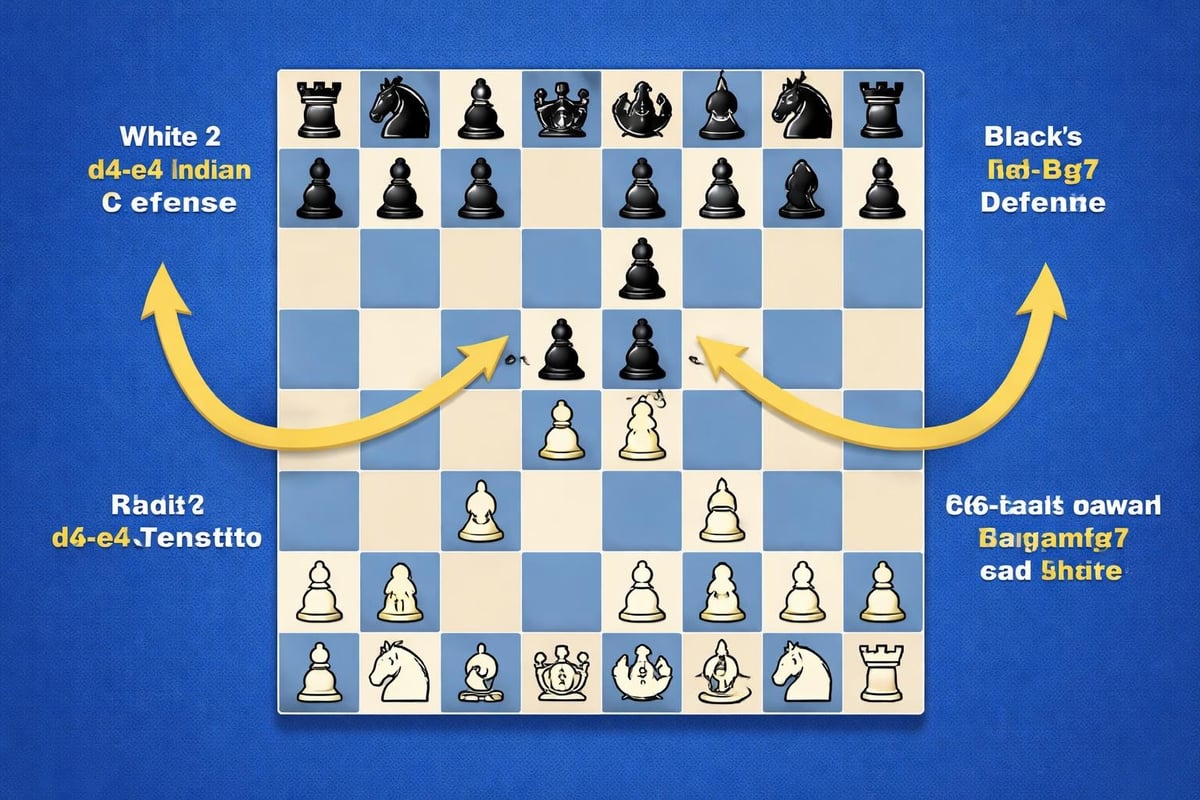
The kings indian defence begins after 1.d4 Nf6 2.c4 g6, where Black fianchettoes the kingside bishop and prepares to castle. You're essentially allowing White to establish a strong pawn centre with pawns on e4 and d4, which might seem counterintuitive at first. But here's the thing: you're not conceding the centre, you're preparing to attack it.
Your dark-squared bishop on g7 becomes a powerful piece, controlling the long diagonal and supporting your eventual ...e5 or ...f5 pawn break. The kings indian defence is fundamentally about piece activity and dynamic potential rather than static pawn control. This makes it quite different from more classical openings you might already know.
The Main Move Order
The typical move sequence goes like this:
- 1.d4 Nf6 2.c4 g6 - Black signals the kingside fianchetto
- 3.Nc3 Bg7 - Developing the key bishop
- 4.e4 d6 - White grabs space; Black prepares ...0-0
- 5.Nf3 0-0 - Both sides complete kingside development
- 6.Be2 e5 - Black challenges the centre
This is the Classical Variation, but White has numerous other setups including the Sämisch (f3), the Averbakh (Be2 and Bg5), and the Four Pawns Attack (f4). Each requires different plans from Black, which is why having a proper understanding of the middlegame ideas matters more than memorising specific move orders.
Strategic Plans for Black
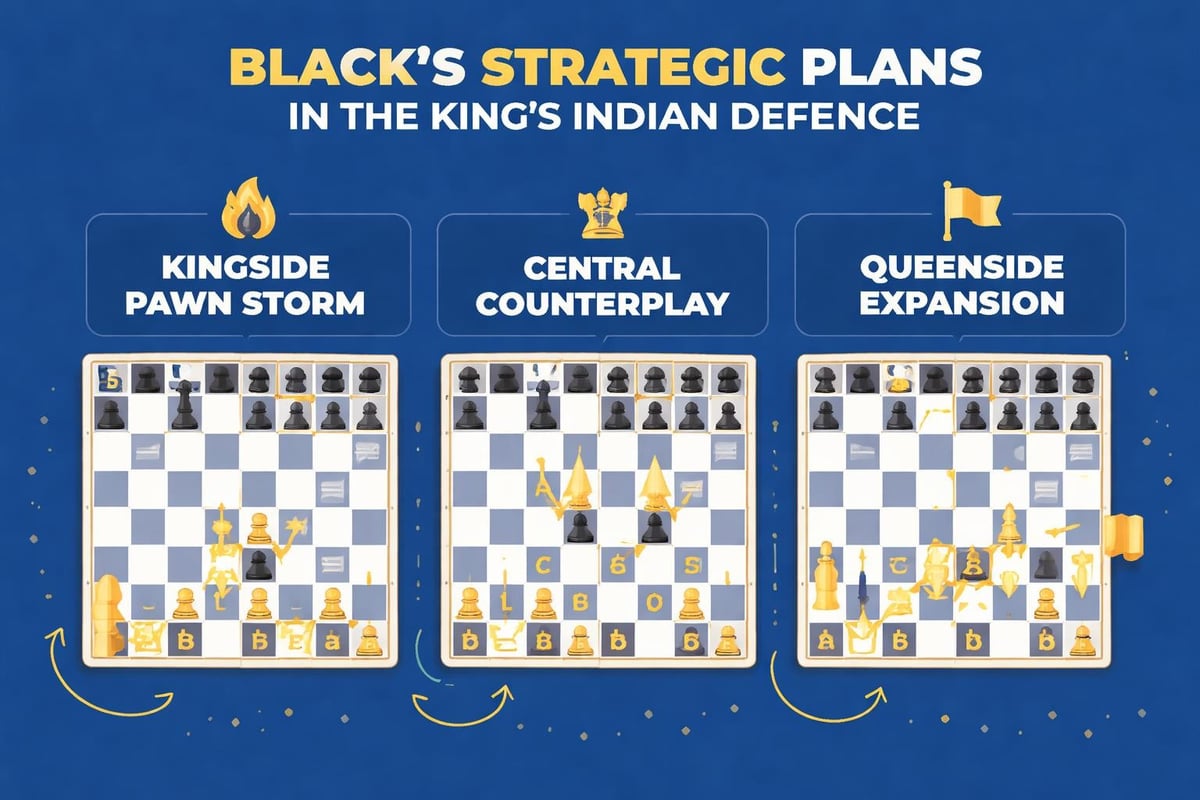
What makes the kings indian defence so exciting is your ability to generate kingside attacks even when White appears to have more space. Your strategy typically revolves around several key themes that work together to create threats.
The Kingside Attack
Your primary plan often involves pushing ...f5, sometimes prepared by ...Nbd7, ...Nh5, and ...Nf4. This creates immediate threats against White's king, especially if they've castled kingside. You're not just moving pawns forward randomly - you're creating weaknesses in White's position whilst opening lines for your pieces.
The typical attacking sequence includes:
- Manoeuvring your knight from f6 to e8 to d6 or f4
- Advancing ...f5, often with ...f4 to follow
- Bringing your queen into the attack via e8 or f6
- Using your h-pawn to open the h-file with ...h5-h4
Central Counterplay with ...c5
Not every kings indian defence game involves a pure kingside assault. Sometimes you'll play ...c5, challenging White's d4 pawn and creating central tension. This is particularly effective in lines where White has played Be3 rather than developing their queenside pieces quickly.
The ...c5 plan offers flexibility. You can exchange on d4 to open the c-file for your rook, or maintain tension and wait for White to resolve it. This approach often leads to positions where both sides have chances on opposite flanks.
| Strategic Plan | Key Moves | Best Against |
|---|---|---|
| Kingside Attack | ...f5, ...Nf4, ...g5-g4 | Classical systems with Be2 |
| Central Break | ...c5, ...cxd4, ...Nc6 | Quiet setups with Be3 |
| Queenside Expansion | ...a6, ...Rb8, ...b5 | When White attacks kingside |
Key Variations You Need to Know
The beauty of this opening is that whilst the fundamental setup remains similar, White's different approaches require you to adjust your plans. Let me walk you through the most important variations you'll encounter.
Classical Variation (6.Be2)
This is the most popular line you'll face. After 6.Be2 e5 7.0-0, both sides have completed development and the real battle begins. White often continues with 7...Nc6 8.d5 Ne7, and now they must choose their plan.
The critical decision for White is whether to play 9.Ne1 (preparing f3 and g4 to attack your kingside) or 9.Nd2 (keeping pieces flexible). As Black, you'll respond accordingly - against 9.Ne1, you might accelerate your ...f5 plan, whilst against quieter moves, you can prepare methodically.
Sämisch Variation (5.f3)
When White plays 5.f3 instead of 5.Nf3, they're preparing to build a massive centre with Be3 and Qd2. This variation is less theoretical in nature but requires careful handling. Your typical response is 5...0-0 6.Be3 e5, and then White usually castles queenside.
Here's where it gets interesting: with opposite-side castling, both players race to attack the enemy king. You'll push ...f5 and ...f4, trying to open lines, whilst White advances on the queenside with b4, c5, and so forth. These games tend to be sharp and tactical - perfect if you enjoy attacking chess.
Four Pawns Attack (5.f4)
The most aggressive approach White can adopt is 5.f4, grabbing maximum space. This looks intimidating with pawns on c4, d4, e4, and f4, but it comes at a cost - those pawns can become targets, and White's king often stays in the centre longer.
Your main response is typically 5...0-0 6.Nf3 c5, immediately challenging White's centre. If they take on c5, you recapture with the d-pawn and gain active piece play. If they maintain the tension with 7.d5, you've successfully fixed their centre and can plan around it.

Common Middlegame Patterns
Understanding typical middlegame structures helps you play the kings indian defence more confidently. Rather than worrying about specific move orders, focus on recognising these patterns when they appear on the board.
The Mar del Plata Structure
Named after the Argentine resort town where it was heavily analysed, this structure arises after 9.Ne1 Nd7 10.Nd3 f5 11.Bd2 Nf6. Both sides have clear plans: White plays for c5 to open queenside lines, whilst you push ...f4 and attack the kingside.
This structure appears frequently, so it's worth studying games by strong players. The Chess.com Kings Indian Defense guide offers excellent examples of how grandmasters handle these positions.
The Bayonet Attack
When White plays b4 before you've committed to ...f5, they're employing the Bayonet Attack. This aggressive approach aims to cramp your queenside before you can generate kingside play. Your best response usually involves 9...Nh5, preparing ...Nf4 and ...f5 whilst keeping an eye on White's queenside expansion.
The key tactical point is that after b4-b5, closing the queenside, you often play ...a5 to fix White's pawns and prevent c5. Then you can focus entirely on your kingside attack without worrying about queenside breakthroughs.
Practical Tips for Playing the Kings Indian Defence
You might be wondering how to actually implement these ideas in your games. Here are practical guidelines that'll help you navigate the opening and transition into the middlegame successfully.
Don't Rush Your Attacking Plans
One mistake I see players make is pushing ...f5 too quickly without proper preparation. Make sure your pieces are coordinated first. Your knight often needs to reach e8 or d7, your queen might need to come to e8, and you should consider whether your rooks are on useful squares.
Patience pays off in the kings indian defence. White's extra space doesn't disappear overnight, and premature attacks often backfire when your pieces aren't supporting the advance.
Learn to Calculate Pawn Storms
When both sides castle on opposite flanks, you'll need to calculate whose attack arrives first. This isn't about vague positional play - it's concrete calculation. Count tempos, identify forcing moves, and assess whether your attack has enough firepower before committing.
The good news? These positions follow recognisable patterns. After playing several games, you'll develop intuition for timing and the critical moments when you need to accelerate or slow down.
Study Complete Games
Rather than memorising opening variations, study complete games by kings indian defence specialists. Players like Garry Kasparov, Bobby Fischer, and more recently Teimour Radjabov have contributed significantly to our understanding of this opening. The collection at 365Chess provides numerous instructive examples.
Watch how these players transition from opening to middlegame, how they identify the right moment to strike, and how they convert their advantages. This practical approach beats pure theory memorisation every time.
Handling White's Alternative Setups
Not every opponent will play the main lines. White has numerous ways to avoid the critical theoretical battles, and you need to be prepared for these alternatives as well.
The London System Setup
Some players combine 1.d4 with an early Bf4, creating a London System structure against your kings indian defence setup. When this happens, you've got excellent prospects - your fianchettoed bishop on g7 works beautifully against White's Bf4, and you can often generate quick counterplay with ...c5 and ...Qb6.
Don't feel obligated to stick to traditional kings indian defence plans when White deviates significantly. Adapt your strategy based on what's actually happening on the board.
The Exchange Variation
If White plays an early dxe5 (exchanging their d-pawn for your e-pawn), they're trying to reduce tension and reach a more manageable position. You recapture with ...dxe5, and suddenly you've got a nice central pawn whilst White's centre has been partially dissolved.
This isn't dangerous for Black at all. You can develop comfortably, perhaps playing ...Nc6 and ...Be6, with a solid position and no particular worries.
Training Your Kings Indian Defence Skills
Simply knowing the theory isn't enough - you need to develop practical skills that'll serve you in real games. Here's how to build genuine competence in this opening system.
Work Through Tactical Puzzles
The kings indian defence produces tactical positions, especially in the sharp variations with opposite-side castling. Regular tactical training helps you spot the combinations that arise from your pawn storms and piece activity. Resources like those at Chess Cheat Sheets can help strengthen these pattern recognition skills.
Focus particularly on tactics involving:
- Breakthrough pawn sacrifices (...f4-f3 or ...g4-g3)
- Knight forks from typical kings indian defence squares
- Bishop sacrifices on h3 or g2
- Queen infiltration to your opponent's kingside
Play Practice Games
Theory only takes you so far. Play numerous games with the kings indian defence to understand the positions from practical experience. You'll make mistakes, miss opportunities, and occasionally get crushed - that's part of the learning process.
After each game, analyse what happened. Did you time your ...f5 break correctly? Were your pieces coordinated? Did you identify White's threats accurately? This self-analysis accelerates your improvement dramatically.
Use Opening Guides and Cheat Sheets
Rather than drowning in encyclopaedic databases, start with streamlined guides that explain the key concepts. The beginner's guide at SCG Chess offers an accessible introduction, whilst more advanced resources like those from ChessBase provide deeper theoretical coverage.
For quick reference during practice, having a concise overview of main variations and typical plans makes a significant difference. This is where opening guides from Chess Cheat Sheets prove particularly valuable - they distil essential information without overwhelming you.
Common Mistakes to Avoid
Even experienced players stumble in the kings indian defence sometimes. Being aware of typical errors helps you sidestep them in your own games.
Neglecting Development for Pawn Moves
It's tempting to rush ...f5 or ...c5, but premature pawn breaks without piece support usually backfire. Make sure your knights, bishops, and rooks are actively placed before launching your central or kingside operations. Development first, pawn breaks second - that's the right order.
Allowing White's c5 Break Unchallenged
When White achieves c4-c5, they often gain significant queenside space and can create threats against your d6 pawn. Sometimes you need to meet c4-c5 with ...dxc5, accepting that White recaptures and opens lines. Other times, you should prevent it entirely with ...c6 or accelerate your kingside play before White's queenside attack gets rolling.
Forgetting About Defence
The kings indian defence encourages aggressive play, but you can't ignore White's threats entirely. If White's pushing pawns on the queenside or building an attack, you need to address it somehow - whether through counterplay ("his attack better be faster than yours") or direct defence.
| Mistake | Why It's Bad | Solution |
|---|---|---|
| Premature ...f5 | Pieces aren't supporting the advance | Prepare with ...Nd7, ...Nh5, ...Qe8 first |
| Ignoring queenside | White achieves c5 with advantage | Play ...c6 or accelerate kingside play |
| Passive piece placement | Your pieces don't support your plans | Actively manoeuvre knights to key squares |
Resources for Deeper Study
Once you've grasped the fundamentals, you'll want to deepen your understanding through quality learning materials. Let me point you towards some excellent resources that'll take your kings indian defence to the next level.
The detailed overview at ChessGeek explores the aggressive nature and strategic foundations brilliantly. For a systematic approach to building your opening repertoire, you might also explore recommended chess books on openings that cover the kings indian defence comprehensively.
Visual learners benefit from video content - there are excellent YouTube tutorials that walk through key variations and middlegame plans step-by-step. Combining different learning formats (text guides, video lessons, practice games, tactical puzzles) creates a well-rounded training programme.
Don't overlook the value of studying related openings either. Understanding how the Grünfeld Defense differs from the kings indian defence, or how the Nimzo-Indian Defense provides alternative responses to 1.d4, enriches your overall opening understanding and helps you choose the right system for each game.
When to Choose the Kings Indian Defence
You might be wondering whether this opening suits your style and when you should employ it. The kings indian defence isn't for everyone, and that's perfectly fine - chess would be boring if we all played the same openings.
This opening works brilliantly if you:
- Enjoy tactical, attacking chess more than quiet positional play
- Don't mind accepting some risk for winning chances
- Have the time to study typical middlegame patterns
- Play for wins as Black rather than settling for draws
- Feel comfortable calculating concrete variations
Consider alternatives if you prefer:
- Solid, defensive systems with minimal risk
- Positional play over tactical complications
- Quick equality against stronger opponents
- Avoiding extensive theoretical preparation
The honest truth? The kings indian defence requires more study than some other Black openings, but it rewards that investment with exciting games and genuine winning chances. For players who want to fight for the initiative rather than just equalising, it's an excellent choice that'll serve you well from club level to master level.
The kings indian defence offers dynamic, fighting chess that rewards patience, tactical awareness, and courage. By understanding the core strategic plans - whether kingside attacks, central breaks, or queenside expansion - you'll navigate these positions with growing confidence. Ready to master this powerful opening system? Chess Cheat Sheets provides streamlined guides and practical resources that'll help you learn the kings indian defence efficiently, giving you the tools you need to add this aggressive weapon to your repertoire without spending months on theoretical study.


